From Tab-Hopping Panic to Steadier Momentum: A School-Work-Health Reset
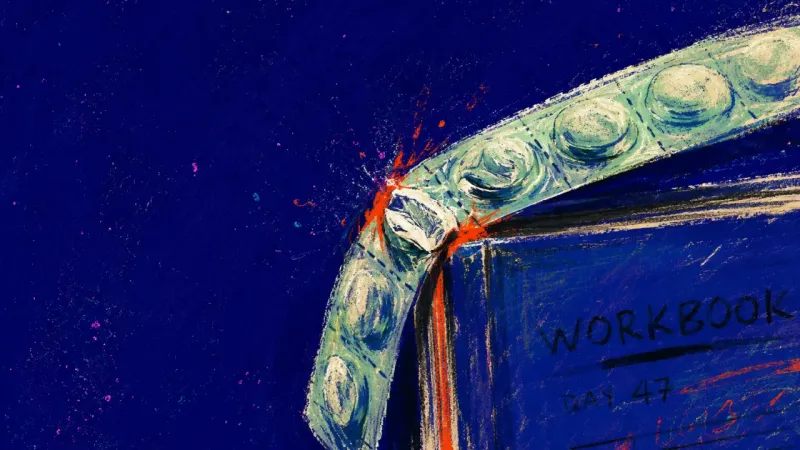
Finding Clarity in the 11:32 p.m. Tab-Hop
If you keep three tabs open at night—assignment, work messages, and a “get healthy again” plan—and somehow none of them gets finished cleanly (hello, context switching), I already know what your shoulders feel like.
Jordan (name changed for privacy) sat across from me with their tote bag still on, like taking it off would tempt fate. They were 26, a grad student in Toronto with a part-time job, and they had the kind of tired that isn’t sleepy—it’s braced. Their jaw looked like it was holding a secret.
“Last night was 11:32,” they said, not even checking their phone, like the time was stamped into their nervous system. “Laptop open to my draft. My phone lighting up with work messages. Notes app: ‘get healthy again.’ And I’m toggling between all three like it’s… triage.”
In my mind, the scene sharpened into a little film: fluorescent kitchen light humming in a Toronto apartment, screen heat warming fingertips, the tiny click of a trackpad as if clicking could somehow click life back into place. The radiator doing its steady tick in the background, refusing to participate in the panic. Jordan’s shoulders creeping up by their ears while they kept bargaining with the night—one more small task—and paying for it in real time.
“I keep making plans like I’m not a human with a body,” they said, and their laugh came out dry. “My backpack is basically a portable anxiety shrine.”
The core contradiction sat right there between us: wanting to keep up with school/work demands, and fearing that if they slowed down, they’d be seen as unreliable—like their worth was a deadline that could be missed.
Overwhelm, for Jordan, wasn’t a concept. It was like wearing an overstuffed backpack with straps cutting into skin—then insisting you can still run. It was the sensation of trying to breathe through a scarf you tied yourself because you thought it looked “responsible.”
“Okay,” I said, keeping my voice gentle and plain. “We’re not going to moralize your stress. We’re going to map it. Let’s do a Journey to Clarity that actually gives you a next step—one you can do as a human with a body.”

Choosing the Compass: The Energy Diagnostic Map (7) Spread
I asked Jordan to take one slow breath with me—not as a ritual for the universe, just a gear shift for the brain. While they exhaled, I shuffled. The sound of cards sliding—soft, papery—always changes a room. It turns “I’m drowning” into “I’m looking.”
“Today we’ll use something I call the Energy Diagnostic Map (7) · Context Edition,” I told them. Then, for anyone reading along: this spread works beautifully when the problem isn’t one decision, but a feedback loop—school/work/health feeding each other until everything feels like a wall of blocks.
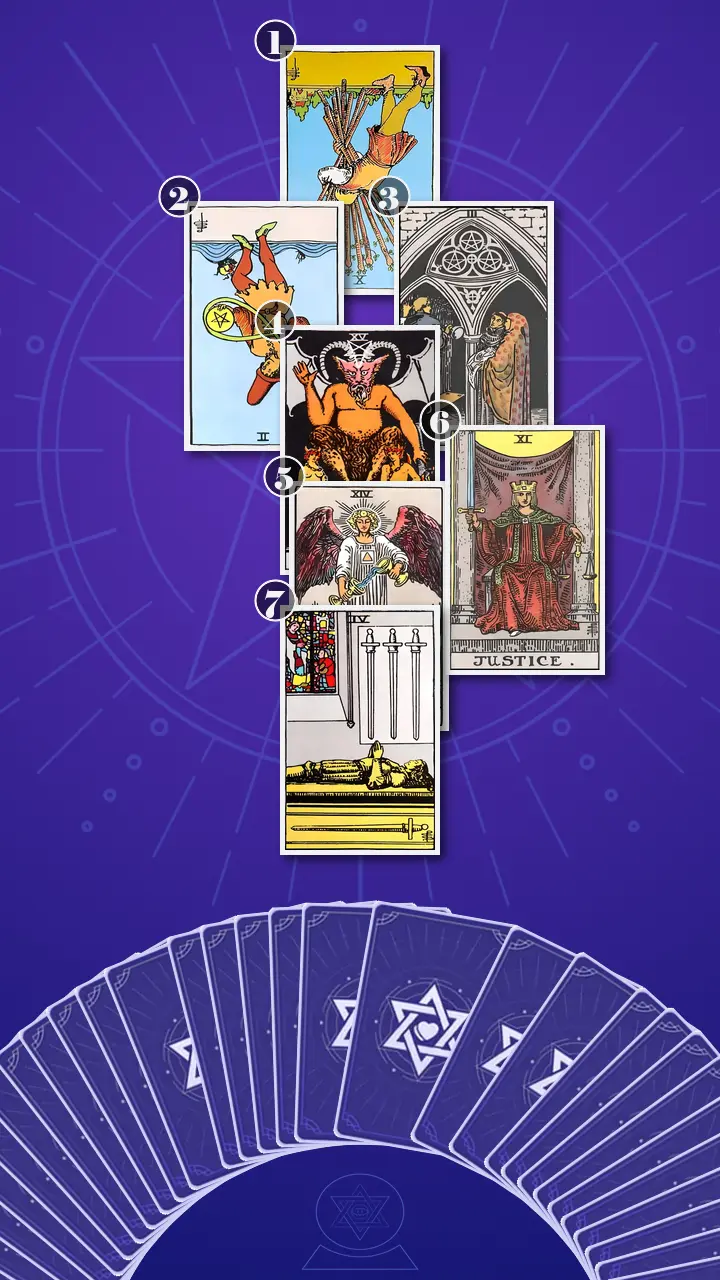
The rationale is simple: instead of doing a vague life scan, we separate the loop into parts. Card 1 shows the visible overload (the ‘backpack spilling open’). Card 2 names the inner mechanism that keeps cycling. Card 4 finds the root knot. Then we move into what resource is actually usable, what transformation breaks the loop, and the next step you can take in the next 48 hours to a week.
I laid the cards out like a backpack map—top to bottom: symptoms, straps, knot, pocket, turning point, and the grounded action at the base. “We’ll read it like unpacking,” I said. “Not dumping everything on the floor—just sorting what’s real.”
Reading the Backpack Map: Where the Weight Actually Lives
Position 1: Surface load — Ten of Wands, reversed
“Now we turn over the card representing Surface load: the most visible ‘overflowing backpack’ symptoms and how overwhelm is showing up day-to-day,” I said.
Ten of Wands, reversed.
I didn’t need to dramatize it. This card already looks like the body telling the truth. “It’s 7:55 p.m. and you’re walking home with a backpack that actually hurts: laptop, charger, gym clothes you won’t use, a printed reading, plus the mental weight of unread emails and a health plan you keep postponing,” I said, using the scene the card handed me. “You’re doing the thing where nothing leaves the load—tasks just get rearranged—so the day feels heavy before you even open your laptop.”
Reversed, the Ten of Wands isn’t “work hard.” It’s strain. The energy is blocked and overfilled—like running 25 browser tabs and calling it multitasking. Your laptop isn’t broken. It’s overheating. Your backpack isn’t just heavy—it’s blocking your view of the next step.
Jordan’s unexpected reaction came fast, and it wasn’t a nod. It was a three-part micro-collapse: first their breath paused (a tiny freeze), then they stared at the card like it was a screenshot of their week (cognition seeping in), and then they let out a short laugh that sounded almost offended.
“That’s… brutal,” they said. “Like, accurate, but rude.”
“I know,” I replied. “And I’m glad it’s accurate, because accuracy is where we stop guessing. One note, though: reversed can tempt you to overcorrect—to drop everything at once, disappear from commitments, and then end up doing emergency cleanup later. This card isn’t asking you to vanish. It’s asking you to put one thing down on purpose.”
I asked, “What are the top three things you’re carrying this week—school, work, health—and which one do you secretly treat as ‘optional’ the second the day runs long?”
Jordan didn’t answer immediately. Their fingers worried the strap of their bag. That was answer enough.
Position 2: Inner loop — Two of Pentacles, reversed
“Now we turn over the card representing Inner loop: the internal tug-of-war and the specific pattern that keeps school/work/health cycling,” I said.
Two of Pentacles, reversed.
“You’re at your desk doing the tab-hop: write two sentences → check work chat → open meal plan → feel guilty → switch back to assignment → remember an email → start drafting → abandon it halfway,” I said, letting the card speak in a modern accent. “The day has motion, but nothing lands, and you end up staying up late to compensate for the switching.”
The energy here is unstable Earth—capacity leaking through constant rebalancing. Upright, this card is juggling with rhythm. Reversed, it’s juggling on rough waves. You can be “busy” and still be stuck, because the loop is designed to keep you in motion.
“Context switching is a stealth tax on your nervous system,” I added, watching Jordan’s jaw tighten and then soften a millimeter as if their body recognized the phrase before their mind did. “It’s not that you’re lazy. It’s that your attention is paying transaction fees all day.”
I asked, “When you bounce between tasks at night, what’s the exact thought that makes you switch tabs—what are you trying to prevent from happening?”
Jordan swallowed. “That someone will think I’m not on it,” they said. “That I’ll miss something and it’ll… prove something.”
Position 3: External pressure — Three of Pentacles, upright
“Now we turn over the card representing External pressure: where school/work systems, expectations, or evaluation amplify the load,” I said.
Three of Pentacles, upright.
This card always makes me think of a rehearsal room before opening night—someone watching from the back row, clipboard in hand, even if they’re kind. “You treat a normal deliverable like it’s going in a portfolio review,” I said. “Extra formatting, extra citations, extra polishing—because you can almost feel the grade, the feedback, the manager’s opinion hovering. Collaboration or asking for clarification feels risky, so you over-prepare alone and call it being responsible.”
The energy is competent, but it’s also performative—like every task is a public audition. In a high-cost city where saying no to hours feels financially risky, the pressure becomes a strap you can’t loosen without panic.
Jordan’s eyes flicked away from the card toward the window, where the late-afternoon sky looked washed out. “I hate how much I care,” they said quietly. “Like, I can feel myself trying to be… museum-quality.”
“That word matters,” I said. “Because museum-quality is expensive. It costs time, attention, and your body.”
Position 4: Core blockage — The Devil, upright
“Now we turn over the card representing Core blockage: the deepest belief/attachment that links the three areas into a self-reinforcing loop,” I said.
The Devil, upright.
Jordan went still. Even before I spoke, their shoulders tightened as if the card had weight.
“You’re exhausted but you keep negotiating with your body like it’s a roommate you can talk into waiting: ‘Just one more task, then you can sleep,’” I said. “Rest becomes a reward you never quite qualify for. Under it is the fear: if you stop carrying everything, you’ll be exposed as not capable—and that thought feels worse than the headache.”
Here’s the “loose chains” truth of The Devil: the chains are often not locked. They’re familiar. They feel safer than uncertainty.
In my mind, I saw Jordan at 1:07 a.m., Notion board open like a confession booth. A sore throat starting to bloom in the back of the mouth. The cold glow of a productivity app promising control while their body quietly filed a complaint. The internal monologue goes, I’m being responsible—and then, if you get honest, it flips to: I’m negotiating my body like it’s optional.
Jordan’s reaction came exactly as this card often lands: a long exhale that emptied their chest like they’d been holding air hostage. They nodded once—small, uncomfortable, real.
“Oh,” they said. “This is why I can’t ‘just manage my time.’”
“Exactly,” I told them. “Time management isn’t strong enough to break an identity contract.”
And I said one line slowly, because it matters: “If rest is something you have to earn, you’ll always be in debt.”
Position 5: Usable resource — Temperance, upright
“Now we turn over the card representing Usable resource: what stabilizing support or skill you can access immediately without a total life overhaul,” I said.
Temperance, upright.
The room felt different with this card—like someone opened a window you didn’t realize was painted shut. “Instead of trying to fix your whole life on Sunday, you build one repeatable handoff between roles,” I said. “After your shift, you take a nine-minute walk, refill water, eat something real, and only then open your assignment. It’s not dramatic, but it reduces the chaos spike and keeps the day from tipping.”
The energy here is integration—measured, paced, doable. Temperance is not a lifestyle overhaul. Temperance looks like a tiny ritual you repeat.
I have a personal bias toward this card because I’m an artist: I’ve watched people burn out trying to create masterpieces on adrenaline. Real work—good work—usually happens in rhythm. Sometimes I think of it like Beethoven: not one endless, blaring movement, but a symphony with structure—tension, release, rest, return. Your week needs movements too.
Jordan’s face softened. “Wait,” they said, a little surprised at their own relief. “So I don’t need a full reset. I need a rhythm.”
“Yes,” I said. “A rhythm that your nervous system can learn.”
When Justice Held Up the Scales
Position 6: Key transformation — Justice, upright
I let my hand hover over the next card a beat longer. The air went quiet in that specific way it does right before someone tells the truth. “Now we turn over the card representing Key transformation: the most important mindset shift or boundary that breaks the loop,” I said. “This is the bridge.”
Justice, upright.
“You write a week plan that includes sleep, meals, and one recovery block as fixed—then you treat everything else as negotiable around that, not the other way around,” I said. “You send one message that states the trade-off plainly: ‘I can do X by Y. If you need Z too, I’ll need to move…’ It feels terrifyingly clear—and that’s why it works.”
Justice isn’t punishment. Justice is accounting. It’s the moment you stop doing fuzzy math with your life.
And here’s where I used one of my favorite tools—an Einstein-style thought experiment—because Justice is easier to understand when you change the frame. “Imagine,” I said, “that your week is a train moving at a fixed speed. You can’t secretly add more track by squeezing sleep. You can only change what you load onto the train. Your current strategy is pretending the train will go faster if you glare at it.”
Jordan smiled once, despite themself.
“Justice asks: what’s fair to the body that has to ride this train?” I continued. “Not what’s ideal. Not what would impress someone on LinkedIn. What’s fair.”
The Aha Moment: Making the Hidden Contract Visible
Here was the setup I could feel in Jordan’s posture: that 11:30 p.m. moment, toggling between an assignment doc, a work chat, and a half-written ‘get healthy again’ to‑do list—telling yourself you’ll stop after one more tiny task, while your shoulders stay up by your ears.
Not ‘I’ll carry it all and hope I survive,’ but ‘I’ll weigh what’s fair and make the cut,’ like Justice’s scales and sword.
The sentence landed like a clean click. Jordan’s reaction wasn’t instant relief—it was a layered, human response. First, their breath caught again, but differently than before—less freeze, more recognition. Their eyes unfocused for a second, like they were replaying a specific Tuesday night on fast-forward: the Slack ping, the Google Doc, the sudden urge to “just check” meal prep ideas. Then their shoulders dropped, slowly, as if gravity finally got permission to do its job. Their mouth opened and closed once. Their eyes went glossy, not with drama, but with the kind of clarity that stings.
“But…,” they started, and a flash of heat crossed their face—anger’s little cousin. “Does that mean I’ve been doing it wrong? Like I made it all up?”
I didn’t rush to soothe it away. “No,” I said. “It means you’ve been keeping a promise you didn’t realize you signed. The promise was: if I carry everything, I’m safe and worthy. Justice is you renegotiating that contract—without shaming the version of you who thought that was the only option.”
I held their gaze and asked, softly but precisely: “Now, with this new lens—can you think of one moment last week when this insight would’ve made you choose differently? One tiny point where you would’ve made a clean cut instead of bargaining with your body?”
Jordan looked down at their hands, then back up. “Wednesday,” they said. “I answered work messages at midnight so no one would think I disappeared. I could’ve said, ‘I’m offline. I’ll reply in the morning.’”
“That,” I said, “is the first inch of the emotional transformation we’re actually here for: from overwhelm-and-guilt-driven overcommitting to self-respecting boundaries and sustainable momentum. Not a personality transplant. A fair cut.”
Position 7: Next step — Four of Swords, upright
“Now we turn over the card representing Next step: one grounded action for the next 48 hours to a week that protects health while supporting school/work,” I said.
Four of Swords, upright.
“You schedule a real pause like an appointment: 6:30–7:30 p.m., phone on Do Not Disturb, one quiet place—bedroom floor, library, park,” I said. “You’re not ‘catching up.’ You’re letting your nervous system come down so tomorrow isn’t another rescue mission.”
This card is rest with walls around it. Not collapsing. Not scrolling yourself into a shame spiral. It’s choosing quiet before your body forces a shutdown.
Jordan made a face that was half laugh, half wince. “I literally don’t know where to put it,” they said. “Like—between class and work and everything—there isn’t a blank space.”
“That’s the loop talking,” I replied. “Your calendar currently worships urgency. Four of Swords is asking for one protected appointment that reminds your brain: rest is part of the system, not a reward at the end.”
From Insight to Action: The Fair Baseline and the Protected Pause
I leaned back and stitched the whole spread into one coherent story—because clarity isn’t seven separate insights; it’s one sentence you can live by.
“Here’s what I see,” I said. “Ten of Wands reversed is your body saying the backpack is past capacity. Two of Pentacles reversed shows the mechanism: constant switching between student/employee/human-with-a-body, paying a stealth tax in attention and sleep. Three of Pentacles says you’re under evaluation—real or imagined—so you upgrade everything to audition-level work. The Devil is the hidden glue: an attachment to proving worth through output, where rest becomes something you earn. Temperance offers a stabilizer: tiny, repeatable transfer rituals that reduce chaos. Justice is the turning point: explicit trade-offs and a fair baseline that guilt doesn’t get to rewrite. Four of Swords lands it: one protected recovery appointment in the next 48 hours so you can think, not just push.”
The cognitive blind spot was sharp and simple: Jordan had been treating every obligation as equally urgent, and treating health as the flex item—so the system had to crash in order to change. The transformation direction was equally simple (and harder): choose a small set of non-negotiables, renegotiate the rest before the body is forced to do it for you.
“Now,” I said, “I want this to be practical—how tarot works best is when it turns into actionable advice. So here are your next steps. Small. Concrete. Testable.”
- Run the 10-minute “Fair Baseline” checkIn the next 24 hours, open Google Calendar (or whatever you actually use). Add three blocks as if they’re real appointments: (1) your sleep start time, (2) one meal you won’t skip, (3) one recovery pause (20–45 minutes). Then choose ONE task to downgrade (not delete): rewrite it as a minimum version in one sentence (e.g., “submit at 80%,” “reply within 24 hours,” “one page draft”).If your chest tightens and you start bargaining with sleep, pause for three slow breaths—then stop. You’re not proving anything here; you’re noticing what you treat as ‘fair.’
- Send one clean renegotiation message (X by Y, or move Z)This week, pick one place you’re over-carrying (work Slack, a group project, a recurring school deliverable). Send one sentence that states the trade-off plainly: “I can deliver X by [day/time]. If you need Y as well, I’ll need to move Z to [alternate time].”Expect your brain to label this “risky.” That’s the old Devil-contract. Keep it boring and specific—clarity is what makes it kind.
- Schedule “Four of Swords: Reset” like an appointmentIn the next 48 hours, choose a time + place for a 45–90 minute recovery block. Phone on Do Not Disturb. One low-stim activity only: lie down, hot shower, quiet walk, or sitting in a library corner with eyes closed. Afterward, write one sentence: “What got easier by resting on purpose?”If 90 minutes feels impossible, do 45. If guilt flares, note it and keep resting. This is practice, not proof.
Before we wrapped, I offered one optional tool from my own studio life—my Manuscript Mindmaps strategy—because sometimes your brain needs a physical cue to stop looping. “If your thoughts keep sprinting,” I told Jordan, “try five minutes of mirror writing. Literally write your ‘fair baseline’ sentence backward on paper—messy is fine. It forces the brain to slow down and makes the plan feel less like a panic-scroll and more like a choice.”

A Week Later: Ownership, Not Perfect Calm
A week later, Jordan messaged me a screenshot: their calendar with a block labeled Four of Swords: Reset. Under it, a short note: “I didn’t scroll. I put my phone in another room. I just lay down and listened to Mozart for 45 minutes. It felt… weirdly adult.”
They also sent a second screenshot—one Slack message they’d been terrified to send: “I can deliver the update by 3 p.m. tomorrow. If you need the extra analysis too, I’ll need to move the draft to Friday.” No apology spiral. No paragraph-long justification. Just a clean trade-off.
They didn’t claim their life was fixed. Their bittersweet proof was smaller and truer: they slept a full night, but the next morning their first thought was still, “What if I’m wrong?”—and then they exhaled and got out of bed anyway, without bargaining with their body.
For me, that’s the real Journey to Clarity: not certainty, but ownership. A realistic load you can carry daily, where health is a foundation, not a reward you earn later.
When you’re carrying school, work, and ‘fix my health’ all at once, it can feel like if you loosen your grip for even a second, everyone will finally see you’re not as capable as they thought—so your shoulders take the hit instead.
If you treated rest as part of what’s fair (not something you earn), what’s one tiny boundary you’d be willing to test for the next 48 hours—just as an experiment?