From Med School Timeline Panic to Grounded Agency: A Two-Week Cadence Plan

Finding Clarity in the Sunday-Night Portal Loop
If your Sunday-night “prep session” turns into rereading admissions pages and SDN threads instead of writing a single messy paragraph, you’re not alone—and yes, it’s the Sunday Scaries spiral.
Jordan (name changed for privacy) joined my Zoom call from a tiny Toronto rental kitchen, the kind where the overhead light is too bright for the hour and everything feels a little louder than it should. She had leftover takeout on the counter, her laptop fan doing that anxious little whir, and three windows tiled like a courtroom exhibit: OMSAS portal, prereq requirements, and a Google Sheet she kept “improving.”
“I’m stuck on the same question,” she said, pressing her tongue against the inside of her cheek like she was trying to hold something back. “Gap year or apply now. And I keep… checking. I’m not scared of hard work, I’m scared of doing it at the wrong time.”
When she said “wrong time,” I watched her jaw clamp. It wasn’t metaphorical—it was physical, a lock-click in her face. The pressure sat in her chest like a seatbelt pulled one notch too tight: secure, but making it hard to breathe.
I nodded. “That makes sense. High-stakes timelines can turn into a kind of identity test—like one decision will define your whole career forever.” I kept my voice grounded on purpose. “Let’s try something different tonight. Not a prophecy. A map. We’re going to work toward clarity by finding one next step that’s small but real.”

Choosing the Compass: The Two Paths · Context Edition Spread
I asked Jordan to take one slow breath in, one out, and then to say the question in plain language—no justification, no defending it. Just: “Med school: apply this cycle, or take a gap year?”
While I shuffled, I explained what I was doing in the least mystical way I know: “This isn’t about summoning certainty. It’s a focusing tool. It helps us see what your brain is doing when it’s under pressure.”
“Today, we’ll use a spread called Two Paths · Context Edition.”
For readers who’ve ever Googled ‘apply to med school now or take a gap year’ at 1 a.m., here’s why I like this spread: it separates the decision into two columns—benefits and costs—so your mind stops treating it like a single, all-or-nothing verdict. It also includes an integration card at the end, because big decisions don’t become clear through thinking harder; they become clear through a testable plan and actionable next steps.
I told Jordan what to expect: “Card 1 will show the exact loop you’re stuck in. Cards 2–3 map the strengths and trade-offs if you apply now. Cards 4–5 map the strengths and trade-offs if you take a gap year. And Card 6 gives you a grounded move you can take this week—something that breaks decision paralysis without forcing a premature identity choice.”
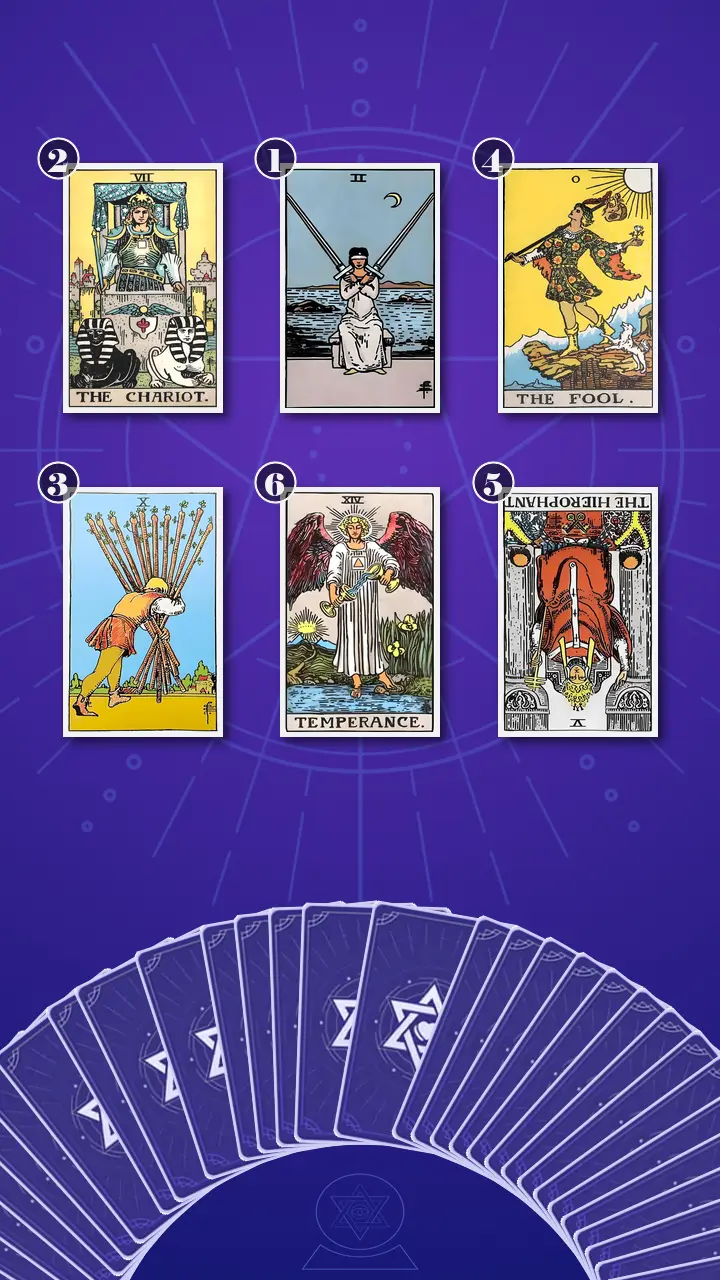
Reading the Fork in the Road (Without Turning It Into a Verdict)
Position 1: Current stuck point — The checklist loop
“Now turning over,” I said, “is the card that represents your current stuck point: the observable behavior loop around the checklist and decision paralysis.”
Two of Swords, upright.
I didn’t even have to reach for a metaphor—this card is the metaphor. “It’s 11:38 PM,” I said, translating the image into her life, “and you’ve got OMSAS/med school portals, prereq pages, and a Google Sheet open in three different windows. You keep re-checking the same deadline and the same minimum requirements, because re-checking feels like control. Then you hover over ‘Start Personal Statement’—or the document titled ‘PS_v1’—and your chest tightens. So you switch tabs to ‘just confirm’ letters of reference rules again.”
I watched Jordan’s eyes flick down and left—classic internal replay. She let out a small laugh that was all sharp edges. “That’s… brutal,” she said. “Like, accurate. But brutal.”
“You’re not behind—you’re bracing,” I told her. “This card is self-protection through analysis.”
Energetically, the Two of Swords is blocked air: too much thinking, not enough permission to feel, decide, and move. The blindfold isn’t ignorance; it’s a strategy—if I don’t choose, I can’t be wrong. The crossed arms aren’t laziness; they’re armor.
I leaned in a little. “Here’s the question this position asks in real life: what’s the exact moment you switch from ‘I’m reviewing’ to ‘I’m avoiding’? Like, which tab do you open right before you’d have to write something messy or send the recommender email?”
Jordan’s fingers tightened around her mug, then slowly loosened. “Forums,” she admitted. “Or the prerequisites page. Like it’s going to change overnight.”
Position 2: Apply now — What this path strengthens
“Now turning over is the card that represents Apply now—what this path strengthens in you.”
The Chariot, upright.
“Applying now looks like treating your application like training season,” I said. “You pick a weekly target, block two real calendar chunks, and move even when your confidence is wobbling. It’s drafting 300 messy words, emailing one recommender, booking one info call—letting progress be the proof.”
The Chariot’s energy is excess will that can become structure—but only if you hold the reins. It’s forward motion with competing forces still present. “This card says you can steer while you’re still unsure,” I told her. “You don’t need the fear gone. You need a plan strong enough to move with the fear in the passenger seat.”
Jordan nodded once, quick, like she wanted to accept it before her brain could argue.
Position 3: Apply now — What it would cost or require you to manage
“Now turning over is the card that represents Apply now—what this path would cost you or require you to manage consciously.”
Ten of Wands, upright.
“The cost of applying now is the ‘carry everything alone’ trap,” I said. “Research job, volunteering, MCAT/CASPer logistics, personal statement drafts, references—plus the invisible job of comparing yourself to everyone’s highlight reel.”
As I spoke, I saw her shoulders creep up, almost reflexively, like she could feel the TTC backpack weight in her collarbone. “That’s the Ten of Wands,” I added. “It’s not ‘you can’t do this.’ It’s ‘you can do this, but not by loading your week until you can’t see your why anymore.’”
Energetically this is excess responsibility. The wands block the figure’s vision—just like a packed calendar can obscure meaning. I said one of my favorite truth-lines for high achievers: “Re-checking the requirements is the clean version of action. Drafting is the honest version.”
Jordan swallowed. “I hate how true that is.”
Position 4: Gap year — What this path strengthens
“Now turning over is the card that represents Gap year—what this path strengthens in you.”
The Fool, upright.
I let the room breathe for a beat, then shifted the camera away from the laptop—like the card asked me to. “A gap year, at its best,” I said, “is permission to learn by doing—without needing to already feel ‘ready’ inside your head.”
“It’s you saying: I’m going to get lived evidence. You apply for a role that gives you real patient-facing moments—or deeper research responsibility. You try one community health commitment that aligns with your values. Your confidence returns in small data points you can’t argue with.”
The Fool is balanced openness when it’s structured—light pack, one step, then another. The energy here is a release valve: not escaping effort, but escaping the frozen debate.
Jordan’s shoulders softened, just a fraction. Her face unclenched the way it does when someone realizes there’s a third option besides “panic” and “push harder.” “I could do that,” she said quietly. “I could actually… collect evidence.”
Position 5: Gap year — What it would cost or require you to manage
“Now turning over is the card that represents Gap year—what this path would cost you or require you to manage consciously.”
The Hierophant, reversed.
“This is the part most people don’t name,” I said. “The hidden cost of a gap year isn’t time—it’s the noise of the approved timeline voice getting louder.”
“You read forum threads like they’re laws. You catch yourself thinking ‘How will this look?’ more than ‘Will this help me grow?’ And when you see a white coat post, your brain turns it into a scoreboard.”
Energetically, the Hierophant reversed is a blockage created by outsourced authority. I’ve seen this pattern in finance and in medicine—different uniforms, same pressure. On the trading desk, there was always a mythical “right move” everyone pretended existed. But the people who lasted weren’t the ones who guessed perfectly; they were the ones who built systems to manage uncertainty without letting it manage them.
I pointed to the keys in the card’s symbolism. “The key you’re searching for is permission. And the brutal truth is: no forum can hand that to you.”
Jordan’s mouth tightened, then she exhaled through her nose. “If the advice makes you more panicked, it’s not guidance—it’s noise,” she repeated, like she was trying the sentence on for size.
When Temperance Spoke: Turning “Apply Now vs Gap Year” Into One Workable Plan
Position 6: Integration and next step — The grounded move this week
I slowed down before turning the last card. “We’re flipping the bridge now,” I told her. “This is the card that answers: what’s the most grounded move you can take this week that keeps agency with you.”
Temperance, upright.
For a second, the kitchen behind Jordan looked even harsher in the overhead light—like the world was daring her to make this complicated. In my experience, this is the exact moment decision fatigue tries to stage a comeback.
Setup: I said, “Picture that Sunday-night moment: the checklist is open, your jaw is clenched, and you’re rereading requirements like the page might finally tell you who you are. You’re trying to pick the perfect door because you think the door proves something about you.”
Delivery:
Stop treating timing like a verdict and start pouring your energy in measured doses—Temperance turns two options into one workable plan.
I let it sit. No extra commentary. Just the sentence hanging there, like steam above a mug.
Reinforcement: Jordan’s reaction came in layers. First, a tiny freeze—her breath paused mid-inhale, and her eyes held on the screen like she’d been caught doing something private. Then her gaze went unfocused, as if her brain replayed last week in fast-forward: the TTC ride, the white coat post, the tab-switch, the chest tightness, the relief of “research,” the emptiness after. Finally, the release: her shoulders dropped like she’d been wearing a backpack she forgot was there, and a shaky laugh escaped—softer than before, almost relieved.
“But if I stop treating it like a verdict…” she began, then stopped. Her eyebrows pulled together, and for a flicker she looked angry—not at me, but at the trap. “Does that mean I’ve been making it dramatic for no reason?”
I shook my head. “No. It means you’ve been trying to buy certainty with control. That’s a normal response to a competitive pipeline. But timing isn’t a verdict on your identity. It’s a strategy you can test.”
I brought in my own framework—the one I built back when my world ran on timelines and outcomes. “I use something called a Potential Mapping System,” I said, “to spot how someone learns under pressure. You’re a Deep Thinker. Your superpower is understanding the system. Your risk is thinking you have to understand the whole system before you’re allowed to move in it.”
“Temperance is your antidote,” I continued. “Not more thinking. Calibration. Measured doses of action that create evidence.”
I asked her the question that turns insight into lived reality: “Now, with this new lens—can you think of one moment last week where you were about to switch tabs, and this would’ve changed how you felt?”
Jordan blinked a few times, eyes shinier than before. “Tuesday,” she said. “Hospital hallway. I drafted an email to a recommender and deleted it twice. I could’ve just… sent a ‘rough’ version.”
That was the shift, right there: from pressure and contraction to the first edge of agency. Not certainty—agency. The beginning of grounded confidence from evidence.
The Temperance Cadence Plan: Actionable Next Steps for the Next 72 Hours
I summed up what the cards were saying as one coherent story, the way I’d write it in a boardroom memo and the way I’d say it to a nervous 24-year-old on a Sunday night.
“Here’s the pattern,” I said. “Two of Swords is the checklist-as-a-shield loop: the more you need a perfectly safe decision, the more you freeze. The Chariot shows the strength you’d build by applying now—discipline and follow-through—but Ten of Wands warns you’ll over-carry and burn out if you treat intensity as proof of readiness. The Fool shows the gift of a gap year—lived evidence and renewed confidence—but the Hierophant reversed reveals the real threat: letting unspoken rules and online timelines become your boss. Temperance integrates all of it: you don’t choose a personality today. You choose a cadence.”
“Your cognitive blind spot,” I added, “is believing there’s one timing choice that removes all risk. That’s what keeps you stuck in analysis paralysis. The transformation direction is to move from perfect timing to a two-track experiment—where you build readiness while you decide.”
Then I got practical, because clarity without a next step is just a prettier form of overthinking. I used my 5-Minute Decision Tools—a tri-axis assessment I’ve used with clients making career crossroads decisions—so Jordan could stop spiraling and start calibrating weekly.
- Temperance Cadence (Two-Week Block)Open your calendar tonight and create one repeating two-week block called “Temperance Cadence” with exactly two items: (1) one application deliverable (200 messy words of your personal statement or a bullet list of 6 stories you might write about), and (2) one readiness-building move (message your supervisor asking for one added responsibility that could become a real story for your application).Make it tiny on purpose. If your brain says “not enough,” name it as perfectionism, not truth.
- Official vs Unspoken Rules FilterIn Notes or Notion, make two columns: “Official requirements” and “Unspoken rules.” Before you read r/premedcanada, SDN, or ask anyone’s opinion, complete one action from the Official column (example: send one recommender email—even if it’s rough).One action earns one scroll—not the other way around. If the advice spikes your chest tightness, log out for the next 30 minutes.
- 72-Hour Micro-Commitment (The “Bad Draft on Purpose”)Set a 20-minute timer and write the worst version of your opening paragraph on purpose. Save it as “PS_bad_draft_on_purpose.” Stop when the timer ends, even if it’s ugly. The goal is proof of movement, not quality.If your jaw clenches, pause and label it—“tight chest, clenched jaw”—then make the smallest next click anyway: type one sentence, or hit send on one email.
I finished with the tri-axis calibration question, the one that turns “gap year vs apply now” into strategy: “In five minutes, score each path on Advantage, Risk, and Breakthrough—then we recalibrate next week based on what you actually did, not what you feared.”

A Week Later: The Quiet Proof
Six days later, Jordan messaged me a screenshot instead of a spiral. It was a sent email—subject line plain, body imperfect—asking a supervisor for a recommendation chat. Under it, she’d typed: “Chest got tight. Did it anyway. Also wrote 214 words. They’re bad. But they exist.”
That’s what a real Journey to Clarity looks like most of the time: not fireworks—evidence. Timing stops being a prophecy, and becomes a rhythm you can repeat.
When timing feels like a verdict, even clicking into a blank document can make your chest tighten—because it’s not just an application, it’s your fear of proving you can’t control your future.
If you didn’t have to decide your whole timeline today, what’s one small, measurable step you’d be willing to take this week just to give yourself real evidence to work with?