From Shame Spirals to Re-Entering Class After One Missed Lecture

Finding Clarity in the 8:47 p.m. Portal Scroll
If missing one lecture turns into a full-on catch-up spiral where you convince yourself you can’t show up again until you’re “back on track,” you’re not alone.
Taylor (name changed for privacy) sat down across from me with the careful posture of someone trying not to take up too much space—shoulders slightly forward, hands tucked around a paper cup like it could anchor her. She’d messaged me from Toronto, a 20-year-old undergrad with the kind of planner system that looks soothing until it becomes a trap.
“It was one lecture,” she said, and there was a tight little laugh that didn’t reach her eyes. “But it feels like I broke the whole semester.”
I could almost see the scene as she spoke it—8:47 PM on a Tuesday in a Toronto bedroom, Quercus/Canvas open to ‘Week 6’ slides sitting there like proof. The laptop fan whirring. Blue light making her eyes sting. Her phone warm from doomscrolling Instagram Stories of classmates’ neat notes and campus posts. And inside her body: that sudden heat in her face, that clamp in her chest, like she’d been caught doing something wrong even though she was alone.
“After I miss one lecture,” she told me, “the shame loop kicks in. I start planning this perfect catch-up day. I toggle between the recording, my Notes app, and Instagram until it’s too late to sleep. Then I skip again because… now it’s worse. And if I walk in behind, everyone will be able to tell.”
Her shame wasn’t an abstract feeling. It moved like a spotlight she couldn’t turn off—bright, hot, and aimed directly at her, even in an empty room.
I let that land without rushing to fix it. “Okay,” I said gently. “We’re not here to judge you for the loop. We’re here to understand the mechanics of it—so you can interrupt it. Let’s draw a map through the fog, and find one next step you can actually do.”

Choosing the Compass: The Transformation Path Grid
I asked Taylor to take one slow breath—not as a ritual for luck, but as a way to shift from self-roasting into observation. Then I shuffled, slow enough that her nervous system could keep up with the room.
“Today,” I said, “I want to use a spread called Transformation Path Grid (6) · Context Edition.”
For readers: this question isn’t about predicting a grade or an outcome. It’s about a tight behavioral loop—miss one lecture → shame spike → hide → over-prepare → skip again. A huge spread can accidentally feed the same pattern (“more information will make me feel safe”), so I keep this one minimal on purpose. It separates the loop into parts you can actually work with: surface behavior, the self-judging narrative, the hidden rule underneath, the interruption point, a practical next step, and what integration looks like.
The layout is a 2×3 grid: top row is diagnosis, bottom row is remedy. Like a classroom whiteboard—messy thoughts up top, then the teacher writes the clean plan underneath.
“We’ll look at three places first,” I told Taylor. “What you do right after you miss one lecture. The exact inner sentence that spikes the heat in your face. And the deeper rule that keeps the whole thing running. Then we pivot—what resource interrupts it, what one grounded action gets you back in the room, and what ‘coming back’ looks like when you stop treating it like a courtroom.”
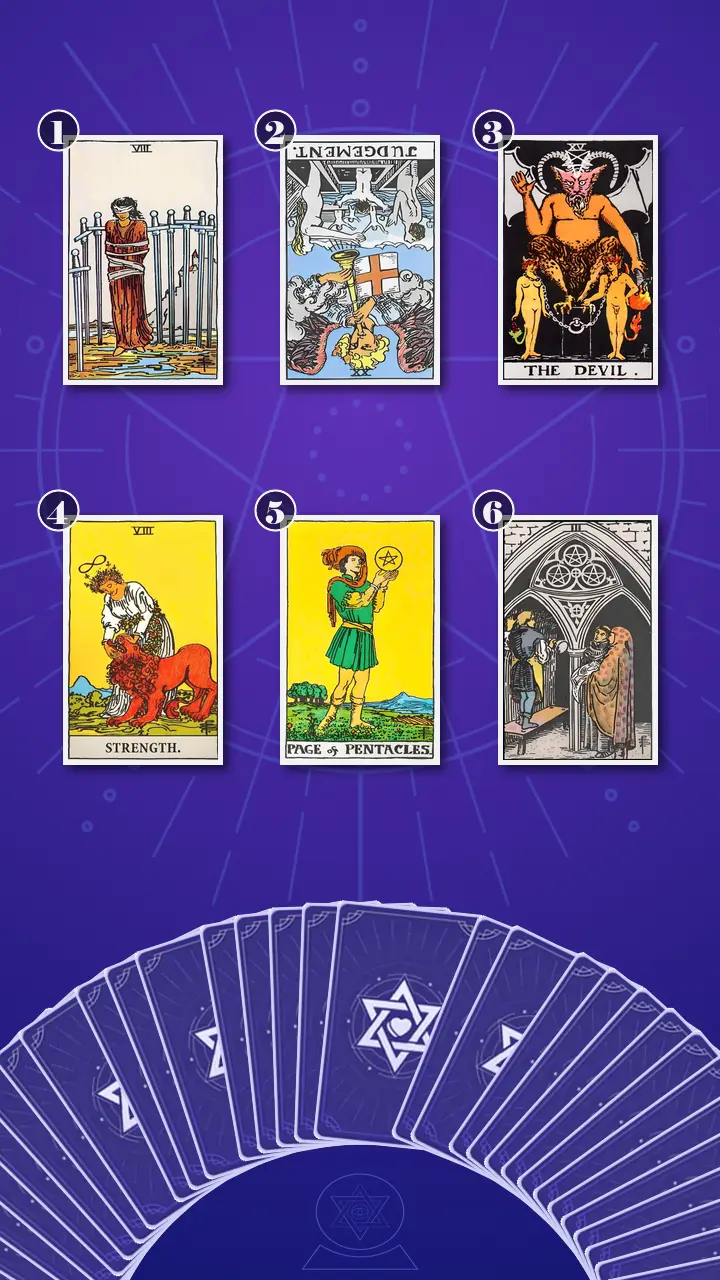
Reading the Map: Six Cards, One Return
Position 1 — The Doorway Freeze After One Miss
“Now we turn over the card that represents Surface pattern: what you do right after missing one lecture (the observable freeze/avoidance behavior),” I said.
Eight of Swords, upright.
“This is the ‘hand on the door handle’ card,” I told her, angling the image toward the camera. “Blindfold. Loose bindings. A ring of swords that looks like a cage, even though it’s not locked.”
I used the translation that fits her life exactly: “You miss one lecture, and the next time you think about going back, you feel like you’ve lost the right to enter. You hover outside the room—or over the Zoom link—and your brain plays a highlight reel of imagined looks. You tell yourself you’ll ‘catch up first,’ then go home and over-prepare until it’s too late.”
“That’s… brutal,” Taylor said, and she laughed once—small, bitter. “Like, accurate. But brutal.”
That reaction mattered. It wasn’t denial; it was recognition with teeth.
“Let’s name the energy,” I said. “Eight of Swords is blockage. Not because the class is inaccessible, but because your attention gets narrowed until the imagined social consequences feel more real than the physical door.”
I painted the doorway moment the way her body knew it: fluorescent hallway light, the muffled lecture audio through the door, phone warm in her palm. Then I gave her the two-voice script the cards were already showing me.
The Inner Judge: “Everyone will know.”
The Reality: “People are thinking about their own notes.”
Taylor exhaled sharply through her nose. Her shoulders dropped a fraction, like she’d been holding a bag she didn’t realize was heavy. That was the first tiny shift: the loop as a pattern, not a personality.
Position 2 — The Verdict Your Brain Hands Down
“Now we turn over the card that represents Shame trigger: the specific self-judging narrative that kicks off the loop and makes returning feel unsafe,” I said.
Judgement, reversed.
“Judgement upright is renewal,” I explained. “It’s the call to begin again. Reversed, the trumpet gets muffled—and the whole scene turns into an inner courtroom.”
I connected it to her lived behavior: “Instead of hearing, ‘Okay, rejoin,’ you hear, ‘Case closed.’ You rewrite the missed lecture like a moral failure. You check attendance rules. You mentally rehearse being called on. You draft a long apology email that’s really a plea to be declared ‘still good.’”
Taylor’s fingers tightened around her cup. “I literally draft the email like twelve times,” she said. “And then I delete it because it sounds… I don’t know. Like I’m making excuses.”
“This is where I want to give you a phrase,” I said. “Not as positive thinking—more like a reality label.”
A missed lecture is data, not a verdict.
Judgement reversed is a deficiency of self-forgiveness and a surplus of prosecution. It turns a neutral event into a sentence. And the sentence is always the same: you don’t belong unless you’re caught up perfectly.
Taylor stared at the card, then looked away, eyes unfocusing like she was watching last week replay. “I hate that I’m like this,” she said quietly. “Because the work isn’t even the hard part.”
Position 3 — The Contract You Never Signed
“Now we turn over the card that represents Root mechanism: the underlying belief or attachment that keeps the loop self-reinforcing over time,” I said.
The Devil, upright.
“This isn’t about you being ‘bad,’” I said immediately, because I’ve seen how quickly students interpret this card as proof of their worst fear. “This is about bondage to a rule.”
I tapped the loose chains in the image. “The Devil is attachment—compulsion, shame, the standard that holds you tighter than the situation itself.”
Then I translated it into her modern reality: “Underneath everything is a deal you didn’t realize you made: ‘If I’m not on top of it, I shouldn’t be seen.’ You’re chained to image-management—being the kind of student who ‘keeps up’—so you’d rather disappear than show up imperfectly.”
Her mouth pressed into a line. She nodded once, slow, like it stung. That’s what this card does when it’s true: it exposes the rule.
“Think of it like a Notion dashboard that becomes a procrastination machine,” I continued. “Beautiful templates, zero actual tasks completed. The to-do list turns into a shackle. The more polished the plan, the more it demands you live up to it before you’re ‘allowed’ to return.”
“Yeah,” she said, voice tight. “Sunday night is basically me negotiating with a strict version of myself.”
“Perfection isn’t a prerequisite for belonging,” I said, and I watched her blink as if a draft had moved through the room.
Position 4 — When Strength Stops the Courtroom
The air changed a little as I reached for the next card. Even through a screen, I’ve learned to notice when a reading turns from explanation to medicine.
“Now we turn over the card that represents Interruption point: the inner resource that can hold discomfort and create movement without self-punishment,” I said. “This is the turning point.”
Strength, upright.
Taylor’s eyes widened—just a little—and then she swallowed, like her throat had gone dry.
Strength is not hype. It’s not a montage. It’s not “new era, new me.” It’s the quiet dignity of moving while your body is still screaming. The gentle hands on the lion. The infinity symbol, not as magic, but as patience.
Here’s the thing I told her, and it’s also the thing I remind myself as an artist when I’m scared to show rough work: you don’t have to feel fearless to be brave. You just have to choose the next honest motion.
Before I gave her the key line, I set it up the way her life actually looks: “You know that moment,” I said, “it’s 8:47 PM, you open the course portal, see the new slides and the recording you missed, and your face goes hot like you’ve been caught—even though you’re alone in your room.”
She nodded once, fast, like please stop reading my mind.
Then I delivered the hook—clean, direct, and exactly as it needed to be:
Stop treating one missed lecture as a life sentence, start guiding yourself back with a steady hand—like Strength taming the lion without violence.
There was a pause. In my studio, a radiator clicked softly; outside my window, New York traffic hissed like distant rain. On Taylor’s side of the screen, she went still in a way that told me the sentence had hit bone.
Her reaction came in layers—three small waves. First, a freeze: her breath held, her eyes locked on the card as if it had just moved. Second, the cognitive seep: her gaze slid slightly to the side, unfocused, like she was replaying every time she’d tried to “earn” her way back by suffering privately. Third, the release: her jaw unclenched. Her shoulders dropped. She let out a shaky exhale that sounded like she’d been carrying a secret and finally set it down.
“But… if I go back while I’m embarrassed,” she said, and there was a flash of anger underneath the fear, “doesn’t that mean I’m admitting I messed up? Like I didn’t have it together?”
That was the unexpected reaction I was waiting for—the moment the inner contract tries to protect itself.
“It means you’re human,” I said, keeping my voice calm. “And it means you’re choosing dignity over disappearance. Strength isn’t ‘I never slip.’ Strength is ‘I can lead myself back even when my face is hot and my chest is tight.’”
This is where I brought in my favorite tool from my own toolbox—an Einstein-style thought experiment. “Let’s do a quick experiment,” I told her. “Imagine you’re not you. You’re a random student in that lecture hall. You’re late because your TTC transfer was a mess. Someone else walks in and sits down. Be honest: do you think, ‘Wow, failure’? Or do you think, ‘Oh—someone sat down’?”
Taylor’s mouth twitched, almost a smile. “I wouldn’t care,” she admitted.
“Exactly,” I said. “Your shame is acting like the camera is always on you. Strength reminds you: the camera is not your identity. It’s just a feeling.”
Then I asked the invitation question, because it turns insight into something trackable. “Now,” I said, “with this new lens—guiding yourself back with a steady hand—can you think of a moment last week when this would have changed how you felt? Even by five percent?”
Taylor looked down, then back up. “Yesterday,” she said. “I was outside the lecture hall. Hand on the door. And I walked away.”
“That’s it,” I said softly. “This isn’t about becoming a different person. It’s about moving from a ‘one slip = I’m a failure’ shame spiral and hiding to self-compassionate re-entry, belonging, and steady follow-through. One doorway at a time.”
Position 5 — The One-Pentacle Step (No Heroics)
“Now we turn over the card that represents Next step: one grounded action you can take this week to re-enter the course and reduce the gap,” I said.
Page of Pentacles, upright.
“This is my favorite kind of student energy,” I told her. “Not because it’s perfect—because it’s real. One pentacle. Both hands. A steady gaze.”
I used the exact life scene: “You treat re-entry like a beginner would. You go to the next lecture with one small plan—sit down, write three key points, circle one thing you don’t understand. You stop trying to ‘fix the semester’ in private and start rebuilding trust through a single action you can repeat.”
Page of Pentacles is balance. It’s the antidote to the Devil’s all-or-nothing contract. It doesn’t negotiate with shame; it just shows up with a pencil and a charger.
Taylor nodded, slower this time. “Okay,” she said. “I can do ‘one small plan.’ I can’t do ‘save my life overnight.’”
“Good,” I said. “One real step beats a private reset fantasy.”
Position 6 — Belonging, Built Like a Group Project
“Now we turn over the card that represents Integration: what ‘coming back’ looks like when the lesson is absorbed—how to rebuild belonging and consistency,” I said.
Three of Pentacles, upright.
“This is the cathedral card,” I told her. “A structured learning space. People collaborating. Plans in hand. It’s competence as a craft built with feedback—not a performance you either nail or fail.”
I translated it into her campus life: “Coming back sticks when you let the course be a shared build. Compare notes once. Ask one question in office hours. React in the group chat so you’re not a ghost. You’re not confessing—you’re participating.”
Taylor’s eyes got a little glossy, but her expression softened instead of collapsing. “It’s so weird,” she said, voice quieter. “I always assume asking means I’m behind. But… everyone asks.”
“Exactly,” I said. “This is the card that normalizes it.”
The One-Pentacle Plan: Actionable Next Steps in 24 Hours
I leaned back and let the whole grid speak as one story. “Here’s the arc,” I said. “Eight of Swords is the freeze—your body believes the door is locked. Judgement reversed turns that freeze into a verdict, like you need permission to exist in the room again. The Devil is the hidden contract: ‘Perfection is the entry fee for belonging.’ Then Strength steps in and renegotiates everything: not by arguing with shame, but by guiding you back with dignity. The Page of Pentacles gives you one doable step. And the Three of Pentacles tells you the comeback isn’t solo—it’s supported, structured, normal.”
“Your cognitive blind spot,” I added, “is treating feeling ready as the same thing as being allowed. You’ve been waiting for your internal weather to clear before you go outside.”
“The transformation direction is simple but not easy: shift from treating a missed lecture as an identity verdict to treating it as a normal data point and taking one visible repair action within 24 hours,” I said. “We’re going for consistency built on self-trust—not zero slips.”
Taylor hesitated. “But I don’t have time,” she said, and it came out fast—practical obstacle as armor. “Like… even five minutes. I’m already behind in two other classes.”
I nodded. “That makes sense. And I’m going to be very specific, so your perfectionism can’t hijack this into a three-hour project.”
- The 10-Minute “Return While It’s Loud” DrillSet a timer for 10 minutes. Write one sentence: “I missed one lecture. I’m going to the next one.” Then do one visible re-entry action: either put the next lecture time/location in your calendar with a 15-minute buffer, or send a 2–3 line message to a classmate/TA.If your chest tightens, pause for 3 slow breaths. Stopping is allowed; the goal is one small, real move—not pushing through misery.
- The Page of Pentacles “Three Bullets + One Circle” RuleGo to the next lecture even if you’re behind. Your only job: sit down and stay for 20 minutes. During that time, write exactly three bullet points you can remember later, and circle one question you don’t understand yet.Choose a low-visibility seat (back/side) if it helps. Attendance is the win; perfect notes are not the assignment.
- A Tiny Collaboration Move (Three of Pentacles)Within 24 hours, do one “normal student” reconnect: attend one office hour and ask “What should I focus on from last lecture?” or text one classmate, “Did I miss anything major? Could you share notes or a quick summary?”Keep it painfully short. If you start explaining, delete the extra. You’re requesting a next step, not asking for forgiveness.
Then—because I’m Juniper and my brain is half Tarot, half studio—I offered her one of my signature focus tools as an optional add-on, not a requirement.
“If your mind spins when you sit down to do the 10-minute drill,” I said, “try something I call Manuscript Mindmaps. Take one blank page and write your one sentence in mirror writing—backwards, like a secret note. It slows your inner judge down because it can’t speed-run criticism. Then draw three branches: ‘Attend,’ ‘Three bullets,’ ‘One message.’ That’s it.”
“That’s… weird,” Taylor said, and this time her laugh had air in it. “But I kind of like it.”
“We’re interrupting a loop,” I said. “Sometimes ‘weird but doable’ is exactly the door.”

A Week Later: Return With Shame in the Passenger Seat
A week later, Taylor sent me a message that was so short I could tell she’d fought for it.
“Went,” she wrote. “Sat in the back. Stayed 20 minutes. Wrote 3 bullets. Asked the TA one question after. My face was hot the whole time, but I didn’t die.”
In a second text: “Also sent the 2-line message. It took me 45 minutes to press send. They replied in 3 minutes like it was normal.”
Her change wasn’t a grand transformation with confetti. It was the smallest, brightest proof—the kind you can hold in your palm.
Clear but still tender: She slept a full night after that lecture, then woke up and her first thought was, “What if I mess up again?” She paused, and instead of spiraling, she breathed once and thought, “Okay. Then I’ll come back again.”
I sat with that for a moment in my studio, surrounded by half-finished canvases—evidence, in my own life, that progress is allowed to look unfinished.
This is what a real Journey to Clarity looks like sometimes: not certainty, but ownership. Not “I never miss,” but “I return.”
When one missed lecture makes your face go hot and your chest clamp down, it’s not laziness—it’s the panic of wanting to look capable while feeling one step away from being exposed.
If you didn’t have to feel “ready,” just honest, what’s one small way you’d let yourself re-enter—today or tomorrow—so the course becomes a place you’re allowed to return to?