A Blank Calendar Felt Like a Verdict—So I Switched to Draft v1

Finding Clarity in the 9:41 p.m. Sunday Scroll
You’re a Toronto undergrad who opens Notion on Sunday night to plan the ‘perfect’ week, and somehow ends up with five tabs on productivity methods and zero actual study blocks—classic Sunday Scaries.
Maya (name changed for privacy) said it like a confession, but her voice had that brittle edge I recognize—the sound of someone trying not to panic out loud.
It was 9:41 p.m. in her small Toronto bedroom apartment. On the video call, I could see the cool glow of her laptop making her face look sharper than it probably did in daylight. Google Calendar sat open on one side, Notion on the other. The hum of a charging cable sounded weirdly loud through her mic, like the room itself was holding its breath. She dragged a study block onto Monday… then deleted it. Her fingers kept tapping her trackpad like they were waiting for permission.
“If I don’t plan the week perfectly,” she said, staring past the screen, “I’ll ruin it before it even starts.”
I watched her inhale—short, shallow, like her chest was a drawer that wouldn’t open all the way. The panic wasn’t abstract. It lived in her body, like someone had poured cold soda into her lungs and the fizz wouldn’t settle.
And there it was: wanting a study plan that proves you’re on track, versus fearing that any imperfect plan will expose you as not disciplined enough.
“Okay,” I said gently, leaning closer to my camera the way I would lean closer across a real table. “You’re not broken. You’re having a very normal nervous-system response to a very specific trigger. Let’s try to give this fog a map. Tonight isn’t about becoming a different person. It’s about finding clarity—enough to place one realistic block and start it.”

Choosing the Compass: The Four-Layer Insight Ladder Spread
I asked Maya to put both feet on the floor—not as a mystical ritual, just a signal to the body that we weren’t in a fire drill. Then I had her take one slower breath while I shuffled. The sound of cards slipping against each other is, to me, the simplest kind of reset: attention returning to one thing.
“For this,” I said, “I’m using a spread called the Four-Layer Insight Ladder · Context Edition.”
And for anyone reading who’s ever Googled ‘how tarot works for self-improvement’ and gotten lost in a sea of prediction content—this layout is built specifically for moments like Maya’s: when the problem isn’t ‘what will happen,’ but why your brain reacts like an alarm to something as normal as open time.
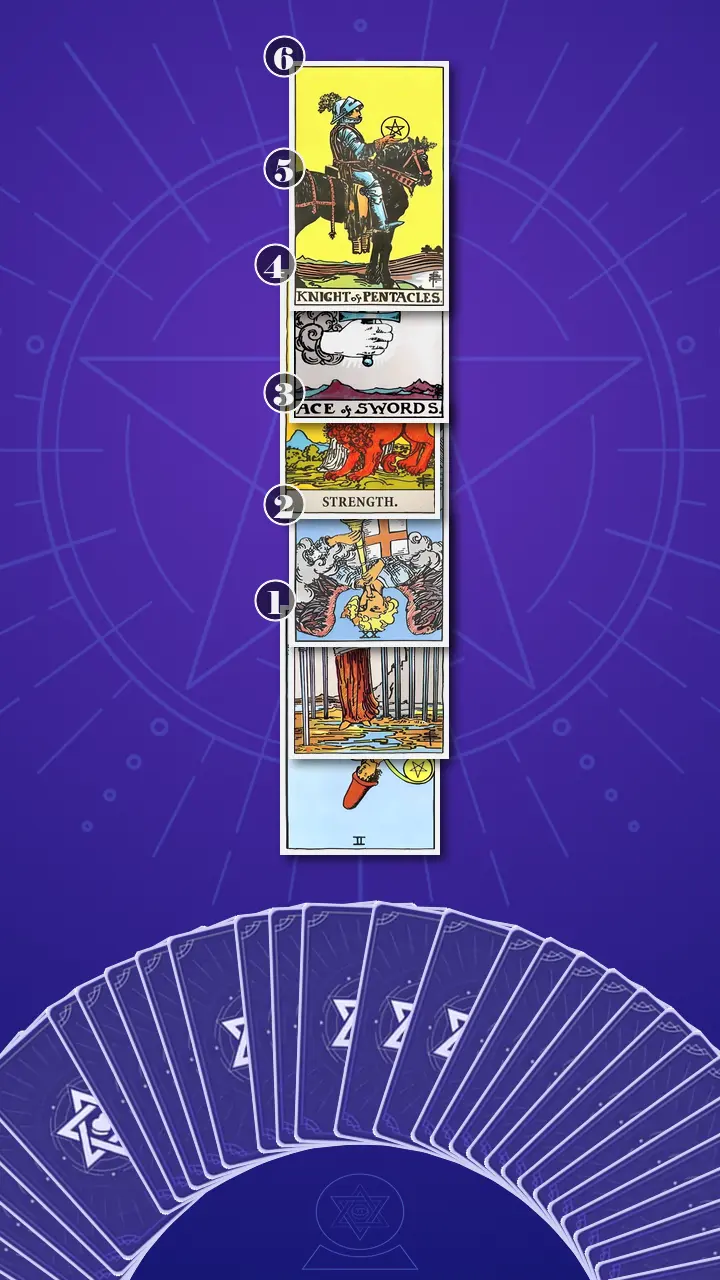
The Ladder works because it climbs in a clean, practical sequence: surface symptom (what you do on autopilot), past message (the old rule that gets triggered), core fear (the emotional engine underneath), then the turning point (the pivot that interrupts the loop), followed by a usable resource and a next step. It’s a tarot spread for perfectionism and productivity anxiety that aims for actionable advice, not fortune-telling.
“We’ll read upward,” I told her. “First we name the loop. Then we find the message behind it. Then we touch the fear under that message. And then—most importantly—we identify one shift you can practice this week.”
Reading the Map: Card Meanings in Context
Position 1 — The Juggle That Looks Like ‘Planning’
“Now we turn over the card that represents the surface symptom: the specific, observable behavior when the study schedule is open,” I said.
Two of Pentacles, reversed.
Even through the camera, I saw Maya’s face change with immediate recognition.
“This card is basically your browser history,” I said, keeping my tone wry but kind. “You open your calendar to place one study block, but your brain tries to juggle everything at once—assignments, readings, shifts, life admin—so you keep the plan in motion. Dragging blocks around. Rewriting the list. Switching from Google Calendar to Notion to a different template. Motion feels safer than committing.”
Reversed, the energy isn’t balanced juggling. It’s a blockage—overload that collapses into constant recalibration.
“And the result,” I added, “is you’ve been ‘organizing’ for an hour, but the first real block still isn’t placed.”
Maya let out a small laugh that didn’t land as humor. It landed as relief mixed with embarrassment.
Then she did a three-step reaction chain I’ve come to treat as a truth signal: (1) her breath stopped for half a second, like her body froze; (2) her eyes unfocused, like she was watching a replay of her own Sunday nights; (3) she exhaled through her nose and shook her head, quietly. “That’s… that’s mean,” she said, but she was smiling in that pained way. “Like, accurate-mean.”
“I’m not here to roast you,” I said. “But I am going to be honest.” I tapped the table once beside the card. “If your system is changing every week, it’s not a system—it’s a hiding place.”
She looked down, then back up. “Why am I doing admin on my own life instead of studying?”
“Because admin has no risk of being graded,” I said softly. “Which brings us to the next layer.”
Position 2 — The Past Message That Tightens Your Chest
“Now we turn over the card that represents the past message: the internalized belief learned earlier that gets triggered by blank time,” I said.
Eight of Swords, upright.
“This is the moment you see open time and an old script turns on,” I told her. “The script sounds like: ‘I can’t start unless I’m fully prepared.’”
I kept the language concrete, because this card is concrete even when people try to make it mystical. “The blindfold and those loose bindings? They’re not handcuffs. They’re rules that feel like law because you learned them under pressure.”
I leaned in. “So you restrict yourself with invisible requirements—pick the perfect order, find the best method, build the ideal schedule—until you feel trapped. You’re technically free to start, but mentally you’re waiting for certainty that never arrives.”
In energy terms, this is Air gone stale: analysis without oxygen. Not thinking that leads to action—thinking that replaces it.
Maya’s fingers, which had been fluttering near her trackpad, went still. “I always tell myself I’m being responsible,” she said. “Like, I’m preparing.”
“Preparation is real,” I said. “But this is a preparation loop. It’s the difference between tying your shoes… and rewriting the concept of shoes until you never leave the house.”
She snorted, then swallowed. The shame was right there, but she didn’t look away. That mattered.
Position 3 — The Inner Gradebook With a Red Pen
“Now we turn over the card that represents the core fear: the deepest emotional driver keeping the planning loop alive,” I said.
Judgement, reversed.
Judgement reversed has a specific kind of weight. When it shows up, people often think they’re afraid of time management. They’re not. They’re afraid of evaluation.
“This,” I said, “is the planner as a scorecard.”
I let my Wall Street brain translate the symbolism into something Maya could feel in her day-to-day life. “The trumpet is an evaluation siren. Like a phone alarm that turns neutral planning into a high-stakes test. Opening your planner feels like stepping into a courtroom where you’re both the defendant and the judge.”
Then I used the exact inner-monologue structure the card was demanding. “Your mind goes: ‘If I choose wrong, it means I’m not disciplined.’ Or ‘If I pick the wrong first task, it means I’m not smart about priorities and it’ll show in my results.’”
She nodded, but her nod was small—like she didn’t want to admit how true it was.
“And here’s the flip,” I continued, my tone flattening into something calmer, more coach-like. “What if this is just Draft v1?”
I had a quick internal flashback—trading floor days, the way juniors would freeze because they thought one mistake would brand them permanently. I remembered my old managing director saying, not unkindly: ‘We’re not writing scripture. We’re drafting a position.’ Seeing Judgement reversed always brings that back. Fear makes everything feel final.
Maya’s shoulders dropped a fraction. She went quiet. It was exactly the response I look for here: the moment the mind stops arguing and just… hears itself.
“So the fear isn’t ‘I’ll waste time,’” I summarized. “The fear is: an imperfect first block will prove something final about me.”
Position 4 — When Strength Changes the Whole Room
“Now,” I said, and I slowed down on purpose, “we turn over the card that represents the turning point: the inner shift that interrupts the fear-based cycle.”
The room on Maya’s side was quiet enough that I could hear the faint buzz of her laptop fan. Even the light on her face looked steadier, like the screen had stopped flickering in her nervous system.
Strength, upright.
This was the hinge. The bridge. The medicine.
Setup—because the setup matters: it’s Sunday night, you open Notion or Google Calendar, and the empty week looks weirdly loud—like if you place the “wrong” first block, you’ll waste the whole term and everyone will somehow know. You’re trapped between wanting control and fearing the moment that control becomes testable.
Stop treating the blank calendar like a verdict, and start holding your first study block the way Strength holds the lion—firmly, gently, and without drama.
I let that sit in the air for a beat. No extra commentary. Just the sentence and the space after it.
Maya’s reaction unfolded in layers, like her body needed time to accept a new rule. First: her eyebrows lifted, not in surprise, but in that specific expression of being seen. Then: her jaw unclenched slightly, and she blinked slower. Then: her shoulders rolled down as if she’d been carrying a backpack she forgot she had on. She took one deeper breath, and for a second she looked almost annoyed—like part of her wanted to protest.
“But if I do it gently,” she said, voice tight, “doesn’t that mean I’m… not trying hard enough?”
There it was—an unexpected reaction, and a real one. Not relief. Resistance. The Inner Gradebook trying to keep its job.
“No,” I said, and I kept it clean. “It means you’re trying correctly. Strength isn’t softness as an excuse. It’s steadiness as a skill.”
Then I brought in my signature way of diagnosing effort, because this is where it becomes practical. “I use something I call a Potential Mapping System,” I told her. “It’s an energy profile, not a personality label. Some people are Sprinters—they get going fast with hype. Some people are Deep Thinkers—they need psychological safety to begin, then they lock in.”
I gestured to the Strength card. “You’re a Deep Thinker. Your brain needs the start to feel survivable. When you try to ‘white-knuckle’ yourself into it, your nervous system bolts—like a skittish animal. Strength is literally the opposite approach: feet on the floor, one tab, timer on. No inspirational montage. Just a calm hand on the lion.”
Maya’s eyes watered a little, which surprised her. She laughed once, quietly, and wiped under one eye like she was annoyed at her own humanity.
“Now,” I asked, “with this new lens—Strength, not Judgement—think about last week. Was there a moment when you could’ve started small, but you treated the first block like a grade?”
She stared up and to the left, replaying. “Tuesday,” she said. “I had forty minutes between class and my shift. I tried to plan the whole week. I… lost the whole pocket.”
“Exactly,” I said. “This turning point is the first real step in your emotional transformation: from blank-calendar panic and perfection-driven planning loops to evidence-based confidence built through one small, repeatable study block.”
“Planning is a container for practice—not a performance for proof,” I added, and this time she nodded like it wasn’t just nice—it was usable.
Position 5 — The One-Sentence Spec That Stops Scope Creep
“Now we turn over the card that represents the usable resource: the clearest mental tool you can use today,” I said.
Ace of Swords, upright.
“This is your one clean cut,” I said. “A boundary that says: one priority, one definition of done, one starting point.”
And I used the modern-life translation exactly the way it needed to land. “You write one sentence that decides the whole block: ‘For the next 25 minutes, I will do 20 practice questions and review mistakes.’ That sentence becomes a filter. You don’t reorganize notes. You don’t redesign Notion. You don’t chase a better method mid-block.”
In energy terms, this is Air in balance: clarity that creates action instead of debate.
Maya’s face shifted—small jolt of decisiveness. I could almost see her wanting to reach for her keyboard.
“It’s like a product requirement,” I said, letting my business side show because it helps. “A spec prevents scope creep. Your anxiety keeps trying to add ‘just one more thing’ because it thinks more equals safer. Ace of Swords says: no. One sentence. One tab. One timer.”
She nodded hard. “I always add things,” she admitted. “And then I feel behind before I even start.”
Position 6 — The Boring Routine That Saves Your Week
“Now we turn over the card that represents the next step: one grounded, repeatable action for the next 7 days,” I said.
Knight of Pentacles, upright.
“This is the card that refuses to be aesthetic,” I said, and Maya smiled for real this time. “It’s consistency over intensity.”
I anchored it to the translation: “Your next step is choosing one dependable study block you can repeat three times this week at the same time—even if it’s not impressive. You show up like it’s a class or a shift. The schedule stops being a performance and becomes a container you can trust—because you keep the appointment and let repetition build the confidence.”
Earth energy, finally stable: not juggling, not debating—building.
“One repeatable block builds capability,” I told her. “The rest is noise.”
The Verdict-to-Draft Plan: Actionable Advice for the Next 7 Days
When I looked back down the ladder, the story was almost painfully coherent.
The Two of Pentacles reversed showed the visible loop: juggling tasks and tools so the calendar never has to hold a real attempt. The Eight of Swords named the past message—‘I can’t start until I’m fully prepared’—that makes blank space feel dangerous. Judgement reversed revealed the real engine: an inner gradebook that treats the first study block as evidence in a trial about worth. Strength offered the pivot: nervous-system steadiness and self-trust, the courage to start without drama. Ace of Swords gave the tool: one sentence that defines “done” and shuts down tab-sprawl. Knight of Pentacles delivered the method: a small, repeatable anchor block that turns panic into data.
The cognitive blind spot was clear: Maya wasn’t using planning to support studying—she was using planning to ask an impossible question: “Am I worthy?” A schedule can’t answer that. It can only provide a container for reps.
“Here’s the transformation direction,” I said. “Shift from ‘a perfect schedule proves I’m capable’ to ‘a small, repeatable block builds capability.’ We’re going to build evidence, not arguments.”
Then I gave her something structured—because vague encouragement is useless at 9:41 p.m. on a Sunday.
“We’ll use my 5-Minute Decision Tool,” I told her, “because you don’t need a life overhaul. You need a quick tri-axis call: Advantage, Risk, Breakthrough. What helps most? What could go wrong? What would be new?”
- Place one Anchor Block (Draft v1)Pick one time you can realistically repeat 3x this week (for your real schedule—classes + shifts). Put it in Google Calendar as “Anchor Block (Draft v1)” for, say, Mon/Wed/Fri 1:30–2:10 p.m. Keep it 25–45 minutes.If your brain says “not enough,” treat that as the alarm. Lower the bar on purpose: 25 minutes beats 0 minutes, every time.
- Write the past-message + counter-sentenceIn your Notes app, write the old script exactly: “I can’t start until I’m fully prepared / until I know the best method.” Under it, write one counter-sentence you can act on today: “I can start with one 25-minute draft block and adjust after.” Put that counter-sentence where you’ll see it—your calendar event title or a sticky note on your laptop.Don’t use it as a debate. It’s a steering wheel, not a courtroom argument.
- Do the 7-minute Gentle Start (the Strength move)Within the next 10 minutes, create ONE block: 25 minutes titled “Draft v1: first block.” In the notes, write: “Done = I start + I stay until the timer ends.” Set a timer for 7 minutes (not 25 yet) and start the easiest first step (open the doc / pull up the problem set / queue the Anki deck). When the timer ends, you’re allowed to stop—or continue for the remaining 18.If your chest tightens, pause for three slower breaths. You’re not failing—you’re noticing your nervous system. Scale down to 3 minutes if needed and still count it as a start.
“And one last thing,” I added, because Judgement reversed needs a boundary. “You get exactly one revision slot mid-week. Wednesday night, 10 minutes. It’s called Evidence Check—not ‘Fix My Life.’ You write: what got done, what didn’t, one adjustment. That’s it.”

A Week Later: Ownership, Not Certainty
Six days later, I got a message from Maya. It wasn’t a novel. It was the kind of text I love because it sounds like real change—small, specific, unglamorous.
“Did Anchor Block Draft v1 three times,” she wrote. “First one I only did the 7 minutes and stopped. Second one I kept going. Also… I didn’t redesign Notion. Which feels weirdly like a win?”
I pictured her on a random weekday morning: sleeping a full night for the first time in a while, then waking up with the familiar first thought—what if I’m doing it wrong?—except this time she doesn’t spiral. She sits up, exhales, and opens her calendar anyway. Clear, but still a little tender.
That’s the journey, in the most honest form: not instant confidence, but ownership. Not a perfect plan, but a plan that can be revised without shame.
When the calendar is blank, it can feel like you’re not looking at free time—you’re looking at a scoreboard that’s about to tell you who you are.
If you treated this week’s plan as “Draft v1,” what’s one small block you’d be willing to place—not to prove anything, just to gather real evidence?