Flex Time vs Raise After Review—Designing a Testable Terms Trial

The 8:47 p.m. Tab-Switching Spiral After a Performance Review
If the week after your review is just “you’re doing great” with no concrete offer, and now you’re stuck in the flex time vs raise spiral… yeah.
Jordan (name changed for privacy) appeared on my screen from a Toronto shoebox condo, laptop perched on a kitchen counter under a warm light that buzzed like it had an opinion. I could see it in the way she held her shoulders—creeping up toward her ears like they were trying to hide from her own calendar.
“It’s so stupid,” she said, and I heard the exhaustion in the tiny laugh that followed. “I have three tabs open. Salary bands, Google Calendar, and a draft email titled Quick follow-up. And I’m… just switching between them. Like it’s research.”
A Slack preview flashed on her phone again, screen-glow warming her palm. In the background, her calendar was a mosaic of color blocks—back-to-back meetings, exactly the kind that make Sunday night feel like you’re walking toward a moving treadmill.
She rubbed her neck. “I can’t keep doing this schedule. But if I ask for flexibility, will they think I’m slacking? And if I ask for money… it’s like I’m agreeing to keep living like this.”
I nodded, slow and clear. “That’s not indecision. That’s a real trade-off trap. You want sustainable control over your time, and you’re afraid that asking for it will reduce your perceived value and bargaining power.”
Her uncertainty wasn’t a vague cloud—it was a restless, buzzy vibration under the skin, like trying to tune a radio between two stations while someone keeps knocking on the door. “If I pick wrong, I’ll look unserious,” she admitted, almost like she was quoting a thought she’d been hearing all week.
“Okay,” I said, keeping my voice warm but grounded. “We’re not here to perform the perfect ask. We’re here to find clarity—something you can actually act on. Let’s draw a map for the fog.”

Choosing the Compass: The Decision Cross · Context Edition Spread
I asked Jordan to take one slow breath and focus on the exact moment the freeze hits—when her manager says, “So what’s on your mind?” and her brain blanks. Not as a mystical ritual. More like closing extra browser tabs in the mind, just long enough to hear what’s underneath the noise.
Then I shuffled and laid out the cards for a spread I use often in post-review negotiations: the Decision Cross · Context Edition.
For anyone wondering how tarot works in a career crossroads like this, here’s why this spread is so practical: it doesn’t try to crown one option as “the answer.” It forces the comparison to become explicit—benefits and costs side by side—then adds two real-world positions people usually forget: how to communicate your ask, and how to integrate the outcome into a sustainable agreement.
In this layout, Card 1 is the current reality (what you’re truly juggling). Cards 2 and 3 map the flex-time path (benefit and cost). Cards 4 and 5 map the raise path (benefit and cost). Card 6 is your negotiation strategy—your wording and stance. Card 7 is the integration point: the “real win” when you stop forcing either/or.
“Think of it like a set of scales,” I told her, “with a compass needle for your communication, and a landing point for your actual next steps.”
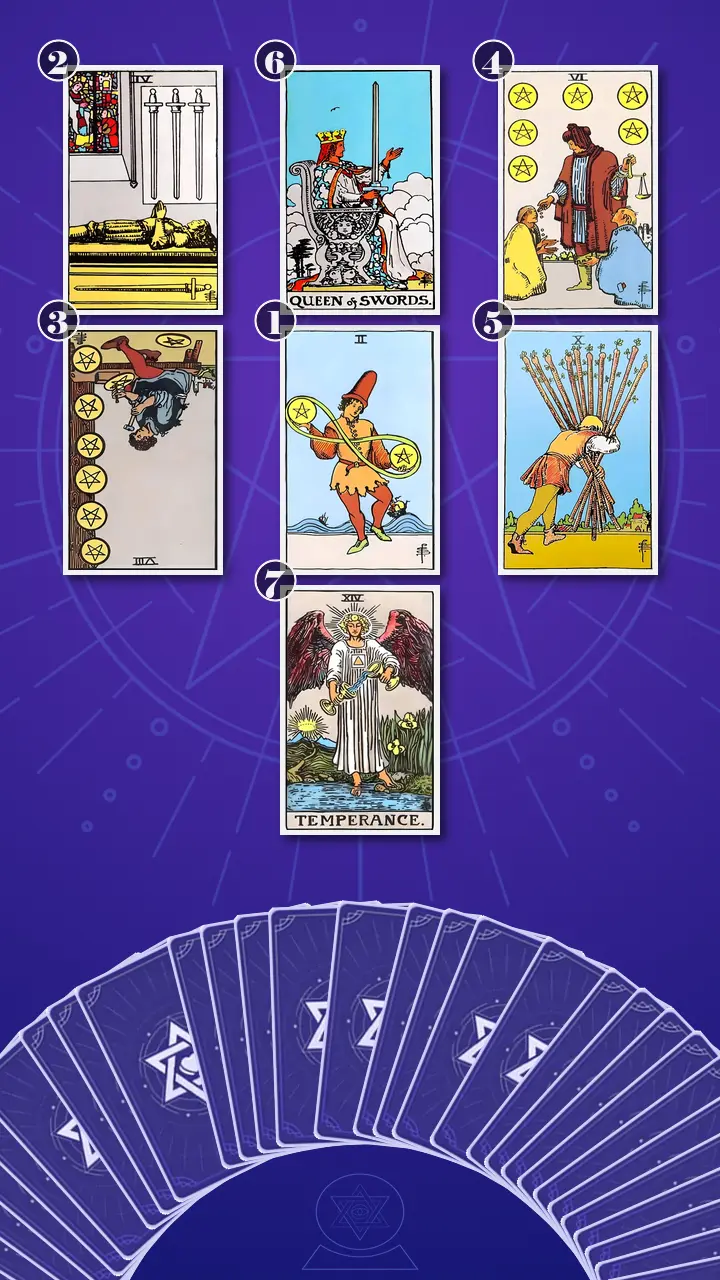
Reading the Map: Time, Money, and the Weight You Don’t See
Position 1 — The current reality: what Jordan is truly juggling
“Now flipped over,” I said, “is the card that represents the current reality: what you’re truly juggling and why this feels urgent.”
Two of Pentacles, upright.
It was almost too on-the-nose: the juggler, the infinity-loop ribbon, the waves behind him like a background app that never stops running.
And I used the life translation that fit her exactly: Jordan on her laptop after dinner, flipping between Slack, a packed calendar, and a salary range spreadsheet—juggling two currencies (time and money) while pretending it’s fine.
“This card is capacity management,” I told her. “Not in the cute ‘look how productive I am’ way. In the real-time, ‘I’m micro-adjusting my life around work every day’ way.”
In energy terms, the Two of Pentacles upright is balance under motion—but it can also be excess: too much adaptive juggling, not enough stable structure. You can keep it going, but only by constantly recalibrating.
Jordan let out a small, bitter laugh. “That’s… accurate. Like, a little too accurate. Almost rude.”
“I’ll take ‘rude’ over ‘vague,’” I said gently. “Because rude accuracy means we can work with it.”
Position 2 — Flex time (Benefit): what flex time would support
“Now we’re looking at Flex time (Benefit): what flexibility would actively support in your life and work.”
Four of Swords, upright.
“This is the card people misunderstand,” I said. “It’s not ‘checking out.’ It’s protected recovery and focus—the space where thinking happens.”
In modern life terms, the Four of Swords looked like two no-meeting mornings with notifications off, where her deliverables get done in fewer stressed-out fragments.
“Flex time isn’t ‘less work’—it’s fewer context switches so your output stays steady,” I said, using the phrase with intention. “Your best argument for flexibility is performance stability.”
Energetically, this is balance—a nervous system that can reset, a mind that can actually do deep work instead of constant reactive tasks.
Jordan’s eyes softened, like she was picturing a week that didn’t feel like a sprint inside a maze.
Position 3 — Flex time (Cost): the hidden trade-off that could sabotage it
“Now flipped over,” I said, “is Flex time (Cost): the hidden trade-off, fear, or requirement you’d need to address for flexibility to actually work.”
Eight of Pentacles, reversed.
I watched her blink—once, slow—and then her jaw tightened, like her body already knew the answer before her mind caught up.
“Here’s the close-up scene,” I said, leaning into the analogy I knew would land. “You’re rewriting the same Slack message three times while your laptop fan spins and your tea goes cold. And the thought underneath it is: ‘If they can’t see me online, they have to see perfection.’”
I let the contrast sit between us: visibility vs value. Being available vs being effective.
“If you need flawless to feel safe, you’ll turn any perk into overtime,” I said. “Eight of Pentacles reversed is the craft trap. Not lack of skill—misdirected effort. Over-polishing. Over-replying. Proving instead of delivering.”
Energetically, this reversal is blockage: your standards becoming a hedge against judgment, and that hedge quietly eating your time.
Jordan’s shoulders dropped in a way you can’t fake. She made a sound that was half laugh, half exhale. “Oh. I do that. I 100% do that. If I’m not online at 9, I’m like… ‘fine, then this deck needs to be perfect.’”
“Exactly,” I said. “And that’s why we’re going to build measurable terms. Not vibes.”
Position 4 — Raise (Benefit): what a raise would truly provide
“Now we move to Raise (Benefit): what money would truly give you beyond the number.”
Six of Pentacles, upright.
The scales in the card always make me think of fairness as a structure, not a feeling. It’s one of those places where my research brain and my occult brain shake hands.
In Jordan’s modern life scenario, this was her showing up with calm receipts: expanded responsibilities, measurable outcomes, a clear scope story. Not pleading. Not apologizing.
“This card is reciprocity,” I said. “A raise here isn’t ‘please like me.’ It’s alignment: what you’ve been giving vs what you’re receiving.”
Energetically, the Six of Pentacles upright is balance—fair exchange, recognition, stability. It says: yes, your contribution is real. It deserves a real response.
Jordan nodded slowly. “That’s the part that makes me feel… less embarrassed. Like, I’m not making it up.”
Position 5 — Raise (Cost): the hidden workload tax
“Now flipped over,” I said, “is Raise (Cost): what could increase unless you negotiate it clearly.”
Ten of Wands, upright.
“I want you to picture a tiny workplace micro-drama,” I said. “You get the raise. Maybe you even celebrate for ten minutes. Then suddenly you’re the default for ‘quick questions’ and last-minute escalations. Your calendar becomes Tetris you never win.”
Jordan didn’t laugh this time. She just gave me a look that said: yes, that.
“A raise without workload terms is just a heavier backpack with a nicer label,” I said. “This card doesn’t say ‘don’t ask for money.’ It says: don’t let the number come with invisible scope creep.”
Energetically, the Ten of Wands is excess—too much weight, too little boundary. It’s success that blocks your view of your own life.
Position 6 — Negotiation strategy: the stance that keeps you clear
“Now we flip the lens card,” I said. “This is Negotiation strategy: the communication stance that keeps you clear, confident, and specific.”
Queen of Swords, upright.
Immediately I saw it: the sword raised like a clean line, the open hand like an invitation to be reasonable. Not cold. Just precise.
In Jordan’s modern translation, the Queen of Swords is her walking into the follow-up with a short script and calm tone—proposing terms, not pitching herself.
I told her, “Don’t choose a vibe. Choose terms.”
Energetically, this card is balance in Air: enough detachment to be factual, enough courage to be direct. It’s the opposite of approval-seeking spirals.
“You’re going to want to add ten caveats,” I warned her, gently. “Because you’ve learned that over-explaining feels safer. But the Queen’s leverage is clean structure.”
I imagined a sticky note beside her trackpad, like a small blade of clarity in a chaotic kitchen: a two-sentence script. One sentence for the ask. One for the performance rationale. Then a concrete next step.
Jordan swallowed. “That sounds… almost too blunt.”
“Blunt isn’t the goal,” I said. “Clear is. And clear is kind—because it gives the other person something real to respond to.”
When Temperance Poured Between Two Cups
Position 7 — Integration: what a real win looks like
“We’re turning over the most important card now,” I said. Even through a screen, I felt the room quiet a little—like the moment in the planetarium when the lights go down and everyone instinctively stops moving.
Temperance, upright.
Jordan stared at it. I watched her eyes flick from the two cups to the steady pour between them, like she was seeing a third option appear in real time.
Setup: She was caught in that familiar hour—salary band tab open, calendar grid glaring back, half-written email—switching between them until it felt too late to send anything. In her mind, this negotiation had become a high-stakes test: pick the single perfect ask, or prove you’re not strategic.
Delivery:
Not ‘either time or money’—mix your needs like Temperance pouring between two cups, with terms you can actually live with.
I let it hang. No extra explanation. Just air.
Reinforcement: Jordan’s body did a three-step reaction chain I’ve seen in a hundred different forms, in a hundred different cities. First: a brief freeze—her breath paused and her hands went still on the counter. Second: cognitive seep—her gaze unfocused, like her mind replayed every late-night draft and every “just one more task to earn it.” Third: the release—she exhaled, and her shoulders dropped like she’d been holding an invisible bag for months.
But relief wasn’t the only thing on her face. There was a flash of irritation too, sharp and human. “But if it’s not either/or,” she said, voice tighter, “doesn’t that mean I’ve been wasting time? Like I’ve been… wrong?”
I kept my tone steady. “No. It means your nervous system has been doing its job: avoiding a choice that felt like it could cost you safety. That’s not ‘wrong.’ That’s protection.”
Then I brought in the framework that’s become my signature—what I call Orbital Resonance. At the planetarium, I explain to teenagers why some moons stay locked in stable patterns while others get tugged into chaos. In workplace terms, it’s the same question: where are you in sync with the system, and where are you fighting invisible gravity?
“Right now,” I said, “your workplace is sending mixed signals: they value your output, but the culture rewards visible availability. That mismatch creates ‘noise’—and you compensate by overworking, over-polishing, and staying online.”
“Temperance isn’t telling you to be patient and hope. It’s telling you to design resonance: a package where your manager can say yes because it protects performance metrics and protects your bandwidth. That’s the integration.”
I asked her the question I always ask when Temperance hits: “Now, with this new frame—terms instead of vibes—can you think of a moment last week when this would’ve changed how you felt?”
Jordan looked down and then laughed softly, almost embarrassed. “Tuesday night. Literally Tuesday night. I was rewriting ‘Would love to explore’ into ‘Wanted to ask’ into ‘I was hoping…’ for an hour.”
“That’s the shift,” I said. “From pressure-fueled analysis paralysis and approval-seeking to calm, terms-based self-advocacy and measurable confidence. Not because you become fearless—but because the ask becomes testable.”
From Insight to Action: The 60–90 Day Terms Trial
I pulled the spread together for her in plain language: the Two of Pentacles showed the real strain—juggling time and money like two currencies while pretending it’s sustainable. The Four of Swords showed what flexibility would truly buy: fewer context switches and recovery that stabilizes performance. The Eight of Pentacles reversed named the sabotage risk: perfection theater and visibility anxiety turning flex into hidden overtime. The Six of Pentacles validated the raise as fair exchange. The Ten of Wands warned that money without workload terms becomes scope creep. And the Queen of Swords gave the method: clean language, clean request, clean next step.
“Your blind spot,” I said, “is thinking you need a single perfect ask. That frame keeps you stuck, because it turns negotiation into a referendum on your worth.”
“Your direction is different: a clear, testable package—terms plus timeline—so your work and your life stop competing for oxygen.”
Then I offered her the smallest possible set of next steps—practical, not performative. (This is the part readers usually want when they’re googling raise vs flexibility decision framework after performance review or how to stop overthinking a negotiation email.)
- Draft the “60–90 Day Terms Trial”Open Notes. Set a 7-minute timer. Write one flex structure (e.g., two no-meeting mornings) + one deliverable with a deadline + one check-in date (60–90 days). Keep it collaborative: “Let’s test this and review outcomes.”When the timer ends, stop. Save it as Draft v1. If you start rewriting for tone, step away—no sending required today.
- Use the Two-Sentence Ask (Queen of Swords style)Write your follow-up email as: Sentence 1 = your request (raise and/or flex). Sentence 2 = how it supports performance (focus, delivery, stability). End with one concrete next step: “Could we decide by [date]?” or “What would you need to see to approve this trial?”You can always add detail if asked. Don’t negotiate against yourself in the first message.
- Add one workload term to any raise conversationChoose one boundary that prevents the Ten of Wands outcome: e.g., “No expectation of replies after 6:30 PM unless it’s a true escalation,” or “We’ll revisit priorities monthly so scope doesn’t quietly expand.”If it feels awkward, treat it like project scope: you’re clarifying constraints so delivery stays strong.
Before we ended, I gave her one more tool from my own strategy kit—something I teach nervous tour groups before the lights go down and the stars appear: an Earth-rotation perspective.
“Tomorrow morning before your first meeting,” I said, “take ten seconds and imagine Toronto rotating into daylight. Everything feels urgent at 9:00 a.m., but the world is literally moving under you. Let that remind you: your job isn’t your entire sky. It’s one planet in it.”

A Week Later: Relief You Can Measure
Six days later, Jordan emailed me—not a novel, just a screenshot. Two sentences. Clean. A proposed 90-day trial with two no-meeting mornings and a check-in date. And one line at the end: “Could we decide by next Friday, or let me know what you’d need to see to approve this?”
She added: “I didn’t spiral. I hit send before I could open r/PersonalFinanceCanada. I felt shaky for five minutes. Then… weirdly calm.”
Clear but not invincible: she told me she slept through the night for the first time in weeks, then woke up and immediately thought, “What if I messed this up?”—and still, she made coffee without checking Slack in bed. That was the proof.
For me, that’s the real Journey to Clarity: not certainty, but ownership. A shift from rehearsing to proposing. From trying to be liked to asking for what you can measure.
When you’re forced to pick between time and money, it can feel like your value only counts if you’re constantly available—so you stall, not because you’re indecisive, but because the stakes feel personal.
If you let this be a 60–90 day experiment instead of a forever decision, what’s the smallest set of terms you’d want to try—so your work stays strong and your week finally feels breathable?