From Grade-Text Dread to Self-Trust: A Student’s Shift to Boundaries

The 11:08 p.m. Portal Refresh (and the Text That Makes You 15 Again)
If you’re a Toronto uni student who can be totally fine until a parent texts “Send me your marks,” and suddenly your throat tightens like you’re 15 again—yeah, I know exactly what kind of grade pressure that is.
Taylor (name changed for privacy) slid into the chair across from my tiny café table like they were trying not to take up space. They were twenty, second year, juggling a full course load and a part-time job, and their phone stayed face-up—bright screen, low-level menace—like it might buzz at any second.
They described Tuesday night at 11:08 PM in their rental bedroom: laptop fan humming, the student portal tab already open, blue light washing everything colder than it was. Their thumb kept hitting refresh even though the grade wasn’t going to change. The phone was warm in their palm, like it had its own heartbeat.
“It’s not the grade,” they said, voice flat like they’d practiced sounding fine. “It’s the text.”
What I saw wasn’t “stress.” It was a body reacting like an alarm had gone off: a throat that clamps, a stomach that hardens into a fist, and a restless urge to fix it right now—as if a perfect reply could prevent disappointment from landing. Taylor wanted to be trusted like an adult, but the second that message appeared, they braced to be evaluated as a person.
I leaned in, keeping my voice simple and warm. “We’re not here to shame the spiral. We’re here to understand what old pressure it’s running on—and to leave with one next step that makes your nervous system feel less ambushed.”
On our table, the smell of espresso and toasted pastry was almost unfairly comforting. I’ve owned this Italian café long enough to know: comfort isn’t the same as avoidance. Sometimes it’s what lets you stay in the room long enough to tell the truth. “Let’s draw you a map,” I said. “A real one. A finding clarity map.”

Choosing the Compass: The Four-Layer Insight Ladder Spread
I asked Taylor to take one slow breath—not to “calm down,” but to shift gears. The way you pause before you sip a coffee that’s almost too hot. I shuffled while the espresso machine sighed behind the bar, and the street outside did its usual Toronto thing: a passing streetcar bell, a gust of cold, someone laughing too loudly on their way home.
“Today,” I told them, “we’ll use a spread I like for this exact kind of trigger: Four-Layer Insight Ladder · Context Edition.”
For you reading: the reason I choose this spread for grade-text anxiety is that the question isn’t really predictive. It’s diagnostic and practical: Why does this one text hijack me—and what do I do next? This 2x3 grid maps the whole inner system from symptom to root to solution. Top row: the pressure. Bottom row: the practice.
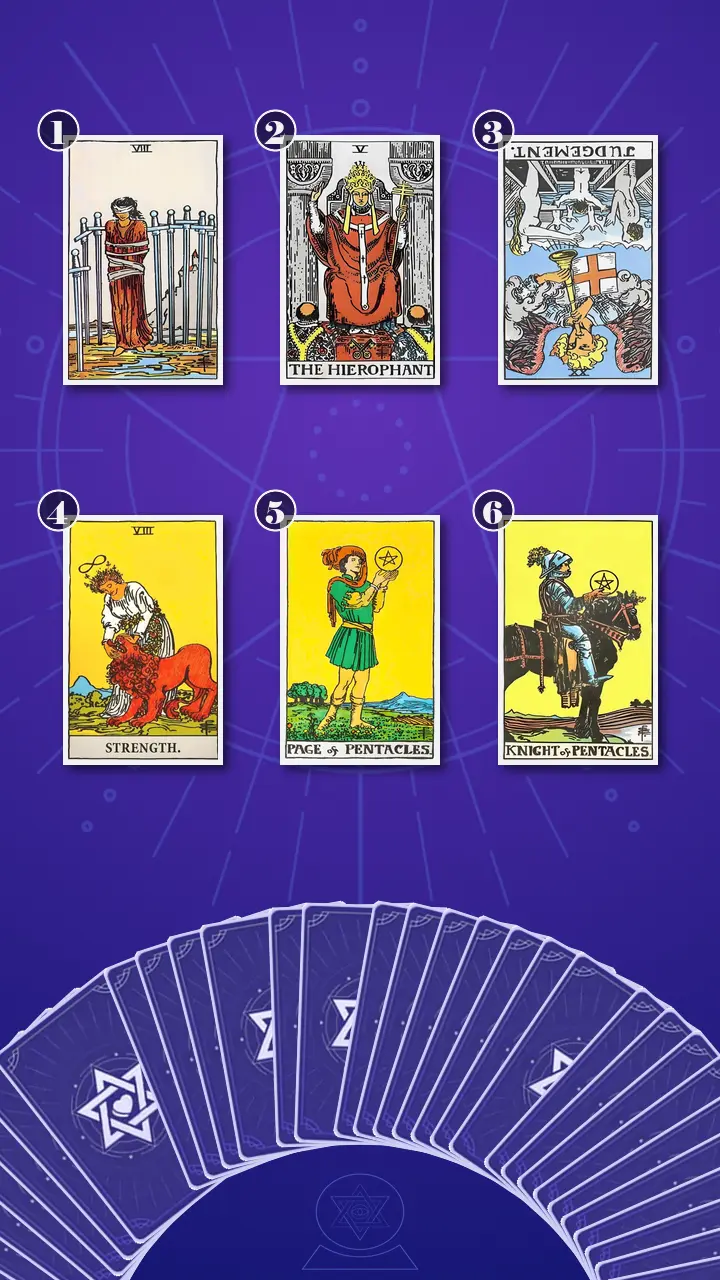
I explained the layout as I placed the cards: positions 1–3 across the top (surface reaction → inherited script → inner judgement), then positions 4–6 across the bottom (resource → key shift → grounded next step). “We’ll read across the top like we’re diagnosing the system,” I said, “then drop down like we’re stepping out of a courtroom and into a workshop.”
Reading the Map: How Tarot Works When a Text Feels Like a Trial
Position 1 — Surface reaction: what happens in the first 3 minutes
“Now we turn over the card that represents your surface reaction—what you do and feel the moment the grade-text hits.”
Eight of Swords, upright.
I pointed to the blindfold and the loose bindings. “This is the moment you described: you’re at your desk at night with the student portal open and your phone face-up. A parent text about grades lands, and you immediately feel trapped—refresh, stare, draft. Like there’s one perfect phrasing that can keep you safe.”
In my language, this is blocked Air energy: thoughts moving so fast they turn into a cage. The Eight of Swords isn’t saying you are powerless. It’s saying your nervous system believes there’s only one safe option, so you freeze and overthink instead of choosing.
Taylor let out a small laugh that tasted like burnt coffee—bitter, too hot, too real. “That’s… kind of brutal,” they said. “Like, yeah. I literally write the reply in Notes like it’s a press release.”
“I’m not here to be brutal,” I said. “I’m here to be accurate. And accuracy is kind. Because if the trap is made of rules, we can change the rules.”
Position 2 — Inherited script: the rulebook you didn’t choose
“Now we turn over the card that represents the inherited script—the old authority that gets activated by grade questions.”
The Hierophant, upright.
“This is the ‘standards check’ feeling,” I told them. “A grade question doesn’t land like curiosity; it lands like an audit.”
And I could see it in their face: the tiny tightening around the eyes, like they were watching a childhood montage they didn’t ask to stream. In the Hierophant, the crossed keys are everything. “In your head,” I said, “who holds the keys to ‘good enough’?”
Taylor’s shoulders rose a fraction. “It’s… my parents’ voice, but also not. Like, it’s the whole vibe. ‘Be practical.’ ‘Don’t waste tuition.’ ‘We’re doing this for your future.’ And then my friends will casually say they got a return offer like it’s weather.”
I nodded. “This is where we name the system without villainizing anyone. Being cared for and being monitored can feel identical in a one-line text.”
Position 3 — Core fear and inner verdict: the internal court
“Now we turn over the card that represents the core fear and inner verdict—what you think the grade proves about you.”
Judgement, reversed.
I exhaled slowly. “Okay. This is the inner tribunal.”
Judgement reversed is that moment when feedback becomes condemnation. The notification doesn’t just inform you; it summons you. “You see the grade and your brain instantly turns it into a story about your value,” I said. “And then you draft a long reply like a courtroom defense, trying to prove you’re still worthy—then freeze because nothing can guarantee you won’t be judged.”
In energy terms, this is Fire turned inward: instead of courage, it becomes self-attack. Accountability gets mistaken for punishment. Learning gets mistaken for a verdict.
I leaned into the echo the card asked for. “If your phone screen is the witness stand, your Notes app becomes your closing argument,” I said. “Your inner monologue goes: ‘If they read it this way, then…’ → ‘So I need to…’ → ‘Unless I…’ And it never ends, because you’re trying to become un-judgeable.”
Taylor stopped fidgeting. Their eyes unfocused for a second like they’d just replayed the last twenty texts with their parents, frame by frame. Then they swallowed. “Yeah,” they said quietly. “It’s like… if I can explain it perfectly, maybe I can stop the disappointment from landing.”
For a split second, my mind flashed to something I learned long before tarot: in a café, a bad brew doesn’t mean you’re a bad barista—it means something in the process needs adjusting. Grind size. Water temperature. Timing. In other words: data.
Position 4 — Usable inner resource: the hand on the lion
“Now we turn over the card that represents your usable inner resource—what helps you respond from choice, not reactivity.”
Strength, upright.
I softened my voice. “Strength is not white-knuckle productivity. It’s regulated courage.”
I guided Taylor through it in real time, second-person on purpose because the body listens differently when you speak to it directly: “Feet on the floor. Let your jaw unclench like you’re letting go of a bite that’s too chewy. One slow inhale, longer exhale. You don’t have to feel confident. You just have to be present long enough to choose.”
Their shoulders dropped a millimeter. That tiny exhale—the first moment of loosening—was the whole point. Because when Strength is online, the Eight of Swords doesn’t get to run the show.
When the Page of Pentacles Turned the Trial into Training
Position 5 — Key shift: the mindset reframe that changes everything
“We’re flipping the card that represents the key shift—the reframe that turns pressure into a learning path.”
Page of Pentacles, upright.
The room felt a little quieter, like even the café noticed we’d hit the heart of it. The Page held that single pentacle with full attention—one tangible thing, not a thousand spiraling scenarios.
Setup: Taylor was still stuck in the familiar loop: laptop open to the portal at 10:41 PM, parent’s text unread, stomach clenched like they were on trial. The thought behind the thought was always: If I can just explain it perfectly, I can keep the disappointment from landing.
You’re not on trial for your performance; you’re in training, and the Page’s pentacle is a lesson you can hold and work with.
Reinforcement: Taylor’s reaction came in layers. First, a physical freeze—breath held, fingers hovering above their phone like it weighed more than it did. Then, the cognitive shift—eyes flicking down to the card, then away, as if their brain was trying to refile the whole situation under a new folder. Then the emotion: a sudden blink-hard, the tiniest shine at the edge of the eyes, and a breath that finally made it all the way to the bottom of their lungs.
“But—” they said, and there it was: the resistance, sharp and honest. “If it’s not a verdict… does that mean I’ve been doing it wrong this whole time?”
“No,” I said immediately. “It means you’ve been surviving inside an old system.”
I pulled in my café brain—my Knowledge Filtration lens—because this is where people either spiral again or finally get traction. “A coffee filter doesn’t judge the grounds,” I told them. “It separates what you can use from what you can’t. Feedback is the same. Your brain has been drinking everything—facts, fear, imagined disappointment—like it’s one bitter shot.”
“So here’s your Page of Pentacles move,” I continued. “We filter. We hold one usable piece.”
I invited them into the 10-minute reset, slow and non-dramatic: “Phone face-down. Two columns: Facts and Story. Under Facts: the grade and one sentence from the rubric. Under Story: the harsh label your mind jumps to—‘I’m disappointing,’ ‘I’m failing at adulthood.’ Then circle one fact you can act on this week. If your throat tightens, you pause. This is an experiment, not a test you have to pass.”
Then I asked the question that makes it real: “Now—with this new lens—think back to last week. Was there a moment when that text hit, and if you’d treated the grade as data instead of identity, you would’ve felt even five percent different?”
Taylor stared at the table for a beat, then nodded once. “Yeah. I would’ve replied. Like… a normal person.” They gave a small, stunned laugh. “I would’ve just said the grade and asked my prof what a better answer looks like.”
That’s the emotional transformation in motion: from shame-tinged anxiety and freeze-response spiraling to calm clarity, self-trust, and grounded follow-through. Not as a personality makeover—just as one clean pivot from “defend” to “learn.”
Position 6 — Next step: boring consistency that builds trust
“Now we turn over the card that represents your next step—one grounded, repeatable action that makes future texts less high-stakes.”
Knight of Pentacles, upright.
“This is my favorite kind of magic,” I said. “The kind that looks like a calendar reminder.”
Knight of Pentacles is Earth energy—steady, not flashy. It doesn’t do panic productivity. It does routines that keep promises. “Boring consistency beats panic productivity,” I told Taylor. “Not because you’re lazy. Because your nervous system needs predictability more than it needs another late-night sprint.”
I described it the way they’d actually live it: a Google Calendar view with two 45-minute study blocks, a recurring Sunday check-in time, a two-sentence reply draft saved as a template. The portal logged out so refreshing takes just enough effort to break autopilot.
The One-Page Plan: Facts in One Sentence. Boundaries in One Sentence.
I stitched the whole spread into one story for them—simple, coherent, usable. “Here’s why it feels so intense,” I said. “Eight of Swords is the freeze: your mind insists there’s one safe way to answer. The Hierophant is the inherited rulebook: grades as morality, approval as a key you have to earn. Judgement reversed is the inner court: a number becomes a verdict on your worth. Strength is your pause button—regulation as the real flex. The Page of Pentacles is the pivot: trial mode to training mode. And the Knight of Pentacles is the method: consistency and a predictable boundary so the conversation stops ambushing you.”
The cognitive blind spot was clear: Taylor kept treating a relationship check-in like a performance review, and kept confusing being accountable with being condemned. The transformation direction was equally clear: from earning safety through performance to self-led learning and calm boundaries about when and how grades get discussed.
Then I gave them actionable advice—the kind you can do even when your stomach is clenched.
- The 30-Second Strength PauseBefore you open Canvas/Quercus or start typing, plant both feet on the floor, soften your jaw, and take one slow inhale + a longer exhale. Then decide: portal first, or reply first—on purpose, not on autopilot.If your brain calls this “lazy,” label it: “old script.” Thirty seconds counts. If you feel flooded, stop at the body reset and reply later.
- The Two-Sentence Grade Reply TemplateSave a draft in Notes that you can paste into texts: Sentence 1 is the factual update (grade + one neutral detail). Sentence 2 sets timing: “I’ll update you Sundays after I’ve reviewed feedback.”Repeat this mantra while you type: Facts in one sentence. Boundaries in one sentence. Short is not rude; it’s regulated.
- The Page of Pentacles “One Skill” BlockFor the next 14 days, choose ONE learning goal (one concept, one method) and book one office-hours question: “Can you show me what a B answer vs an A answer looks like on this rubric?” Put it in your calendar like a shift.Make it realistic. If you’re working late, use my Focus Period Diagnosis: schedule your hardest studying for when caffeine helps you focus without spiking anxiety—often mid-morning or early afternoon, not midnight.

A Week Later: The Quiet Proof of Self-Trust
A week later, between my morning cappuccino rush and a lull that smelled like fresh-ground beans, I got a message from Taylor.
“They texted,” they wrote. “I did the pause. Didn’t open the portal first. Sent the two sentences. No essay. No Notes-app courtroom.”
They added, “I still felt shaky after. But I didn’t doomscroll. I logged out. And I booked office hours.”
It wasn’t a fairytale ending. It was the kind of progress that actually holds. Clear, but a little vulnerable: they slept a full night, but the next morning their first thought was still, What if I messed it up? Then, apparently, they laughed—small—and made coffee anyway.
That’s the journey to clarity I trust: not certainty, but ownership. Not “I’ll never feel triggered again,” but “I know what to do when I am.”
When a simple “How were your grades?” text hits like a throat-tightening alarm, it’s rarely about the number—it’s about the old fear that one result could change how safe you are in someone’s eyes.
If grades were allowed to be information for the next tiny adjustment—not a verdict—what would you try this week that you wouldn’t need to justify to anyone?