Two Offer Emails, Two Draft Replies—How I Picked a Learning Container

Finding Clarity in the 9:46 p.m. Offer-Email Loop
Jordan said it the second we got on Zoom: “You’ve got two job offers in your inbox, and you keep re-reading the salary and benefits lines like they’ll suddenly reveal the hidden ‘right answer.’”
They were half-joking, but their voice had that thin edge you get when you’ve been holding your breath for days. Behind them: a Toronto condo living room that looked too tidy for how little they’d slept. The glow from their laptop washed their face a cool blue. Through a cracked window, I could faintly hear the streetcar bell and the wet hush of traffic. Their phone kept lighting up on the coffee table—LinkedIn notifications, little sparks of other people’s certainty.
“It’s like I’m doing due diligence,” they added, dragging the PDF highlighter over “flexible hours” in one offer and “professional development” in the other. “But it never turns into… an actual reply.”
I watched their knee bounce under the edge of the couch cushion. Each time they toggled between tabs, their shoulders lifted a millimeter higher, like their body expected impact. The uncertainty wasn’t abstract; it sat in their chest like a tight seatbelt that wouldn’t click into place—restless energy, no full exhale.
“We can work with that,” I said, keeping my voice steady. “This isn’t about forcing a perfect answer. It’s about finding clarity—enough clarity to take one clean next step without spiraling into decision fatigue.”

Choosing the Compass: The Decision Cross Tarot Spread
I asked Jordan to place both offer emails out of reach for one minute—not as a dramatic ritual, just a nervous-system reset. “One hand on your sternum,” I said. “One slow inhale. Let’s give your brain a pause from proving.”
While they breathed, I shuffled. The sound of the cards is soft and ordinary—paper on paper—yet it creates a boundary between the loop and the conversation. A psychological doorway.
“Today, we’ll use a spread called the Decision Cross,” I explained. “It’s built for exactly this: two viable paths—remote autonomy versus a mentorship-heavy office—and the stuckness that happens when both look good on paper.”
To the reader: this is why the Decision Cross works so well for a career crossroads. The left and right cards make a side-by-side comparison that cuts through ‘optics’ and vague vibes. But it also includes a hidden driver—what’s actually steering the freeze—and an integration card that turns the question from prediction into design. In other words: it shows you how tarot works in context—less “what will happen,” more “what pattern are you in, and what would change it?”
“We’ll read it like a compass,” I told Jordan. “Center is what you’re juggling. Left is the remote offer’s lived texture. Right is the office offer’s lived texture. Above is the hidden driver. Below is guidance—your next step toward finding clarity and momentum.”
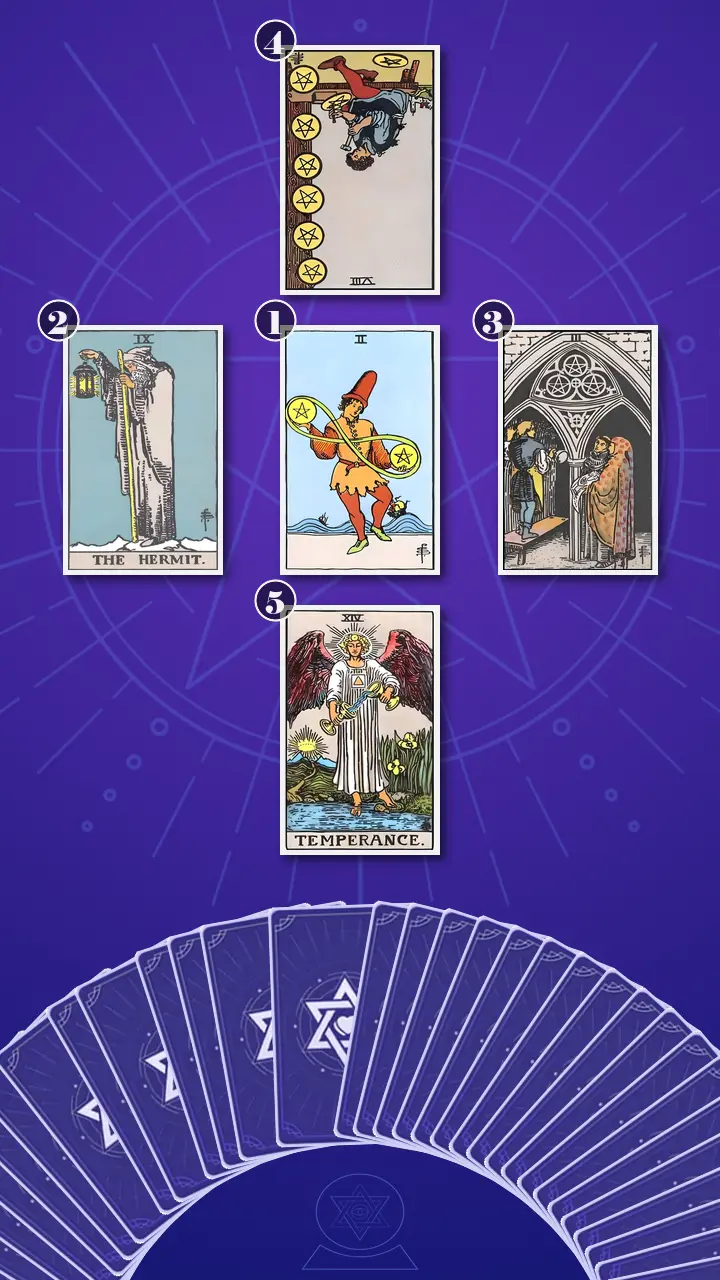
Reading the Map: Remote Autonomy vs Mentorship-Heavy Office
Position 1: The current decision pressure (what you’re juggling)
“Now we’re looking at the card that represents the current decision pressure and how it shows up behaviorally—what you’re juggling right now.”
Two of Pentacles, upright.
I didn’t even have to reach for metaphor; Jordan’s life had already drawn the card. “This is you with two offer emails like open tabs you refuse to close,” I said. “A spreadsheet, a Notion page called something like ‘Decision Matrix v4,’ two acceptance drafts saved but not sent. You keep tweaking criteria—salary, title, growth, flexibility—and calling it careful.”
“Indecision can feel like flexibility—until it starts charging interest,” I added, letting the words land.
Jordan gave a small laugh that surprised them. It wasn’t joyful. It was the kind of laugh that says, Yeah. That’s me. And I hate that it’s me. “That’s… brutal,” they said. “Accurate, but brutal.”
“It’s not a character flaw,” I said. “It’s an avoidance strategy that looks like productivity. The infinity loop on the card is what happens when your mind tries to keep both futures alive to avoid the discomfort of choosing. Meanwhile, the waves keep rocking you—sleep, focus, even downtime.”
Energy-wise, this is Earth energy in motion: practical, capable, but spinning. Not broken—just over-tasked.
Position 2: Remote offer texture (autonomy, focus, self-direction)
“Now we’re looking at the card for the remote offer—its lived experience and growth style.”
The Hermit, upright.
“This card gets romanticized,” I said, “but I’m going to translate it into your calendar.” I tapped the table lightly with a knuckle. “Remote looks like quiet power: headphones on, deep work blocks, fewer interruptions. A day that feels like it belongs to you.”
Then I pointed to the lantern in the image. “But it also means you can’t wait for mentorship to happen accidentally. If you choose this, your growth depends on you building the lantern—setting recurring feedback, finding a peer circle, documenting goals—so autonomy doesn’t turn into isolation.”
Jordan’s eyes narrowed slightly, not in disagreement—more like they were seeing the real cost. “I love the idea of uninterrupted work,” they said. “But I’ve been under-supported before. That’s the part that makes my stomach drop.”
“That’s the honest read,” I replied. “The Hermit is a seeker, not a lone wolf. It’s self-directed growth with structure. The lantern isn’t ‘vibes.’ It’s a scheduled system.”
Position 3: Mentorship-heavy office texture (feedback, apprenticeship, visibility)
“Now we’re looking at the card that represents the mentorship-heavy office offer—its lived experience, and the kind of growth container it creates.”
Three of Pentacles, upright.
“This is the workshop,” I said, and my voice softened because I’ve seen what this card does for early-career people when the mentorship is real. “Standards are visible. You show your work-in-progress, you get clean notes, and you learn faster because you’re not guessing in private.”
I made it modern on purpose. “Think: code review. Design critique. PR feedback. An onboarding buddy who doesn’t just say ‘welcome!’ but says, ‘Here’s how we actually do things.’ In-office makes that proximity easier.”
Jordan’s posture changed—tiny, but real. Their shoulders eased down as if their body recognized the relief of not having to invent the standard alone. Then their mouth tightened again, like a second thought arrived.
“The vulnerability is part of it,” I said, naming what they weren’t saying. “Being coached is being seen, not being judged. But if you’ve got visibility anxiety—if you equate ‘seen’ with ‘evaluated as a person’—this option can feel like growth and pressure at the same time.”
Jordan nodded once. “It’s exactly that. I picture the office and I get excited. Then I picture the kitchen small talk and the ‘quick question’ interruptions and I feel… watched.”
“That tension matters,” I said. “It doesn’t make the office wrong. It tells us what boundaries you’d need to make it sustainable.”
Position 4: The hidden driver (what’s quietly steering the choice and keeping you stuck)
“Now we’re looking at the card for the hidden driver—the fear or learning-pattern quietly steering this choice.”
Eight of Pentacles, reversed.
This card always makes the room feel a little more honest. Like the air gets less flattering.
“Here’s the snag,” I said. “The hidden snag isn’t remote vs office—it’s that part of you wants the next job to hand you the feeling of mastery.”
“So you over-polish,” I continued, speaking in scenes Jordan had already lived: “You rewrite drafts, reopen comp calculators, dive into Glassdoor and Reddit threads at 1 a.m. You polish an acceptance email without sending it, because sending creates reality. Your jaw clenches. Your chest tightens. Your thumb keeps scrolling like it’s trying to find a safety latch.”
Jordan stared at the card as if it had said their browser history out loud.
“The real blocker isn’t remote vs office,” I said, keeping it gentle but direct. “It’s your relationship with being a beginner. You want the confidence of expertise without the discomfort of apprenticeship—without being corrected, without not knowing yet.”
They reacted in a three-beat sequence that I’ve come to trust as truth. First: a freeze—breath held, fingers hovering over their trackpad like they forgot what they were doing. Second: their gaze unfocused, like a memory rewound itself—late nights, drafts, the ‘just one more data point’ bargaining. Third: a quiet release, almost a whisper. “Oh,” they said. “That’s… me.”
“And it’s fixable,” I said. “Because this isn’t about picking the offer that guarantees you’ll never feel new. That offer doesn’t exist. This is about choosing a learning environment you can sustain long enough to actually become strong.”
For a second, I flashed back to my trading-floor years—how people tried to trade away uncertainty with more screens, more indicators, more hot takes. The market never rewarded that. Structure did. Risk limits did. A system did. I left Wall Street, but I didn’t leave that lesson.
When Temperance Spoke: Building a Learning Container Instead of a Perfect Future
Position 5: Integration and next step (how to decide and structure sustainable growth)
“Now we’re turning over the card that represents integration and next step—how you make a self-trusting decision and structure the chosen path for sustainable growth.”
Temperance, upright.
The moment Temperance hit the table, the whole spread stopped feeling like an argument and started feeling like a plan. Even over video, I could see it: Jordan’s eyes stopped darting between hypotheticals.
“Temperance is the ‘both/and’ card,” I said. “Not remote or mentorship. It’s you designing a blend: structure and autonomy. Feedback cadence and protected deep work. One foot on land, one foot in water.”
And then I slowed down. “Before we go further,” I said, “I want to name what’s been happening.”
Setup: Jordan had been on their couch after dinner, laptop open to two offer PDFs, highlighting the same lines again—flexibility, title, growth—like the right sentence would finally unlock the correct choice. They’d been trying to make the decision erase the beginner phase, to make one offer prove they’d be okay.
Delivery:
Not an all-or-nothing bet—build your blend, like Temperance pouring between two cups.
I let a beat of silence hang. Even the street noise through their window felt quieter, like the city agreed to wait.
Reinforcement: Jordan’s face did a sequence I’ve learned to recognize as the mind shifting gears. First, their eyebrows lifted and their mouth opened slightly—caught off guard, as if they’d expected tarot to pick a winner and instead it handed them a steering wheel. Then their shoulders dropped on a long exhale, the kind you don’t realize you’ve been withholding. Their hands, which had been clasped tight near their chin, loosened and fell into their lap. And then—this part mattered—their expression flickered with something like irritation.
“But… if it’s a blend,” they said, voice sharper for a second, “doesn’t that mean I’ve been doing all this wrong? All the research, all the trying to calculate it?”
I nodded. “That reaction is real. And no—you weren’t wrong. You were trying to regulate anxiety with proof. That’s a normal strategy. It just has diminishing returns.”
“Temperance is saying: a job can’t guarantee your growth,” I continued, letting the logic be clean. “What you can guarantee is the system you’ll build inside the job: feedback rhythm, practice cadence, and boundaries that keep you learning without burning out.”
I leaned into my own lens—this is where my background always clicks into tarot instead of fighting it. “In my work, I use something I call Transition Roadmapping,” I said. “Think of a career change like preparing a company for an IPO. You don’t ask, ‘Will Wall Street love us forever?’ You build a stable operating rhythm: reporting cadence, governance, sustainable growth metrics. Temperance is your IPO prep cycle. Your ‘prospectus’ isn’t your LinkedIn headline—it’s your weekly system.”
Jordan blinked, then nodded slowly. Their eyes were a little wet, not in a dramatic way—more like their nervous system had finally been allowed to stop performing certainty.
“Now,” I said softly, “use this new lens and look back at last week. Was there a moment where you caught yourself thinking, ‘I need the job to calm my anxiety,’ instead of ‘I can build a calm system inside whichever job’?”
Jordan didn’t answer immediately. They looked off to the side—past the laptop, toward the window—like they were replaying an evening. “Thursday,” they said. “I had both acceptance drafts open. I literally thought, ‘If I pick the office one, I’ll be safe.’ Like… safe from being new.”
“That’s the step,” I said. “This isn’t just about choosing between two job offers. It’s moving from analysis-paralysis and identity-level pressure toward grounded curiosity and self-trust—built through a designed learning container.”
The One-Page Learning Contract: Actionable Next Steps for Your Decision Freeze
I pulled the whole story together for Jordan, the way I would for a client on a trading desk—clean narrative, clear causality.
“Here’s what the spread says,” I summarized. “You’re in a Two of Pentacles loop: juggling to feel in control. The Hermit shows the remote role can be strong if you schedule mentorship instead of hoping it appears. The Three of Pentacles shows the office role can accelerate growth if the mentorship is real—and if you protect focus so visibility doesn’t become burnout. The Eight of Pentacles reversed is the antagonist: you’re trying to buy certainty with effort and research because being a beginner feels dangerous. Temperance resolves it: you’re not choosing a job, you’re choosing a learning container—and then you build the blend inside it.”
“Your cognitive blind spot,” I added, “is thinking the decision needs to eliminate discomfort. It won’t. The transformation direction is choosing the environment where you can realistically keep a steady practice rhythm, get feedback on a schedule, and protect your energy—so your growth doesn’t depend on luck or vibes.”
Then I gave Jordan what they’d actually come for: clear, low-drama next steps. Not a motivational speech—actionable advice.
- The Feedback Cadence Email (24-hour rule)Send each recruiter or hiring manager one targeted question within 24 hours: “What does feedback look like in the first 60 days—weekly 1:1s, written reviews, or ad hoc?” If you need one more, ask: “Is there a defined onboarding plan or learning roadmap for the first 4–8 weeks?”Paste the question into a note first, then send it exactly as-is—no rewriting more than once. You’re gathering process info, not arguing a case.
- Write the One-Page Learning Contract (two versions, max 15 minutes each)Create one page per offer with: (1) Top 3 skills you want to grow, (2) the exact feedback cadence you’ll request, (3) one boundary you’ll protect (e.g., “No meetings before 10:30” or “Slack off after 6:30”). Then circle the contract that feels easiest to actually live for 12 months—not the one that sounds best at a dinner party.Stop at 70% done. If you feel the optimization spiral starting, you’re done. This is a clarity tool, not a personality test.
- The Random Tuesday Test (calendar screenshot version)Open Google Calendar and write one “random Tuesday” for each offer. For remote: block deep work and add a recurring feedback touchpoint. For office: add commute + likely meeting clusters + a protected focus block. Look at the screenshot and ask: which Tuesday feels like a container you can sustain?Make a rule: no new research after 7 p.m. for this exercise. Your body needs a boundary so your mind can stop auditioning futures all night.
Because Jordan is the type who tries to “look composed” even when their nervous system is sprinting, I added one more tool from my own toolkit—something practical they could feel in their body.
“Before you hit send on any email,” I said, “do a 60-second version of my trading-floor opening simulation: feet on the ground, shoulders back, jaw unclench, one steady exhale. You’re telling your body, ‘Commitment is survivable.’ Then send. Then immediately stand up and do a tiny decompression—water, stretch, quick walk to the corner—so your system learns that clarity doesn’t equal danger.”

A Week Later: Ownership, Not Certainty
Eight days later, Jordan emailed me a screenshot—not of a spreadsheet. Of their calendar.
“I sent the feedback cadence question,” they wrote. “Both replied fast. The office role had a real onboarding plan and weekly 1:1s on the calendar already. The remote role was flexible but vague. I realized vagueness is what makes me spiral. I accepted the office offer—and I asked for a protected deep work block twice a week.”
Then, in a second message: “I slept through the night for the first time in weeks. This morning my first thought was still, ‘What if I picked wrong?’—but it didn’t swallow me. I just… opened my calendar and adjusted Tuesday.”
That’s the Journey to Clarity I trust: not a lightning bolt of certainty, but a steadier self-trust built through structure. Temperance doesn’t promise you’ll never doubt yourself. It teaches you how to stop negotiating with your fear and start building a system that supports you in real life.
When two offers are both “good,” it can feel like you’re not choosing a job—you’re choosing a future version of you, and your chest stays tight because you’re trying to make the choice erase the beginner phase altogether.
If you stopped asking the offer to prove you’ll be okay, what’s one tiny structure you’d add—this week—to make whichever choice you pick feel supported on a random Tuesday?
Every reading at AceTarot is a Journey to connect with inner wisdom and empower next step.
Learn more about our Journey to Clarity.