The 11:47 p.m. Resignation Draft—and the Choice I Could Back for 30 Days
Finding Clarity in the 11:47 p.m. Draft Limbo
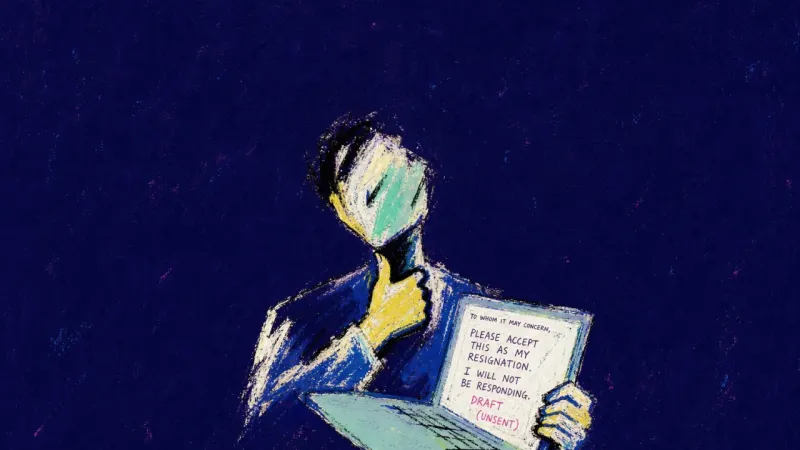
You’ve had a resignation email saved as a draft for weeks, and somehow you’ve edited it more times than you’ve slept properly.
Taylor (name changed for privacy) sat down across from me and did that thing I’ve come to recognize in high performers: she tried to smile like she was about to “talk through a normal career question,” while her body told the truth first.
She described Thursday night in her Toronto condo with a precision that made the scene feel like it was still happening: 11:47 p.m., the living room lit mostly by laptop glow, the dry heat in the air, her phone warm in her palm from one more scroll. The cursor blinking in the resignation draft sounded louder than it had any right to. “I hover near Send,” she said, “and my jaw locks. It’s like my body is trying to keep the future from happening.”
On the surface, her question was simple: resignation draft saved—send it for peace or stay from fear of failure.
But the feeling underneath wasn’t “a tough decision.” It was dread that lived in her throat—like she’d swallowed a tight knot of wire and every time she pictured people judging her, the wire pulled.
“I just want peace,” she told me, voice low. “But I don’t trust myself to survive the in-between. And if I quit and it doesn’t work out… that says something about me.”
I nodded, slow and steady, the way I used to when a client across a boardroom table was about to confuse pressure with truth. “We’re not here to force a dramatic leap,” I said. “We’re here to get you out of limbo. Let’s try to draw a map through the fog—something that helps you find clarity and a next step you can actually live with.”
A pause, then I added the line I wanted her to take home with her: A resignation draft saved is a decision delayed, not a decision avoided.

Choosing the Compass: The Decision Cross · Context Edition
I asked Taylor to take one slow breath—nothing mystical, just a clean transition from spiraling in her head to being present in her body. While she focused on the question, I shuffled the deck in that quiet, repetitive rhythm that gives the mind something to rest against.
“Today,” I told her, “we’ll use a spread called the Decision Cross · Context Edition.”
For a resignation email saved as draft—especially when fear of failure is in the driver’s seat—this spread works because it doesn’t pretend the cards will “predict” the perfect outcome. It maps the motivations underneath each option: the need behind leaving, the need behind staying, and the hidden engine that turns a normal career crossroads into decision fatigue and a full-body freeze.
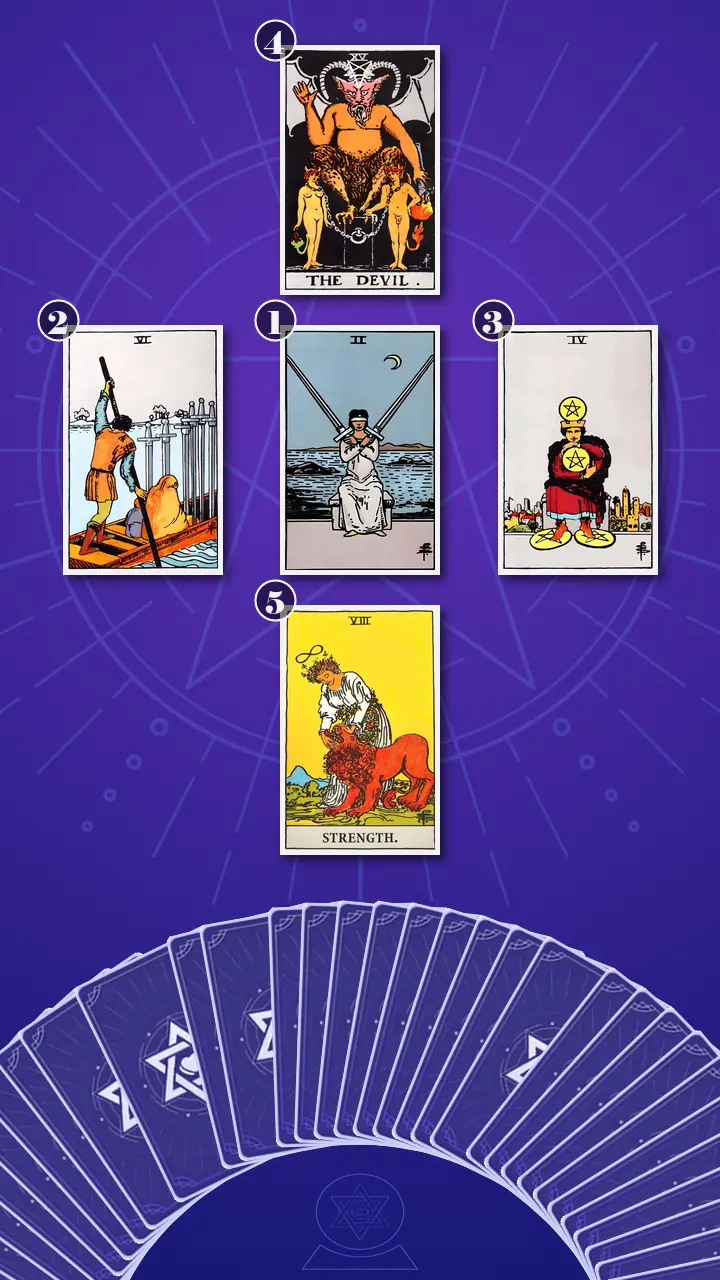
Here’s the structure I laid out on the table as I spoke: one card in the center for the present stalemate, one to the left for what pulls you toward sending (the peace you’re trying to get back), one to the right for what pulls you toward staying (the security you’re trying to protect), one above for the deeper fear driving the whole thing, and one below for the integration step—the healthiest micro-action to restore agency before you choose.
“We’ll read it like a compass,” I said. “Center first, then the two pulls, then we name the engine, and finally we anchor the response.”
Reading the Map: Card Meanings in Context
Position 1: The observable present stalemate
“Now flipping,” I said, “is the card that represents the observable present stalemate: what you are doing (and not doing) right now that keeps the decision stuck.”
Two of Swords, upright.
I didn’t have to reach for an abstract definition. The card met her life exactly: you’re sitting on your couch at 11:47 p.m. with your resignation email open, reading it like it’s a legal document, tweaking one word, rereading the whole thing, then closing the laptop before it becomes real.
“This is the blindfold energy,” I told her. “Not because you’re unaware. Because you’re protecting yourself. The crossed swords pressed to the chest are like: ‘I’m holding two truths at once—I need peace and I can’t risk being seen failing—and if I put either sword down, I’ll have to feel the consequences.”
In energy terms, the Two of Swords is a blockage—Air overloaded. Thinking becomes a shield. Pros-and-cons become a sedative.
I watched her eyes flick down toward her hands. “Tell me what happens in the five minutes right before you might take a real step,” I asked gently. “Right before you might send the email, or book the meeting. What do you do?”
She let out a small laugh that had no humor in it. “I’ll decide tomorrow,” she said, almost quoting herself. “Then I reword one line. Then I tell myself I need more info. Then it’s ‘I’m not ready.’”
“Exactly,” I said. “Like keeping 47 tabs open so you don’t have to click the one that changes everything.”
Position 2: The psychological need behind sending
“Now flipping,” I said, “is the card that represents the psychological need behind sending the resignation: what you hope will change internally.”
Six of Swords, upright.
This card didn’t scream “glow-up.” It whispered: you imagine the quiet that would come after leaving—fewer Slack pings, fewer ‘quick’ end-of-day asks, fewer Sunday-night stomach drops. It’s like taking a boat out of choppy water.
“Peace doesn’t always look like a win. Sometimes it looks like a quiet exit ramp.”
In energy terms, this is balance returning—not immediate happiness, but a deliberate passage out of mental noise. You can still be carrying swords—questions about money, identity, what’s next—while choosing a calmer shoreline.
Taylor’s shoulders dropped about a millimeter, the tiniest physical admission that relief was not a fantasy; it was a need.
“If the mental noise was thirty percent quieter,” I asked, “what would change first? Sleep? Appetite? How you show up in the morning?”
“I think I’d stop waking up braced,” she said. “Like I’m already late to a disaster.”
Position 3: The psychological need behind staying
“Now flipping,” I said, “is the card that represents the psychological need behind staying: what you believe you preserve or prevent.”
Four of Pentacles, upright.
This card is the body’s grip made visible: the job is a known container—paycheck, identity, being ‘the reliable one.’ You tell yourself you’ll leave when you’re 100% ready, but the readiness bar keeps moving.
In energy terms, the Four of Pentacles is excess—security-seeking so tight it becomes a cage. It’s control disguised as safety.
“I want to say this with zero judgment,” I told her. “This grip has kept you functioning. It’s protected you from uncertainty in a city where rent threads on r/toronto can make the future feel like a threat. But it has a cost.”
I painted it the way it shows up in her day: rewriting a two-sentence Slack update into five sentences to preempt criticism, saying yes automatically to late revisions, staying online just long enough to prove something to someone she can’t even name.
Her mouth tightened and then softened. “I hate that it’s true,” she said. “But it is.”
Position 4: The underlying fear that turns this into a threat to self-worth
“Now flipping,” I said, “is the card that represents the underlying fear/assumption that turns this decision into a threat to self-worth—the deeper engine.”
The Devil, upright.
Even before I spoke, the room felt quieter—like the fridge hum in the background suddenly got louder because neither of us was filling the space with extra words.
I named it carefully, because this card can land like an accusation if you don’t hold it right: the real chain isn’t your job—it’s the internal rule that says ‘If I leave and struggle, that proves I’m not capable.’ One career move becomes a verdict on your worth.
Then I gave her the sentence that often unlocks the whole spread: This isn’t a job problem. It’s a worthiness problem wearing a job problem costume.
The Devil is a compulsion energy—fear-based attachment. And the most important symbol here isn’t the horned figure; it’s the chains being loose. The captivity feels absolute, but it’s not as welded shut as it feels at midnight when LinkedIn timeline math starts sounding like evidence in a trial.
Taylor swallowed hard—visible in the way her throat moved like she was trying to get past something stuck. Her eyes didn’t water, but her gaze went slightly unfocused, like she’d just replayed a memory of a critical comment at work and how it turned into a whole-body “I’m not cut out for this” spiral.
“Finish the sentence,” I said softly. “If you quit and it’s hard for a while… it means you’re ____.”
She barely breathed as she answered. “Not good enough.”
In my head, I flashed to my old life—trading floor noise, numbers moving like weather, and that familiar illusion that if you model enough scenarios you can eliminate risk. You can’t. You can only decide what risk you’ll carry, and what risk you refuse to keep paying for.
When Strength Put a Hand on the Lion
Position 5: The integration step—how to choose from courage, not fear
“We’re turning now,” I told her, and I meant it. “This is the card that represents the integration step: the most empowering stance or micro-action that restores agency before you decide.”
Strength, upright.
The image is never about domination. It’s about leadership: a calm hand on the lion, an infinity symbol overhead, the sense that courage is a practice you repeat—not a switch you flip one heroic time.
Setup: I could feel how Taylor’s mind had been demanding a guarantee it could never get. It was late-night logic trying to solve an emotional problem. In her body, it looked like the jaw lock—like her nervous system was saying, “If I don’t let this become real, I can’t be judged for it.”
Delivery:
Not ‘I’ll move only when I’m fearless,’ but ‘I’ll hold fear gently and still choose’—like Strength’s quiet hand guiding the lion instead of letting it drive.
I let the line sit between us for a beat.
Reinforcement: Her reaction came in a chain, not a single moment. First, a tiny freeze—her breath paused, fingertips hovering over the edge of her water bottle as if she’d forgotten what she was holding. Then her eyes shifted away from the table, unfocusing toward the window like she was replaying every midnight she’d treated the resignation draft like a verdict. Then the exhale finally arrived—long and shaky—and her shoulders dropped in a way that looked almost unfamiliar to her, like her body was surprised it was allowed to unclench.
“But…” she started, and there was a flash of anger under it, sharp and honest. “If that’s true, does it mean I’ve been doing it wrong this whole time? Like I’ve been letting fear run my life?”
I didn’t rush to comfort her out of that feeling. “It means fear has been doing what fear does,” I said. “Trying to keep you safe by controlling the story. But Strength doesn’t shame the lion. She holds it. She leads it.”
Then I brought in my own toolkit—the part of me that still thinks in strategy and probability, because it’s a language that turns overwhelm into something you can work with.
“Here’s the thing,” I said. “Your choice isn’t ‘quit forever’ or ‘stay forever.’ Your nervous system can’t handle forever right now. So we do what I call Strategic Crossroads Analysis: we treat this like a decision under uncertainty, not a moral test. We do a three-scenario forecast—not to predict the future, but to stop acting like there’s only one ‘correct’ move.”
I drew three simple columns on my notepad:
Scenario 1: You stay for 30 days with one boundary that protects your health.
Scenario 2: You prep to leave for 30 days with one support that reduces the cliff-edge feeling.
Scenario 3: You do nothing and remain in Draft Limbo—resignation email saved as draft, self-worth on the line, jaw clenched at midnight.
“We probability-weight,” I continued, “not the outcome, but your ability to support yourself through discomfort. Because that’s the missing variable. Strength is telling us: you don’t need certainty, you need self-leadership.”
Her eyes came back to me, clearer. “Okay,” she said, voice quieter. “That makes it… smaller. Human.”
“Exactly,” I told her. “This is the emotional transformation right here: from dread-driven analysis paralysis to calm, values-based agency. Not because you’re suddenly fearless—because you’re finally the one holding the leash.”
I leaned in a fraction. “Now, with this new lens—can you think of one moment last week when this would’ve changed how you felt? A moment where fear grabbed the wheel?”
She didn’t hesitate. “Wednesday,” she said. “My manager messaged at 6:30 asking for ‘one quick tweak’ and I said yes instantly. Then I opened the resignation draft that night like… like it was oxygen.”
“That’s the moment,” I said. “That’s where Strength starts—not at midnight with a grand decision. In the small moment where you lead fear with one clear action.”
The One-Page 30-Day Choice (Actionable Advice You Can Start Tonight)
I pulled the whole spread together for her, like threading beads into a single string.
“Here’s the story your cards told,” I said. “The Two of Swords shows the freeze—your resignation email saved as draft is your self-protection strategy, because choosing would force feelings you can’t control. The Six of Swords shows what you’re actually craving: quieter mental water, not a flashy win. The Four of Pentacles shows why you stay: the known container, the paycheck, the identity of being ‘reliable,’ the illusion that if you grip hard enough you can’t fall. The Devil names the engine underneath all of it: the Shame Contract—worth equals performance, and leaving risks being seen struggling. And Strength offers the antidote: calm courage and nervous-system steadiness, so you can make a clean choice that reflects your values rather than your shame.”
“Your cognitive blind spot,” I added, “is thinking you need 100% certainty before you deserve respect—from other people or from yourself. The transformation direction is different: you make a values-based decision supported by one concrete plan for handling discomfort. That’s what breaks decision paralysis.”
Then I gave her actions so small they couldn’t hide behind perfectionism. I also used my Pre-commitment ritual—a trading-floor focus technique I still swear by—not to hype her up, but to keep her from negotiating with fear in the moment.
- The Send Button Somatic Check (3 days)Once a day, open your resignation draft for 2 minutes. Notice jaw, throat, shoulders. Then close the laptop without deciding. You’re collecting body data, not forcing a choice.If your brain says “this is silly,” label it as the pattern. Keep it tiny on purpose—2 minutes is the point.
- Name the fear in one sentence (Notes app)Write: “I’m afraid leaving and struggling will mean I’m not competent.” Save it as the first line above any pros/cons list. This separates the decision from the Shame Contract.Don’t soften it. The goal is clarity, not comfort. One clean sentence beats ten vague paragraphs.
- One 24-hour Strength action (pick only one)Choose one action you can stand behind for the next day: either (a) request a meeting with your manager to discuss workload boundaries, or (b) block 30 minutes to update your resume. Not both.This is a pre-commitment: decide the action before you’re spiraling at 11:47 p.m., like setting a trade before the market noise hits.
- Draft a one-page “30-Day Choice”On one page, sketch two plans: Staying for 30 days with one boundary (e.g., no after-hours revisions), and Leaving with one support (e.g., weekly check-in with a friend + a savings runway number). No lifelong promises—just 30 days.Remember: “Make a choice you can live with for 30 days, not a choice that solves your whole life.”

A Week Later: Ownership, Not Certainty
A week after our session, I got a message from Taylor. Not a paragraph. Not an essay. One line: “I did the 2-minute check three days in a row—and I realized my jaw clenches hardest right after I check LinkedIn. I asked my manager for a meeting. Just that. I’m shaking, but I did it.”
That’s what I call proof: not a perfect outcome, but a shift from being governed by fear to being guided by values. The cards didn’t hand her a prophecy. They gave her a map out of Draft Limbo.
Later, she told me something else that felt almost bittersweet in its simplicity: she slept through the night for the first time in weeks, but in the morning her first thought was still, “What if I’m wrong?” She paused, then added, “It just didn’t feel like a verdict anymore.”
When your finger hovers over “Send” and your throat tightens, it’s not because you’re lazy or dramatic—it’s because peace and self-protection are pulling on you at the same time.
If you didn’t need certainty to deserve respect—what’s the smallest choice you’d be willing to stand beside for the next 24 hours?
Every reading at AceTarot is a Journey to connect with inner wisdom and empower next step.
Learn more about our Journey to Clarity.