Seeing an Old Report Card Again—From Verdict Brain to Study Reps

Finding Clarity in the Transcript PDF That Hit Like a Siren
You sit down to study and somehow spend 40 minutes building a new Notion template—because doing the next 30 minutes of practice might produce a score.
Alex (name changed for privacy) didn’t say that as a joke. They said it like a confession you make to someone who won’t flinch. When they told me why they booked a session, their voice did that tight thing people do when they’re trying not to sound dramatic.
They were cleaning up their laptop after work—Toronto evening-course life, the whole “I’ll just do 30 minutes before I crash” promise. Then it happened: a transcript PDF in the Downloads folder. Not even a dramatic discovery. Just a filename sitting there like a dare.
They described the moment so clearly I could see it: 9:18 PM at the kitchen table, mug of tea cooling into lukewarm disappointment, laptop glow drying their eyes, the fridge hum suddenly too loud. Their jaw locked. Their hands got restless. And instead of opening practice questions, they started renaming folders. Because steady, skill-building reps are what they want—yet being “average” feels like getting found out.
The shame in their body wasn’t an abstract feeling. It was like swallowing espresso grounds—bitter, gritty, impossible to fully wash down—followed by the familiar buzz of “can’t start” tension that always turns into late-night wired exhaustion.
“Seeing the report card,” they said, rubbing their thumb along their phone case like it was a worry stone, “I can’t tell if I’m preparing or just hiding inside the plan.”
I nodded, letting that land without rushing to fix it. “We’re not going to scold you into discipline,” I said. “We’re going to map the loop—so you can step out of it on purpose. Think of this as a Journey to Clarity: not a verdict, just a clearer view and one workable next step.”

Choosing the Compass: How Tarot Works When You’re Stuck in a Study Loop
In my café, the air always smells like a decision being made—fresh espresso, toasted sugar, and the quiet comfort of a place that doesn’t demand you be impressive to deserve a chair. I asked Alex to take one slow breath in, one breath out. Not as a ritual for the universe, but as a handoff: from panic-thinking to pattern-seeing.
I shuffled slowly, the way I’ve done for years between cappuccinos and conversations. “Today we’ll use a spread I created for exactly this kind of situation,” I told them. “It’s called the Four-Layer Insight Ladder · Context Edition.”
For readers: this spread is built for moments that aren’t really about choosing between options—like ‘should I study at 7 or 8?’—but about identifying a repeating internal pattern. It traces the ladder down from what you do on the surface (the obvious loop) into what triggers it, what belief hooks it, what it costs you, and then—crucially—what single reframe shifts the whole system into something repeatable.
I pointed to the space where the cards would go, laid in a simple vertical line, like steps down from noise into something you can stand on. “Card one shows the repeating pattern you can observe. Card two is the trigger—the past echo. Card five is our hinge, the key shift. And card six is the next grounded step you can actually do this week.”
Alex’s shoulders lowered a millimeter. Not relaxed—just less braced. In Toronto, with peers posting certifications on LinkedIn like it’s casual, that tiny change matters.
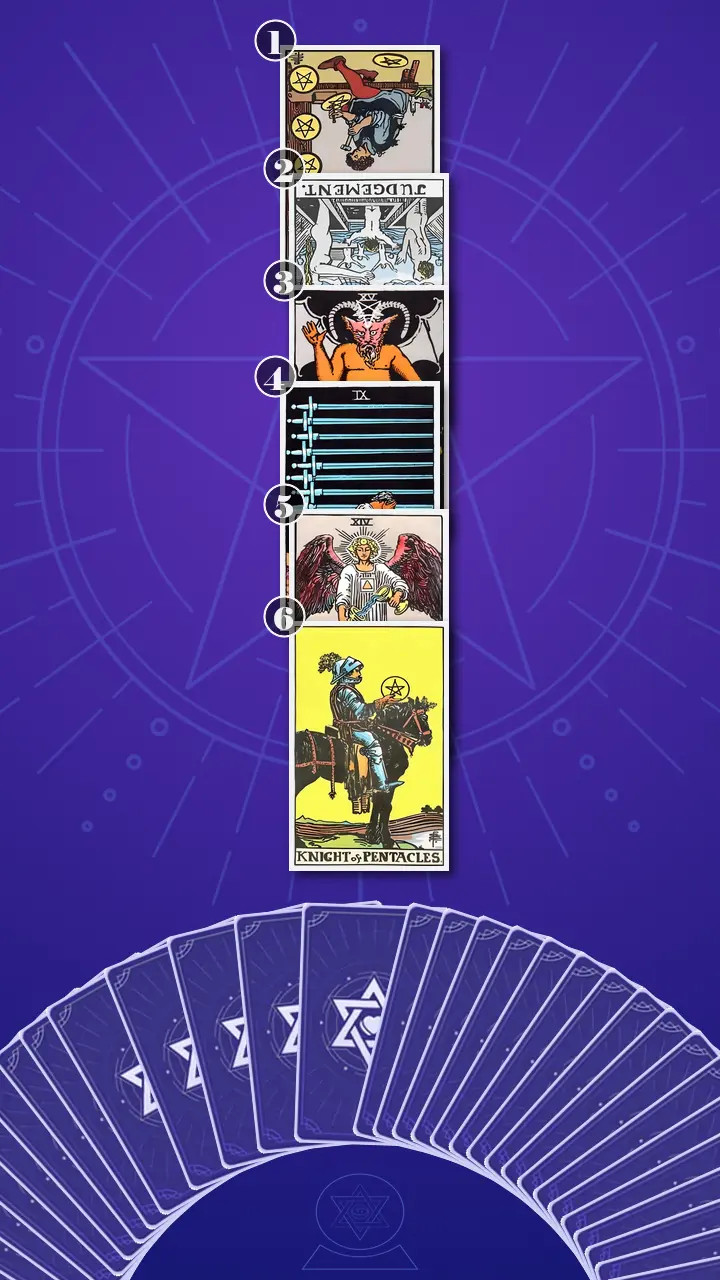
Reading the Ladder: Card Meanings in Context (When Planning Becomes Hiding)
Position 1 — The repeating study pattern now
“Now flipped over,” I said, “is the card representing the repeating study pattern now—the observable loop that shows up after seeing the report card.”
Eight of Pentacles, reversed.
I tapped the workbench in the image. “This is the craft card. In the upright, it’s mastery through repetition—showing up, doing the reps, learning by doing. Reversed, the energy gets… misdirected.”
And I used the exact modern translation that matched their life like a key in a lock: “It’s you sitting down after work telling yourself you’ll study, but spending the whole session tweaking your setup—reformatting notes, renaming folders, rebuilding a Notion dashboard, making a color-coded plan—because those actions feel like effort without risking a score.”
“Busy-looking effort,” I added, “that doesn’t reliably build skill. This isn’t laziness. It’s protection.”
Alex let out a short laugh, the kind that’s half air and half bruise. “That’s… so accurate it’s kind of mean.”
I didn’t smile, because I wanted them to feel I took it seriously. “I hear you,” I said. “And I want you to notice something: you’re not avoiding studying—you’re avoiding evidence. Planning feels safe because it can’t be graded.”
The reversal here is a blockage in Earth energy: the part of you that can do steady, boring reps gets hijacked by the part that wants a guarantee first. So you keep polishing the bench instead of using the tools.
Alex stared at the card, then at their own hands like they’d just caught themselves mid-habit. Their fingers stopped fidgeting for one breath—then started again, quieter.
Position 2 — The trigger and past echo
“Now we’re looking at the trigger and past echo—how the old report card moment activates the loop.”
Judgement, reversed.
This is where the spread sharpened. I felt it in the café’s ambient hush—espresso machine quiet between orders, a spoon clinking once and then stopping, like the room didn’t want to interrupt.
“Judgement is the ‘call’ card,” I said. “In the upright, it’s renewal: honest review, a second chance, the moment you answer a call to grow. Reversed, that call gets distorted into self-critique.”
I grounded it in their real life, exactly as the translation described: “Finding that old report card doesn’t land as information; it lands like a verdict notification. You don’t think, ‘What did I need then?’ You hear, ‘This is who I am.’”
I let myself go fully into the echo technique because it matters here. “It’s like a push alert with a trumpet-blast tone,” I said, and I wrote it in the air the way people write inner monologues without meaning to:
“Breaking News: You’re not enough.”
“And then your brain opens a courtroom tab,” I continued. “Exhibit A: that one semester.Exhibit B: the quiz you didn’t ace.Exhibit C: your friend’s library selfie.”
Alex’s throat moved in a swallow. Their eyes went glossy—not crying, just that immediate hydration of being seen too precisely. They exhaled long and quiet, like they wanted to close a portal.
“But,” I said, cutting cleanly to the contrast, “what if this is a calendar reminder, not a verdict?”
“A report card is a snapshot—not a personality test,” I added, watching their shoulders drop another fraction.
Position 3 — The root hook
“Now flipped over is the card representing the root hook—the underlying fear or belief that makes performance feel like identity.”
The Devil, upright.
When The Devil shows up for someone like Alex, I never read it as ‘bad.’ I read it as honest. It’s the card that points to the bind—especially the bind you maintain because it seems like it keeps you safe.
“Look at the chains,” I said. “They’re there, but they’re loose. The bind is real, but it’s also… maintainable. Like keeping a tab open that you could close, but don’t, because you think it’s protecting you.”
I pulled the modern scenario straight into the light: “Grades have become a stand-in for worth and belonging. Studying stops being about learning and turns into proving you deserve to be in the room—so every rep feels high-stakes.”
And I said the line that names it without moralizing: “When grades become identity evidence, studying turns into captivity.”
Alex nodded, jaw tightening exactly as if the card had tugged a string. Then, unexpectedly, they half-laughed—small, sharp. “I hate that this is true,” they said, and the honesty in it was almost relieving.
“Of course you do,” I replied. “It’s exhausting to live inside a scoreboard.”
This card’s energy is excess attachment: you’re attaching safety to an external metric. And when safety is on the line, no wonder your system reaches for control—perfect plans, perfect readiness rituals—anything but a measurable rep.
Position 4 — The coping strategy cost
“Now we’re looking at the coping strategy cost—what the pattern does to mind, body, and time when it runs.”
Nine of Swords, upright.
I didn’t need to ask what time of day it hit hardest. The Nine of Swords is basically a timestamp.
“1:12 AM,” I said softly, and I watched Alex’s eyes flick up like I’d read their texts. “Blue light. Tabs open. Your phone warm in your hand. Dry eyes. A heart that’s buzzing like it’s trying to power a whole city.”
I mirrored the scene the way the echo design demanded—specific, sensory, unromantic. “You try to sleep but your mind runs worst-case scenarios like it’s doing you a favor. You replay what a bad score would ‘mean,’ rehearse humiliation, bargain with tomorrow. It’s doomscrolling, but the feed is your own imagined future failures.”
Alex winced—immediate, small, involuntary. “That’s literally my nights,” they said.
“Don’t do self-trials at 1 AM,” I told them, not as a lecture but as a boundary you can hold onto when your brain gets theatrical. “This card is Air energy in excess—thoughts lined up like evidence. Your recovery time is being used as punishment. And then the next day, you start from depleted, so the loop looks like a discipline problem when it’s actually a nervous-system overload problem.”
Alex’s hands went still for a moment on the table. Then their fingers pressed flat, like they were grounding themselves in the wood.
When Temperance Spoke: Choosing the Slow Pour Instead of Another Reset
I set my palm lightly on the deck. “We’re flipping the hinge now,” I said. “This is the card representing the key shift—the most effective reframe that breaks the cycle without forcing perfection.”
Temperance, upright.
Outside the café window, a streetcar hissed by on wet pavement, and the sound felt like the exact opposite of a trumpet blast—steady, regular, unbothered by anyone’s internal courtroom.
Setup: Alex knew the moment I meant. The laptop opens. The stomach drops. The brain reaches for Notion because Notion can’t fail you. Forty-five minutes later, there’s a gorgeous system—and zero evidence of learning—because doing the work feels like risking a number that might define you.
Delivery:
Not another dramatic reset—choose the slow pour, and let small daily mixing turn pressure into progress (Temperance).
I let it sit in the air for a beat, the way I let espresso settle before I add milk—so it doesn’t get drowned out.
Reinforcement: Alex’s face did a three-step change I’ve seen a thousand times, but never in exactly the same order. First, a micro-freeze: their breath paused, and their eyes widened like they’d been caught between two versions of themselves. Then the meaning seeped in: their gaze unfocused, not blank—more like they were replaying last week’s spiral and seeing it from above for the first time. Then the release: a long exhale that started in their chest and ended in a soft, almost embarrassed “Oh.” Their shoulders dropped, but with that strange dizziness that comes after you’ve been holding tension for so long you forgot it was optional.
“That sounds too simple,” they said, and there was relief in it… and skepticism. “But if it’s that simple, does that mean I’ve just been—”
“No,” I cut in gently. “It means your nervous system learned a survival strategy. Temperance isn’t telling you to become a different person overnight. It’s telling you to adjust the recipe. Small pours. Taste. Adjust. Repeat.”
This is where my café brain and my tarot brain become the same brain. I told Alex what I know from twenty years of making coffee for real humans with real nervous systems: “When I dial in beans for espresso, I don’t throw the machine out because one shot pulled bitter. I change one variable—grind, dose, time—and I pull another shot. That’s Temperance. That’s calibration.”
And I brought in my Knowledge Filtration skill—the coffee-filter principle—because Alex’s mind was clogged with verdict-noise. “A coffee filter doesn’t judge the grounds,” I said. “It separates what you need from what you don’t. Your study system needs a filter too: practice first goes through; verdict thinking stays behind. Otherwise everything gets muddy and you can’t taste what you’re actually learning.”
“Now,” I asked them, “with this new lens, think back to last week. Was there a moment—maybe Sunday night, maybe on the TTC scrolling the portal—where this would’ve helped you feel different?”
Alex blinked twice. “Wednesday,” they said. “I found the PDF. And I immediately started building a whole new schedule.”
“Right,” I said. “Temperance would’ve said: one small rep first. Then adjust.”
That’s the emotional pivot too: this isn’t just about studying. It’s the beginning of moving from shame-driven scorekeeping and perfectionism-to-procrastination to grounded self-trust built through small, repeatable practice reps.
Position 6 — The next grounded step
“Now flipped over,” I said, “is the card representing the next grounded step—a realistic, repeatable action that builds self-trust this week.”
Knight of Pentacles, upright.
Alex immediately leaned in. This card has that effect—like your body recognizes a pace it can actually live with.
“This is ‘no drama’ progress,” I said. “Same time, same place, same minimum rep. It’s not exciting. It’s reliable.”
I anchored it in the modern scenario: “You commit to a routine that’s almost boring: one small practice set a day (or three set days a week), tracked as reps completed. Confidence stops being the prerequisite and becomes the result.”
The Knight’s energy is balance in Earth—steady, not frantic. And I used the exact language that matters for perfectionism loops: “What’s the smallest daily standard you can keep on your worst day, not your best day?”
Alex gave a slow nod, like their brain was finally agreeing to a contract it could afford.
The One-Page Calibration Log: Actionable Advice That Doesn’t Require a New Personality
I leaned back and looked at the whole ladder as one story. “Here’s what I’m seeing,” I said. “The surface pattern is misdirected effort—planning that feels productive but avoids being measured (Eight of Pentacles reversed). The trigger is that old transcript landing like an announcement about who you are (Judgement reversed). Under that is the hook: approval has been equated with safety, so an average score feels like exposure (The Devil). The cost is late-night rumination—your recovery time turned into a courtroom (Nine of Swords).”
“Temperance flips the meaning of evaluation,” I continued. “It turns ‘verdict’ into ‘calibration.’ And the Knight of Pentacles makes it real: you build proof by reps, not by panic.”
The cognitive blind spot—the thing Alex couldn’t see from inside the loop—was painfully simple. “You’ve been treating a study system like a moral identity,” I said. “So when you can’t execute it perfectly, you think it means something about your worth. But this is a systems problem, not a character flaw. The transformation direction is exactly this: move from ‘I need proof I’m exceptional before I start’ to ‘I build proof by doing small, repeatable practice reps first.’”
Alex frowned a little, not in disagreement—more like an honest obstacle forming. “But I genuinely don’t have time,” they said. “I work full-time. I commute. I’m already depleted. I can’t do hours.”
“Good,” I said, and I meant it. “We’re not building an ‘hours’ plan. We’re building a rep plan. Worst-day standards. Small pours.”
- Rep-First Study Rule (25 minutes)Once this week, set a 25-minute timer at your default spot (same café table, same desk corner, or same library floor). The only allowed activity is graded practice: 3–5 active-recall flashcards you actually answer, 1 timed quiz set, or 4 messy sentences of a draft you can improve later. No Notion tab. No portal refresh.Expect your brain to argue: “This is too small to count.” That’s scoreboard logic. Treat it like an experiment. If 25 feels impossible, do 10. If 10 feels impossible, do 5—and stop on purpose.
- Two-Sentence Calibration LogImmediately after the timer, write a plain note titled “Calibration Log” (no template): (1) “I missed __ because __.” (2) “Next rep is __.” Save it where you can find it fast.If your chest tightens or your thoughts go courtroom-mode, name it—“verdict brain”—put one hand on the desk, and end the rep early. The win is ending intentionally, not pushing through panic.
- No-Portal Night Boundary + Coffee ‘Blend’ SupportFor 3 nights this week, set a cutoff time (example: 10:30 PM) when you stop making new study decisions—no new schedules, no syllabus rereading, no grade-portal refreshing. If you spiral anyway, do a 3-minute brain dump note titled “Not evidence, just thoughts,” then close it. If you want a focus cue, choose a consistent, gentle drink ritual: a half-caf or decaf latte at the same time you start your rep, so your body learns “this smell = small pour.”This is my café version of a study blend aroma strategy: same scent, same start. Keep caffeine humane—especially with evening courses—so you don’t feed the Nine of Swords at 1 AM.
I watched Alex’s face as they read the list. Their eyes didn’t dart like they were scanning for a loophole. They were measuring it for realism.
“I can do that,” they said, almost surprised by their own voice. “It’s… annoyingly doable.”
“That’s exactly the point,” I told them. “Temperance is not a motivational speech. It’s a recipe. And the Knight of Pentacles is the person who cooks it the same way even when their mood is trash.”

A Week Later: The Quiet Proof
Six days later, between the lunch rush and the afternoon lull, my phone lit up with a message from Alex.
“Did the 10-minute version,” it said. “Three flashcards + one quiz question. Wanted to open Notion so bad. Didn’t. Wrote the two lines. It felt weirdly clean.”
And then, a second text: “Also didn’t check the portal after 10:30 PM twice. Still thought about it. But I didn’t do the self-trial.”
It wasn’t a dramatic transformation. No cinematic montage. Just a small, real shift: their progress was something they could do, not something they had to be.
That’s the thing tarot gives me, over and over, in this café: not certainty, but a map. The Journey to Clarity isn’t about becoming fearless. It’s about stepping out of verdict-thinking and into calibration-thinking—so your nervous system can finally cooperate with your goals.
And if you’re trying to build steady study habits but your body reacts to “average” like an exposure risk, you start grading yourself before you even begin—tight jaw, buzzy hands, and that heavy thought: “If this isn’t exceptional, it won’t count.”
If you treated your next study session like a quiet calibration—one small rep that creates evidence—what would you choose as your ‘worst-day minimum’ for this week?