The SAT Prep Book at 11:42 PM—From Dread Spiral to Practice-Not-Proof

The 11:42 p.m. Closet Find
You’re 24 in NYC, cleaning out a closet, and the second an old SAT prep book shows up your stomach drops like it’s test day again—career pivot anxiety hits before you even turn a page.
Jordan (name changed for privacy) said it like they were embarrassed their body had such a dramatic reaction. They sat across from me at a small marble café table, hands wrapped around a warm cup even though they hadn’t taken a sip yet.
“It was 11:42 PM on Tuesday,” they told me, and as they spoke I could see it: a tiny bedroom, donation bags half-tied on the floor, the SAT prep book open like evidence. Dusty-sweet paper smell. Highlighter bleeding through thin pages. A laptop fan whirring while another how to study effectively thread loaded. Their shoulders creeping toward their ears as if they were trying to make themselves smaller.
“I can feel my stomach drop just looking at that book,” Jordan said. “And I hate that a score from years ago still gets to have an opinion about me.”
The dread they described wasn’t an abstract feeling. It was a physical trapdoor—stomach dropping, jaw tightening, breath turning shallow—like their body hit ‘replay’ before their mind could even argue.
I set a small saucer of biscotti between us, the kind that crumbles if you grip it too hard. “Okay,” I said softly. “We’re not here to force you to be ‘over it.’ We’re here to figure out what story your nervous system is still running—and what your next step is, so you can get your life back from a book.”
Outside, NYC winter air pushed against the window. Inside, my espresso machine clicked and sighed—steady, familiar. “Let’s make this a Journey to Clarity,” I added. “Not a performance review.”

Choosing the Compass: The Four-Layer Insight Ladder
I’m Sophia Rossi—coffee first, always. I’ve owned this little Italian café long enough to know two things: people bring their real selves to the table, and the body never lies about pressure. Tarot, to me, works the same way good coffee does. It doesn’t magically change your life. It helps you taste what’s actually happening—so you can choose what to do next.
I asked Jordan to take one slow breath in through the nose, out through the mouth—nothing mystical, just a nervous system handoff. While they did that, I shuffled the deck with the same rhythm I use to tamp espresso: firm enough to be intentional, gentle enough not to crush what’s delicate.
“Today,” I said, “I want to use a spread I designed for moments exactly like this. It’s called the Four-Layer Insight Ladder · Context Edition.”
For you reading along: this spread isn’t about predicting whether you’ll ‘do well’ on a test. It’s built for tracing a repeating inner narrative—adult test anxiety, performance pressure, that sick feeling around evaluation—from the surface symptom down to the belief-root, and then back up into an actionable next step. It’s a ladder: we go down into the old story, then climb back out with a new stance.
Here’s what I told Jordan to expect: the first card shows the present-day symptom—what happens in the first 60 seconds when the trigger hits. The third card goes deeper—the root belief the anxiety is protecting. And the fifth card is the pivot—the inner capacity that changes everything. The last card lands us in real life: what to do this week, not someday.
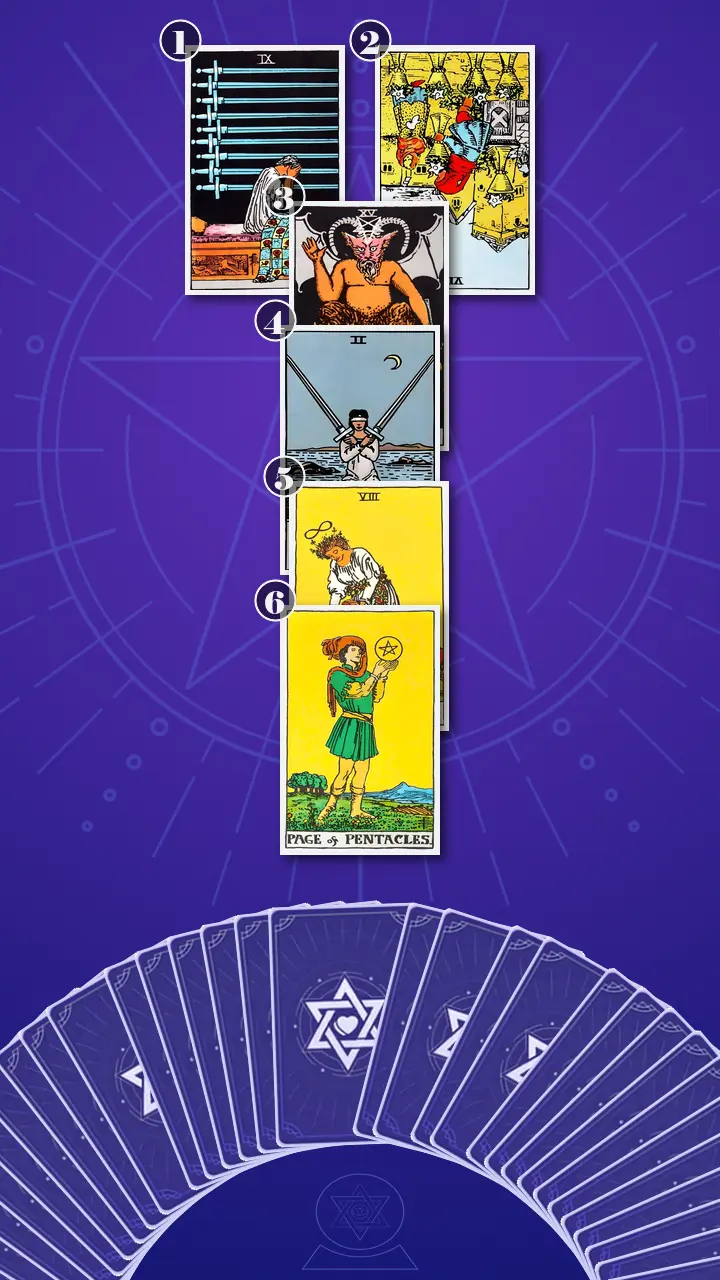
Reading the Map: Adult Test Anxiety in Six Frames
Position 1 — The present-day symptom
“Now we turn over the card that represents the present-day symptom: what you do or think the moment the test-anxiety story gets activated,” I said.
Nine of Swords, upright.
I didn’t even need to dramatize it. The image does that by itself: a person sitting up in bed, face covered, the night pressing in.
“This,” I told Jordan, “is that past-midnight loop where the mind is on overdrive.” And I made it concrete, because tarot is only useful when it’s specific: It’s past midnight in your NYC apartment, and you’ve got the SAT prep book open on the floor like it’s evidence in a trial. You don’t even fully start—you skim the hardest sections to ‘see if you still have it,’ feel your stomach tighten, then end up in a two-hour loop: YouTube study videos, Reddit threads, reorganizing a Notion page. You go to bed wired, replaying every past score and every future ‘what if,’ like the test is happening tomorrow.
Jordan let out a short laugh—sharp at the edges. “That’s… literally my bedtime routine,” they said, and it sounded like: you’re right, and I hate that you’re right.
Energy-wise, the Nine of Swords is excess Air: too much mental oxygen feeding a fire that doesn’t warm you, it just burns. Planning becomes a way to avoid being evaluated. I said it the way I say it to regulars who come in “just for a coffee” and end up confessing their whole week: “Planning can be care, or it can be armor. Armor feels safe, but it keeps you untested.”
Jordan’s fingers rubbed the cup sleeve again and again, like they were trying to sand down the sensation in their chest.
Position 2 — The trigger-memory echo
“Now we turn over the card that represents the trigger-memory echo: what the old SAT prep book is symbolically bringing back online,” I said.
Six of Cups, reversed.
Reversed, this card isn’t the sweet nostalgia highlight reel. It’s the past arriving with unfinished business.
I watched Jordan’s eyes track the artwork, then drift unfocused for a second—like a screen buffering.
“Here’s the modern translation,” I said. The prep book isn’t just a book—it’s a shortcut back to 16. One page of old highlights, and suddenly your body is back in that fluorescent-lit, too-cold testing center vibe. You catch yourself scanning for the hardest questions like you’re trying to renegotiate the past in real time: ‘If I can do this now, it means I’m actually smart.’ Then you snap it shut, but the feeling keeps running in the background all day.
Jordan exhaled through their nose, slow and surprised. “Oh. Yeah,” they said quietly. “It’s… a time-travel feeling.”
The energy here is a backward current—Water pulling you into an old survival strategy. Your adult mind says, This shouldn’t matter. Your body says, We know what happened last time. We remember.
In my café, the air always smells a little like toasted sugar and espresso. That smell is a memory key. I told Jordan, “Your brain is doing the same thing. The book is a scent-trigger for an old identity. Not because you’re weak. Because the circuit is still live.”
Position 3 — The root belief and core fear
“Now we turn over the card that represents the root belief and core fear under the story: what the anxiety is trying to prevent you from facing,” I said.
The Devil, upright.
This is the moment I’ve learned to speak plainly. The Devil card gets misunderstood. It’s not ‘you’re bad.’ It’s: you’re chained to something you once called safety.
And the modern-life scenario was painfully clean: This is the part where a number starts acting like an authority figure. The SAT score, a timed assessment at work onboarding, a future GRE/GMAT requirement—your brain treats all of it like the same courtroom. You’re not just afraid of doing poorly; you’re afraid it will ‘prove’ you don’t belong… So you keep paying the Devil tax: more prep, more control, more private over-functioning—because it feels like the only way to earn safety.
Jordan swallowed hard. Their throat moved like they were trying to get a word past a locked gate.
“This is the KPI-dashboard version of self-worth,” I said, a little wry, because sometimes naming it that way makes it less holy and more editable. “Like your life refreshes every time someone posts a promotion on LinkedIn.”
Then I added the line I needed them to borrow from me until they could believe it themselves: “A score is information. It’s not a personality.”
The Devil is bondage energy—Earth turned heavy. Not grounded. Heavy. It’s the belief: If I can be perfect, I’ll be safe. That belief feels protective, but it keeps your nervous system on 24/7 surveillance.
As I said it, my mind flicked to a barista training from years ago—how beginners try to grind coffee too fine because they want control, and all they get is a bitter, choked shot. Control can look like competence. But sometimes it’s just fear in a nice outfit.
Position 4 — The protective block
“Now we turn over the card that represents the protective block: the coping move you use to feel safe that also keeps the pattern running,” I said.
Two of Swords, upright.
Blindfold. Crossed arms. A calm sea that isn’t actually calm—it’s just held back.
I translated it exactly into their life: You tell yourself you’re over it—then you quietly freeze. You avoid anything that could create a measurable outcome… Instead you hover in the ‘safe zone’: planning, researching, color-coding, adjusting the schedule. It looks calm on the outside, but inside it’s bracing—like crossing your arms over your chest and refusing to let the possibility of judgment touch you.
“Yeah,” Jordan said. “I keep everything in draft mode. Like… if I don’t click ‘submit,’ nothing can come back and label me.”
That’s the Two of Swords energy: blockage. Not a lack of intelligence. Not laziness. A self-protection stance—airplane mode for your heart. It gives short-term relief. No score happens today. But long-term, it keeps the fear untested, and untested fears don’t get smaller.
I leaned in a little. “This is the part where your body is trying to be unjudgeable,” I said. “And it makes sense. But it’s also why you feel stuck at this career crossroads—because every next step feels like a grade.”
When Strength Met the Lion
Position 5 — The key shift
“We’re turning over the most important card in this reading,” I said, and even my café felt quieter for a second—like the espresso machine paused to listen.
Strength, upright.
Jordan’s eyes softened immediately, then flickered away like they didn’t want to want it.
I grounded it in real life: This is you learning to meet pressure without turning on yourself. The moment dread spikes—tight shoulders, clenched stomach—you don’t sprint into punishment-mode or numb-out planning. You breathe, stay present, and choose one small step with a steady voice: ‘Fear can sit in the room, but it doesn’t get the keyboard.’ You build confidence the way Strength does: not by dominating the lion, but by staying in relationship with it.
Setup (the trap you’ve been living in): I could feel Jordan bracing for the usual advice—push harder, grind more, become a robot. They were stuck in that late-night logic: If I can just eliminate fear, I’ll finally start. If fear is here, it means I’m not ready.
Delivery (the sentence that reframes the whole thing):
Stop treating pressure like a predator you must outrun, and start meeting it like Strength meets the lion—present, calm, and in relationship rather than in combat.
I let it hang there. No fixing. No pep talk. Just air.
Reinforcement (what changed in their body): Jordan’s breath caught—an actual pause, like their lungs forgot the next move. Their fingers went still on the cup sleeve. Then their gaze went slightly unfocused, as if they were replaying every moment they’d tried to sprint away from pressure: the prep book on the floor, the timed onboarding module, the LinkedIn doom-scroll. Finally, their shoulders dropped a fraction. Not a transformation montage—just a tiny, real unclench. Their eyes got shiny and they blinked fast, like they were annoyed at their own nervous system for being tender.
“But if I stop fighting it,” they said, and the first word came out sharper than they intended, “doesn’t that mean… I was wrong the whole time? Like I made it such a big thing.”
“No,” I said, gentle but steady. “It means you did what worked when you were sixteen. You survived. Strength isn’t calling you dramatic. Strength is calling you current.”
This is where I used my signature lens—the one I’ve built behind the counter, watching people try to become ‘productive’ by swallowing more caffeine than their bodies can handle.
“I think of this as Knowledge Filtration,” I told them. “Your mind is throwing a lot of grounds into the water—verdict-stories, shame, ‘prove you belong.’ Strength isn’t asking you to stop having thoughts. It’s asking you to filter: What is information, and what is panic foam? When evaluation hits, we separate signal from noise.”
I slid a napkin toward them and drew two quick columns—like a coffee filter splitting the brew from the sludge. “On the left: facts. On the right: flashback story. We don’t argue with the story. We just don’t let it drive.”
Then I asked, exactly as I always do at this point: “Now, with this new lens—relationship instead of combat—can you think back to last week? Was there a moment where this would’ve changed how you felt, even by 5%?”
Jordan stared at the Strength card, then nodded once. “The onboarding quiz email,” they said. “My brain went blank and then I opened five tabs on ‘how to pass’ instead of just… starting.”
“That’s the shift,” I said. “Not from fear to fearless. From score-as-identity dread and avoidance… to steady self-trust under pressure. That’s what we’re building.”
Practice, Not Proof: The Page’s Plan
Position 6 — The next step
“Now we turn over the card that represents the next step: one grounded action and mindset to practice this week to change the pattern in real life,” I said.
Page of Pentacles, upright.
The Page looked like the opposite of a courtroom. Just a person holding one pentacle with full attention—beginner energy, craft energy.
I anchored it in their actual NYC life: You treat test skills like a craft, not a verdict. Three times this week, you do a 25-minute session at a specific spot (same chair, same playlist, phone face-down). You pick one tiny set of questions or one concept—no dramatic ‘prove I’m smart’ storyline. You stop when the timer ends, even if it’s imperfect. The point is repetition with self-respect: you’re becoming someone who practices, not someone who auditions for worth.
“That sounds… doable,” Jordan said, and then immediately flinched. “Except,” they added, “I don’t even have 25 minutes. My job is chaos and by the time I get home I’m fried.”
There it was—the real-life obstacle. The moment where advice either becomes a guilt weapon, or it becomes compassionate engineering.
“Then we don’t start with 25,” I said, like it was obvious—because it is. “We start with the version that keeps you steady. Ten minutes. Or two. Page of Pentacles doesn’t care about drama. It cares about reps.”
And because I’m a café owner, I added the part I’ve watched work for a thousand overwhelmed people: “Pick a time your body can actually handle. That’s Focus Period Diagnosis. If coffee after 3 PM makes you wired at night, your best study window isn’t late-night. It might be a 20-minute ‘pre-dinner’ block, or a weekend morning with a small cappuccino.”
The Ladder in One Sentence—And a One-Week Repatterning Plan
Here’s the story the spread told, cleanly: an old SAT prep book lights up a memory circuit (Six of Cups reversed), your mind floods with worst-case verdicts at night (Nine of Swords), and underneath it all is a chain you’ve been dragging for years—worth equals measurable approval (The Devil). To feel safe, you freeze and keep everything ungraded in draft mode (Two of Swords). The turning point isn’t more discipline. It’s a new relationship with pressure—gentle courage and self-compassion while fear shows up (Strength)—and then a grounded, boring craft routine that builds trust through repetition (Page of Pentacles).
The cognitive blind spot I named for Jordan was simple, but sharp: they were treating clarity like it had to do the job of safety. If they could just find the perfect plan, the perfect resource, the perfect mood… they wouldn’t have to risk being judged. But the transformation direction is the opposite: from tests as a referendum on worth to tests as a skill context. You build steadiness by practicing while fear is present, not by waiting for fear to disappear.
I wrote them a plan that didn’t require motivation—just a timer and a little respect.
- The Strength Moment Reset (3 minutes)Before you study (or before a timed work module), put one hand on your stomach or chest. Do three slow 8-count exhales. Name the thought pattern once: “This is a flashback story, not a verdict.”If your mind argues “this is pointless,” treat that as the old chain tugging. Do the smallest version anyway—one exhale still counts.
- One Ungradeable Start (2 minutes)Open the old prep book to a random page. For 2 minutes, only circle what you recognize. No answering. Close it when the timer ends, and write down one body sensation (tight/loose/warm/cold).Stop immediately if you feel flooded. Ending on time is part of the rep—your nervous system learns “I can touch this and come back.”
- Three Craft Reps (10–25 minutes, three days)Do three sessions this week (e.g., Tue/Thu/Sun). Same spot, phone face-down. One tiny set or one concept. Stop exactly when the timer rings, even if it’s messy.Say it out loud once: “Practice, not proof.” If 25 minutes feels too big, do 10. If 10 feels too big, do 5.
Before Jordan left, I offered one extra anchor from my world—optional, but surprisingly powerful. “If you want,” I said, “use scent as a boundary. That’s my Study Blend Aromas trick. Brew the same coffee or use the same simple scent every time you do a rep. It tells your body: this is practice time, not trial time.”

A Week Later: The Quiet Proof
A week later, Jordan DM’d me a photo: a kitchen table, a cheap timer app on their phone, the SAT book closed—not looming, just existing. Under it, a sticky note that said: “Fear can sit in the room—but it doesn’t get the keyboard.”
“Did the two-minute circling thing,” their message read. “My stomach still dropped, but it didn’t hijack the whole night. I stopped on time. I slept.”
They added, almost like they were admitting something tender: “Woke up and my first thought was still ‘what if I’m not smart enough?’ But… it was quieter. I made coffee and did ten minutes anyway.”
That’s what a real Journey to Clarity looks like in practice: not a sudden personality transplant. A small, steady proof that evaluation can be information—and you can still belong to yourself.
When evaluation shows up, it can feel like your whole body is bracing for a verdict—like one measurable moment could expose you as not actually smart enough to belong.
If you didn’t have to prove you’re worthy before you start—what’s one tiny, boring “practice not proof” step you’d be willing to try this week?