Replying to Stories to Stay Visible, Then Choosing Real Contact

The 6:14 Streetcar and the Proof-of-Life Ping
When Maya (name changed for privacy) sat down across from me, I recognized the pattern before she even finished her first sentence: if you are in your 20s, living in a city, doing the hybrid-job thing, and sending a story reply on the commute home because the chat went quiet, this might be digital relevance anxiety, not just being friendly.
She described a Wednesday at 6:14 p.m. on the 504 streetcar heading west in Toronto. One AirPod in. Tote bag wedged against her knee. The doors wheezing open at each stop. The overhead lights flattening every face into the same tired blur. Her phone screen was warm in her hand as she tapped through the same person’s stories twice, typed lol this is so you, hit send, and then kept glancing down at the screen as if the next vibration might settle something in her body. From the outside, it looked tiny. Inside, it felt like holding her breath underwater for the length of a Seen stamp.
“I know it’s not that deep,” she told me, then gave a short laugh that had no real humor in it. “But it still gets under my skin. If I don’t keep the thread warm, it dies.”
What she wanted was simple and very human: to feel connected, remembered, naturally woven in. What she feared was much harsher: that silence meant she was already slipping out of people’s minds. Her insecurity had the texture of standing just outside a lit apartment window in winter, hearing laughter through the glass and pretending she was not cold. Even as she spoke, I could see the pattern in her body: the tight stomach, the thumb that kept wanting to reach for her phone, the tiny alertness spike every time a notification buzzed somewhere in the building.
I nodded. “That makes sense to me,” I said. “You’re not being dramatic, and you’re not random online. You’re trying not to feel forgettable. So let’s not shame the behavior. Let’s make a map of it. We’re not here to decide whether one DM was too much. We’re here to find clarity about what that reflex is protecting.”

Choosing the Compass: The Shadow Spread for Digital Relevance Anxiety
I asked Maya to put her phone face down on the table and take one slow breath with both feet on the floor. I shuffled slowly while she held the real question in mind, not Will they reply? but Why does quiet feel like disappearing? For me, that is what ritual is for: not drama, not mystique, just a clean psychological threshold between reacting and actually seeing.
For a question like why do I keep replying to Instagram stories just to stay on people’s radar, I use The Shadow Spread. It is a five-card tarot spread for texting anxiety, reassurance-seeking, and belonging wounds. I chose it because this was not really about an outcome. It was about a repeating micro-behavior with a hidden engine. This spread is precise: it shows the visible coping habit, the emotional trigger beneath it, the shadow belief running the whole loop, the healing truth that loosens it, and the next self-respecting action. In other words, it takes us down into the basement to find the fuse box, then brings us back upstairs with the lights on.
I told her where I would be looking most closely. The first card would show the surface behavior that looks casual but keeps the wound alive. The middle card would reveal the deeper worth-belief underneath the habit. And the fourth card, the antidote card, would show the perspective shift that could move her from attention management and read-receipt spirals toward self-trust, calm visibility, and direct connection.
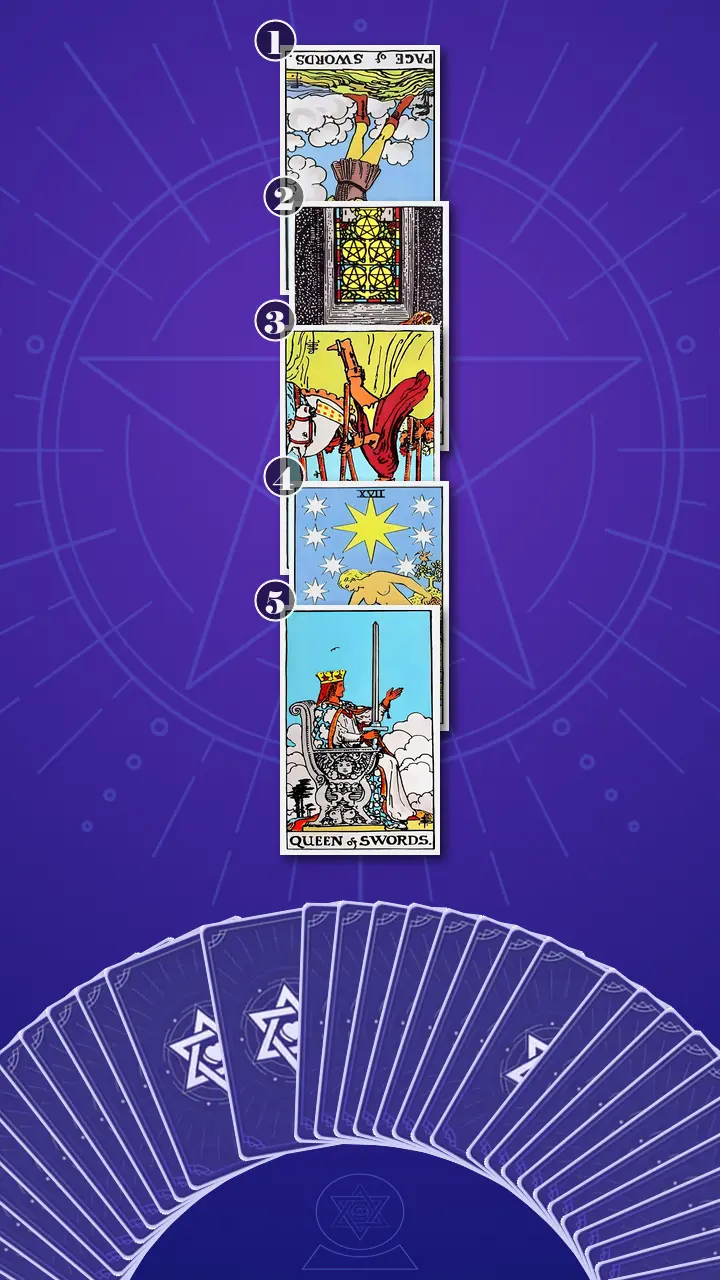
Reading the Descent: Where the Ping Begins
The Sideways Glance of the Page
I turned over the card for the surface coping pattern: the visible social-media behavior that keeps the belonging wound activated. It was the Page of Swords, reversed.
I smiled a little, because it was almost painfully exact. “This is you half-watching stories, half-writing a reply, scanning for a safe opening before the thread dies,” I said. “It looks casual, but it isn’t casual in your nervous system. It’s screenshotting a story to think, deleting three versions of a one-line message, then sending something light just to test whether you are still on their screen.”
In upright form, the Page of Swords is curious, alert, mentally quick. Reversed, that air energy gets distorted. It becomes surveillance instead of curiosity. Restlessness instead of clarity. Communication becomes less about expressing truth and more about managing uncertainty. A story reply can be contact, but it cannot carry the weight of belonging. When this card shows up here, I read it as a proof-of-life ping habit: like sending push notifications from your personality instead of making one actual request.
Maya winced, then let out a dry little laugh. “Okay,” she said, looking down at the card. “That’s... rude. Accurate, but rude.” Her fingers went to the edge of her water glass and stayed there. That quick, embarrassed smile told me she recognized herself fully.
The Warm Room You Think You’re Outside Of
I turned over the card for the emotional trigger: the moment the fear of being left out or forgotten gets activated. The card was the Five of Pentacles, upright.
“This,” I said, “is the exact second a normal digital gap turns cold.” I described the image in modern terms rather than old ones: mutuals posting from a patio you were not at, a crush sharing a dinner table you are not part of, a quiet group chat right after everybody else looks warmly lit and already in motion. “The story itself may be ordinary,” I told her, “but your body reads it like exclusion before logic catches up. You suddenly feel on the cold side of the glass.”
The Five of Pentacles is contracted earth. Scarcity. The feeling that warmth exists, but not for you. This is where the urge to react begins. Not because you actually have something meaningful to say, but because the body wants out of the cold fast. “You are not random online,” I said gently. “You are trying not to feel forgettable.”
She took in a tight breath through her nose and looked toward the window beside my table. Outside, the late afternoon sky had that flat Toronto grey that makes every building look slightly farther away. “Yeah,” she said quietly. “It’s when other people already look inside something. That’s when I feel it.” Her shoulders dropped a fraction. Not fixed. Just less defended.
The Feed as a Tiny Approval Stage
I turned over the card for the hidden shadow: the core fear and worth-belief underneath the urge to stay on people’s radar. It was the Six of Wands, reversed.
“Here’s the harder truth,” I said. “The blockage is not that you like people or that you enjoy messaging. It’s that your nervous system has started treating visibility as proof of value.” I pointed to the image and translated it into her world. “This is measuring closeness by who answers, how fast they answer, who reacts first, who remembers you without being prompted, whether you feel memorable enough in the feed to relax. It is belonging versus performance. And the hidden rule under it sounds like this: If I stop nudging the thread, do I disappear?”
Reversed fire does something exhausting. It turns healthy expression into approval-hunger. The moment attention becomes a substitute for worth, every quiet gap starts feeling like a verdict. In my perfumer’s language, this is where I make what I call an Aura Permeability Diagnosis. Some people move through a room with a clean boundary; they can smell what is in the air without becoming the air. But Maya’s digital boundary had become too porous. Viewer lists, Seen stamps, rooftop stories, group-chat silence—everything was permeating straight through the membrane of her self-worth. Not because she was weak. Because the social ecosystem had gotten too close to her skin.
For a second, I had a familiar flash from my years in perfumery: if a scent has no base note, people keep overspraying, hoping the room will finally hold it. The problem is not effort. It is structure. Looking at the reversed Six of Wands, I felt that same truth land in me again.
Maya went very still. First her breath paused. Then her eyes lost focus for a beat, as if she were replaying a dozen viewer checks at once. Then her jaw tightened. “That sounds bleak,” she said, barely above a whisper. It was not disagreement. It was the sting of hearing the pattern more honestly than she had let herself hear it before.
When The Star Spoke Over the Feed
The room changed when I turned the fourth card. It always does, if the medicine is real. Outside, a streak of pale light slipped through the cloud cover and laid itself across the table, catching the edge of the card before I even named it.
Steady Light, Not Frantic Flashing
I turned over the card for the healing truth: the perspective that loosens recognition hunger and restores internal steadiness. It was The Star, upright.
I could feel the exact moment this card met her loop: the streetcar ride, the late-night bed scroll, the drafted casual reply, the whole body waiting for a tiny digital sign that she still mattered there.
Stop treating silence as proof you have faded; let The Star show you that steady light carries farther than frantic flashing.
I let the sentence sit between us. Then I said, more softly, “Being memorable is not the same thing as being connected. The Star is not asking you to stop caring. It is asking you to stop performing reminders of yourself just to feel real. This card is less strobe light, more lighthouse. One honest self, visible without armor. One steady signal instead of twenty little flashes.”
The Star restores balance where the earlier cards were distorted. Its water is not frantic. It pours at a constant rate. That matters. In real life, this looks like letting one honest version of yourself exist online and offline without chasing immediate proof. It is the shift from looking through other people’s glass for warmth to holding some of that warmth in your own hands. “Silence is space, not a verdict,” I told her.
Her reaction came in a chain I know well. Her breath stopped halfway. Her gaze slid past me and unfocused, the way it does when a person is suddenly replaying memory with a new key. Then her eyes snapped back to mine, bright and a little angry. “But if I stop doing that,” she said, “then I might actually find out who doesn’t care. Isn’t that the worst part?”
“Sometimes it is the hardest part,” I said. “But it is not the same as the worst part. The worst part is living on a loop where you have to keep tapping the glass to make sure your reflection is still there. The Star is not asking you to be colder. It is asking you to trust your own signal enough to stop auditioning for scraps.”
The muscles around her mouth softened first. Then the tight line in her shoulders loosened, not dramatically, just enough that I could see the drop. She looked down at the card again and blinked a little too slowly. There was relief in it, but also that strange dizziness clarity can bring—the slight emptiness that opens when a coping habit stops sounding inevitable and starts sounding optional. I asked her, “Now, with this new perspective, can you think of a moment last week when this insight would have made you feel different?”
She nodded. “Friday night,” she said. “I saw mutuals out, and I reacted to someone else’s story just to prove I still existed somewhere.” She gave a small, almost disbelieving exhale. “I didn’t want conversation. I wanted relief.”
That was the turning point. Not perfection. Not detachment. Just recognition. A first move from attention management and read-receipt spirals to self-trust, calm visibility, and direct connection.
The Clean Sentence That Follows
I turned over the final card for the conscious practice: the next relational behavior that turns insight into self-respecting action. It was the Queen of Swords, upright.
“This is the grown-up counterpart to that first card,” I said. “The Page watches sideways for clues. The Queen faces forward.” I pointed to the upright sword and the open hand together. “That combination matters. Boundaries and openness can coexist. This is what it looks like when you stop reacting to vague stories and either send a clean invitation—Want to grab coffee after work this week?—or choose not to message because the impulse is mostly reassurance. Both are clearer. Both respect you more.”
In energetic terms, this is balanced air. Communication with structure. Directness without drama. The action here is not message less because nice girls should be chill. It is message more honestly and less strategically. If the real message is I miss you, the emoji will not do the job.
Maya smiled then, actually smiled. “So basically,” she said, “send the calendar invite instead of reacting to the vague Instagram story?”
I laughed. “Exactly. Muting the algorithm and using your actual voice. And if there is no real desire for contact—if it is only a reassurance spike—you are allowed to choose the non-send. Let non-response give you information, not identity.”
From Insight to Action: Boundary-First Messaging
Once all five cards were on the table, the story they told was clean. The Page of Swords reversed showed the proof-of-life ping habit: the low-stakes story reply that keeps the thread warm but keeps the nervous system warmer. The Five of Pentacles showed the real trigger: those moments when other people’s lives look lit from within and you suddenly feel outside the frame. The Six of Wands reversed named the deeper distortion: trying to earn steadiness through visibility, as if being remembered in the feed could settle worth. Then The Star changed the architecture of the whole reading. It replaced frantic flashing with a steadier light. And the Queen of Swords translated that healing into behavior: one honest bid, one clear boundary, one forward-facing sentence.
The blind spot was this: Maya had been mistaking visibility for belonging. She had also been mistaking digital information for identity. A pause in contact felt like proof of low value, so she kept managing other people’s attention in miniature, like running a one-person brand campaign from the Notes app. The real transformation direction was simpler and braver: fewer, more honest bids for contact; more tolerance for the space in between.
I gave her three concrete next steps. Small. Boring, even. That is usually how real change begins.
- The Radar Pause Before replying to any Instagram story this week, set a 10-minute timer and put the app down. During that pause, use my Scent Bubble Protocol: feet on the floor, one slow inhale, one slow exhale, and imagine a clear bubble one arm’s length around you so the digital crowd does not rush straight into your body. Then open Notes and write one line: ‘What am I hoping this reply will give me in the next 10 minutes?’ Put the urge under either ‘real interest’ or ‘reassurance.’ If 10 minutes feels absurdly long, do 2. The point is not discipline theater. It is giving your nervous system a boundary before you act.
- One Honest Bid Choose one person you genuinely want to spend time with and send one direct, simple message this week, like ‘Want to grab coffee after work this week?’ Do not soften it with three jokes, a meme, and a story reaction first. Pick someone relatively safe and keep the ask time-bound. If you need help not spiraling, mute the chat for one hour after sending it.
- The Read-Receipt Limit Rule After you send something, check read receipts or story viewers once. Not six times. If you catch yourself going back in, move the app off your home screen for the evening and spend that reclaimed energy on something embodied: a shower, a walk around the block, a stretch, or a text to a real friend. Expect withdrawal. That little checking jolt is a nervous-system habit, not a character flaw. Reduce the loop; do not try to win perfectly.
These were not tricks for making anyone answer. They were ways of taking her mood back out of the algorithm’s hands. That is what actionable advice is for in a tarot reading: not control over other people, but cleaner next steps inside your own choices.

A Week Later: The Quiet Proof
A week later, Maya sent me a message. Short. Plain. Exactly the kind I like receiving after a reading. She had seen the usual story from the usual person, felt the old buzz rise under her ribs, and this time she put the phone down for ten minutes instead. In Notes, she wrote reassurance. She did not send the reply. Later that evening, she texted one friend she actually wanted to see: Want to grab coffee after work this week? Then she muted the chat for an hour and walked to a café by herself. She told me she still had the morning-after thought—what if that was too direct?—but this time she caught herself smiling at it.
That is the kind of clarity I trust. Not a new personality. Not social invincibility. Just a small, visible transfer of power back to the person living the life. The Shadow Spread did not make Maya unforgettable. It helped her stop negotiating with silence as if silence were a final ruling on her worth. Connection began to feel a little less like performance, and a little more like choice.
When the chat goes quiet and your thumb keeps hovering over the screen, what hurts is not just the silence. It is the flash of fear that maybe you only stay real in people’s lives when you keep reminding them. If you notice that fear tonight, you are not back at the beginning. You are already seeing the loop instead of automatically serving it.
If you trusted that going quiet does not erase you, what kind of honest reach-out would actually feel worth making?
Every reading at AceTarot is a journey to connect with inner wisdom and empower your next step. The stories shared here are psychological mirrors, not private records—crafted to reflect universal emotional loops and help you find your own clarity. Learn more about our Journey to Clarity.