The 'You Choose' Dating Loop and What One Clear Preference Reveals

The 8:43 p.m. Delete-and-Resend
When someone can brief a client in five minutes but freeze at a simple Friday-night question because she does not want to sound high-maintenance, I know I am not looking at a mere logistics problem. I am looking at people-pleasing in dating, the kind that hides inside phrases like 'whatever works for you' and then quietly turns into one-sided date planning.
Jordan (name changed for privacy), a twenty-eight-year-old content strategist in Toronto, sat across from me with the polished calm of someone who can run a room for a living. Then she showed me the thread. Thursday, 8:43 p.m. Downtown condo. Laptop finally shut. Hinge open. Three restaurant tabs glowing on her phone. The HVAC hummed through a dark room while the screen light cut across her face. She had typed, I'd love tapas at 7, stared at it, deleted it, and sent, I'm easy, whatever works for you instead.
She gave me a half-smile that did not reach her throat. “Every date plan ends with ‘you choose.’ Why does that make me feel so bad? I do not want to be the difficult one this early. But if I keep being chill, I end up doing the whole thing.”
I could see the contradiction immediately: she wanted mutual effort and shared initiative, but she feared that stating a clear preference would make her seem difficult, needy, or simply less easy to date. The frustration sat in her like a swallowed paperclip—sharp at the throat, then a small drop lower down in the stomach, as if her body had already read the situation before her mind was willing to.
“That makes perfect sense,” I told her. “And it is far more common than people admit. Easygoing is not the same as mutual. So let us make a map of this fog. We are not here to guess anyone’s destiny. We are here to see the pattern clearly enough that you get your agency back.”

Choosing the Compass: A Relationship Spread for the ‘You Choose’ Loop
I asked Jordan to take one slow breath and hold in mind that exact moment before she deletes the real text. Then I shuffled slowly and laid out five cards in a small cross. I use that beginning not as theatre, but as a way to move the nervous system out of spiraling and into focus.
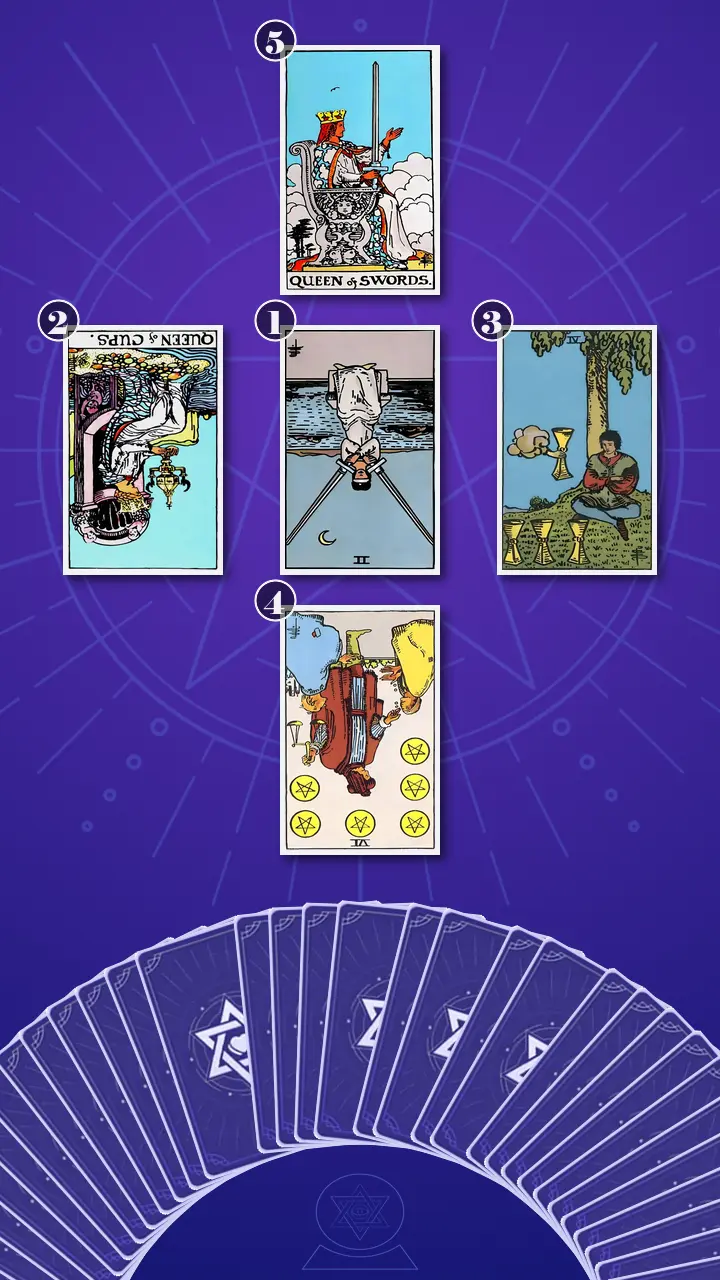
For recurring dating patterns like this, I chose the Relationship Spread · Context Edition. It is one of the best tarot spreads for recurring dating patterns because it does not try to predict where the connection will go. Instead, it examines the interaction itself: the visible loop, each person’s contribution, the imbalance underneath it, and the communication shift that could change the whole atmosphere.
In plain language, I wanted three things from this spread. The center card would show the actual pattern on the phone screen—the stalled date-planning loop. The card beneath it would reveal the shared blind spot: where flexibility had quietly turned into unequal emotional labor. And the final card above it would point to the healthiest next move, not in theory, but in the form of practical dating communication.
I told Jordan what I tell many clients: tarot works best when we let the cards become a structured mirror. Not a verdict. A mirror. And mirrors are useful precisely because they return the power of choice to the person looking in.
Reading the Loop Hidden in Maybe-Mode
Position 1: The Loop That Calls Itself Flexibility
I turned over the first card. “This position shows the visible date-planning loop: how repeated ‘you choose’ turns connection into a stalemate instead of a shared decision.” The card was the Two of Swords, reversed.
In modern life, this is the thread that keeps cycling through ‘whatever works’ and ‘you choose’ until the reservation window closes, the vibe goes strangely flat, and the eventual plan gets made by urgency rather than desire. The energy here is blocked Air leaking sideways: too much self-protection, too little actual statement. It is like a Slack thread where everyone says they are happy either way and the deadline becomes the decision.
I pointed to the blindfold and crossed swords. “This is polite non-movement. Two people holding the door open for each other until nobody actually walks through. It looks harmless on the surface, but it drains chemistry because nobody is willing to let wanting become visible.”
Jordan let out a short laugh, dry and a little bitter. “That is painfully accurate,” she said. Her fingertips tightened around her mug, then loosened. I took that as a good sign. Recognition had arrived before defensiveness could.
Position 2: The Emotional Autocorrect
I turned to the second card. “This position reveals how you manage preference, harmony, and the fear of seeming difficult during planning.” The card was the Queen of Cups, reversed.
Here the pattern became personal. This is the moment Jordan notices one slightly shorter reply, rereads the message three times, and changes I’d love drinks at 7 into anything works :) so she can stay likable without risking a direct ask. The energy is not a lack of feeling. Quite the opposite. It is feeling turned inward so fast that it edits the self before anyone else has to. Like emotional autocorrect changing the sentence before the other person has even read it.
“The Queen of Cups reversed is warmth without enough boundary,” I said. “Sensitivity is a gift. But in this position, you are using that sensitivity to manage the atmosphere before your own preference even gets air. There is a real difference between being warm and being self-erasing.”
I asked her what the last real preference was that she almost sent before softening it. She stared at the card for a moment. “Wine bars,” she said. “I wanted to say I’d rather do wine bars than dinner. But then I heard this voice in my head going, ‘Don’t make this weird. Don’t be too much.’”
She looked down at her phone on the table and rubbed her thumb across the case as though she were smoothing out an invisible draft. That, too, was recognition. Not shame. Just the precise discomfort of seeing the mechanism in daylight.
Position 3: Agreeable, Available, and Still Adding No Momentum
I turned over the third card. “This position reflects what the other person’s ‘you choose’ stance adds to the loop, without claiming certainty about their inner world.” The card was the Four of Cups, upright.
This is not proof that the other person does not care. I am always careful about that. Tarot can show observable energy; it should not be used to fabricate motives. What this card does show is low-initiation ease: happy enough to say yes, slow to suggest anything, leaving the interaction in receive mode unless someone else creates the momentum.
“It is like liking the playlist but never pressing play,” I said. “There is an opening here, but no real reach. A plan cannot become mutual if one person contributes approval and the other contributes movement.”
Jordan nodded slowly. “That is exactly it. Nothing is technically wrong. Nobody is rude. It just... goes nowhere.” Her shoulders made that small, involuntary drop I often see when someone finally hears the subtle part named correctly.
Position 4: The Tilted Scales Beneath the Chat
I turned over the fourth card. “This position exposes the shared blind spot that turns flexibility into unequal emotional labor and weak reciprocity.” The card was the Six of Pentacles, reversed.
Now we had arrived at the real blockage. In modern life, this is Jordan doing the invisible half of the date before the date even exists: comparing spots, checking transit, scanning menus, testing vibe, keeping the tone light, and quietly noticing that the effort is not being matched. The energy here is imbalanced Earth. Not abstract emotion now, but measurable exchange. Who suggests. Who follows through. Who carries the producer work.
At that point my old fieldwork mind stirred. In archaeology, one shard of pottery tells me very little. But a repeated layer of ash, coins, and broken vessels tells me how a household actually functioned over time. I use the same lens in relationships; I call it Emotional Historiography. I do not judge a connection by one vague text. I ask what repeated small behaviors are depositing over time. And here, the record was clear: one person was doing the planning, the tone management, and the emotional labor while the other mostly approved from the sidelines.
“This,” I said, “is like carrying the whole group project while someone else says they are happy to help. It is not only about who picked the place. It is about who keeps the whole machine moving. Stop doing producer work for a two-person date.”
Jordan went very still. First her breath caught. Then her gaze lost focus, as if she were replaying Saturdays at her kitchen counter with cold coffee, OpenTable, Google Maps, and one final ‘sounds good’ from the other side. Only after that did her jaw release. “Yes,” she said quietly. “That is exactly what has been bothering me. If I stop moving it forward, does anything happen at all?”
“That is the useful question,” I replied. “Not who is wrong. Not whether you are overreacting. Simply: what level of mutual effort is actually being shown? Vagueness is still data. And you do not need to fill every silence to know where the effort lives.”
When the Queen of Swords Cut Through the Fog
Position 5: The Warm-Direct Voice That Tests Reciprocity
When I reached the final card, the room altered in that subtle way good readings sometimes do. Outside, a streetcar bell rang once and vanished into the wet Toronto dark. Inside, even the HVAC seemed to recede. I turned over the card. “This position points to the most useful communication posture for breaking the loop and testing mutual effort.” It was the Queen of Swords, upright.
This card is the antidote. In modern life, it is the clean message Jordan had already drafted and deleted: I’d like drinks at 7 at this place. Does that work for you? The energy is balanced Air at last—clear language, direct preference, and enough steadiness to let reality answer back. The raised sword matters. So does the open hand. This is not harshness. It is truth with room.
I brought her back to the Thursday-night sofa scene: laptop closed, three tabs open, thumb hovering over the honest text she never sent. “Right there,” I said, “you were still treating choice as a likability test. But this card asks a better question: what do you actually want, and can the other person meet you there?”
You do not need to stay blindfolded by endless options; raise the Queen of Swords' blade, name one honest preference, and let reciprocity show itself.
The breakthrough is not choosing the perfect date. It is letting one clear preference replace the performance of being endlessly easy to choose.
Jordan’s body reacted before her words did. First there was a small freeze in her chest, as though her breathing had missed one beat. Then her thumb hovered over the edge of her phone and her eyes unfocused, replaying deleted texts, softened drafts, and all those Apple Calendar placeholders called ‘Friday maybe?’ Finally she shook her head, and instead of relief, a flash of resistance came first. “But if I do that,” she said, voice thin and sharp at once, “doesn’t that mean I’ve been helping create the whole problem?”
“It means you were protecting belonging with the tools you had,” I told her. “And now you have a better tool. That is not failure. That is maturity.”
That landed. Her eyes brightened a little, not with tears exactly, but with that tender heat that appears when self-blame begins to loosen. Her shoulders dropped. Her neck lengthened. Then came the second feeling that often follows genuine clarity: a slight dizziness. When the fog thins, responsibility comes back with the view.
I asked her, “Using this lens, can you think of a moment last week when one honest sentence would have changed how you felt?”
She breathed out from deeper in the chest. “Yes,” she said. “I would have known sooner whether he was actually meeting me.” That was the shift in plain language: from tight-throated frustration and quiet scorekeeping to steadier self-respect and clearer evidence of mutual effort. A clear preference is not a character flaw.
Before we moved on, I had her write one sentence in her Notes app: I’d like __ at __. Does that work for you? I did not ask her to send it immediately. I asked her to keep it visible. Practicing clarity still counts, even before it is delivered.
From Insight to Action: The One-Preference Test
When I stitched the whole spread together, the story was remarkably clean. The Two of Swords reversed showed the polite stalemate in dating texts. The Queen of Cups reversed showed how Jordan was softening herself before any real response occurred. The Four of Cups showed the other person contributing too little momentum to build an actual plan. And the Six of Pentacles reversed revealed the deeper truth: flexibility had become a cover for unequal initiative and hidden emotional labor around choosing.
The blind spot was not that Jordan wanted too much. It was that she kept hiding what enough would look like, hoping reciprocity would appear without being tested. Left alone, small vague exchanges harden into a script. In archaeology, we would call that a pattern layer. In dating, it often becomes resentment dressed as being chill. The transformation direction was therefore simple and demanding in equal measure: stop using flexibility to secure likability, name one concrete preference, and let the other person show whether mutual effort is actually present.
I wanted her next steps to be practical, not dramatic. No manifesto. No over-explaining. Just cleaner information. Here I used one of my own frameworks, which I call Amphora Balance. An ancient amphora travels safely when the weight is shared through both handles. If one person grips both sides, the vessel still moves—but all you have learned is who is compensating. Dating works much the same way.
- Save the Warm Clarity Text Tonight, in your Notes app, save one sentence you can use in your next date-planning chat: ‘I’d like drinks at 7 at this place. Does that work for you?’ Use it before you open Resy, Google Maps, or Beli and start doing background producer work. If your body spikes with ‘this sounds too direct,’ do a ten-second check first: unclench your jaw, drop your shoulders, and send it without adding an apology or a fake escape hatch.
- Use the Pause-After-Offer Rule For one week, make only the first planning move with one person you are dating: suggest the time or the place, then stop. Do not also research backup venues, transit routes, and reservation windows unless they answer with equal effort. Give yourself a boundary in real time: ‘I am not touching this thread again for three hours.’ If effort disappears when you stop over-functioning, that is useful information.
- Answer ‘You Choose’ Once, Clearly If they reply with another vague ‘you choose,’ answer once with structure: ‘I’d go with Bar Raval at 8. If that doesn’t work, send me one option you’d prefer by tonight.’ Use this once per thread so you are creating a decision frame, not running a project. Structure is not pushiness. It is how plans become real. Lowest-bar version: offer two time windows first and leave the venue undecided.
None of these actions is about forcing a connection. They are about replacing guesswork with reciprocity data points. That is how clarity begins in dating communication: not by mind-reading better, but by saying one true thing and observing what happens next.

A Week Later: Ownership, Not Certainty
A week later, Jordan sent me a short message. She had used the Notes app template almost verbatim: ‘I’d like drinks at 7 at this place. Does that work for you?’ The reply came back an hour later: 7 was tricky, 8 worked better, and he suggested a spot near Trinity Bellwoods himself. It was a small exchange, but for the first time the plan did not float in vague maybe-mode. It had shape. It had shared movement.
She told me she slept properly that night, then woke with the old thought—what if that was too much?—and laughed before making coffee. Clearer, still a little tender. That is usually what real change looks like.
I have always liked readings that do this. The Relationship Spread · Context Edition did not tell Jordan what to feel or whom to date. It simply helped her stop confusing smoothness with reciprocity. Clarity did not arrive as certainty. It arrived as ownership.
Sometimes the loneliest part is not the vague plan itself but the exact moment your throat tightens over the keyboard and you decide being easy to date matters more than saying you wanted the tapas place at 7.
If you let one honest preference do the sorting this week, what would be the easiest true sentence you could send—your own small Queen of Swords text?
Every reading at AceTarot is a Journey to connect with inner wisdom and empower next step.
Learn more about our Journey to Clarity.