A Borrowed Bike Came Back Flat, and Fairness Had to Be Said Out Loud

Finding Clarity in the 6:12 p.m. Queen Street Window
If you’re a 20-something city commuter who relies on your bike to avoid TTC delays, and you felt your stomach drop when you saw the flat, you already know this isn’t ‘about a tire.’
Taylor (name changed for privacy) showed up to our session with that specific kind of tension you can’t talk yourself out of—the kind that lives in your jaw first. She told me she’d been standing outside a bike shop window on Queen St W in the rain, her reflection ghosted over tube prices taped to the glass. Streetcar bells kept chiming behind her, and the air smelled like wet asphalt and chain lube. Her phone screen was smudged from her commute, thumb hovering over Messages like it was a tiny cliff edge.
“I don’t want to make a big thing out of it,” she said, the words coming out careful, like they’d been rehearsed all day. “But it also feels not okay.”
Her friend had borrowed her bike. Returned it. Flat tire. No mention. No, “Hey, something happened.” Just a handoff and a wave, like the consequence would evaporate on its own. Since then, she’d been doing what so many people do when they’re stuck at a friendship boundary: replaying the handoff moment, running fairness math (tube + labour + the time it’ll steal from tomorrow morning), drafting a text, deleting it, and then feeling worse because silence starts to feel like agreement.
The conflict underneath was clean and brutal: wanting to stay easygoing and generous vs wanting respect and accountability.
Resentment, for Taylor, wasn’t a dramatic explosion. It was a tight, quiet heat—like swallowing a mouthful of coffee that’s too bitter, then pretending you’re fine while your chest stays keyed up and your hands keep checking your phone like it might deliver permission to speak.
I nodded, keeping my voice grounded. “We can make this small and still make it real. Let’s not turn it into a referendum on who you are as a friend. Let’s turn it into clarity: what’s fair, what you’re asking for, and what you’ll do next.”

Choosing the Compass: How Tarot Works for Boundary Conversations
I had Taylor take one slow breath with me—not as a ritual for the universe, just a nervous system transition. A way to move from mental court case to present reality. While I shuffled, I asked her to hold the question in a simple sentence: “They returned my bike with a flat—what boundary do I set?”
“Today, we’ll use a spread I designed for moments exactly like this,” I said. “It’s called the Four-Layer Insight Ladder · Context Edition.”
For readers who wonder how tarot works in real life: I don’t use the cards to tell you what someone else is secretly thinking. I use them like a structured conversation tool—an emotional X-ray plus a plan. This spread is built for situations that look simple but feel sticky: a borrowed item returned damaged, the guilt about asking for repair money, the fear of sounding petty, the drafting-and-deleting loop.
The rationale is straightforward: we move rung by rung from what happened (the visible incident), to the internal hesitation that keeps you frozen, to the deeper rule driving that hesitation, then to a fairness principle you can stand on, a script you can actually send, and finally a repeatable standard so you don’t end up here again. In other words: a tarot spread for boundaries, reciprocity, and fair repair conversations—designed to produce actionable advice, not vague vibes.
“The first card will show what the ‘flat tire moment’ is really pointing to,” I explained. “The middle cards will name the exact split inside you—why the send button feels like a threat. Then we’ll land on the boundary principle and the cleanest way to communicate it.”
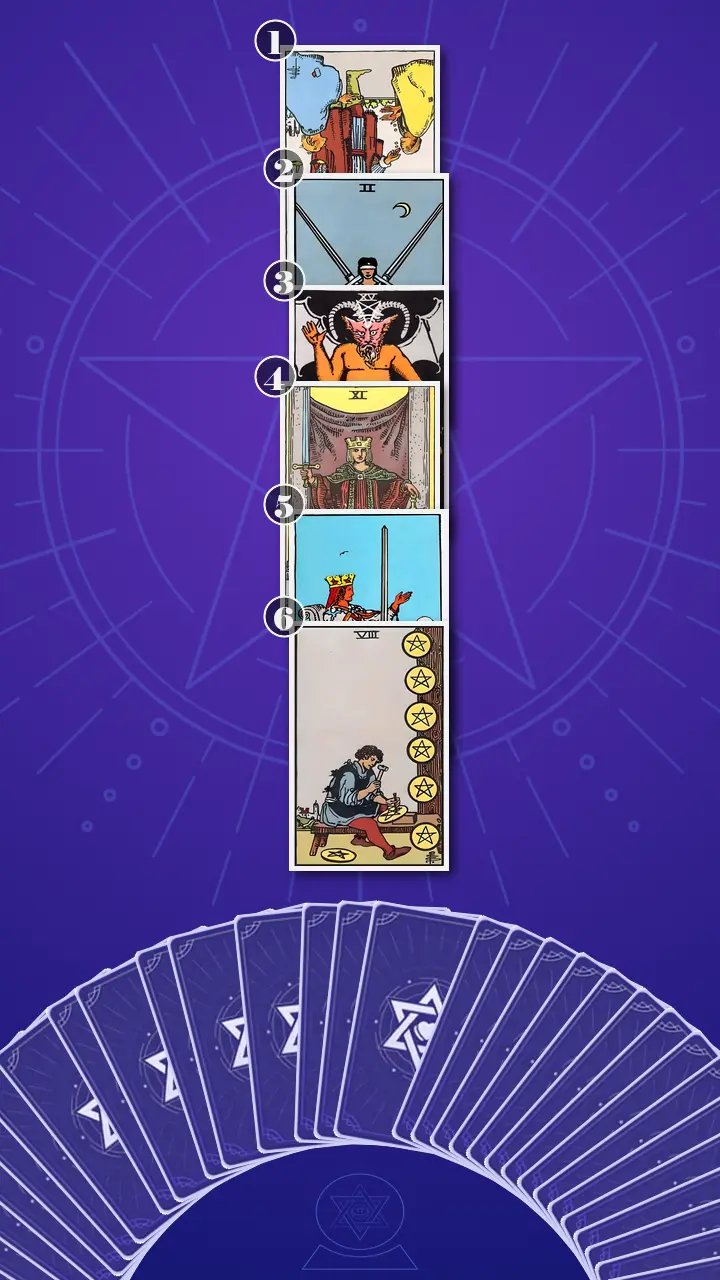
Reading the Ladder: The Friendship Tax in Black and White
Position 1 — Surface symptom: what the situation is asking you to notice about reciprocity right now
I turned over the first card. “Now we’re looking at the position that represents the surface symptom: what the situation is asking you to notice about reciprocity right now—the observable ‘flat tire moment.’”
Six of Pentacles, reversed.
“This is the card of giving and receiving—scales, coins, the whole exchange,” I said. “Reversed, the energy is blocked. It’s imbalance.”
I used the translation that always lands in modern life: You discover the flat the moment you get your bike back and your brain starts running a tiny invoice: the tube, the labour, the time you’ll lose tomorrow, and the emotional effort of ‘not making it a thing.’ You’re not angry because you’re cheap—you’re angry because the exchange got lopsided without anyone naming it.
“It’s like paying a friendship subscription fee you never agreed to,” I added, because her face already said she knew that exact feeling. “A hidden charge. Not huge money, but huge meaning.”
Energetically, this is distorted Earth: practical resources—money, time, access—moving in one direction. The tilted scales on the card are the whole story: they got the benefit (a ride), you got the bill (repair, disruption, stress).
Taylor gave a short laugh that wasn’t really a laugh—more like air escaping. “Ugh. Yes. That’s… honestly kind of mean how accurate that is.” Her shoulders rose as she spoke, like her body was bracing for the part where she’d have to defend herself for caring.
Position 2 — Inner contradiction: the exact hesitation or split that stops you from setting a boundary
I turned to the next rung. “Now we’re looking at the position that represents the inner contradiction—the exact hesitation that stops you from setting a boundary.”
Two of Swords, upright.
“This is the draft message as a lifestyle,” I said gently. “A stalemate. Protection through postponing.”
And again, I anchored it to her real-life loop: You’re stuck in the exact moment before you set a boundary: staring at the half-written text, rehearsing your tone, trying to pick the version of yourself that won’t be judged. The stalemate isn’t about what’s fair—you already know—it’s about not wanting to risk the social fallout of saying it plainly.
“In the card, the blindfold isn’t ignorance,” I continued. “It’s self-protection. The crossed swords are mental defense. And in your life that looks like: thumb hovering over send… phone locks… and suddenly you’re looking for your bike pump instead.”
I kept it crisp, because this card needs simplicity. “Drafting is not the same as deciding.”
She let out a quiet exhale, the kind that softens the chest by one millimeter. Her hands, which had been fidgeting with her sleeve, went still for a second—like being accurately named gave her nervous system permission to stop performing competence.
Position 3 — Root driver: the deeper fear/attachment or identity rule that keeps the pattern repeating
I turned over the third card. “Now we’re looking at the position that represents the root driver—the deeper fear or identity rule that keeps this repeating.”
The Devil, upright.
Whenever The Devil shows up in a boundary reading, people expect it to mean something dark or dramatic. Usually it’s quieter: a role you can’t stop playing, even when it’s costing you.
I gave Taylor the modern translation straight: Under the tire situation is a bigger deal: the role you’ve been playing in newer friendships—‘I’m low-maintenance, I don’t ask for much’—because it feels safer than risking being seen as difficult. The trap is that you end up paying for closeness with your time, money, and swallowed frustration.
“This is the unspoken contract,” I said. “The Terms of Service you didn’t read, but somehow you keep clicking ‘Agree’ on: I’ll be easy if you keep me included.”
Here’s the key symbol: the chains in The Devil are loose. “You’re not actually trapped,” I said. “You’re following a habit that once kept you safe—being the chill one, the no-drama one, the person who doesn’t ‘nickel-and-dime.’”
I watched her face heat a little at the word nickel-and-dime. That embarrassment is part of the bind: the fear of being labeled intense in the group chat, the fear a mutual friend will hear a version of the story where she’s “doing too much.”
This is where my own work—my version of Social Pattern Analysis—becomes useful. I told her, “In groups with casual sharing norms, there’s an invisible rule that keeps people from speaking plainly: Whoever names the cost becomes ‘the one making it awkward.’ That’s the interaction barrier. It’s not that your request is unfair. It’s that the group’s vibe rewards silence and punishes clarity.”
Taylor’s eyes flicked away from the cards, unfocusing for a second—like she was replaying every time she’d smiled at a meme about boundaries while swallowing her own. Then she nodded once, sharp. “Yeah. That’s… exactly it.”
When Justice Spoke: Turning “Awkward” Into “Clear”
Position 4 — Boundary principle: the clearest standard of fairness/responsibility to anchor your request
I slowed down before turning the next card. The room got quieter in that way it does right before something lands—like even the fridge hum seems to wait.
“We’re turning over the core of the reading,” I said. “Now we’re looking at the position that represents the boundary principle—the clearest standard of fairness and responsibility to anchor your request.”
Justice, upright.
I felt my own internal click. Justice is not about being cold. It’s about structure—fairness you can stand on when your emotions are trying to drag you into a personality debate. In my other life, in fragrance, we talk about structure all the time: top notes that grab attention, a heart that tells the truth of the blend, and base notes that last. Justice is a base note. It holds.
I gave her the modern scenario first: You turn the situation into a clean, adult agreement: ‘When you borrow something, you return it in the same condition. If something happens, you cover the fix.’ It’s not a character debate or a vibe check—it’s a proportional repair request grounded in facts (what happened, what it costs, how to resolve it).
“The scales show balance,” I said, “and the upright sword is direct truth. Fair isn’t harsh. Fair is just clear.”
Setup: Outside the bike shop window, prices taped behind the glass, phone in hand—Taylor had been trying to decide whether to be ‘chill’ or be ‘fair,’ as if those were mutually exclusive identities and not just two different nervous-system strategies.
Delivery:
Not ‘I have to swallow this to stay liked’—choose fairness and clarity, and let Justice’s scales set the standard.
I let the sentence sit. No rush to soften it. No apology tour for wanting reciprocity.
Reinforcement: Taylor’s body reacted in a chain, not a single emotion. First, a tiny freeze—her breath caught high in her chest, and her fingers stopped moving mid-fidget. Second, cognitive seep-in—her eyes went slightly glossy and unfocused, like she was running a silent highlight reel: the handoff, the group chat, the bike room, the Notes app drafts. Third, release—her shoulders dropped with an audible exhale, and her jaw unclenched like it had finally been given a job other than “hold this in.” Then came the complicated part: a flicker of anger, not at her friend, but at the rule she’d been living by. “But if I do that,” she said, voice sharper for a moment, “doesn’t it mean I’ve been… letting people get away with stuff?”
“It means you’ve been paying for belonging,” I answered. “And you don’t have to keep renewing that subscription.”
I grounded it in the exact exercise from the card’s energy—Justice needs practice, not just insight. “Try a 10-minute ‘Justice Draft,’ and you can stop anytime if you feel activated,” I said. “Open Notes. Write the fact in one line: ‘The bike came back with a flat.’ Write the ask in one line with a number: ‘Can you cover/split $__ for the repair?’ Then set a two-minute timer and read it out loud once. If your body spikes—jaw, chest—shorten it, not soften it.”
Then I asked the question that turns insight into lived memory: “Now, with this new lens—fairness out loud—think back to last week. Was there a specific moment when this could’ve helped you feel different?”
Taylor swallowed, then nodded. “Sunday night. I had three versions in Notes. Polite, jokey, and… like a manifesto.” She made a face. “If I’d had a standard, I wouldn’t have been trying to win an AITA trial in my head.”
“Exactly,” I said. “This is the shift from swallowing the cost to stay liked to calm self-respect through clear fairness and accountability. You’re moving from fog to structure.”
The Queen of Swords in Your Messages App
Position 5 — Delivery: how to communicate the boundary in a way that is clean, direct, and self-respecting
I turned over the next rung. “Now we’re looking at the position that represents delivery—how to communicate the boundary in a way that’s clean, direct, and self-respecting.”
Queen of Swords, upright.
“This is the grown-up part of you that can say something true without turning it into punishment,” I said. “Raised sword, open hand.”
I tied it to her exact scenario: You send a short text that doesn’t apologize for existing: one fact, one request, and then you stop typing. You don’t soften it into hints, and you don’t inflate it into a lecture. You let the other person show who they are in response to clarity.
“Here’s the Queen’s method,” I said, and I could feel her attention sharpen because this part is actionable. “Fact. Request. Pause.”
As a perfumer, I spend my life thinking about impact. Too much sillage—too big a scent trail—and people feel overwhelmed. Too little, and you disappear. This is where my strategy of first impression calibration through sillage control translates perfectly into texting: you don’t need a paragraph. You need the right dose, placed cleanly.
“Three sentences max,” I told her. “If you start writing a thesis, you’ve left the Queen and you’ve gone back to managing their feelings.”
Taylor gave a small, reluctant smile. Her shoulders rose—then fell. Like she could feel the difference between clarity and overexplaining in her body.
Position 6 — Integration: what it looks like when the boundary becomes a repeatable practice
I turned the final card. “Now we’re looking at integration—what it looks like when this becomes a repeatable practice: repair plus future terms.”
Eight of Pentacles, upright.
“This is the craftsperson card,” I said. “Skill-building. Standards. Doing the small thing the same way until it becomes muscle memory.”
And again, the real-life translation: You get the tire fixed, document the cost, and set a repeatable standard for future lending—either a quick ‘before/after’ check, a simple expectation spoken upfront, or a personal rule about who gets access to your stuff. The win isn’t only the bike; it’s the new muscle memory of not absorbing hidden costs.
“This card protects you from the overcorrection,” I added. “It keeps you from swinging into ‘I’ll never lend anything again’ or ‘I need Terms & Conditions.’ It says: make it normal. Make it repeatable.”
Taylor nodded, but then—an unexpected snag, very real. “Okay,” she said, “but I genuinely don’t know when to send it. If they reply weird, I’ll spiral. And if I send it at night, I won’t sleep.”
“That’s not you being dramatic,” I said. “That’s your nervous system trying to protect belonging. So we work with that, not against it.”
From Insight to Action: The Justice Draft and the Sillage Rule
I pulled the whole ladder together for her in one clean story—because this is how finding clarity happens: you stop treating each piece as random and start seeing the pattern.
“Here’s what the spread says,” I summarized. “On the surface, the Six of Pentacles reversed shows a lopsided exchange—your generosity turned into a one-way transaction, a friendship tax. The Two of Swords explains why it persists: you pause at the send button because you’re trying to stay ‘easy’ and avoid social fallout. The Devil reveals the deeper rule—be low-maintenance to keep belonging. Justice is the pivot: we move from ‘will they like me?’ to ‘what’s fair repair?’ The Queen of Swords gives you the delivery: clean words, no apology. And the Eight of Pentacles makes it a standard, so you don’t keep paying with resentment.”
“The cognitive blind spot,” I added, “is thinking you need the perfect wording to stay safe. That’s the trap. The transformation direction is simpler: shift from keeping the peace by swallowing the cost to defining fairness out loud and letting people respond to clarity.”
Then I gave her concrete next steps—small, specific, and doable.
- The Receipt Anchor (2 minutes)Before you text, get the exact number: screenshot the bike shop estimate/receipt for the tube/patch/labour (or take a photo of the posted price if you’re walking by).If your brain starts arguing with itself, touch the screenshot and say: “Facts first.” It keeps you in Justice, not in vibes.
- The “Justice Draft” (10 minutes, timer on)Open Notes and write two lines only: (1) “The bike came back with a flat.” (2) “I’m getting it fixed today; it’s $__ — can you cover it or split it?” Then read it out loud once.If your jaw tightens, shorten the sentence—not the ask. Clarity reduces activation over time.
- The Queen’s Text (3 sentences max)Send this during a time you can handle a reply (lunch break, end of workday): “Hey—when I got my bike back the tire was flat. I’m getting it fixed today; it’s $__. Could you cover it (or split it with me)?”Use my “sillage control” rule: no extra context, no pre-emptive defensiveness. Then put your phone down for 60 seconds before reading their reply.
- The Grounding Cue (30 seconds)Right before you hit send, do one sensory anchor: a steady woody perfume on your wrist (cedar, vetiver, sandalwood) and one slow inhale.This is my professional presence enhancement with woody accords: it’s not magic—it’s conditioning. You’re teaching your body what “steady” feels like while you do a hard thing.
- Repair-Then-Standard Reset (next time you lend anything)Do a quick before/after check (2 minutes): tires inflated, lights working. Decide your private rule: “I only lend my bike to people who can fix/replace what they break.”Keep it light. This is Eight of Pentacles: a repeatable standard, not a courtroom.
I looked at her and said the line I always mean: “Resentment is a delayed boundary—delivered with interest.”
And because Taylor’s social battery was clearly running hot from the whole situation, I added one more tool from my own kit: “After you send it, do something that signals ‘reset’ to your body—a quick citrus mist, wash your hands with a bright soap, step outside for one block. Social energy renewal with cleansing citrus sprays sounds fancy, but it’s just a clean sensory full stop.”

A Week Later: The Quiet Proof
Eight days later, Taylor messaged me a screenshot—not of a manifesto, not of five drafts. Just a clean exchange. She’d sent the three-sentence text at 4:10 p.m., not at midnight. Her friend replied, “Oh no—sorry. Yeah, send me the cost. I’ll e-transfer.”
Her follow-up message to me was one line: “I didn’t die. And my bike is fixed.”
There was still a little bittersweet in it, the kind that’s honest: she told me she’d slept through the night for the first time all week, but when she woke up, her first thought was still, What if they think I’m annoying? Then she said she laughed at herself—small, quiet, and real.
That’s the Journey to Clarity I trust: not instant fearlessness, but steadier self-respect. Not a perfect outcome, but a clear standard you can live inside.
When you keep swallowing the cost to stay easy to love, your body holds the bill—tight jaw, tense shoulders, and that quiet, hot resentment you don’t want anyone to see.
If you let fairness be a normal part of respect—not a big emotional referendum—what’s the smallest, cleanest sentence you’d want to say this week?