From Self-Editing in Meetings to Quiet Courage: Jordan’s Shift at Work

Finding Clarity in the Drafts Folder
You’re a 20-something in London tech who can explain a UX decision perfectly in a doc… but in a fast meeting you go quiet and later rewrite a Slack message three times before deleting it.
Jordan (name changed for privacy) said that sentence like it was a confession and a punchline at the same time.
We were on a video call, but I could see their whole week in the way their shoulders hovered—like they were bracing for an impact that never fully arrived. When they talked about meetings, their hand kept drifting to their throat, two fingers pressing lightly as if to hold a word in place.
“It’s like… I always have something to say,” they told me, eyes flicking off-camera as if they could still see the meeting room. “I just don’t say it fast enough. And if I say the wrong thing, people will remember it forever.”
I pictured the scene they described: 10:12 AM near Old Street, glass-walled meeting room, Figma on the projector, burnt espresso in the air and that steady projector-fan whir. A teammate talking over the exact space Jordan was about to enter. Their notebook hugged to their chest like a shield. Their breath held so tightly it barely counted as breathing.
Jordan’s question wasn’t really “How do I talk more?” It was sharper and quieter: Grandma’s scrapbook—‘the quiet one’—what identity script runs me?
Because that label wasn’t just a family caption. It had become a survival setting. A personality preset.
The emotional texture was specific: a tight throat and a paused breath right before speaking, followed by that heavy stomach drop when the moment passed and someone else’s voice took the slot. Like watching your own cursor hover over “Send,” then feeling your hand choose invisibility.
I leaned in, slow and steady. “I believe you. And I want to say this early, because it matters: You’re not ‘the quiet one.’ You’re someone who learned that being easy was safer than being known. We’re not here to make you louder. We’re here to help you find clarity—so you can choose your voice, instead of getting chosen by a caption.”
Choosing the Compass: How Tarot Works When the Problem Is a Script
I asked Jordan to take one breath that wasn’t performative. Not a “calm down” breath—just a come back into your body breath. Then I shuffled slowly, the way I used to do on transoceanic voyages when a lounge full of strangers would turn quiet for one question that felt too personal to say out loud.
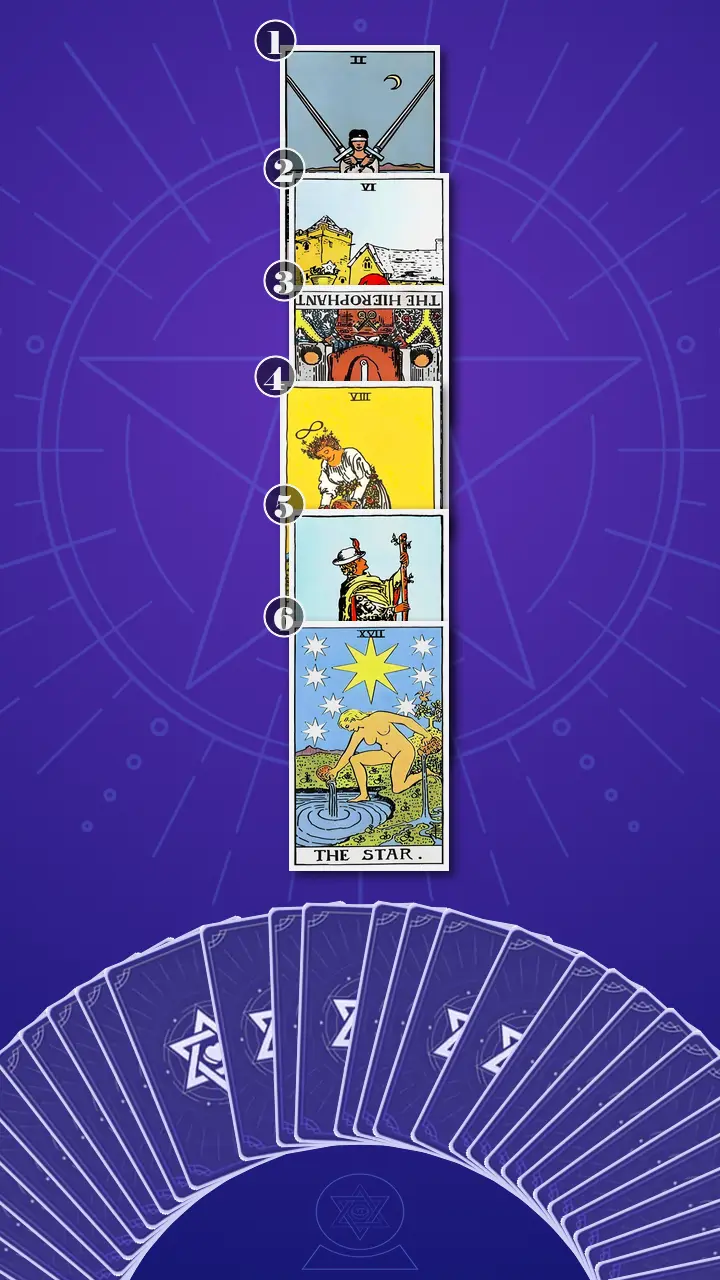
“Today,” I said, “I want to use a spread called Four-Layer Insight Ladder · Context Edition.”
Here’s why this spread fits a question like Jordan’s: when you’re trying to understand why you freeze in meetings even when you have ideas, the answer usually isn’t sitting on the surface. It’s layered. You have the visible behavior (the pause), then the emotional origin (why that pause once felt smart), then the hidden rulebook (the inner standards that police you), and only then do you get to a realistic path forward (transformation energy → micro-action → integration). Tarot works well here because it gives the mind a map—something to point at—so you can talk about a pattern without becoming the pattern.
I told Jordan what to expect as I laid the cards in a vertical ladder. “The first card will show what the ‘quiet one’ script looks like in trackable behavior this week. The middle card will touch the invisible rulebook behind it. And we’ll have a turning-point card—your medicine—followed by a one-week experiment.”
“Okay,” they said, voice small but present. “I like that it’s… an experiment. Not a personality verdict.”
Reading the Caption Line by Line
Position 1: The Observable Pattern — Two of Swords (upright)
I turned over the first card. “Now we’re looking at the card that represents how the ‘quiet one’ script shows up right now as a concrete, observable pattern in your daily interactions.”
Two of Swords, upright.
“This is the card of the pause that looks like calm,” I said. “But it’s not relaxed. It’s guarded.”
I tapped the blindfold in the image with my nail. “In modern life, this is exactly what you described: in a rapid-fire product meeting, you have a solid UX concern, but you keep a neutral face, hands tight around a notebook, waiting for the perfect gap. The gap never comes. Afterward, you try to regain control by drafting a follow-up in Slack—then delete it, because sending it would mean being clearly seen.”
Energetically, this card is blocked Air: thinking used as armor. The mind says, “If I just calculate the risk perfectly, I won’t be the problem.” But the cost is you living in Drafts mode—everything prepared for approval, nothing allowed to be real-time.
I offered Jordan the question I use when I’m trying to separate “thoughtfulness” from “self-erasing.” “When you don’t speak, is it because you have nothing to say… or because you’re preventing a consequence you fear?”
Jordan gave a small laugh that didn’t reach their eyes. It had a bitter edge. “That’s… cruelly accurate,” they said. “I’m literally like—mic muted forever because I’m scared of background noise. Except the noise is me.”
I nodded, letting that land. “Yes. And the scary part is: the longer you keep the mic muted, the more your nervous system decides that speaking is an emergency.”
Position 2: The Origin Story — Six of Cups (upright)
I turned over the next card. “Now we’re looking at where the script first got reinforced: the emotional origin story and the kind of early reward it offered.”
Six of Cups, upright.
“This is the nostalgia glue,” I said. “The sweetness that makes the label feel true.”
In modern life, this looks like: Jordan flips through family photos or gets a nostalgia-text from a relative: ‘You were always the quiet one.’ It’s meant lovingly, and that’s what makes it sticky. The warmth of the label makes it harder to question—even though adult Jordan feels boxed in by it.
I watched Jordan’s face tighten almost imperceptibly at the word lovingly. Their eyes softened, then hardened again, like they were trying to respect their family and also protect themselves from the hook.
“I’m going to borrow a lens from where I grew up,” I said. “In Venice, you can call to someone across a canal and hear your own voice come back differently—echoed, warped, amplified. I call this Generational Echo Mapping. Family labels are echoes. They were spoken once, then repeated until they start to sound like truth.”
Jordan swallowed. “It’s always at weddings,” they said. “Or when my gran texts old pictures. Like—‘Jordan was always the quiet one ❤️.’ And I feel… warm for half a second. And then—cold.”
“That cold pinch matters,” I said gently. “It’s your present self saying: This role kept me safe, but it’s not the whole story.”
Position 3: The Hidden Rulebook — The Hierophant (reversed)
I turned over the third card. “Now we’re looking at the hidden rulebook behind the script: what you believe you must do to stay acceptable and safe in groups.”
The Hierophant, reversed.
“This is the inner gatekeeper,” I said. “Not your actual boss. Not your actual friends. The voice in your head that acts like there’s a right way to be—so you can be blessed as ‘good.’”
In modern life, it’s this: Jordan walks into every group setting like there’s an invisible handbook: be agreeable, be appropriate, don’t disrupt. Even when nobody is demanding it, they self-censor to pass the imagined test. Their opinions get translated into ‘neutral helpfulness’ so they can stay likable—and uncontroversial.
I could feel Jordan nodding before they even meant to. Their body recognized it faster than their pride did.
“Here’s the mechanics,” I said, keeping it plain. “Trigger belief: ‘If I’m clearly seen, I can be judged and rejected.’ Coping behavior: stay neutral, wait, self-edit, let others lead. Short-term relief: no immediate awkwardness. Long-term cost: invisibility, resentment, and weaker self-trust.”
I paused, and then I gave them a line I wanted them to remember without shame. “Silence can be a coping skill—and still not be your identity.”
Jordan’s mouth opened, then closed. A small “oh” without sound. Their fingers tightened around their water glass, then loosened—like their body was running a test: Is it safe to admit this is a rulebook?
And then came the “handbook glitch”—the moment the spell breaks just enough to see the code.
“I always say ‘I don’t mind,’” Jordan said, voice sharper now. “Even when I do. It’s like my mouth does it before I decide.”
“That’s the handbook auto-fill,” I said. “And reversed Hierophant is the permission slip to edit it.”
When Strength Spoke: Quiet Courage Instead of Loudness
Position 4: The Transformation Key — Strength (upright)
I held my hand over the next card for a beat longer than the others. The room—our shared silence across screens—felt different, as if the air had thickened and then decided to settle.
“Now we’re looking at the transformation key: the inner quality you can embody to re-author the identity without becoming a different person.”
Strength, upright.
In modern life, it’s this: Jordan speaks once in a meeting with a steady tone—no over-explaining, no apologising for having a view. They let a small silence happen afterward without rushing to fill it. The power isn’t volume; it’s self-trust strong enough to tolerate being perceived.
“Strength is not the ‘be bold’ card,” I said. “It’s the ‘be steady’ card. It’s a calm hand on a reactive lion. Fear doesn’t get fired—it gets held.”
As a Jungian psychologist, this is where I see the shift from persona to self: from performing the version of you that gets approved, to inhabiting the version of you that feels true. I’ve watched people on ships cross entire oceans with a perfectly pleasant mask—then crumble in private cabins because they never got to be real. This card is the opposite of that private collapse.
And this is where I brought in my own signature lens—because Strength, for Jordan, wasn’t abstract. It was craft.
“I want to use something I call the Glass Workshop Metaphor,” I said, thinking of Murano: furnaces, breath, hands that can’t tremble. “In a glass workshop, being ‘careful’ is not the same as being ‘small.’ The glass doesn’t want you to disappear. It wants steady heat and clean movement. If you hold your breath, your hands jitter. If you over-control, the shape collapses. The craft is: breathe, stay present, let the material be seen.”
Jordan’s eyes flicked up to the camera. For the first time, they looked directly at me, not slightly to the side.
Setup (the mind-state before the shift): I could feel them in the familiar loop: it’s 8:47 PM on the Northern line, phone warm in your hand, you rewrite the Slack message again—then delete it—and that quiet stomach drop turns into another private rehearsal. The anxiety says: If I don’t get it perfect, I shouldn’t say it.
Delivery (the sentence that changes the angle):
Stop treating silence as the only way to stay safe, and start practicing gentle courage like Strength—hands steady, heart open, and your voice no longer kept behind a lock.
I let the silence sit for two seconds. Long enough for the nervous system to hear it. Short enough not to turn it into a performance.
Reinforcement (the body’s response, layered): Jordan froze first—the kind of stillness that isn’t calm, it’s a system pausing. Their breath stopped mid-inhale. Their eyes went slightly unfocused, as if a memory replayed behind their pupils: a meeting, a family dinner, a caption typed with a heart emoji. Then their face changed in a small cascade: brows lifting, lips parting, a blink that came too slowly. Their shoulders, which had been almost up near their ears, dropped by a centimeter. Their jaw unclenched like a door unlocking. And then—unexpectedly—anger flashed across their expression, hot and quick.
“But if that’s true,” they said, voice tighter, “doesn’t that mean I’ve wasted years? Like I’ve been… lying?”
I met that honestly. “It means you’ve been surviving,” I said. “A survival strategy isn’t a moral failure. It’s a nervous system doing its best with the rules it learned.”
Jordan exhaled, shaky but real. The anger softened into something like grief, and then into relief so quiet it almost looked like tiredness.
“And it also means,” I added, “you don’t have to become someone else. You can become more you.”
I watched their hands—still visible at the bottom edge of the camera—release their grip on the mug. They set it down. Both palms rested on the desk, open.
“Okay,” Jordan whispered. “So the goal isn’t ‘be louder.’”
“Exactly,” I said. “You don’t need a louder voice—you need a voice that doesn’t ask permission. Now, with that new lens—can you think of a moment last week when your throat tightened, and this would’ve changed the outcome?”
They nodded, slow. “Wednesday. Someone asked about onboarding. I had a clear take. I waited. I didn’t say it. I went into Slack after and… did the delete thing.” They looked away, then back. “If I’d said it once, cleanly… it would’ve been fine.”
“That’s the bridge,” I said. “From contracted self-editing to grounded self-trust. Not a makeover. A rep.”
Position 5: The One-Week Experiment — Page of Wands (upright)
I turned over the next card. “Now we’re looking at a one-week, low-stakes experiment that translates insight into behavior and builds evidence for self-trust.”
Page of Wands, upright.
In modern life, it’s this: Jordan tries a ‘v1 opinion’ in public: sharing an early idea in the first ten minutes of a workshop, framing it as a starting point. They treat the response as information, not a verdict. It’s awkward in a normal way—and that’s exactly what builds evidence that they can survive visibility.
Energetically, this is Fire in beginner mode. Not a bonfire. A pilot light.
I smiled, because this is where people often try to skip ahead to “confidence.” “Page energy is not ‘I feel ready.’ It’s ‘I’m willing to be a beginner where it matters.’”
Then I said the phrase I wanted them to carry like a simple tool. “Say it once. Say it clean. Let it land.”
Jordan’s mouth twitched. “That sounds terrifying,” they said. Then, after a beat: “But also… simpler than what I do now.”
Position 6: Integration — The Star (upright)
I turned over the final card at the bottom of the ladder. “Now we’re looking at integration: what it looks like when the new identity script starts to feel natural and sustainable.”
The Star, upright.
In modern life, it’s this: Jordan stops aiming for a perfectly approved persona and starts using an internal reference point: ‘What feels true today?’ In groups, they share small honest preferences consistently, so visibility becomes normal and breathable instead of a high-stakes event.
This isn’t a dramatic reinvention. It’s “clean UI” energy—fewer hidden states, fewer defensive pop-ups. Less armor. More honest defaults.
Jordan stared at the card a long moment. “So the opposite of ‘quiet one’ isn’t… being a different personality.”
“No,” I said. “The opposite is: you’re not hiding in shame. You’re letting yourself be seen without bracing.”
The Invisible Handbook Audit, Plus a Dock-Bollard Boundary
I leaned back and threaded the whole ladder into one story—the kind that answers “why” without trapping you in it.
“Here’s what I see,” I said. “The Two of Swords shows the present lock: you freeze and self-edit to stay safe. The Six of Cups explains why the lock feels emotionally correct: quietness once earned you belonging. The Hierophant reversed reveals the mechanism: an invisible rulebook that equates being ‘good’ with being small. Then Strength brings the medicine: quiet courage—self-trust that can tolerate being perceived. Page of Wands turns that into evidence through small reps. And The Star is the long-term outcome: you stop building a persona that will be approved and start living from what feels true.”
“Your blind spot,” I added, “is that you’ve been treating your real-time self like it’s unreliable, and your drafted self like it’s the only safe version. The transformation direction is the opposite: shift from performing quietness to practicing small, honest self-expression as a repeatable experiment.”
Then I gave Jordan actions—small enough to start, concrete enough to measure. I anchored them in one of my favorite tools from Venetian docks, because boundaries are not dramatic speeches. They’re posts you tie your boat to.
“I want to use my Bollard Marking Method here,” I said. “In Venice, boats don’t stay safe by guessing where the edge is. They stay safe because the dock has clear bollards—fixed points you can tie to. Your voice needs a few fixed points too.”
- One-Sentence Preference Drop (first 10 minutes)In your next team meeting or workshop, speak once in the first 10 minutes: “My take is we should test option B first.” Then stop. No three disclaimers, no apology-laugh.Aim for 60% polished, not 100%. If your brain screams “too direct,” label it: “Old handbook doing quality control.”
- Draft-to-Send Rule (No Third Rewrite)The next time you catch yourself rewriting a Slack message, you get two edits. On the third rewrite urge, you either send it as-is to a low-stakes channel or one trusted colleague, or you close Slack for 10 minutes.Ask yourself: “Am I clarifying—or am I disappearing?” If it’s disappearing, step away for 10 minutes and come back with one clean sentence.
- Hands-Open Body Reset (one breath)Right before you speak, put both hands flat on the table (or on your thighs if you’re on Zoom), take one slow breath, and then talk. This is you practicing Strength: steady hands, present body.If you spiral afterward, set a 2-minute timer and name sensations (“tight throat, heat in face, urge to fix”) without fixing them. Clarifying later is allowed; self-erasing isn’t required.
Jordan hesitated—then gave me the most honest obstacle. “But what if I do this and I sound… intense?”
“Then you’ll have data,” I said. “And we’ll keep the experiment small enough that your nervous system doesn’t treat it like a life-or-death trial. Page of Wands isn’t asking for a rebrand. It’s asking for one rep.”
“And for family,” I added, “a bollard can be a sentence too. If someone says, ‘You were always the quiet one,’ you can answer with something gentle and true: ‘I’m still me—I’m just practicing being more direct.’ You’re not fighting them. You’re marking your dock.”

A Week Later: The Caption Written in Pencil
A week later, Jordan messaged me: “I did the first-10-minutes thing. My voice shook a tiny bit, but I said it clean. Nobody freaked out. Someone actually said, ‘Good point—let’s test that.’ And then I sat there feeling weirdly… empty? Like I was waiting for punishment that didn’t come.”
I could picture the after-scene, the bittersweet version of change: they slept a full night for the first time in a while, but the next morning the first thought was still, What if I did it wrong?—and then, this time, they noticed the thought and didn’t obey it.
That’s the real Journey to Clarity: not instant fearlessness, but a new relationship with fear. A move from being described to choosing your own caption.
And if you want a sentence to keep, let it be this: When you feel your throat tighten and your breath pause right before speaking, it’s not that you have nothing to say—it’s that a part of you still believes being clearly seen could cost you belonging.
So I’ll leave you with the same question I left Jordan with—simple, practical, and quietly radical: If you didn’t have to become louder—just a little more real—what’s one small preference you’d let yourself say out loud this week?