Offer-Deadline Paralysis: When Burnout Counted as a Real Cost

The 11:47 p.m. Loop of Leaving a Stable Job or Staying Burned Out
If you keep drafting a resignation note, deleting it, and opening a salary calculator instead while Slack or Teams pings after hours, you are probably not just overthinking a job offer. You are probably in golden-handcuffs burnout.
When Casey (name changed for privacy) sat across from me after the lunch rush, the back corner of my café still smelled like espresso and orange peel. What she brought in with her, though, was Tuesday night in Toronto at 11:47 p.m.: the offer letter glowing on her laptop, Teams buzzing face-down beside a cold mug of tea, and a resignation draft half-written in Notes. The fridge hummed. The screen light was too blue. Every vibration pulled her shoulders closer to her ears.
She looked at me the way people do when they are tired of sounding reasonable about something that is no longer reasonable in their body. “I know I can’t keep doing this,” she said, “but leaving still feels reckless.” That was the whole knot: leaving for a role that might finally relieve the burnout, or staying inside the security and predictability of a steady paycheck, benefits, and a title that still looked respectable on paper.
The dread in her had the texture of swallowing espresso grounds: bitter, gritty, and settling low in the chest where it refused to dissolve. I nodded and said what I felt was true. “You’re not being dramatic. You keep treating this like a decision problem when your body is already living it as a capacity problem. Let’s make a map of the fog and find the clearest next step.”

Choosing the Compass: The Decision Cross · Context Edition
I slid her phone onto an empty saucer so the screen could stop auditioning as an emergency, then asked her to take one full breath, hold the offer deadline in mind, and shuffle until the cards stopped feeling noisy. In my space, that moment is never about theatre. It is about focus—the same way I clear a counter before I start making coffee.
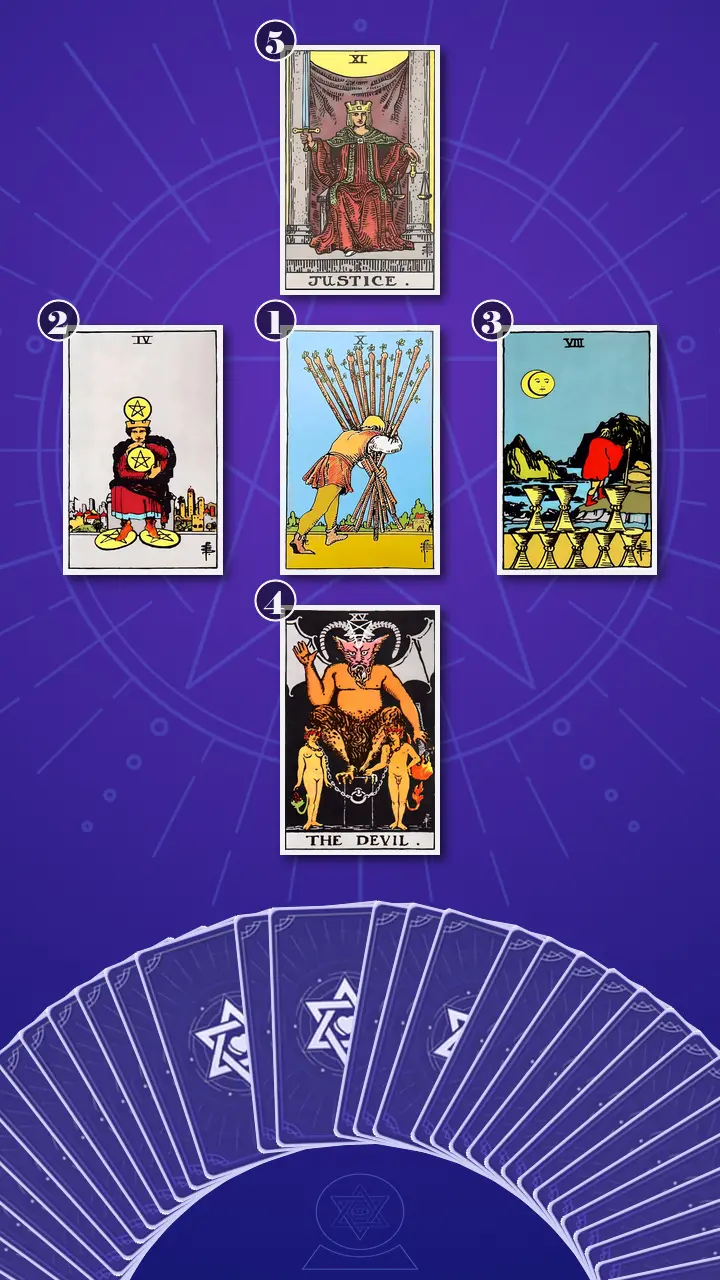
For a deadline-driven career crossroads like this, I use a five-card spread called the Decision Cross · Context Edition. It is one of the cleanest ways I know to answer the question burned out but scared to leave a stable job, because it is small enough to respect the urgency and precise enough to hold both options, the hidden fear underneath them, and the guidance that can actually move the decision. This is how tarot works best for career pivot anxiety in your late 20s: not as a magical shortcut, but as a structure that separates facts, risks, assumptions, and the story fear keeps telling.
The center card would show the visible knot—the burnout pattern and the deadline pressure already happening in real life. The card to the left would show what staying preserves, and what it quietly keeps charging her for. The card to the right would show what leaving opens, and what discomfort it asks her to tolerate without calling that discomfort danger. The bottom card would reveal the hidden fear, and the top card would give the clearest decision principle for finding clarity.
Reading the Pressure Map
When I laid the cards on the wooden table, the cross looked exactly like her week had felt: one body caught in the middle, two paths pulling sideways, fear pressing from below, and one cleaner line of sight above. A road sign at an intersection, except the traffic was happening inside her chest.
Position 1: The Load That Has Been Blocking the View
Now I turned the card representing the visible knot: the concrete burnout pattern, the deadline pressure, and the behavior showing she was already carrying too much. Ten of Wands, upright.
I did not have to reach far to translate it. This card looked exactly like Casey being online after dinner with a “quick” work request in one tab, the offer letter in another, and a resignation draft parked unsent on her phone. Not only too much work—too much work plus a major life decision plus the pressure to make the “responsible” choice while already exhausted. The bundled wands in the image block the figure’s vision, and here that became tabs, pings, and last-minute asks crowding out any long-view thinking. In energetic terms, this was excess: too much fire, too much pushing, too much proving. Very The Bear ticket-printer energy, except in project-manager form.
I told her, “You keep saying it’s only for tonight, and somehow tonight has been going on for months. Burnout is not a neutral price of stability.” Casey let out a short laugh that tasted bitter even at a distance. “Okay,” she said, rubbing the heel of her hand across one eye, “that’s accurate enough to be rude.” Her joke was light, but the hand that went to her jaw told the deeper truth.
Position 2: What Staying Preserves, and What It Keeps Charging
Next I turned the card representing the staying path: what remaining in the stable job preserves, and what it quietly asks her to keep sacrificing. Four of Pentacles, upright.
This is the card of visible security and white-knuckled holding. I could see her immediately back at that kitchen table, toggling between the offer email, the Ontario after-tax calculator, and the rent payment screen, hunting for a number that might finally make the answer obvious. The pentacle clutched to the chest in the card became the bodily truth of gripping a job for safety while the breathing room around that safety gets tighter and tighter. In energetic terms, this was excess Earth: protection hardened into constriction. Staying would preserve income, benefits, predictability, and a title other people understand quickly. But it would also keep charging her evenings, her recovery, her focus, and the quieter parts of her personality that only show up when she is not braced.
I said, “This is like staying in an apartment because moving costs are scary, even though the space itself stopped fitting your real life months ago.” Casey’s fingers closed harder around her cup. She did not argue. That is often how I know a card has landed.
Position 3: The Door That Opens Without Pretending It’s Easy
Now I turned the card representing the leaving path: what the new offer opens up, and what emotional honesty or uncertainty it asks her to tolerate. Eight of Cups, upright.
This card never tells me to romanticize the exit. It tells me to tell the truth about nourishment. The cups in the image are neatly stacked, not smashed, and that mattered here. The current job was not a disaster movie. It was decent pay, familiar systems, respectable paper, and a body that had started objecting anyway. I thought of the Sunday-evening TTC ride she had described, winter coat zipped to the chin, fluorescent light buzzing overhead, staring at the offer deadline email while Monday started loading into her nervous system before the week had even begun. Nothing dramatic happened, which is partly why it had been so hard for her to admit it was still too much. In energetic terms, this card brought balance through movement: emotional honesty finally loosening a stuck loop.
I said, “A job can look solid on paper and still be too expensive for your body. This card isn’t impulsive. It’s honest. It asks what becomes possible if discomfort is not automatically treated as danger.” Casey exhaled more quietly this time. “I keep waiting for it to get objectively bad enough,” she said, eyes on the card. “Like I need a disaster before I’m allowed to leave.” The room went softer around that sentence.
Position 4: Where Fear Starts Sounding Responsible
Then I turned the card representing the hidden fear underneath the decision, especially the way safety, self-worth, and control had become fused together. The Devil, upright.
This was the deepest blockage in the spread. Underneath the offer-deadline paralysis was the belief that the steady paycheck and structure were not just helpful, but proof that she was competent, responsible, adult, safe. That is why the choice had started to feel moral instead of practical. Leave, and what if that meant she had created her own instability? Stay, and at least nobody could accuse her of being reckless. The image matters here because the chains are loose. The fear is powerful, yes, but it is not the same thing as having no agency. In energetic terms, this was pure blockage: fear fused with self-worth until the known stress began to look like the only acceptable stress. Very Severance, in a way—the polished work self functioning beautifully while the other self already knows the pace is unsustainable.
I leaned slightly closer and said, “Fear gets loudest when it borrows the voice of responsibility. Together, this card and the Four of Pentacles show the real trap: not stay versus go, but safety versus self-abandonment.” Casey’s breath snagged. Her hand stopped halfway to the cup. A streetcar light slid across the café window and briefly crossed the table like a chain loosening one link at a time. “This is exactly how my brain makes fear sound sensible,” she said at last. The pause after that was heavy, but it was honest.
When Justice Lifted the Scales
When I reached for the top card, the grinder in the front room went quiet. For half a second, all I could hear was the milk cooler humming and the small click of Casey setting her cup down. The air in the café changed in the way it sometimes does right before the truth becomes simple enough to be uncomfortable.
Position 5: Guidance for Finding Clarity Before the Offer Deadline
Now I turned the card representing the clearest decision principle for the case: the shift from certainty-seeking to values-based discernment and honest weighing. Justice, upright. I asked Casey to picture the Tuesday-night version of herself again—laptop open, tea cold, work chat still lighting up while the offer deadline stared back from the inbox. She was not deciding from neutral ground. She was choosing while already overloaded.
You do not need to stay chained to the familiar just because it pays; put both paths on the scales, lift the sword of clarity, and choose what is fair to your future self.
I let the sentence sit between us. Then I said, quietly, “The most honest question is not, ‘Which option feels safest tonight?’ It’s, ‘What changes when burnout is counted as a real cost, not background noise?’” Justice always pulls a memory out of me from those dawn hours when I am doing the café books before the street wakes up. If I write down coffee beans and forget rent, milk, or wages, I have not made a wiser ledger. I have made a flattering lie. In my own practice, I call this Conflict Sedimentation: when the espresso is still swirling, the grounds cloud the whole cup; when it settles, you can finally separate the drink from the grit at the bottom. Casey had been stirring fear and facts together until both tasted like danger. Justice asked her to let the fear settle, then count everything—salary and benefits, yes, but also sleep, recovery time, focus, and self-respect.
Her reaction came in waves. First, a physical stillness: her thumb froze against the cup handle and even her breathing seemed to pause halfway in. Then the thought reached her more deeply; her eyes unfocused, not dreamily, but with the sharp distance of someone replaying a Sunday train ride and a Tuesday kitchen table at the same time. When she looked back at me, the skin under her eyes had gone bright. Her shoulders dropped so suddenly that the release seemed to make her a little unsteady. “But if I count burnout,” she said, and this time there was a flash of anger under the shakiness, “then staying isn’t automatically the responsible choice. It’s just the option that calms me down for one night.” I shook my head gently. “Exactly. Justice isn’t here to shame you for surviving. It’s here to give the full case a fair hearing.” I asked her, “Now, with this new perspective, think back to last week—was there a moment this could have made you feel different?” She stared at the card for another beat. “Sunday on Line 1,” she said. “I thought the nausea meant leaving was wrong. Maybe it was my body telling me staying already has a cost.” That was the shift, right there: not from fear to certainty, but from fear-based clutching and deadline dread to the first real inch of grounded, values-based self-trust.
The One-Page Audit for a Livable Choice
By then, the story of the spread was clean. The Ten of Wands showed a work life already overloaded. The Four of Pentacles showed what staying genuinely preserves: income, benefits, predictability, and a familiar identity. The Eight of Cups showed that leaving was not fantasy; it was the sober recognition that good enough on paper is not always sustainable in a real body. The Devil showed the root knot: safety, self-worth, and control had been braided together so tightly that fear started sounding like common sense. And Justice corrected the math. The real question was never only which job to pick. It was whether fear or clarity would get the final vote.
The blind spot was clear too: Casey had been treating burnout like background noise, as if visible salary were real but invisible depletion somehow did not count. She was also confusing the discomfort of commitment with proof that a choice was wrong. The shift this reading asked for was simple, but not easy: stop demanding a risk-free guarantee and ask which option better supports health, values, and long-term stability. Like finally adding hidden fees to the total instead of pretending the sticker price is the whole cost.
- Make the Justice Sheet tonight Set a 10-minute timer at your kitchen table or in Notes and write only four lines: what staying preserves, what staying costs, what leaving opens, and what leaving asks. Include money, benefits, workload, recovery time, focus, and self-respect. If numbers help you regulate, give each line a simple 1-10 impact score. No new tabs during those 10 minutes. If your mind says this is too simple for a decision this big, that is usually a sign the exercise is finally cutting through the perfection loop.
- Record one unsent truth on a walk During a short walk, voice-note or write: ‘Even though this job gives me ___, it no longer gives me ___.’ Then add: ‘What I am grieving about leaving is ___ . What I am relieved to leave is ___.’ Keep it private if you need to. Label it ‘Not for sending.’ Listen back once and notice what happens in your jaw, chest, or stomach. You are not building a case for court. You are letting emotional honesty into the decision.
- Create one boundary before you reply Pick one evening this week and log off work chat 30 minutes earlier than usual. Move one non-urgent task out of tonight and into tomorrow’s calendar. If it helps, use a visible status like ‘Offline for the evening, back in the morning.’ Make it small enough that your nervous system can believe it. This is not a grand workplace revolution. It is one tiny proof that every urgent thing is not yours to carry tonight.
I gave her one more café-born tool I trust: my Cup Bottom check. After the page or the voice note, finish the last sip of tea or coffee and sit for one quiet minute. Which option leaves less grit in the jaw and chest once the adrenaline settles? Not prophecy. Residue.
I told her, “The goal is not a risk-free choice. It’s a livable one. You can want security without offering your nervous system as payment.”

A Week Later, the Quiet Proof
Five days later, before my morning rush, Casey sent me a message with a photo of one plain Notes page: four headers, a few impact scores, no spreadsheet drama. Underneath it she wrote, “I accepted the offer before opening Teams.”
She sent the reply, then sat alone in a café for forty minutes with a cappuccino gone cool, staring out at Queen Street and letting the silence catch up with her.
The next morning, she told me, she had slept a full night. Her first thought on waking was still, What if I got this wrong? But this time she laughed, noticed her jaw was not already clenched, and got out of bed anyway.
That is what a real journey to clarity usually looks like when I watch it happen across a café table. Not fireworks. Not perfect certainty. Just the movement from panic to discernment, from white-knuckling security to a steadier kind of agency that can live with trade-offs because it finally tells the truth about them.
There is a specific kind of loneliness in looking fully functional on paper while your chest tightens every time Monday gets close, because one part of you wants out and another part is terrified that wanting out means you failed at being safe. If that is where you are tonight, noticing the split is already a form of clarity.
If you let recovery count as part of long-term stability for one quiet minute—if you place it on the scales beside salary, title, and benefits—what answer starts to feel a little more honest?