From Restless Urgency to a Clean Pause: Breaking the Chase Cycle

Finding Clarity in the 11:47 p.m. Thread Re-Open
If you’ve ever promised yourself you’d respect their “space,” then found yourself reopening the thread an hour later because they were “online” (classic pursue–withdraw trap), this is for you.
Jordan showed up to our session the way a lot of Toronto weeknights feel in late winter: still wearing work clothes, hair scraped back like she’d been negotiating with her own nervous system all day. She told me about Wednesday at 11:47 p.m.—streetlight glow through the blinds, the steady hum of a fan, and her phone warm from living in her palm too long.
“I was lying on top of the duvet,” she said, staring past me like she could still see the screen. “I kept rereading the last message like it had a hidden subtext. I told myself I wouldn’t text. And then I… opened it anyway. Just once.”
Her chest felt tight, she said, and her hands had that buzzing, can’t-settle feeling—like her body was a subway platform right before the train arrives, vibrating with the need for movement. The contradiction sat right under her ribs: she wanted reconnection and reassurance, and she was terrified that if she gave space, she’d be rejected and forgotten.
“I know I should give space,” Jordan said. “But what if space just means disappearing.”
I nodded, slow and steady, the way I do when someone is already bracing for judgment. “That makes sense,” I told her. “Not because chasing is the answer—but because your body is treating uncertainty like an emergency. Let’s make a map of the chase cycle so you can step off it with dignity. This is a Journey to Clarity, not a test of willpower.”

Choosing the Compass: The Celtic Cross · Context Edition
I started the way I always do—no theatrics, just a clean transition from spiraling to observing. I asked Jordan to put both feet on the floor, inhale for four, exhale for six. Then I shuffled slowly, not as a ritual for fate, but as a way to give her mind something simple to hold while the rest of her settled.
“Today,” I said, “we’re using the Celtic Cross · Context Edition.”
For anyone reading who’s wondered how tarot works in a situation like this: I’m not using cards to predict whether someone will text back. I’m using a structure—the Celtic Cross spread—to trace a chain. In this case, it maps the visible chase-cycle behavior (what you do after they ask for space) down into the deeper driver (what your nervous system is trying to prevent), then back up into an actionable interruption point and an integration move you can actually live.
This is why the Celtic Cross is perfect for a career crossroads—and also for a relationship crossroads: it doesn’t settle for “yes/no.” It shows mechanics, and mechanics can be changed.
“We’ll start with the center,” I explained, tapping the table. “Card 1 is what you’re doing in real time. Card 3 goes underneath—what’s driving it under the surface. And Card 10 at the top of the staff is integration: the empowered way to communicate and hold boundaries so you can exit the chase cycle.”
Jordan swallowed and nodded, like she was both scared of the truth and desperate for it.
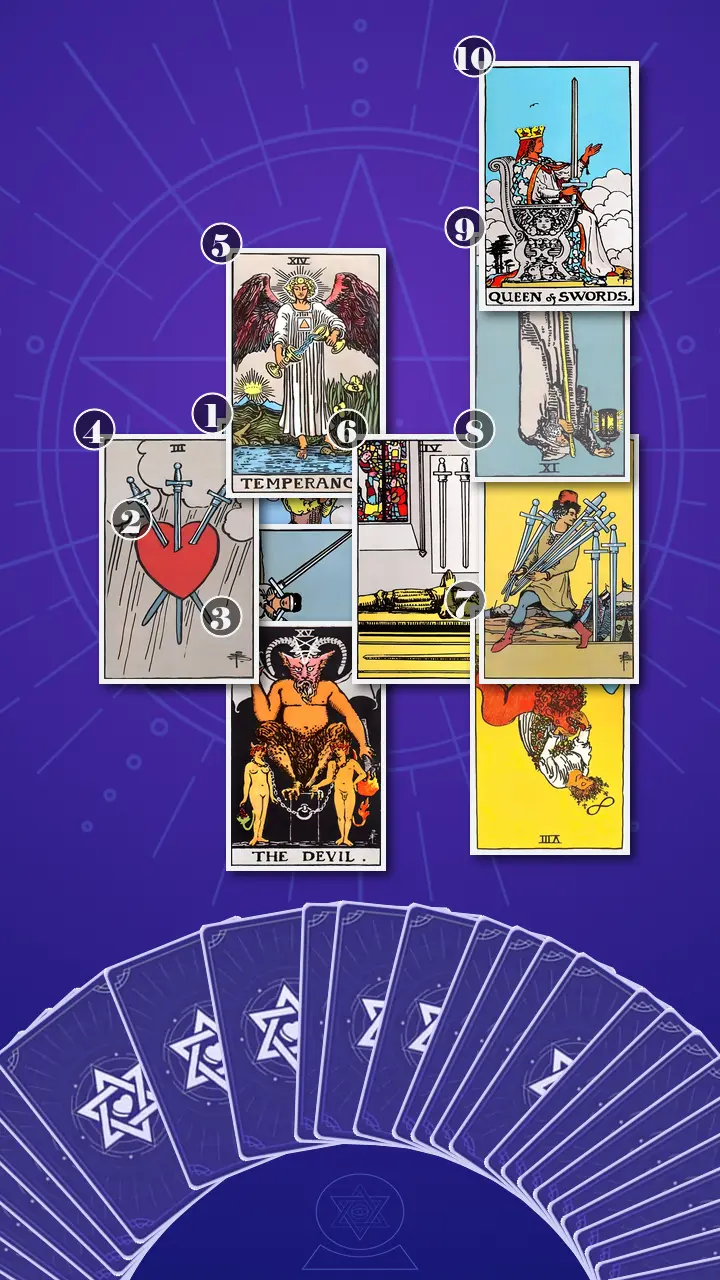
Reading the Map: The Chase Cycle, One Card at a Time
Position 1 — The current chase-cycle behavior in real time
“Now we’re turning over the card that represents the current chase-cycle behavior in real time—what you actually do after they ask for space,” I said.
Page of Swords, upright.
In the card, the Page holds the sword up like they’re on watch. The wind whips their hair and the clouds. It’s alertness—hyper-alertness.
“This is you with your phone in your hand,” I told Jordan. “Refreshing the chat. Checking Instagram. Treating ‘last seen’ like it’s a live stock ticker for your self-worth.”
Air energy is dominant here: thought, interpretation, scanning. It’s not that you’re “crazy.” It’s that your attention gets pulled outward, hunting for certainty, because your body believes certainty is the only thing that will let it unclench.
Jordan let out a small laugh that sounded like it had teeth. “That is… too accurate,” she said. “Like, kind of brutal.”
“Accurate doesn’t have to be cruel,” I replied. “It just means we’re looking at the real pattern, not the version you wish you were doing.”
Position 2 — What blocks you from stopping
“Now we’re turning over the card that represents what blocks you from stopping—the tension you keep pushing against,” I said.
Two of Swords, upright.
A blindfold. Two swords crossed right over the heart. Calm water behind her, but she can’t access it because she’s bracing.
“This is the bind,” I told Jordan. “Part of you wants to respect their boundary. Part of you wants reassurance now. And instead of choosing a container, you hold the tension until it spikes—then you reach out.”
The Two of Swords is not lack of intelligence. It’s emotional stalemate. It’s the moment you think, I can’t decide without more information, while reality is saying, more information isn’t available right now.
Jordan stared at the blindfold in the image. Her fingers tightened around her coffee cup, then loosened, like her body was practicing letting go without her permission.
Position 3 — The hidden root driver beneath the chase
“Now we’re turning over the card that represents the hidden root driver beneath the chase—the compulsion behind the urge,” I said.
The Devil, upright.
The chains in this card are always the part I focus on: they’re loose enough to slip off, but the figures don’t move. That’s what compulsion feels like—I could stop, but I can’t stop.
“Here’s the truth,” I said gently. “You’re not texting to connect. You’re texting to stop the feeling.”
I watched Jordan’s eyes flick to her phone on the table and back, like it was a magnetic field. I layered the contrast, the way the spread invites it: the blindfold of the Two of Swords—trying to decide while refusing the reality that you don’t have full info—and the loose chain of the Devil: the thumb hovering, the stomach drop, the bargaining thought—If I just send something small, I’ll calm down.
Jordan’s breath caught, then released in a long exhale. “Oh,” she whispered. Not embarrassed. More like relieved to have the mechanism named without shame.
“The Devil isn’t a moral judgment,” I added. “It’s an honest diagnosis of a loop: short-term relief, long-term cost. The loop convinces you that if you don’t act now, you’ll be replaced or forgotten.”
I let the silence hold for a beat. Then I offered one of my anchor phrases, quietly: “You don’t have to outsource your calm to their reply.”
Position 4 — What recently triggered the cycle and made it urgent again
“Now we’re turning over the card that represents what recently triggered the cycle and made it feel urgent again,” I said.
Three of Swords, upright.
The heart on the card is stark and red against grey weather. Three blades right through it. It’s not subtle. It’s impact.
“This is the moment ‘I need space’ landed in you,” I told her. “And your mind keeps touching the wound to see if it’s still there.”
Jordan nodded once, sharp. “I replay the exact wording,” she said. “Like if I can find the one line I missed, I’ll… fix it.”
“That’s the marketing brain in you,” I said, and she looked up. “You’re used to running campaigns where the right tweak changes the metric. But people aren’t dashboards. Silence isn’t a KPI.”
The Three of Swords doesn’t ask you to text your way out of pain. It asks you to treat pain as something to care for, not something to erase by chasing.
Position 5 — What you consciously want instead
“Now we’re turning over the card that represents what you consciously want instead—your stated intention and ideal outcome,” I said.
Temperance, upright.
The angel pours between two cups with a steadiness that’s almost boring—until you realize how rare steadiness feels when you’re activated. One foot in water, one on land. A path toward light.
“You’re not trying to become cold,” I told Jordan. “You’re trying to become steady.”
As a Paris-trained perfumer, Temperance always feels personal to me. Blending isn’t dramatic. It’s disciplined. It’s knowing that if you keep adding notes because you’re afraid the formula isn’t ‘enough,’ you don’t get a masterpiece—you get mud.
“Temperance is the part of you that wants a calm plan,” I said. “One respectful message, one boundary, and then you returning to your routines. No swinging between overtexting and total shutdown.”
Jordan’s shoulders lowered a fraction, like her body recognized the word plan and stopped fighting for a second.
Position 6 — The most likely near-term shift if you interrupt the pattern
“Now we’re turning over the card that represents the most likely near-term shift if you interrupt the pattern—the next emotional weather,” I said.
Four of Swords, upright.
In this image, the swords aren’t in anyone’s hands. They exist, but they’re not being wielded. The figure rests. There’s a hush to it.
I described it the way it arrives in real life: “Phone goes into a drawer. Focus mode turns on. The room gets quieter. Your shoulders drop one notch.”
Jordan’s eyes softened like she could feel the scene in her body before she believed she could do it.
“This isn’t ghosting,” I said. “This is a container.”
And I gave her the line I wanted her nervous system to borrow: “A pause isn’t a game—it’s a container.”
The Four of Swords is the first realistic interruption point for a chase cycle. Not because you suddenly stop wanting them, but because you stop reacting to the craving for relief like it’s a command.
Position 7 — How you are showing up internally
“Now we’re turning over the card that represents how you are showing up internally—your self-state, attachment activation, and agency,” I said.
Strength, reversed.
Strength is gentle hands on a lion. Reversed, it’s not weakness—it’s self-doubt about your ability to handle the surge without outsourcing it.
“This is you treating texting like the only off-switch,” I told Jordan. “The moment your chest tightens, your brain says: Do something. Do it now.”
Then I named the overcorrection risk, because I see it so often: “And when you try to prove you’re ‘strong,’ you go cold. You mute them. You open Hinge. You make plans you don’t even want. Then the loneliness hits at night and you rebound into contact.”
Jordan’s mouth tightened and then relaxed. “Yeah,” she said, barely audible. “I hate that I’m like this.”
“We’re not going to hate you into stability,” I said. “We’re going to build it in 90-second increments.”
Position 8 — The external feedback loop you’re reacting to
“Now we’re turning over the card that represents the external feedback loop: their signals, the social/digital environment, and what you’re reacting to,” I said.
Seven of Swords, upright.
This is information asymmetry. Someone holding cards close. Partial signals that make your mind fill in blanks.
“This is like trying to plan your whole week from a vague calendar invite,” I said. “No time, no agenda, just ‘TBD.’ Your brain will try to do project management on a situation that’s not giving you the data.”
We talked through the modern cues that hook her: they’re online, they viewed her story, they reply with “busy rn” or “lol,” and the gap becomes a canvas her anxiety paints on.
“Missing information is still information,” I told her. “It doesn’t mean they’re evil. It means certainty isn’t available right now. And if certainty isn’t available, chasing isn’t problem-solving—it’s self-abandonment.”
Jordan’s gaze dropped to the table. She nodded once, slow, like she was finally letting the environment share the blame.
Position 9 — The hope–fear loop that keeps you reaching
“Now we’re turning over the card that represents the hope–fear loop that keeps you reaching—what you’re afraid will happen if you stop chasing,” I said.
The Hermit, reversed.
In the Hermit, there’s a lantern—your own light. Reversed, the fear is that solitude won’t restore you; it will erase you.
“This is the part of you that treats alone time like punishment,” I said. “So you keep checking. You keep pinging. Because the quiet feels like proof you don’t matter.”
Jordan’s hands went still for the first time. Three tiny beats happened in her face: a blink that lingered too long, her jaw tightening, then her lips parting like she was about to say something she’d been hiding from herself.
“Weekends are the worst,” she admitted. “Nights. It’s like the silence gets loud.”
“That’s the reversed Hermit,” I said. “Your phone becomes a lantern you keep lifting into the dark. But it’s not guiding you. It’s just keeping you awake.”
When the Queen of Swords Held the Line
Position 10 — Integration: the empowered way to communicate and hold boundaries
I touched the last card before turning it, and the air in the room shifted. Even the fan sounded louder for a second, like the space was making room for the point of the whole reading.
“Now we’re turning over the card that represents integration: the empowered way to communicate and hold boundaries so you can exit the chase cycle,” I said.
Queen of Swords, upright.
Jordan’s eyes went straight to the sword—upright, clean, not flailing. The Queen’s gaze is direct, but not cruel. There’s an open hand, too: honest, not punishing.
Setup: I could almost see the scene in her body: that moment they asked for “space,” and suddenly she’s holding her phone like it’s a life-support device—refreshing the thread, rereading tone, trying to text her way out of silence.
Delivery:
Not another perfectly crafted text to win closeness—one clear boundary, like the Queen of Swords holding her blade upright.
I let that sentence sit between us, the way a clean scent sits in the air when you stop overspraying. In my old training, we called it the moment you stop “fixing” and let the formula reveal itself.
Jordan’s reaction came in a chain—fast, human, messy in the best way. First, she froze: breath paused mid-chest, eyes widening a fraction. Then her gaze unfocused, like her mind replayed every draft she’d typed and deleted, every “no pressure” she didn’t mean. Finally, emotion moved in: her shoulders dropped, but her mouth pulled tight with something like anger.
“But if I do that,” she said, voice sharper than before, “doesn’t it mean I’ve been doing it wrong? Like… I’ve been embarrassing myself?”
“It means you’ve been trying to survive,” I said, steady. “And survival strategies get weird when your nervous system thinks it’s about to be abandoned.”
Then I brought in the lens that makes my work mine—my Emotional Repair Pathway. “In fragrance, there’s a difference between a quick fix—covering a smell—and true repair: neutralize, ventilate, rebuild. Relationships are similar. Repair isn’t ‘more contact.’ It’s a phased system.”
I held up three fingers. “Phase one: contain—you stop bargaining with panic. Phase two: clarify—one message, one boundary, no overexplaining. Phase three: rebuild—only if the other person meets you with reciprocity.”
Jordan swallowed. Her eyes went wet, not dramatic—just honest. “So I can miss them,” she said slowly, “and still be precise.”
“Exactly,” I said. “You don’t earn clarity by chasing their nervous system—you choose clarity by setting your line and protecting your self-respect.”
I leaned in, just a little. “Now, with that new lens—think back to last week. Was there a moment where you reached for the phone, not because you had something true to say, but because you needed the feeling to stop?”
Jordan’s hand drifted to her sternum, as if to confirm where the urge lived. “Yeah,” she whispered. “Friday night. They watched my story. I felt hope for like two seconds. Then my stomach dropped.”
“That’s the exact pivot point,” I said. “This reading isn’t only about a decision. It’s about moving from restless urgency to a grounded, self-led stance—where you can tolerate uncertainty, respect their boundary, and still protect your own dignity and needs.”
The One-Message Boundary Ladder: Actionable Advice to Break the Chase Cycle
When I stitched the whole spread together, the story was painfully coherent. Page of Swords showed the vigilance—refreshing, rereading, scanning for signals. Two of Swords showed the standoff—“respect space” versus “get reassurance now,” with the blindfold of needing certainty that isn’t available. The Devil named why “just don’t text” fails: the chase is a compulsion for relief. Three of Swords reminded us the pain is real. Temperance offered the north star: moderation, pacing, a sustainable rhythm. Four of Swords opened the door: a chosen pause container. Strength reversed showed the skill to build: self-soothing without shutdown. Seven of Swords located the external trap: mixed signals and information gaps. Hermit reversed named the fear: that quiet equals erasure. And the Queen of Swords gave the exit: clean boundaries, self-respect, and direct communication without overexplaining.
The cognitive blind spot here is subtle: it’s believing that your discomfort means you must act—when actually, discomfort is often just your nervous system asking for a container.
The transformation direction is equally specific: shift from trying to get regulation through their response to creating a self-chosen pause + a clear boundary for your next contact.
Here are your next steps—small, real, and built for the moments when your hands start buzzing and your thumb wants to bargain.
- The 90-Second Relief CheckBefore any text, put the phone face-down. Set a timer for 90 seconds. Breathe slowly and label the urge in plain language: “I want relief.” When the timer ends, decide again—send nothing, draft in Notes, or take a walk.Your brain will argue. That’s normal. Lower the bar: 90 seconds counts, even if you still feel shaky after.
- The 24-Hour “Pause Container” (Four of Swords)Choose a 24-hour window where you do not open the chat thread and do not check “online” cues. Use Apple Focus mode or move the app into a folder literally named “Not Now.” Tell one friend you’re doing it so you don’t recruit the group chat as a decoding committee.Use my space-clearing strategy: open a window, wipe one surface, and add one grounding scent (a candle, a shower gel, even hand cream). You’re training your body to associate “space” with safety, not erasure.
- The Queen of Swords Draft (One Message, Two Parts)Set a 10-minute timer. In Notes (not the chat), draft ONE message with only two parts: (1) a clear boundary about space, (2) what you’ll do next (a check-in plan or stepping back). Stop at two parts. Do not add a paragraph.Remember: “One message is communication. Five messages is bargaining.” If you feel the impulse to explain, that’s your cue to end the draft and return to your life.

A Week Later: Ownership, Not Certainty
A week after our session, Jordan messaged me—not with a screenshot, not with a new theory. Just a small report like she was logging a real experiment.
“Did the 24-hour container,” she wrote. “Moved WhatsApp into a folder called Not Now. Did the 90-second thing twice. Drafted the boundary in Notes. Didn’t send it yet. But I didn’t open the thread. I went for a walk by the waterfront instead.”
It wasn’t a Hollywood ending. It was better: it was proof she could stop negotiating with panic.
She later told me she slept through the night for the first time in weeks—then woke up with the thought, What if I’m wrong? She sat up, breathed, and didn’t reach for the thread. “I was still scared,” she said. “But I didn’t abandon myself.”
That’s what I mean by a Journey to Clarity: not certainty about what they’ll do, but ownership of what you do—how you hold your line, how you protect your dignity, how you stop asking someone else’s nervous system to regulate yours.
When someone asks for space, it can feel like your chest is holding its breath—like if you don’t say the perfect thing right now, you’ll be forgotten, and that fear turns your phone into a lifeline you can’t put down.
If you let “space” be a boundary you hold too—not a silence you survive—what’s one small line or pause you’d choose this week that protects your dignity even before you get an answer?