From Long-Distance Uncertainty to Self-Respect: The Moving-Away Talk

Finding Clarity in the 12:40 a.m. Tabs
If you’ve ever rewritten a “we need to talk about the move” text three times, deleted it, and sent something casual instead—because you’re scared of what the answer will say about your worth—this is for you.
Jordan (name changed for privacy) came to me from a condo a few blocks off Line 1, the kind of place where the hallway always smells faintly like someone’s laundry and takeout. They didn’t sit down so much as land—phone in one hand, tote bag slipping off their shoulder, eyes a little too bright like they’d been staring at a screen for hours.
“It’s my partner,” they said, like the word itself carried a deadline. “They’re moving away. And I can’t tell if we try long-distance or… call it. I keep toggling between ‘we can totally do this’ and ‘end it now so it hurts less.’”
As they spoke, I could hear the tiny sounds that always give the real story away: their breath catching on the word goodbye, the quick swallow, the way their knee bounced like a metronome set too fast. Uncertainty, in their body, wasn’t a thought—it was a tight throat holding back a whole conversation, restless evening energy that had nowhere to go, and that stomach-drop flash when either choice got too real.
Jordan described their nightly routine with the kind of precision only a UX designer could: “At like… 12:40 a.m. I’ll have three tabs open—Google Flights, our shared Google Calendar, and a Reddit thread in r/LongDistance. And then there’s this half-written text in Messages: ‘Can we talk about what this is going to look like?’ And I just… don’t send it.”
I nodded. “That makes so much sense. Planning is the closest thing your nervous system has to a seatbelt right now.” I leaned forward, softening my voice. “But tonight, we’re not here to force a forever answer. We’re here to find clarity—something you can stand on, even if it’s tender.”

Choosing the Compass: The Decision Cross · Context Edition
I lit nothing dramatic. No incense fog, no theatrics—just the small ritual I use as a psychological threshold. I asked Jordan to put their phone face-down, take one slow breath in through the nose, and let the question land in their body instead of their browser tabs.
Then I shuffled—my hands moving with that familiar, quiet rhythm that, after years in radio, still feels like cueing the next track: steady, intentional, no rushing the downbeat.
“For this,” I said, “we’ll use the Decision Cross · Context Edition—a five-card decision spread for a relationship crossroads. It’s built for exactly this kind of either/or question: try distance or end it. And it does something I love: it compares both paths without turning either into a moral verdict.”
For you, reading along: this spread works because it holds two options side by side (long-distance vs calling it), while also exposing the deeper driver behind the indecision—the thing that makes the choice feel like a referendum on worth, not just logistics. And instead of claiming to predict fate, the final position is framed ethically as integration and next step: what you can do this week to create clarity through structure, not through guessing.
“Card 1,” I added, “shows what’s actually strained right now, before the move even happens. Cards 2 and 3 show the lived reality of each option. Card 4 names what’s secretly driving the intensity. And card 5 is the grounded next step—the action you control.”
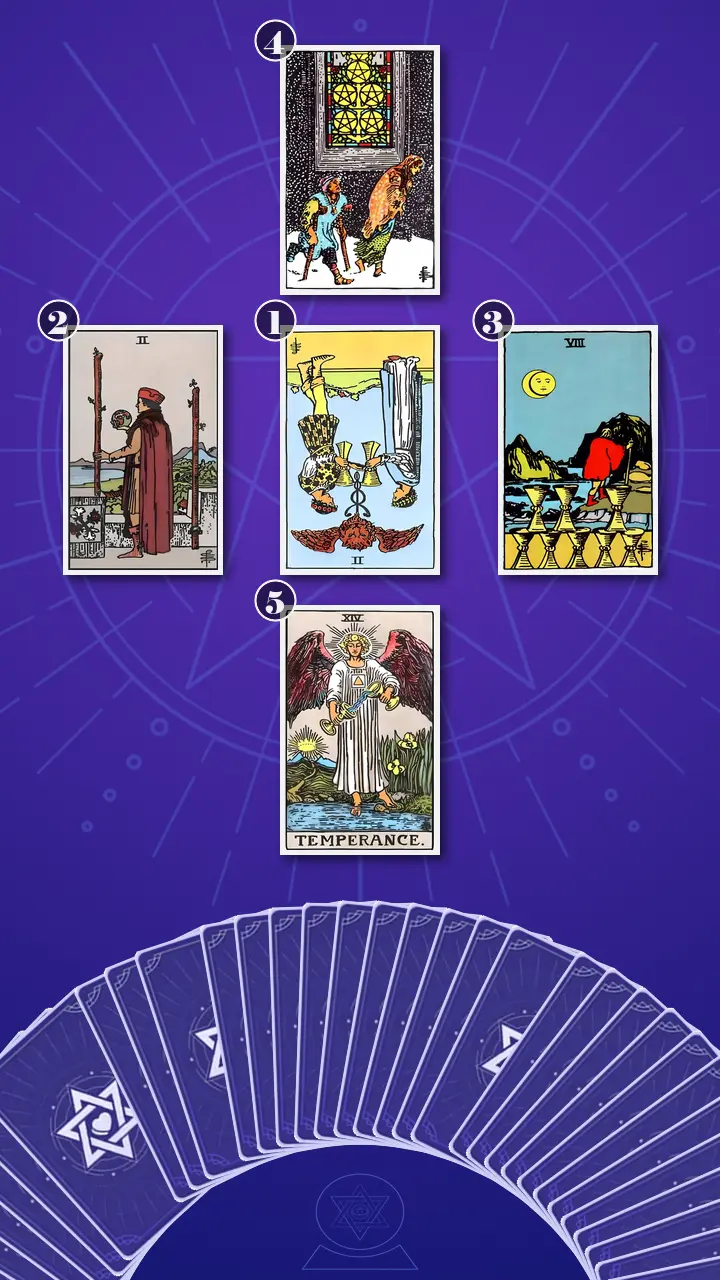
Reading the Map, Not the Comments Section
Position 1: The current relationship reality as the move approaches
I turned over the first card. “Now we’re looking at the position that represents the current relationship reality as the move approaches—what is actually strained or true right now.”
Two of Cups, reversed.
I didn’t have to over-explain the symbolism; Jordan’s face did that for me. The Two of Cups is mutual exchange—two people meeting each other in a clean, mirrored way. Reversed, it often shows a bond that’s real, but not synced. Not necessarily broken—just out of rhythm.
“Here’s the modern version,” I said, keeping it plain. “Right now, the love is real but the sync is off. Every small practical thing—reply time, call scheduling, who initiates, how excited they sound—starts to feel like a quiet scorecard.”
And because the echo technique for this card is specific, I let the scene play: “It looks like watching timestamps, rereading older sweet messages for proof, then feeling stung by today’s tone… and acting chill anyway.” I paused. “The inner line is: ‘I’m not asking for too much… I’m just asking for proof.’ Intimacy versus measurement. Connection versus confirmation.”
Jordan gave a short laugh—dry, almost embarrassed—then rubbed their thumb across the edge of their phone like they could sand down the feeling. “That’s… painfully accurate,” they said. “Like, too accurate. Kinda brutal.”
“I hear you,” I replied. “And I’m not saying you’re wrong for wanting reassurance. I’m saying the way you’re trying to get it right now—silently, through data—keeps you stuck.” I tapped the card gently. “Reversed energy is often a blockage. The love is there, but the exchange isn’t landing as mutual. And distance is going to amplify whatever you two don’t name out loud.”
Position 2: What trying long-distance would require and highlight
I flipped the second card. “Now we’re looking at what trying long-distance would require and highlight—the workable strengths and the real challenges.”
Two of Wands, upright.
“This is the planner card,” I said, and Jordan’s mouth twitched like they didn’t know whether to feel seen or exposed. Upright, the Two of Wands is Fire energy that’s directed—vision, structure, a choice that becomes a design.
“Trying long-distance,” I continued, “looks like you opening a shared calendar and building a rhythm like a design spec: scheduled calls, realistic visit cadence, budget that doesn’t quietly punish you. That part, you can do. You’re already doing it.”
Then I named the trap: “But Two of Wands has a shadow: planning can become a substitute for hearing a real yes. It’s control dressed up as strategy.” I kept my tone gentle, not accusing. “So the question isn’t whether you can architect it. The question is whether both of you are genuinely choosing the same future—or just tolerating a temporary setup because it sounds romantic.”
Jordan stared at the figure holding the world on the card like it was an app icon they’d been ignoring. Their knee slowed, just a little. A small sign: the nervous system listening.
Position 3: What ending the relationship would require and give back
I turned the third card. “Now we’re looking at what ending the relationship would require and give back—the cost and the relief.”
Eight of Cups, upright.
“This one never calls something a failure,” I said. “It calls it a truth.” Upright, the Eight of Cups is Water energy that chooses—leaving what’s not emotionally fulfilling enough anymore, even if it once was, to honor a deeper need.
I spoke in the exact modern language Jordan had been living: “Calling it looks less like a dramatic breakup and more like a slow, steady exhale. You notice you’re spending more time bracing for disappointment than enjoying connection. The grief would still hit—especially at night—but your nervous system might calm down because you’re no longer negotiating for basic consistency.”
Jordan’s eyes softened in a way that felt like guilt. “I hate that it sounds… relieving,” they admitted.
“Relief doesn’t mean you didn’t love them,” I said. “Sometimes it means your body is tired of living in the in-between.”
Position 4: The hidden fear/need driving the intensity of the choice
I flipped the fourth card. “Now we’re looking at the hidden fear or need driving the intensity—what the decision feels like it would ‘prove’.”
Five of Pentacles, upright.
This card always changes the room. Even in my little studio—acoustic panels, a mug of tea going lukewarm, the faint city hush outside—the Five of Pentacles can make the air feel colder.
“Under everything,” I said quietly, “there’s a raw fear of being left outside.” I let the Toronto imagery do its work, like the blueprint asked: “It’s like standing on a cold sidewalk outside a condo lobby. Warm yellow light inside. People laughing. And you’re out here thinking: ‘If they wanted to, they would… and if they don’t, what does that say about me?’ Belonging versus exclusion. Reassurance versus scarcity.”
Jordan’s body reacted in a three-step chain I’ve heard in a hundred voices on my show when people finally name the real lyric they’ve been avoiding: 1) a brief freeze—their breathing paused, 2) a distant look—their eyes unfocused like they were replaying a memory, 3) then a small, involuntary exhale that sounded like surrender.
“Oh,” they whispered. Not dramatic. Just honest. “Oh… that’s what this is about.”
“Yes,” I said, and I meant it with full respect. “Not just ‘my partner is moving.’ It’s ‘when life gets inconvenient, am I worth the effort?’ And that fear makes you treat every delayed reply like evidence. That’s not you being ‘too much.’ That’s you being human in the snow.”
I felt my own internal flashback—me in a radio booth years ago, watching levels spike when someone tried to sound fine while saying something devastating. Sound doesn’t lie. The waveform tells the truth the sentence avoids. This card was the waveform.
When Temperance Poured Between Two Cups
Position 5: Integration and the most grounded next step you can take to clarify
I set my palm lightly on the deck before I turned the last card. “This is the anchor,” I told Jordan. “Not an outcome you’re doomed to—an integration step. Something you control.”
Then I flipped it.
Temperance, upright.
The room felt quieter in that specific way it does when a song drops from noise into a clean, steady groove. Temperance is the alchemist: one foot on land, one in water. Emotion and practicality. Two cups, but not forced mirroring—measured transfer.
I could almost see Jordan’s usual loop trying to start up again: the 12:40 a.m. scramble—flights tab, calendar tab, advice thread—like if they just found the right plan, they’d finally feel safe. That’s the setup: the hunger for certainty, the belief that a “right answer” will prevent pain.
And then I gave the core sentence, exactly as it needed to land.
Not an all-or-nothing verdict—choose a measured blend, like Temperance pouring steadily between two cups, and let consistency (not intensity) tell you what’s real.
I let it hang there. No immediate explanation. Just silence long enough for it to become a body-thought instead of a concept.
Jordan’s reaction came in layers. First, their shoulders dropped as if they’d been holding up a ceiling tile. Then their jaw unclenched, slow, almost surprised—like they hadn’t realized they’d been biting down this whole week. Their eyes went glossy, but not in a breakdown way; more like the moment before a singer finally hits the note that resolves the tension.
They blinked hard once. Their throat bobbed with a swallow. Then they shook their head, small and angry for half a second—an unexpected flare. “But… if it’s an experiment,” they said, voice tightening, “does that mean I’ve been doing this wrong? Like I should’ve been able to just… trust it?”
I met their eyes. “No. It means you’ve been trying to make a forever decision with midnight tools.” I kept it steady. “Temperance isn’t shaming you. It’s offering you a way to be honest without panicking.”
“In your language,” I added, leaning into the echo technique, “this is a UX redesign: stop shipping assumptions. Run a short, measurable beta. Not a verdict—an experiment. Intensity versus consistency. Hope versus proof-of-effort. Romantic vibes versus operational agreements.”
And then I brought in my signature lens—because this is where it becomes uniquely my work. “Jordan, can I use something I call the Melodic Mirror?”
They gave a wary smile. “Sure.”
“Tell me the last three playlists you’ve actually listened to since the move became real,” I said. “Not what you think you should listen to. What your thumb chose at 1 a.m.”
Jordan exhaled, almost laughing again. “Okay. Spotify: ‘goodbye.’ ‘airport.’ And—don’t judge me—‘late night spirals.’”
“No judgment,” I said. “That’s data.” I tapped Temperance. “Those titles are basically your nervous system speaking in track names. And Temperance is asking for a different playlist—not to erase grief, but to change the rhythm so you can think clearly.”
I lowered my voice. “Now, using that new lens: you don’t need a forever decision to get clarity—you need a calm, time-bound agreement that shows what’s actually mutual. Set a 10-minute timer tonight. In your Notes app, write two lists: (1) your three non-negotiables for long-distance to feel mutual, and (2) three flex points you can experiment with. When your throat tightens or your stomach drops, pause and breathe. That’s information, not a test.”
Jordan nodded—this time not embarrassed, just serious. “Okay,” they said. “Okay. I can do ten minutes.”
“And one more thing,” I added, letting Temperance become the emotional bridge the spread promised. “This is the key shift: you’re moving from ‘Which choice guarantees I won’t get hurt?’ to ‘What agreement lets me stay honest with myself even if I feel hurt?’ That’s self-trust. That’s you stepping out of worth-based panic and into self-respecting clarity.”
The One-Page “Long-Distance Clarity Draft” (Consistency Over Intensity)
I gathered the five cards into one story, the way I’d summarize a setlist after a live session.
“Here’s what the spread is saying,” I told Jordan. “Right now, the relationship is real but not synced (Two of Cups reversed), so your brain is turning love into a KPI dashboard—reply times, tone, effort metrics—because measurement feels safer than asking directly. Long-distance can work (Two of Wands), but only if it’s architected with mutual buy-in, not just optimism. Ending it (Eight of Cups) would hurt, but it could also return peace and stop the slow depletion of living in limbo. Underneath everything is the belonging wound (Five of Pentacles): the fear that if this gets hard and they leave, it proves you weren’t worth staying for. Temperance says: don’t decide from panic—decide from data you two create together.”
Then I named the cognitive blind spot gently, because shame never helps: “The blind spot is thinking that more planning will replace a mutual ‘yes.’ A plan can’t replace a yes. Logistics can support love, but they can’t substitute for reciprocity.”
“So,” I said, “our next steps are simple and specific. Small enough to do this week. Clear enough to create real clarity.”
- Write the Long-Distance Clarity Draft (10 minutes)Open your Notes app and list 3 non-negotiables for long-distance to feel mutual (e.g., two scheduled calls/week, a 24-hour reply expectation, visit cadence) and 3 flex points you can experiment with (e.g., voice notes instead of texts on busy days, swapping call days when work hits).Set a timer. When it ends, stop. Don’t optimize it—Temperance clarity comes from containment.
- Send the 20-minute container inviteText your partner: “Can we do a 20-minute check-in this week about what long-distance would actually look like? I want us to be honest, not just optimistic.” Choose a time and put it on the shared calendar.Expect the feeling of “this is awkward.” That’s not a red flag—it’s you replacing mind-reading with agreements.
- Run a 4–6 week trial (a beta test, not a trap)Propose a time-bound long-distance trial with a defined rhythm: two scheduled calls/week + one low-pressure touchpoint on off days. Add a Sunday calendar check-in question: “What felt connecting? What felt hard? One tweak for next week?” Set a monthly travel budget cap so “effort” doesn’t quietly become “financial drain.”If you feel the urge to ask “Are we okay?” daily, redirect to the agreed check-in time. Consistency tells the truth that intensity can’t.
Before Jordan left, I offered one more tool from my own practice—the part that makes my readings feel like mine. “If you want,” I said, “we can build an Emotional BPM plan. When your nervous system is fast, you’ll try to solve everything fast. So we choose a tempo on purpose: your Sunday check-in isn’t a crisis meeting. It’s a steady 80 BPM—calm, honest, repeatable.”
Jordan’s shoulders loosened again. “That… makes weird sense,” they said. “Like my brain is always trying to do this at 140 BPM.”
“Exactly,” I said. “We’re not killing the song. We’re changing the tempo so you can actually hear each other.”

Ownership, Not Certainty
A week later, Jordan messaged me. No essay. Just a screenshot: the sent text—the 20-minute invite—plus a calendar block titled “Check-in (honest, not just optimistic).” Under it, three bullet points labeled “Non-negotiables.”
“We did it,” they wrote. “It was awkward for like two minutes. Then it was… real. We’re trying a six-week trial. And I’m weirdly calmer.”
They added, almost as an afterthought: “Also I made a new playlist called ‘steady.’ It’s not happy. It’s just… not spiraling.”
In my mind I pictured them in that small bittersweet proof moment—sleeping a full night, then waking up with the first thought still being What if I’m wrong?—but this time, not grabbing the phone to open flight tabs. Just breathing once, and letting the plan they created hold them for a second.
This is what I mean when I talk about a Journey to Clarity. Not certainty. Not a guarantee. Just the clean shift from spinning in worth-based fear to a decision anchored in articulated needs, boundaries, and a realistic rhythm you can actually live inside.
When someone you love is moving away, it can feel like every unanswered text and every flight search is secretly asking, “Am I worth the effort?”—and your body carries that question before you ever say it out loud. You’re not “the weak link” for wanting a relationship you can actually live inside.
So if you’re standing at your own career-crossroads-style relationship crossroads—try distance or end it—here’s the question I’ll leave you with: If you didn’t have to pick the option that guarantees you won’t hurt, what’s one small agreement you’d want in place so you can stay honest with yourself—no matter which way this goes?