The Typing Bubble Disappeared—And I Learned to Wait Before Double-Texting

The Typing Bubble Disappeared, and So Did Your Peace
If you’ve ever been fine until the typing bubble disappeared—then suddenly you’re in a full-body panic spiral on your Toronto commute, refreshing the chat like it’s breaking news—then you already know this isn’t “just texting.” It’s your nervous system grabbing the wheel.
Jordan (name changed for privacy) sank into the chair across from me with the careful posture of someone trying to look calm while their insides were sprinting. She was 27, lived in Toronto, and worked as a marketing coordinator—the kind of job where you’re expected to be quick, polished, and pleasantly unbothered, even when you’re anything but.
She described an exact scene—so specific I could practically hear the overhead light hum through the screen.
“It was 8:47 PM on Tuesday,” she said. “Condo living room. Laptop open to a deck I should’ve finished. Phone face-up next to the trackpad. The typing bubble appeared… three dots… and then it disappeared. And it was like someone pulled a drawstring around my ribs.”
As she spoke, her thumb kept doing a tiny twitch against her index finger, like it was still hovering over iMessage. Her breath was shallow and high. The kind you don’t notice until someone names it.
“I refresh the thread,” she admitted. “I reread my last message. I start drafting a follow-up like it’s a work deliverable I can perfect. Then I hate myself for caring. But I can’t stop.”
Under the story, I could hear the engine: Wanting steady reassurance and connection vs fearing being left the moment the signal goes quiet. The contradiction doesn’t feel like a contradiction when you’re inside it. It feels like survival.
She swallowed, jaw tight. “I was fine until the bubble disappeared.”
That line landed in my chest like a stone dropping into canal water—quiet, heavy, instantly rippling.
“Silence feels like a decision has been made about me,” she added. And when she said it, her hand went to the center of her sternum as if she could press the panic back down into something manageable.
I leaned forward, warm but steady—the way I used to speak to anxious travelers on night decks during transoceanic crossings, when the horizon was only darkness and people tried to read meaning into every creak of the ship.
“You’re not ‘too much’ for having a body that reacts,” I told her. “This spiral is a nervous-system move—not a personality flaw. A disappearing bubble is a trigger, not a verdict. Let’s try to draw a map of what’s happening, so we can find clarity instead of arguing with your alarm system.”

Choosing the Compass: The Transformation Path Grid (6)
I invited Jordan to take one slow breath with me—not as a mystical ritual, but as a clean transition. A way of telling the mind: we’re here now. I shuffled the deck slowly, the soft rasp of cards like tide against a dock.
“Today,” I said, “I want to use a spread I call the Transformation Path Grid (6) · Context Edition.”
And for anyone reading along, here’s why I chose it: this issue isn’t about predicting what the other person will do. It’s about translating a micro-trigger—the typing indicator disappearing—into an inner process you can actually work with. This six-card grid is the fewest cards that still maps symptom → blockage → root → turning point → action → integration without drifting into fortune-telling.
I laid the cards in two rows of three, like a phone screen split into panels. The top row would show the spiral; the bottom row would show the repair. A before-and-after storyboard—exactly the kind of structure that helps when decision fatigue and texting anxiety make everything feel like fog.
“The first card,” I explained, “will show what your nervous system does in the exact moment the bubble disappears. The second will name the mental habit that turns uncertainty into a threat. The fourth card—our pivot—will show what inner capacity can soften the abandonment activation without needing immediate external reassurance.”
Jordan nodded, but it was the kind of nod that said, I want this to help, but I’m scared it won’t.
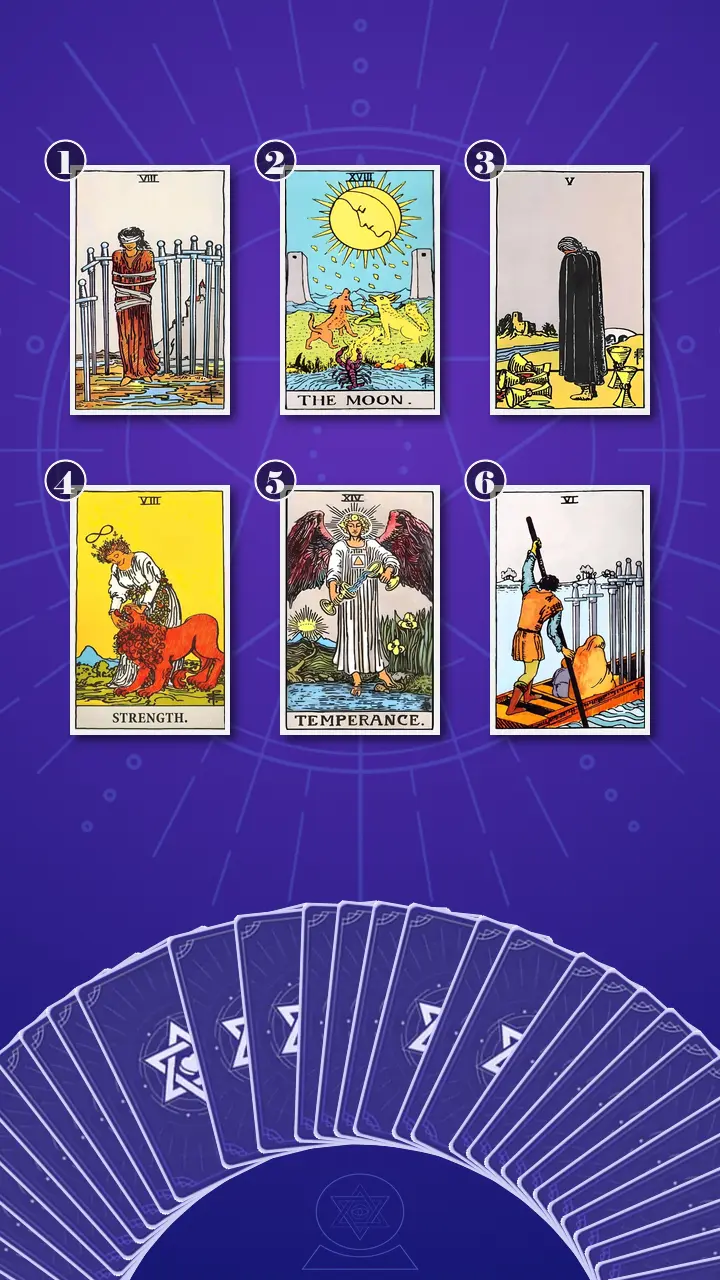
Reading the Map: The Spiral Row (and Why It Feels Like a Trap)
Position 1 — Surface symptom: what your nervous system does when the bubble disappears
“Now we’re turning over the card that represents the surface symptom,” I said. “What your nervous system is doing in the exact moment the typing bubble disappears.”
Eight of Swords, upright.
The image is a classic thought-cage: a blindfolded figure, eight swords forming a loose prison, bindings at the wrists that look tighter than they truly are. The symbol I always watch for is the gap—the way there’s actually space to step out, if you can see it.
“This,” I told her, “is like when you keep the chat open and refresh it, and it feels like you cannot do anything else until you know what the silence means.”
I made it painfully modern on purpose, because Jordan’s problem lived on a lock screen, not in a castle. “Phone face-up like a tiny security camera. Reopening the thread. Rereading punctuation. Watching timestamps. Checking the green dot or ‘active now.’ Drafting a follow-up, deleting it, drafting again.”
“It feels like your whole evening is on pause until the screen changes,” I said. “That’s the Eight of Swords energy: Air—thought—turning sharp and constricting. Not balance. Blockage.”
Jordan let out a laugh that had zero humor in it—more like a pressure valve releasing. “Okay,” she said, voice thin. “That’s… too accurate. Even a little mean.”
“I know,” I replied gently. “And the point isn’t to shame you. It’s to name the cage so we can find the latch. Because the Eight of Swords isn’t telling you you’re doomed—it’s telling you your options get hidden when fear puts a blindfold on.”
Her shoulders were up near her ears. I noted it quietly. Not as a diagnosis—just information. As a Jungian psychologist, I pay attention to what the psyche does with the body when it can’t bear uncertainty.
Position 2 — Main blockage: the mental habit that turns uncertainty into threat
“Now we’re turning over the card that represents the main blockage,” I said. “The mental habit that turns uncertainty into a threat.”
The Moon, upright.
The room went a little quieter. Outside, a distant city hush pressed against the window—Toronto in that late-evening mode where condo hallways feel too silent and every sound echoes a bit too long.
“The Moon is night-journey energy,” I said. “It’s ambiguity. Projection. The mind trying to build a story because it can’t tolerate missing information.”
I used the metaphor that always lands for people living inside screens: “The typing bubble disappearing becomes night mode for your mind. Everything gets darker and louder.”
And then I gave her the split-screen, because that’s what The Moon does—two tracks running at once.
Alarm voice (top line): “They saw it. They changed their mind. I’m about to get ghosted.”
Reality voice (bottom line): “I don’t have enough data yet.”
“The Moon makes you treat missing info like danger,” I continued. “You start collecting ‘evidence’—active status, story views, response patterns—like you’re building a case in a courtroom where your worth is on trial.”
I heard myself get a little wry, close-friend energy, because sometimes we need language that cuts through the drama without mocking it. “Don’t negotiate with your nervous system through iMessage,” I said. “That’s The Moon’s trap. It will always ask for one more piece of proof.”
Jordan exhaled slowly—one of those exhales that’s half relief, half resignation. She gave a tiny nod like, yep, that’s my brain.
“So the blockage isn’t that they aren’t replying,” I summarized. “It’s that your mind interprets the pause as a threat, and then your body spikes.”
Position 3 — Root pattern: the emotional theme underneath that makes this land so hard
“Now we’re turning over the card that represents the root pattern,” I said. “The emotional theme underneath that makes this trigger land so hard.”
Five of Cups, upright.
This is the grief card people underestimate because it doesn’t look dramatic. It looks quiet: a cloaked figure staring at spilled cups, while two upright cups remain behind them.
“This is the memory overlay,” I told Jordan. “The current chat thread becomes a projector screen for older losses.”
I watched her throat bob as she swallowed. Her eyes went slightly unfocused—like she was replaying something she didn’t fully want to name.
“The silence doesn’t just feel like a pause,” I said. “It taps an older ache: It’s not just this person—it’s the familiar feeling that people leave. So your attention locks onto what’s missing—the reply—and you can’t access what’s still here.”
“The two upright cups,” I continued, “are your steadiness, your friends, your routines, your life outside this thread. They’re not a magical fix. They’re evidence. Not everything is gone.”
Jordan’s voice dropped. “That’s the part I hate,” she said. “Because I’m so independent in every other part of my life. And then a screen goes quiet and I feel… twelve.”
“That makes perfect Jungian sense,” I replied. “A younger part of you—the part that learned silence could mean loss—steps forward when the signal goes quiet. We don’t shame her. We don’t exile her. We learn how to lead her.”
When Strength Spoke: Taming the Inner Lion
Position 4 — Turning point: the inner capacity that softens abandonment activation
“Now,” I said, and I let the word slow the room down, “we’re turning over the card that represents the turning point—the inner capacity that can soften the abandonment activation without needing immediate external reassurance.”
Strength, upright.
In the image, a woman rests gentle hands on a lion. No fight. No domination. Just presence. Above her head, the infinity symbol—a sign of steadiness that isn’t performative, just practiced.
Jordan looked at the card, and I could feel how badly she wanted it to be true. How badly she wanted “calm” to be something you either have or you don’t—like a personality trait you’re born with. But Strength doesn’t work that way. It’s earned in small repetitions.
Before I went any further, I did something I’m known for—what I call my Energy Flow Diagnosis. Not medical. Not labels. Just noticing how the body holds the story.
“Can I check something with you?” I asked. “When you described the bubble disappearing, your shoulders lifted and your jaw tightened. If you tune in right now—without forcing anything—where do you hold it first? Neck? Chest? Stomach?”
“Chest,” she said immediately. “And like… right here.” She touched the base of her throat. “It gets tight.”
“That’s your body’s alarm system,” I said. “And Strength is the antidote because it doesn’t try to win an argument with the alarm. It meets it.”
I held up the card slightly. “Strength says: your soothing doesn’t have to come from a reply. It can come from how you meet the surge in your body with steady, compassionate self-leadership.”
Jordan’s eyes glistened, but she didn’t cry. She looked like she was trying to stay impressive.
I took a breath, then set up the moment the way I’ve learned to on long voyages, when someone is right on the edge of a breakthrough—when the sea inside them is rough, and one sentence can become a lighthouse.
You know that exact moment: the typing bubble pops up, your chest loosens for half a second—and then it vanishes. Your stomach drops, your thumb hovers, and suddenly the whole room feels too quiet.
Stop trying to tame uncertainty by chasing a message; start taming the inner lion with calm hands and steady breath.
I let the sentence hang there, like a bell tone that keeps vibrating even after you stop it.
Jordan’s reaction came in a chain—three small waves that told me it went in deep.
First: a physical freeze. Her breath paused. Her fingers went still on her lap, as if the part of her that reaches for the phone had been gently interrupted mid-motion.
Second: the cognitive seep. Her gaze went slightly distant, like she was replaying every time she’d tried to “tame uncertainty” by perfecting a text—ten drafts in Notes, one too-long paragraph, then the shame spiral of, why did I send that.
Third: the release. Her shoulders dropped a few millimeters, and she took a deeper inhale than she had since she’d sat down. Her voice cracked, just slightly. “But… if I don’t do something, it feels like I’m just waiting to be left.”
“Yes,” I said softly. “And this is the radical part: you can want reassurance and still not abandon yourself to get it.”
I watched her throat move again. Her jaw unclenched, then clenched, then softened—like her body was negotiating a new contract in real time.
“Here’s a borrowing sentence,” I offered, because sometimes we need a line we can grip when the mind goes slippery: “This is activation, not evidence.”
She whispered it back, testing the fit. “Activation, not evidence.”
“Exactly,” I said. “And Strength is the moment you stop outsourcing safety to someone else’s response time. Not because you don’t care. Because you care and you choose to lead yourself anyway.”
I asked the question that turns insight into lived memory. “Now, with this new perspective—think back to last week. Was there a moment when the bubble vanished and this line could have changed how you felt?”
Jordan stared at the card, then nodded slowly. “Saturday,” she said. “I saw him active on Instagram while my message just… sat there. I literally built a whole case out of punctuation.”
“That’s The Moon feeding the Eight of Swords,” I said. “And Strength is you stepping in like, ‘I see the fear. I’m not going to punish you. I’m also not going to let you run the whole story.’”
In terms of the emotional transformation, I named it clearly: “This is a move from texting-triggered panic and shame toward self-led steadiness and values-based communication. Not overnight. But it starts here—body, breath, choice.”
Temperance as a Protocol: Measured Communication Instead of Ten Drafts
Position 5 — Actionable next step: a concrete practice for the next week
“Now we’re turning over the card that represents the actionable next step,” I said. “A concrete practice for the next week to soothe and respond with clarity.”
Temperance, upright.
The angel pours water between two cups—slow, patient, exact. One foot on land, one in water. A visual lesson in titration: not flooding, not freezing.
“Temperance is your practical plan,” I told her. “It turns Strength into a repeatable process.”
“In modern life,” I said, “this looks like: you stop treating texting like an emergency negotiation. You name the feeling—‘I’m activated.’ You name the fact—‘I don’t know why they paused.’ And then you choose one measured step.”
I let the line land because it’s a small mantra that saves people: “One clean choice beats ten panic drafts.”
Jordan gave a tiny smile—still tender around the edges, but real.
“Okay, but—” she started, then winced. “This is where I get stuck. I tell myself I’ll ‘pause’ and then I’m like… I don’t even have five minutes. My brain is already writing the follow-up.”
There it was: the real-world obstacle. Not a lack of insight. A lack of space.
“Then we don’t aim for five minutes,” I said, clear-eyed coach voice sliding in without becoming harsh. “We aim for twenty seconds. Temperance isn’t about being chill. It’s about being measured. If your system is loud, we lower the bar until it’s doable.”
I brought in one of my personal tools from life in motion—what I call Quick Recovery Techniques. I developed them when I was training intuition on cruise ships, because you can’t tell someone, ‘Go process your abandonment wound for an hour,’ when dinner service is starting and they’re about to see someone they miss.
“We’ll build a micro-reset you can do between Slack pings,” I said. “Under three minutes. Even under one.”
Position 6 — Integration: what it looks like when the trigger no longer runs the story
“Now we’re turning over the card that represents integration,” I said. “What it looks like when the trigger no longer runs the whole story.”
Six of Swords, upright.
A boat crossing water. The swords are still in the boat—thoughts don’t vanish—but the water ahead is calmer. Movement, not captivity.
“This is what ‘finding clarity’ looks like in real life,” I told her. “Not certainty. Not a guaranteed outcome. But movement toward calmer water.”
I flashed back—just for a second—to standing on an open deck in the Atlantic, listening to someone confess they couldn’t sleep because a single unread message felt like a storm warning. The sea was black glass. The ship still moved forward. That’s what this card is.
“Integration looks like this,” I said. “The trigger still happens. Your body still notices. But you step away from the phone anyway. You make dinner. You take a shower. You walk around the block. You carry the swords, but they’re traveling with you instead of trapping you.”
Jordan breathed out, longer this time. “That sounds… boring,” she said.
“In the best way,” I smiled. “Integration looks boring. Your mind might try to restart the drama to feel certain. But calm isn’t a personality trait. It’s a practice.”
From Insight to Action: The Strength Check + Temperance Timer
I gathered the whole spread into one clean story for her—because people don’t change from scattered insights. They change from a coherent map.
“Here’s what your cards are saying,” I summarized. “The Eight of Swords is the moment your world shrinks to one screen. The Moon is the mental habit that turns missing information into a threat, so you start hunting for proof. The Five of Cups is the deeper grief-memory that whispers, ‘people leave,’ making this pause hit like an old loss. Strength is the pivot—meeting the body surge with compassion instead of control. Temperance is the protocol that turns that compassion into one measured choice. And the Six of Swords is the result: you move through uncertainty without making it a verdict about your worth.”
“Your cognitive blind spot,” I added, “is thinking that clarity comes from more data—more checking, more analyzing, more perfectly-worded texting. But the transformation direction is the opposite: safety first, then interpretation, then one boundaried communication choice.”
I offered her a set of next steps that were deliberately small—because in Toronto life, with deadlines and high-rent pressure, anything too elaborate becomes another reason to feel like you’re failing.
- The 60-Second Strength Check (doable even at work)The next time the dots vanish, put your phone screen-down for 20–120 seconds. Place one hand on your chest and one on your lower belly. Inhale for 4, exhale for 6, five rounds. Then say: “This is activation, not evidence.”If 60 seconds feels impossible, do the “tiny version”: 3 slow exhales + screen-down for 20 seconds. You’re not failing—your system is just loud right now.
- The Temperance Timer (your anti-double-text boundary)For the next week, set a 20-minute timer before any follow-up text. During the timer, do one grounding action: wash a mug, step into the condo hallway and feel your feet, stretch your calves against a wall, or grab water.Your only job is to reduce urgency by 10%. After the timer, choose one: wait, or send one clean sentence. No paragraphs.
- The Two-Cups Reality Check (feelings vs facts)Once a day, open Notes and write two lines: (1) “What I feel is ____.” (2) “What I know for sure is ____.” Keep them separate—no mixing. This is Temperance pouring between cups.Pin the note, or make it the first thing you see. If you’re tempted to doom-scroll their story views, run this check first.
Before we closed, I added one more piece—my Venetian Aqua Wisdom, because it’s how my own mind makes regulation feel practical. “In Venice,” I told her, “water doesn’t become clear by forcing it. It becomes clear by letting it circulate. Your feelings are the same. If you trap them in one thread, they turn stagnant. If you let them move—breath, body, one measured action—they clear.”
“And a final non-medical body note,” I said, because she’d mentioned headaches and neck tension. “When your shoulders creep up and your jaw clenches, that’s often ‘responsibility overload’ energy—your body trying to manage the outcome. If you can, drop your shoulders 5% and soften your tongue from the roof of your mouth. It’s a tiny desk-posture correction, but it tells the nervous system: we’re not under attack.”

A Week Later: The Quiet Proof
Six days later, Jordan sent me a message that made me exhale in that relieved way I do when someone chooses themselves in a small, real way.
“Dots disappeared,” she wrote. “I did the screen-down thing for 60 seconds. I hated it. Then my shoulders actually dropped. I waited 20 minutes. Didn’t double text. Made pasta. Still nervous, but not spiraling.”
Clear but vulnerable, just as integration tends to be: she slept through the night, but in the morning her first thought was still, “What if I was wrong?”—and then she smiled, because she recognized the thought as weather, not fate.
I thought back to the spread—how it moved from a thought cage into night projection, down into grief memory, then pivoted into gentle inner strength, blended into a protocol, and finally rowed toward calmer water.
That’s the journey I care about most: not “getting the reply,” but moving from texting-triggered panic and shame to self-led steadiness and values-based communication. The Transformation Path Grid (6) isn’t magic; it’s a mirror with a map. And sometimes that’s what clarity actually is.
When the screen goes quiet, it can feel like your chest is doing the waiting for you—like the pause is already a verdict, and you have to earn your place before you’re left behind.
If you didn’t have to prove you’re worth replying to tonight, what would a slightly kinder, steadier next 5 minutes look like for you?