From No-Rush Panic to Steady Pacing: A Read-Receipt Journey in Dating

Seen But No Reply on the Northern Line
If you work in a Slack-fast job in London and still spiral when someone texts “no rush,” because “Seen” plus silence feels like a slow-motion rejection.
Jordan (name changed for privacy) said it like they were confessing to a crime they hadn’t actually committed. Twenty-seven, a product designer at a scrappy startup near Old Street, the kind of person who can run a Figma review and a feelings check-in with equal fluency—until the waiting starts.
They’d come to me with a very specific question: After they say no rush, what past belief turns waiting into panic?
Jordan described Tuesday, 8:47 PM on the Northern line heading home: the carriage warm and slightly stale, fluorescent lights buzzing like they were inside the ceiling, their phone screen hot in their palm. They opened the same WhatsApp thread again—Seen—and their jaw clamped so hard it made their molars ache.
“I want to be chill,” they said, thumb hovering like it had a mind of its own. “I want to be respectful of their pace. But my body treats the pause like… a verdict.”
Panic isn’t abstract in moments like that. It’s a restless fizz under the sternum, like a tiny slot machine in your ribcage: refresh, hope, spike, crash. And then the shame layer on top—why am I like this?
I nodded, gentle but steady. “We’re not here to diagnose you as ‘too much.’ We’re here to map the pattern. Let’s find clarity in the in-between—so your next move doesn’t come from a timestamp.”

Choosing the Compass: The Transformation Path Grid (6)
I asked Jordan to take one slow breath with me—just enough to mark a transition from spiraling to observing. While I shuffled, I framed the cards the way I always do: not as a way to read the other person’s mind, but as a practical tool to read your nervous system in context.
“Today we’ll use a spread called the Transformation Path Grid (6) · Context Edition,” I said.
For readers: I chose this spread because the problem isn’t “What will they do?”—it’s the direct chain reaction: waiting → panic → old belief → regulation → practical pacing → integration. It keeps the focus on agency and actionable advice, not prediction.
I also told Jordan what to expect: “The first card shows your present reaction in the gap. The next reveals the immediate blocker—the habit that turns uncertainty into urgency. The third goes to the root: the past belief underneath. Then we find the key shift, a real turning point energy, and we finish with a grounded plan and what it changes in you.”
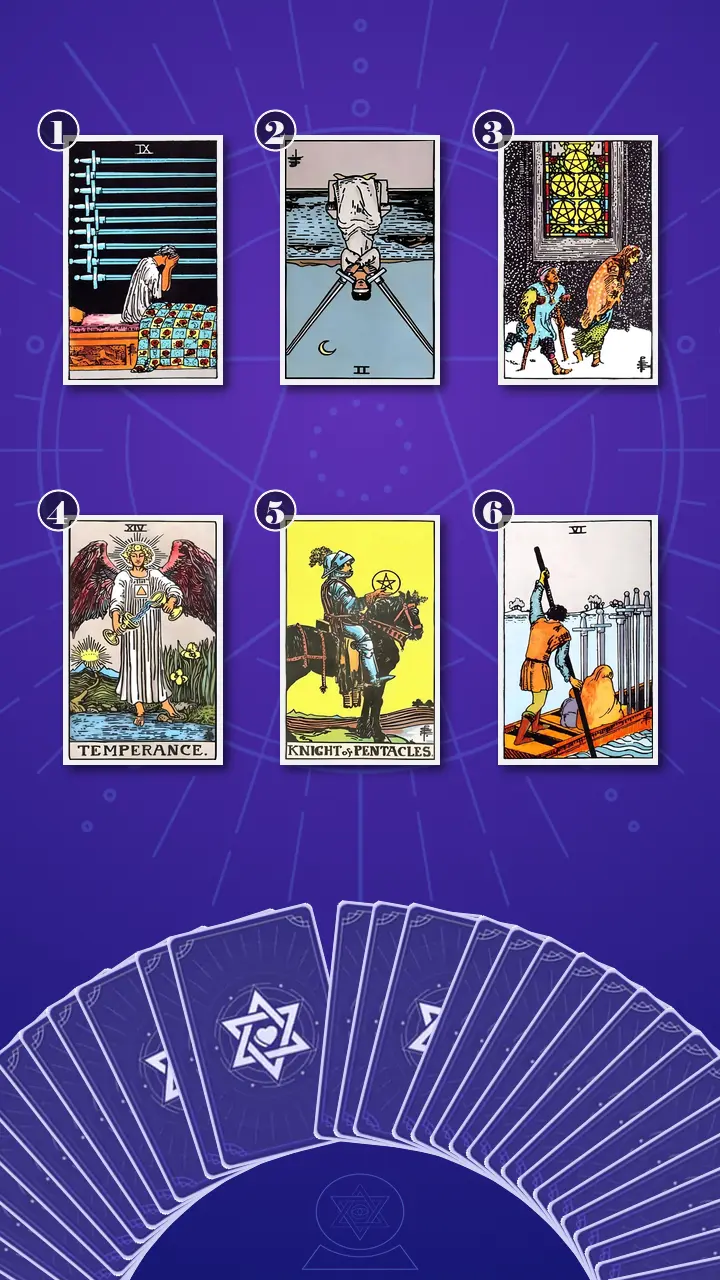
When Temperance Poured Between Two Cups
I laid the cards in a 2x3 grid—top row like weather, bottom row like repair. The Tube inside Jordan’s story felt far away for a second, replaced by the quiet click of cardstock and the soft drag of paper against my table.
Position 1: Present reaction—what your mind and body do in the waiting gap
Now flipped open is the card representing Present reaction: what your mind and body do during the waiting gap after “no rush.”
Nine of Swords, upright.
I didn’t have to reach for anything mystical. The translation landed immediately: It’s 1:26 AM and the room is lit by your phone glow. You’re rereading the last two messages like they’re evidence, zooming in on punctuation and time stamps, and you can feel that chest-and-stomach buzz that says, “Fix it. Do something.”
“This card is your brain as a prosecutor in a dark room,” I told them. “It presents ‘evidence’ like read receipts and timing—things that feel objective—but the verdict is always about your worth.”
The energy here isn’t balance; it’s excess Air: thought loops with no new data. “And I want you to hear this clearly,” I added. “You’re not needy—you’re negotiating with a timestamp. That’s different.”
Jordan gave a grim little laugh that was half recognition, half insulted relief. “That’s… painfully accurate. Like, almost rude,” they said, but their shoulders loosened by a millimeter—as if being named was, in itself, a kind of permission.
Position 2: Immediate blocker—the habit that turns uncertainty into urgency
Now flipped open is the card representing Immediate blocker: the mental habit that turns uncertainty into urgency and pushes you toward reactive texting.
Two of Swords, reversed.
I pointed to the blindfold and the crossed swords. “Reversed, this is what happens when you can’t hold ‘I don’t know’ without trying to end it.”
The modern-life scene was practically Jordan’s Notes app: thumb hovering over a follow-up, three drafts—funny, casual, ‘emotionally mature.’
“The blocker isn’t confusion,” I said. “It’s that not knowing feels like free-fall. So your mind tries to force a landing—double texting, overexplaining, ‘just checking you saw this :)’—anything that creates a hit of certainty.”
Jordan’s eyes flicked down to their phone on the table like it had just vibrated, even though it hadn’t. They did a half-smile—self-recognition—then their face sobered. “I’m not confused,” they admitted quietly. “I’m avoiding the feeling of not knowing.”
Position 3: Past belief—the older story that makes waiting feel like being left out
Now flipped open is the card representing Past belief: the older story about worth and belonging that makes waiting feel like being left out.
Five of Pentacles, upright.
“Here’s the part that hurts,” I said, softer. “This card isn’t about a bad texter. It’s about the old imprint that decides what silence means.”
I offered the scene analogy that lives in this card’s bones: standing outside a lit pub window in winter, watching laughter inside and deciding you’re not invited—before anyone even spoke to you. “Your internal OS goes: Warmth exists… just not for me.”
Jordan swallowed hard. The lump-in-throat response came fast, like their body recognized the category before their mind could edit it. “There was someone,” they said, eyes fixed on the card instead of me, “who said ‘no rush’ and then… just slowly disappeared. I kept acting low-maintenance. I kept ‘being cool.’ And it still happened.”
I let that land. The Five of Pentacles energy is scarcity: the belief that being chosen is fragile, and you must manage it. “So when someone says ‘no rush’ now,” I said, “your nervous system doesn’t hear kindness. It hears the old possibility of being excluded without warning.”
I paused and said the bridge out loud, because Jordan needed it as much as the reader does: Warmth doesn’t only come from the notification bar.
Position 4: Key shift—the regulating energy that changes everything
Now flipped open is the card representing Key shift: the regulating energy that helps you reinterpret “no rush” without self-abandoning.
Temperance, upright.
The room went a little still—not dramatic, just that hush you get when a truth arrives without raising its voice.
Jordan was right back on the Tube in their own head: jaw tight, thread open again, “no rush” starting to sound like a trap instead of kindness.
I tapped the image of the angel pouring water between two cups. “Temperance is pacing. Not suppression. Not flooding someone with reassurance-chasing. It’s titration—making your feelings workable.”
And because I’m a Paris-trained perfumer, I couldn’t not translate it through scent. “In my world, panic is like the top notes of a fragrance—citrus, pepper, alcohol lift. It hits fast, burns bright, evaporates quickly. Self-respect is the base note—cedar, musk, vetiver. It doesn’t scream, but it lasts.”
I looked at Jordan. “Quick question—what do you reach for when you’re stressed? A sharp minty thing? A bright body spray? Something that ‘wakes you up’?”
Jordan blinked, surprised, then nodded. “Yeah. Peppermint oil. Always.”
“That’s my Attraction Analysis lens,” I said, “not in a woo way—in a pattern way. You’re drawn to ‘instant shift’ sensations. In dating, the equivalent is instant reply. Temperance teaches a different intimacy: steady warmth, not a jolt.”
Then I guided them into the modern pacing script: “Two cups. One cup is truth: ‘I want connection.’ One cup is calm: ‘I don’t have to chase it for proof.’ We mix them before we touch the thread.”
Jordan’s brows pulled together, and for a beat the reaction wasn’t relief—it was resistance. “But if I do that,” they said, voice sharp with a sudden anger, “doesn’t it mean I’ve been doing it wrong? Like I made myself small for nothing?”
I held their gaze. “It means you were trying to survive a feeling with the tools you had. Temperance isn’t an accusation. It’s an upgrade.”
Stop treating the pause like a verdict; start mixing calm and truth like Temperance’s two cups, and let time become an ally instead of a threat.
Jordan’s body did a three-step reaction chain I’ve seen in a hundred different forms: first, a brief freeze—breath caught, fingers hovering above their phone as if mid-scroll. Second, the cognitive seep—eyes unfocused, like a memory replayed without permission: the last slow fade, the last “no rush” that wasn’t gentle at all. Third, the release—an exhale that sounded almost annoyed, shoulders dropping as if they’d been wearing a backpack they forgot was there.
“Okay,” they whispered. “That… actually feels possible.” Then, more vulnerable: “I can do something without texting.”
I gave them the 10-minute Temperance Reset, exactly because it’s small enough to use in real life:
“Phone face-down. Ten-minute timer. One regulating action with a clear end—drink a full glass of water, quick shower, or walk to the corner shop and back. Then write two sentences: ‘The story my panic is telling is ___.’ ‘The facts I actually have are ___.’ And you’re allowed to stop early. This is practice, not punishment.”
I leaned in. “Now—with this new lens—think back: was there a moment last week where you could feel your thumb about to send a follow-up? What might have changed if you’d mixed calm and truth for ten minutes first?”
They nodded slowly. “Sunday. I wrote a whole tone-defense paragraph in Notes. If I’d done this, I think I’d have… slept. Or at least stopped auditioning to be ‘low-maintenance.’”
That was the shift in real time: from panic-driven rumination about response time to a first taste of paced self-trust—worth no longer negotiated through response speed.
Position 5: Action plan—the grounded behavior that protects your self-respect
Now flipped open is the card representing Action plan: one grounded behavior pattern that keeps your communication aligned with self-respect.
Knight of Pentacles, upright.
“This is the opposite of adrenaline texting,” I said. “The Knight doesn’t sprint toward reassurance. They build rhythm.”
I made it plain, because Jordan’s brain loves systems: “Think of this as a calendar habit, not a vibe. Reliability over adrenaline.”
Jordan’s face did something I love to see—calmer, slightly stubborn, in a good way. “I can do stubborn,” they said. “I just… forget when my chest starts buzzing.”
“Then we’ll make the plan so simple it survives the buzz,” I replied. “One clean message. One steady pace.”
Position 6: Integration—what changes when you practice the pace
Now flipped open is the card representing Integration: what changes internally when you practice the new pacing consistently.
Six of Swords, upright.
“This is you crossing,” I said. “Not to certainty—just to calmer water.”
The Six of Swords doesn’t promise that waiting becomes fun. It promises transition: you still notice the first flicker of anxiety, but it doesn’t hijack the night. You travel through the interval with structure.
Jordan stared at the boat for a long moment. “I want that,” they said. “Not perfect. Just… less punishment.”
One Clean Message, One Steady Pace
I pulled the whole map together for Jordan, like connecting dots they’d been staring at separately for months.
“Here’s the storyline,” I said. “Your present reaction is Nine of Swords: a mental courtroom where silence becomes evidence. The immediate blocker is Two of Swords reversed: you can’t tolerate not knowing, so you try to force clarity. Under that is Five of Pentacles: an old belonging alarm—‘Warmth exists, but not for me’—which makes ‘no rush’ sound like abandonment. Temperance is the bridge: regulate first, interpret second. The Knight gives you the container: a repeatable communication rhythm. And the Six of Swords is the payoff: calmer water in your body.”
The cognitive blind spot was clean once it was named: Jordan had been treating timing as a measure of worth, imported from Slack culture and past slow-fade pain. “The transformation direction,” I said, “is from controlling timing for reassurance to choosing a paced response plan that protects your self-respect even while you don’t know the outcome.”
Jordan frowned. “But I literally can’t do hours of willpower,” they said. “I’m in meetings. My phone’s right there. And the second I see ‘Seen,’ my body goes feral.”
“Perfect,” I said, not sarcastic—relieved. “Then we don’t do willpower. We do containers.”
- The Message Window RulePick one daily window for this thread (e.g., 7:30–8:00 PM). Outside it, mute that chat or turn off banner notifications for the evening—so your nervous system isn’t doing read-receipt surveillance on the Tube.Start with one 20-minute notification-off block if a whole evening feels impossible. Expect the “I’m losing momentum” argument—label it as the Nine of Swords voice, not a command.
- The Temperance Reset (10 Minutes)Before you open the thread: phone face-down, set a 10-minute timer, drink a full glass of water and take 6 slow breaths. Then write two lines: “The story my panic is telling is ___.” “The facts I actually have are ___.”If scent helps you regulate, choose a “base-note anchor” (cedar/vetiver/musk or any warm, steady fragrance you already own). One spray becomes your cue: regulate first, interpret second.
- The One Clean Message ProtocolSend one thoughtful reply—no extra commentary to manage how it lands. If you need to follow up, do it once after 24 hours (or one business day), and keep it simple. Draft in Notes if you must, then cut the final version by 30%.Boundary: no “tone-defense paragraphs” unless there’s a real misunderstanding to repair. Clean is kind to you, too.

Consistency Is a Boundary You Can Feel
A week later, I got a message from Jordan that wasn’t a screenshot essay—just one line: “Did the message window. Muted the thread. I still felt the spike, but I didn’t double text. I went to the corner shop, came back, and the world hadn’t ended.”
They added, almost begrudgingly: “Also… I slept.”
In my mind I saw it with the bittersweet honesty of real change: they’d finally slept a full night, but in the morning the first thought still arrived—What if I’m wrong?—and this time they just exhaled, reached for their grounding scent, and let the question exist without answering it with a follow-up text.
This is what a Journey to Clarity looks like in practice: not a perfect detachment, but a steadier relationship with the in-between—where “no rush” can be taken literally, and self-respect isn’t negotiated through response time.
When someone says “no rush,” you want to be the cool, emotionally intelligent person who can wait—but your chest still tightens like silence is you being quietly left outside the warm window again.
If you didn’t have to earn warmth through urgency, what would one small, self-respecting pace choice look like the next time you’re waiting?