That “Couples Therapy” Text Hit Like a Verdict—Until I Made It a Trial

Finding Clarity in the 8:53 p.m. Tab Spiral (relationship decision paralysis after a partner suggests couples therapy)
If you’ve ever seen the text “Maybe we should do couples therapy” and felt your stomach drop—like it’s either a growth moment or a breakup in slow motion—you’re not alone.
Jordan (name changed for privacy) sat back on their Toronto condo couch like their own living room had turned into a courtroom. It was 8:53 p.m. on a Wednesday, the streetcar hum leaking through the window in a steady, indifferent line. Their laptop threw cold light across the coffee table—Psychology Today open, three therapists bookmarked, one “Request a consult” button hovering like a dare. Their phone was warm in their palm from being gripped too long, lit up with a screenshot of an old fight and a Notes app draft that started with We need to talk… and ended with nothing.
I watched their jaw work as if it was trying to chew through the decision. Their shoulders kept creeping toward their ears. When they swallowed, their throat moved like it had to push past a knot.
“I don’t even know what I’m asking,” they said, and then exhaled like the sentence had cost them. “They suggested couples therapy. Do I try it or leave? And why does it feel like I’m about to either waste years… or give up too early?”
Confusion isn’t an abstract thing in moments like this. It’s a tight jaw that makes your molars ache. It’s a fluttery stomach every time you imagine the next conversation. It’s the itchy need to reopen the same texts because the past feels controllable in a way the future doesn’t.
“I hear how much pressure you’re putting on yourself to get this ‘right,’” I told them, keeping my voice gentle and steady. “We’re not going to force a forever-answer tonight. We’re going to do what tarot does best when it’s used practically: we’ll draw a map through the fog. And we’ll aim for clarity you can actually act on.”

Choosing the Compass: the Decision Cross tarot spread for deciding whether to try couples therapy or leave
I don’t treat tarot like a dramatic verdict. I treat it the way I used to treat intuition training on long transoceanic voyages—like a navigation tool. When you’re surrounded by water, you don’t wait for the ocean to hand you certainty. You choose a compass, you set a bearing, and you check your course.
“We’ll use a spread called the Decision Cross,” I said as I gathered the deck. “It’s built for exactly this kind of relationship crossroads: one path, another path, and the hidden psychological driver that makes both feel impossible.”
I asked Jordan to take one slow breath—not as a ritual, but as a reset. “Just long enough to let your nervous system catch up,” I told them. While I shuffled, I invited them to hold the question in plain language: After they suggest couples therapy, do I try it or leave?
For you reading this: the reason I like the Decision Cross in situations like “couples therapy vs breakup how to decide” is that it keeps the reading empowerment-focused. It doesn’t try to predict whether the relationship will ‘work.’ It separates the two options cleanly—trying therapy versus leaving—and still gives us a dedicated slot to name the hidden bind (shame, guilt, attachment stories) plus a final slot for actionable advice you can do this week.
“The center card will show how the stuckness is showing up day to day,” I explained. “Left is Option A: what trying couples therapy actually asks of you. Right is Option B: what leaving would protect or reclaim. Above is the hidden driver—the thing that turns this into a high-stakes referendum. And below is guidance: the boundary or next step that restores your agency either way.”
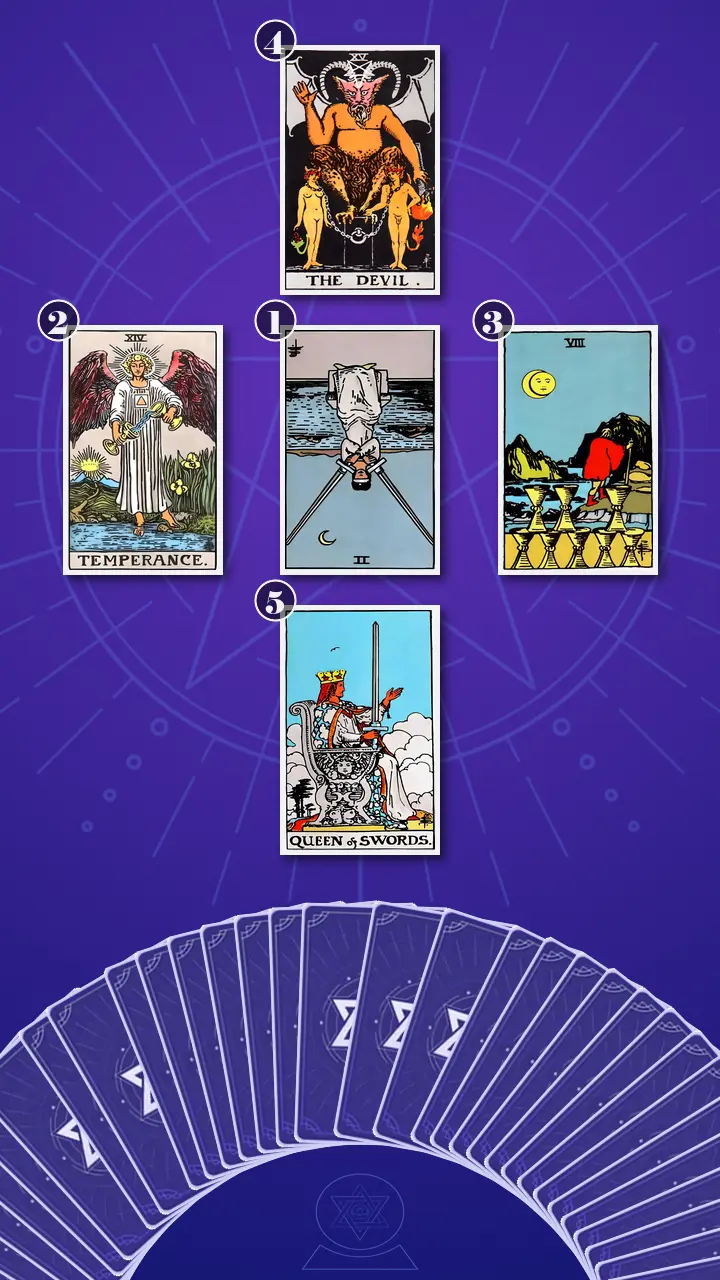
Reading the Map: the Tab Labyrinth in the Middle of the Room
Position 1 — The current stuck point: Two of Swords (reversed)
“Now flipped over,” I said, “is the card that represents the current stuck point—how the indecision is showing up in day-to-day behavior and communication right now.”
The Two of Swords, reversed.
In the classic image, there’s a blindfold and crossed swords held tight to the chest. Reversed, that blindfold doesn’t stay put. It slips. You can’t fully unsee what you’ve already seen—yet the body still keeps the blades up like a guardrail.
“This is like what you described without even meaning to,” I told Jordan. “After the ‘Maybe we should do couples therapy’ text, you turn the relationship into an open-tab labyrinth: therapist directories, old screenshots, Notes app drafts, a pros/cons list. It looks like action, but it’s really a truce with the decision—staying suspended so no one has to hear a boundary yet.”
I named the energy dynamic plainly. “Right now, your Air energy—your thinking—isn’t balanced. It’s blocked. Not because you’re not smart. Because thinking has become a way to stay protected from the sharp edge of saying what you need.”
I could almost hear the inner monologue clicking through them like a carousel: If I just find one more piece of proof, I’ll finally know. Control through research versus vulnerability through a real, time-bound conversation.
Jordan let out a tiny laugh that wasn’t amused. It had teeth. “That’s… yeah,” they said. Their eyes flicked to their laptop like it had betrayed them. “Wait… how did you know I keep toggling between therapist tabs and breakup drafts like I’m building a case?”
Here was the first “unexpected reaction,” and it came in a three-beat sequence I’ve learned to watch for. Their breathing paused for a half-second. Their gaze unfocused, like they were replaying last night at double speed. Then their shoulders dropped a millimeter with a quiet, reluctant exhale—recognition landing before relief.
“Because the Two of Swords reversed always tells on us,” I said softly. “It shows avoidance disguised as analysis. And it asks a very modern question: This week, what did you do that moved the decision forward in real life—a booked consult, a scheduled talk, a stated boundary—not just in your head?”
When Temperance Poured Between Two Cups
Position 2 — Option A (trying couples therapy): Temperance (upright)
I slowed down as I drew the second card. Even over video calls, you can feel when a room changes. The air doesn’t get mystical—it gets quiet, like everyone inside you stops talking long enough to listen.
“Now flipped over is the card that represents Option A—trying couples therapy: what this path asks of you emotionally and practically, and what kind of change process it represents.”
Temperance, upright.
Temperance is the image of an angel pouring water between two cups—steady, measured, unbothered by drama. One foot on land, one in water. It’s not a lightning bolt. It’s a method.
“In real life,” I said, “this looks like treating couples therapy like a structured pilot—not a forever-commitment. A set number of sessions. Clear goals. A check-in date. The relationship stops being managed only during blowups and starts being worked on in calm, consistent increments.”
Jordan’s expression didn’t brighten so much as it grounded. The urgency thinned. They nodded once—slow, like their body could finally picture something doable.
And this was where I brought in the lens I’ve carried since I was a child in Venice, watching how bridges and corridors change what’s possible. “I have a framework I call my Bridge-Corridor Theory,” I told them. “In Venice, a bridge connects two islands, but it doesn’t erase the water. It gives you a way to cross without pretending the canal isn’t there.”
“Couples therapy, at its best, isn’t you and your partner proving who’s right. It’s building a bridge between two emotional realities. And it also creates a corridor—rules of engagement—so you’re not improvising conflict at midnight with a tight jaw and a Notes app draft.”
Jordan’s mouth twisted in a half-smile. “So you’re saying I have to… project manage my relationship?”
There was heat behind the joke. A flash of resentment: I’m already doing the emotional admin.
“I’m saying you deserve a process that protects your dignity,” I answered, direct but not harsh. “And you’re allowed to time-box it so it doesn’t become endless emotional labor.”
Temperance isn’t naïve optimism. The energy here is balanced—emotion and structure in the same frame. It’s the antidote to ‘I must know the final answer before I act.’ It replaces it with: I can run a bounded experiment and learn from real data.
For a moment, Jordan looked like they were back on that couch after work—laptop open, phone hot in their hand, the draft staring like a judgment. You could see how their mind kept trying to turn the next step into a destiny decision.
Then I delivered the sentence I wanted to hang in the air like a lantern.
Stop waiting for a perfect sign and start mixing real evidence, like Temperance pouring water cup to cup, through a clear plan and consistent effort.
I let the quiet hold for a beat.
Jordan’s reaction came in layers—exactly how a real “aha” lands when it’s both comforting and terrifying. First: their throat moved like it wanted to close, then didn’t. Second: their eyes went slightly wider, like something inside them had just realized it didn’t have to win a debate. Third: their shoulders sank, and their jaw unclenched in a way that made their face look suddenly younger, and also a little stunned.
“But… if I do that,” they said, voice lower, “then I can’t hide behind ‘I’m still figuring it out.’ I have to actually do it. And if it doesn’t work…”
“Then you’ll have real information,” I said. “Not screenshots. Not vibes. Not a jury of friends on voice notes. Real information.”
I guided them through the reinforcement practice right there, like we were making the first plank of that bridge.
“Set a 10-minute timer,” I said. “In your notes app, write a tiny Temperance Plan with three lines: (1) One goal you’d want therapy to change—behavior, not vibe. (2) One non-negotiable boundary you need during the experiment. (3) A time box—four sessions plus a check-in, for example.”
As they typed, their fingers hesitated above the screen. Their breathing got shallow. I watched their shoulders tense, then I said, “Pause. Close the notes for a second. Three slow breaths. A rough draft still counts.”
When they reopened the app, the words came out messy and honest: Repair within 24 hours. No silent treatment for days. Four sessions + check-in.
In Jungian terms, this was a shift from a shame-driven inner trial to an experiment that protects the Self. In plain language: this was the first step in the emotional transformation from shame-driven proof-seeking and decision paralysis to values-based self-trust with clear boundaries and a time-boxed next step.
“Now,” I asked, “use this new lens and look back at last week. Was there a moment when you were spiraling—when this ‘plan with a check-in date’ would’ve changed how your body felt?”
Jordan’s eyes drifted to the side, replaying. “Sunday night,” they whispered. “I was watching those ‘healthy communication’ reels and then rereading the therapy text. I felt sick. If I’d had… a time box… I think my stomach wouldn’t have been doing that.”
Two Doors: The Moonlit Exit and the Chain You Can’t See
Position 3 — Option B (leaving): Eight of Cups (upright)
“Now flipped over,” I said, “is the card that represents Option B—leaving: what you’re trying to protect or reclaim through ending it, and what it would require to do it cleanly.”
Eight of Cups, upright.
This card doesn’t scream. It walks. A figure leaves stacked cups behind and heads toward mountains under moonlight. The energy is deliberate, not chaotic. It’s not punishment. It’s honesty.
“In modern terms,” I told Jordan, “this is you imagining leaving without making it a war. A values-led exit plan: a clear conversation, a friend on standby, keys and logistics handled, and space to grieve. Not disappearing. Not reopening the loop at 1 a.m. Not turning it into a performance.”
I watched Jordan’s face soften, then tighten again—grief and relief arriving together like two weather systems colliding. Their fingers slid along the edge of their mug as if it could anchor them.
“The Eight of Cups asks,” I said, “do you feel more like yourself in this relationship… or do you keep shrinking? And if you leave, what are you reclaiming—peace, self-respect, emotional safety, time?”
Position 4 — The hidden driver: The Devil (upright)
“Now flipped over is the card that represents the hidden driver—the attachment, fear, or belief that keeps the choice feeling high-stakes and hard to evaluate.”
The Devil, upright.
I didn’t dramatize it. The Devil isn’t a moral label; it’s a pattern card. In the image, the chains are loose. The trap is partly maintained by habit and shame, not because the door is truly locked.
“This,” I said carefully, “is why the decision feels like it’s about more than your relationship. The Devil shows identity stakes. Thoughts like: ‘If I leave, I’m the villain.’ ‘If we need therapy, it means it was never real.’ ‘If I stay and it doesn’t change, I’m stupid.’”
Jordan’s throat visibly tightened, as if the words had fingers. They looked down, then up, then away—three tiny movements in quick succession. Then: a quiet, choked “Oh.”
“I doom-scroll ‘healthy couples’ content,” they admitted, voice thin. “And it turns into… me prosecuting myself. Like, if I were better at relationships, I wouldn’t be here.”
“That’s the chain,” I said. “And here’s the reframe: The trap isn’t the choice—it’s turning the choice into a verdict on your worth.”
The Devil’s energy in this spread is sticky. It clings. It keeps you paying a subscription you forgot you can cancel—except the currency is your attention, your sleep, your self-respect. It’s what turns a practical question—‘Do we try therapy?’—into ‘Am I lovable and competent?’
Once it’s named, though, it loosens. Not instantly. But enough for the next card to land.
Position 5 — Guidance: Queen of Swords (upright)
“Now flipped over,” I said, “is the card that represents guidance—the boundary, conversation, or concrete next step that restores agency no matter which option you choose.”
Queen of Swords, upright.
Her sword is raised, not to punish, but to cut through fog. The sky behind her is open. This is clean Air—thinking used as a tool, not a battleground.
“Your nervous system is exhausted from mind-reading and bargaining,” I told Jordan. “The Queen of Swords says: clarity over guessing. Terms over debates. A boundary that fits in one sentence.”
Jordan sat a little straighter. Their shoulders dropped. Their jaw unclenched again, but this time with intention—like they were practicing the posture of someone who’s allowed to be direct.
“Clarity isn’t cruelty,” I said, letting the phrase land. “It’s how you stop living in ‘maybe.’”
I offered a script, simple enough to survive an emotional conversation. “Try: ‘I’m willing to try couples therapy for X sessions. What I need is Y and Z. If we can’t do that, I won’t stay in limbo.’”
It was the first time in the reading Jordan looked less like a defendant and more like a person with options.
The One-Page Temperance Plan: actionable advice with a check-in date
I leaned back and stitched the whole spread into one coherent story, the way I do when I’m helping someone stop drowning in details.
“Here’s what the cards are saying together,” I told Jordan. “Right now, you’re in the Two of Swords reversed—decision fatigue and a holding pattern. Your mind is trying to protect you by building a case, but it’s also keeping you stuck. Temperance says therapy can work if you treat it like a time-boxed couples therapy experiment: measurable goals, observable behaviors, and a check-in date that protects your self-respect. Eight of Cups says leaving can also be self-respecting—quiet, clean, values-led. The Devil explains why neither option feels simple: you’ve been carrying a shame story that says your choice will prove something about you. And the Queen of Swords ends it where it needs to end: with a boundary and a calendar, so you stop outsourcing your agency to ‘maybe.’”
“Your cognitive blind spot,” I added gently, “is thinking you need certainty before you act. But the transformation direction here is the opposite: act in a bounded way, then let lived evidence inform your next decision.”
Then I gave Jordan next steps that were small enough to start, and specific enough to count. Not vibes. Not promises. Steps.
- Book a consult while the tab is still openChoose one couples therapist and book a single 15-minute consult call this week. Do it in the same sitting you’re already in the directory—no “I’ll do it later.” Put it on your calendar immediately.If you freeze, make it a two-session pilot instead. You don’t need a lifelong therapist. You need your first data point.
- Write a one-page “meaningful effort” briefIn a note titled “What would count as meaningful effort?”, list 3 observable behaviors (e.g., shows up to sessions, follows through on repair steps, no name-calling). Bring this to your conversation so you don’t get dragged into relitigating the last five fights.If it starts to feel “too transactional,” remember: you’re not negotiating love—you’re defining what you will participate in.
- Use my Gondola Balance Technique for the boundary talkBefore you talk, draw two columns: “What I’ve been carrying” and “What I need us to carry together.” Then say one Queen of Swords sentence: “I’m willing to try therapy for 4 sessions. I need no silent treatment and a repair attempt within 24 hours. If we can’t do that, I’m not staying in limbo.”When the conversation escalates, use a pause clause—“I’m taking 20 minutes and coming back”—and actually come back. Consistency is the new safety.
“If it’s all in your head, it stays unsolvable,” I said, tapping the edge of the table once, like a period. “Put it on the calendar.”

A Week Later: Ownership, Not Certainty
A week later, Jordan texted me a screenshot—not of an old fight, not of a spiral. It was a calendar invite: Couples Therapist Consult — Tuesday 6:30 p.m. and beneath it, a second event: Relationship Check-in (not a fight) — after Session 4.
“I did the 10-minute Temperance Plan,” they wrote. “It wasn’t perfect. I wanted to over-explain. But I booked it. My jaw unclenched after. I slept. I still woke up and thought, ‘What if I choose wrong?’—but it didn’t swallow me whole this time.”
That’s what I mean by a Journey to Clarity. Not a fantasy where you feel certain forever—just the quiet proof that your choices can be anchored in boundaries and real-world data, not panic or proof-seeking.
When the words “couples therapy” land and your stomach drops, it’s not just the relationship you’re weighing—it’s the fear that one wrong choice will ‘prove’ you can’t trust your own judgment.
If you didn’t have to decide the forever-answer tonight, what’s one small, time-boxed experiment—or one clean boundary—you’d be willing to try just to get real data back into your body?