That TTC ride home spiral—and the one-sentence dinner boundary

The TTC Ride Home and the Hot Phone Screen
If you rehearse the perfect boundary in your head for hours, then freeze and laugh it off the second you’re compared to the ex (and hate yourself for it later), this is your nervous system doing conflict-minimizing on autopilot.
Jordan (name changed for privacy) sat across from me with her tote still looped around her wrist like she might bolt. “It’s his sister,” she said, and her mouth tightened on the word sister the way people do when they’re trying not to sound like they’re accusing anyone of a felony.
She described 8:37 p.m. on a Sunday on Line 1 in Toronto—train air too warm, fluorescent lights that make everyone’s face look a little sharper than usual. Her phone was literally warm from scrolling Instagram throwbacks where the ex still popped up in comments. “She made a ‘joke’ at dinner,” Jordan said. “And I did the polite laugh. I went… blank. Then I spent the whole ride home replaying it like I was editing a scene that already aired.”
I watched her jaw work, like she was trying to chew through the humiliation without making a sound. The feeling in her body wasn’t “anxiety” in the abstract—it was more like a seatbelt locking across her chest while she was still expected to smile for the photo.
“You want respect and emotional safety,” I said softly, “but you’re terrified the minute you ask for it, you’ll become ‘the problem.’ Let’s see if we can give this fog a shape. We’re here for clarity—real clarity you can use at the table, not just at 1 a.m. in your Notes app.”

Choosing the Compass: The Energy Diagnostic Map (7)
I asked Jordan to take one slow breath and hold the question in her mind: What boundary do I set when his sister compares me to the ex? Not as a wish. As a design problem.
I shuffled until the deck felt quiet in my hands, then I told her what I was choosing and why.
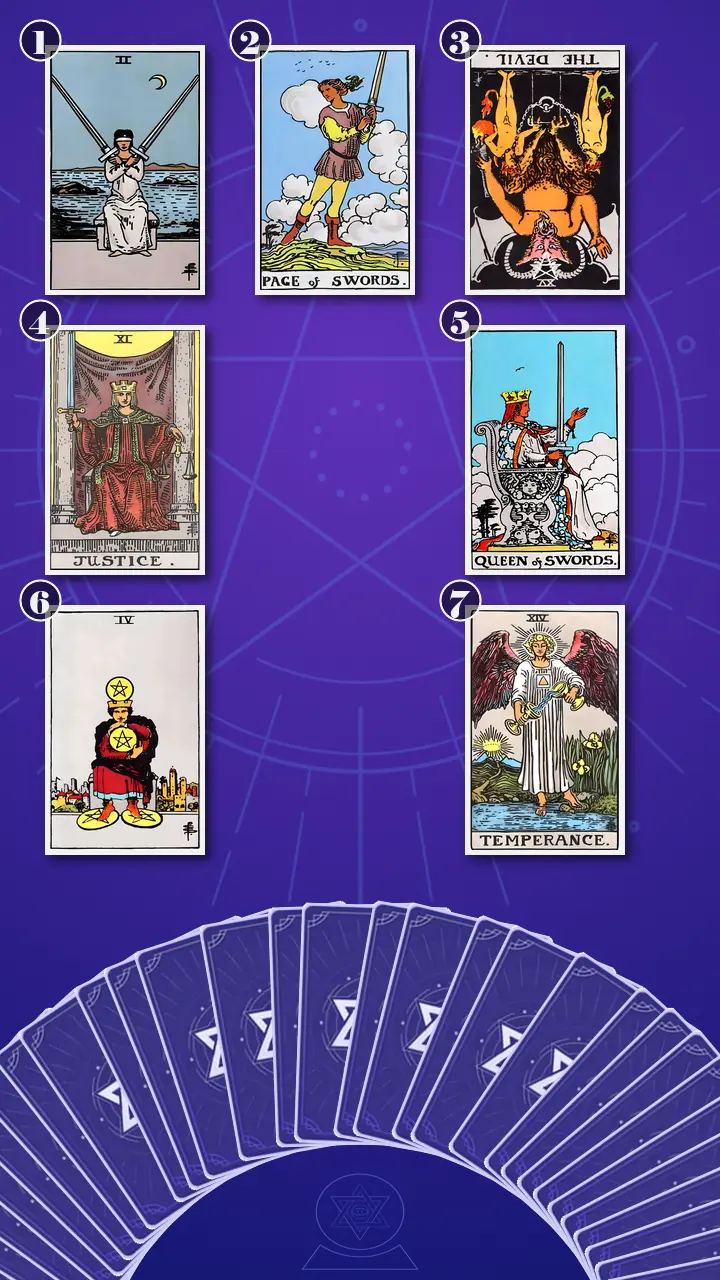
“Today we’ll use a spread I call Energy Diagnostic Map (7) · Context Edition,” I said. “It’s built for exactly this kind of three-person tension—you, the sister, and the ex narrative—without turning it into a prediction. It maps the moment you freeze, the hook underneath it, and then it gives us a boundary system: principle, delivery, follow-through, and a next-step plan.”
I pointed to the layout like stepping stones. “Card 1 will show the surface moment—what your body does when the comment lands. Card 3 will show what keeps the comparison game alive. And Card 4 is the key: the clearest standard you can enforce, even if your voice shakes.”
Reading the Map: Card Meanings in Context
Position 1: The Freeze You Call ‘Being Chill’
“Now we’re turning over the card that represents Surface dynamic: the exact, observable moment you freeze or self-edit when the sister compares you to the ex.”
Two of Swords, upright.
“This is the dinner-table shutdown,” I said. “You’re at a family dinner and she drops a comparison—‘Ex used to…’—and your face goes neutral. You do the small polite laugh. You redirect like a pro. Meanwhile your chest tightens and you go numb. Later, you replay it in bed and script the comeback you didn’t say.”
In this card, the energy isn’t missing—it’s blocked. The blindfold is your nervous system saying, Don’t look directly at the disrespect. If you don’t name it, you won’t be judged for reacting to it. The crossed swords over the chest? That’s your dignity held in place by silence.
I leaned in a little, gentle but blunt. “There’s a difference between peacekeeping and self-abandonment. Your body already knows which one this is.”
Jordan gave a small, sharp laugh that sounded like it scraped on the way out. “Yeah,” she said. “That’s… so accurate it’s almost rude.” Her shoulders stayed lifted, but her eyes softened—the look of someone being seen without being shamed.
Position 2: The Pop Quiz Atmosphere
“Now we’re turning over the card that represents Inner tug-of-war: what you’re trying to protect (peace/acceptance) versus what you’re needing (respect).”
Page of Swords, upright.
“The vibe around her feels like a pop quiz,” I said, using the image as a mirror. “Pointed questions. Quick little observations. Keeping the ex in the conversation like it’s ‘just context.’ And you respond by monitoring your tone, scanning her face, bracing for the next remark like you’re being evaluated in real time.”
This is Air energy in excess: too much thinking, too much scanning, too much subtext. It creates the exact conditions where Two of Swords makes sense—because when the room feels verbally unsafe, your system chooses freeze over risk.
I asked, “In that exact three-second window when she mentions the ex—what do you protect more: the vibe at the table, or your dignity?”
Jordan looked down at her hands. Her thumb rubbed the side of her nail, fast. “The vibe,” she admitted. “And then afterward I’m furious at myself for it.”
Position 3: The Ranking Game You Didn’t Agree To
“Now we’re turning over the card that represents External pressure point: what keeps the comparison narrative alive and hooks your self-worth into it.”
The Devil, reversed.
“This is the hidden hook,” I said. “Every comparison drags you into a ranking game where you feel like you must be more impressive, more chill, more lovable than someone who isn’t even here.”
Reversed, the energy is a release—not total freedom overnight, but the first crack in the contract. The chain loosens the moment you think, Wait. I don’t have to audition for belonging.
I gave her a modern analogy, because it fits this card perfectly. “It’s like getting pulled into a comment thread you didn’t even start. You keep drafting the perfect reply because you think winning the thread equals safety. But the power move is realizing you can mute it.”
Jordan exhaled, small but real. Her shoulders dropped a millimeter. “I hate that it feels like A/B testing,” she said. “‘Ex version’ versus ‘me version.’”
“Exactly,” I said. “And opting out isn’t dramatic. It’s self-respect.”
When Justice Spoke: The Standard That Stops the Debate
Position 4 (Key): The Boundary Principle That Holds Under Pressure
I let the room go quiet on purpose before turning this one. Even the city outside my studio window—sirens in the distance, a passing streetcar bell—felt like it pulled back so we could hear something cleaner.
“Now we’re turning over the card that represents Core boundary principle: the clearest standard you want to enforce when comparisons happen.”
Justice, upright.
“Here’s the boundary blueprint,” I said. “Not a vibe. Not a plea. A standard. Comparisons aren’t a topic you’ll engage with. You say it plainly—no smile to soften it, no lecture to justify it. And if it happens again, you remove your attention: step into the kitchen, change seats, talk to someone else. Not to punish. To enforce the rule.”
Justice is balance, but it’s not passive. It’s a clean line. In energy terms, this is balance through structure: sword (truth) + scales (fair standard) + consequence (follow-through). It’s what ends decision fatigue, because you’re not reinventing yourself at every dinner.
My mind flashed—briefly, like a frame splice—to my own world: gallery openings in New York where people smile too brightly while cutting you down with one sentence. I learned there that dignity isn’t protected by better performance. It’s protected by rules of access.
And because my work lives in classic cinema, I reached for one of my tools: Iconic Line Diagnosis. “In Roman Holiday,” I said, “the ache isn’t that they don’t care—it’s that there’s a line that has to be honored. The most loving moment is the clean one: I have to leave you now. Justice speaks like that. Simple. Final. No speech.”
Setup: You know that moment at the table when a “joke” drops, your smile freezes, and you can feel your jaw lock because everyone’s watching how you’ll react.
Delivery:
Stop negotiating your dignity; let the sword and scales of Justice define the standard and the consequence.
I let the sentence sit there—no rescuing it with extra words.
Reinforcement: Jordan’s breath stopped first, like her lungs forgot which part came next. Then her eyes unfocused for half a second, as if she was replaying last Sunday’s dinner in slow motion, watching herself do the tiny laugh, watching the sister’s satisfied smirk, watching her own hands go still around a glass. Finally, the emotion arrived in her face: her jaw unclenched in a small, involuntary release, and her shoulders lowered like a weight had been taken off a hanger. “But—” she started, and there was heat in it, a quick flare of anger. “But doesn’t that mean I’ve been doing it wrong this whole time?”
I didn’t rush her. “It means you’ve been trying to survive and belong,” I said. “That’s not wrong. It’s just expensive. Justice doesn’t shame you. It offers you a cheaper system.”
“A boundary isn’t a speech,” I added, steady. “It’s one clean standard you repeat—so you stop trying to earn fairness by being ‘easy.’”
Jordan blinked hard once. Her voice got quieter, but it didn’t collapse. “Okay,” she said. “Okay… that’s actually doable.”
“Now,” I asked, “with this new lens—think back to last week. Is there one moment where, if you’d had a single sentence and a consequence ready, you would’ve felt different in your body?”
Jordan nodded, slow. “When she said, ‘Ex used to love this wine.’ I felt my chest lock. If I’d had the line… I think I could’ve stayed in myself.”
This was the pivot: from humiliation-driven people-pleasing toward grounded self-respect—shaky voice allowed.
Position 5: The Voice That’s Firm Without Becoming Cruel
“Now we’re turning over the card that represents Usable resource: the communication stance you can access without becoming harsh or over-explaining.”
Queen of Swords, upright.
“This is you speaking once,” I said. “Brief. Calm. Done. No courtroom evidence. You resist the urge to explain your feelings for five minutes. You say the line, then you let silence happen, then you pivot to another conversation.”
The energy here is balance—clarity without cruelty. The Queen doesn’t perform warmth to be palatable. She stays human, but she stays precise.
“Try this internal mantra,” I told her. “Short. Kind. Final. And remember: silence after your boundary is not your emergency to fix.”
Jordan’s mouth pressed into a line—then softened. She mimed taking a sip of water like she was practicing the pivot. “That,” she said, “is the part I always mess up. I panic and fill the air.”
Position 6: The Part Everyone Skips—Consistency
“Now we’re turning over the card that represents Key transformation in behavior: what you must do consistently so the boundary becomes real, not just an idea.”
Four of Pentacles, upright.
“This is the clench,” I said, “but in a useful way.”
In energy terms, this is Earth in excess if it becomes rigid—arms crossed, emotionally leaving the room. But in balance, it’s the non-negotiable you hold: No comparisons. You don’t try to control the whole family dynamic. You only control your participation. Every time the comparison starts, you say the line and disengage. Same enforcement. No new debate topics.
Jordan’s shoulders rose reflexively, then she caught it and let them drop. “I can do ‘one thing consistently,’” she said. “I can’t do ‘manage her personality.’”
“Perfect,” I said. “That’s the card.”
Position 7: The Two-Person Choreography That Makes It Sustainable
“Now we’re turning over the card that represents Next-step integration: how to keep connection possible while staying unavailable for disrespect (including partner alignment).”
Temperance, upright.
“This is coordination,” I said. “The pour between two cups: firm enough to protect you, calm enough to keep connection possible.”
“In real life,” I continued, “this looks like you and your partner making a quiet plan before the next dinner. You set your one sentence. He backs you up by immediately changing the subject or pulling you into another conversation. No big confrontation. No ‘pick a side’ speech. Just a shared system so you’re not doing all the emotional labor alone.”
Jordan’s eyes watered, but she didn’t wipe them away quickly like she was trying to hide them. “That would help,” she said. “Because when he says, ‘That’s just how she is,’ it feels like I’m volunteering to be the easy one forever.”
“You can be polite without being available for disrespect,” I reminded her. “Temperance is the proof.”
The One-Page Justice Sheet: Actionable Next Steps
I summarized what the map showed, so it became a story Jordan could remember in the moment: you freeze (Two of Swords) because the atmosphere feels like a test (Page of Swords). The comparison hooks your belonging into a ranking game (Devil reversed). The exit is not a better performance—it’s a standard (Justice), delivered with brief, clean composure (Queen of Swords), held consistently through one repeatable action (Four of Pentacles), and stabilized by partner alignment (Temperance).
The cognitive blind spot here is subtle but brutal: you’ve been treating the boundary like something that needs the sister’s agreement to be “real.” Justice says it’s real the moment you enforce your participation rules.
This is the key shift: from trying to be perceived as easygoing to calmly enforcing one repeatable sentence and consequence when comparisons happen.
- Write your one-sentence standardOpen Notes and draft a 10–14 word line you can repeat verbatim, like: “I’m not comfortable being compared to anyone—let’s move on.” Title the note Dinner Script.Expect your brain to scream “rude.” Treat it like weather, not a verdict. Practice once in the mirror and once as a voice memo.
- Choose a consequence your body can actually doPick one exit move that’s realistic at a family gathering: “If it continues, I’m going to step into the kitchen for a bit.” Decide it before you arrive.Start small: even a 60-second bathroom break counts. You’re not punishing; you’re removing access to the topic.
- Use the broken-record delivery + physical pivotSay your line once (twice max), then pivot: take a sip of water, turn your body, and ask someone else, “Anyway—how was your week?”When you feel the urge to add a TED Talk, replace it with a pause. Short. Kind. Final.
Before she left, I gave her the simplest rehearsal I know—because Justice is a card you practice, not just understand. “Set a timer,” I said. “Two minutes: write the line. Then say it out loud three times in a normal voice. Add the consequence sentence. If your chest tightens, hand to sternum, one slow breath, and stop. You’re not proving anything. You’re just testing a script.”

A Week Later: The Quiet Proof
A week later, Jordan texted me after another family dinner. “Voice shook,” she wrote. “But I said it. Once. Then I got up to ‘help with dishes’ and didn’t come back to the conversation. He changed the subject like we planned.”
There was a pause in her next message, like she was surprised by her own steadiness. “It was awkward,” she added. “But I didn’t feel smaller on the ride home.”
That’s the real Journey to Clarity: not the room instantly transforming, but your role changing—from competing to not participating, from humiliation to grounded self-respect with a calm, repeatable boundary.
When you’re trying to be “easy” so you don’t get rejected, every comparison lands in your body like a silent test—and you leave the room feeling smaller than you walked in.
If you didn’t have to win against the ex—what one simple sentence would you want to repeat the next time a comparison shows up?