Freezing on “What Are You?”—And How to Answer Without Overexplaining

The 9:18 p.m. Question That Tightens Your Throat
You can feel your throat tighten the second a friend-of-a-friend asks “what are you?”—and suddenly you’re doing real-time PR for your entire identity.
Jordan (name changed for privacy) came to see me the morning after a Friday night in Brooklyn. She was 28, living in New York City, and she had that very specific post-party look: mascara fully removed, but the moment still stuck under her skin like glitter you can’t wash off.
As she described it, I could see the scene like a close-up: 9:18 p.m. in a walk-up where the bass thumped through the floorboards. The air smelled like citrusy IPA and someone’s vanilla candle fighting for dominance. She was perched on the arm of a couch—because of course there weren’t enough seats—phone warm in her palm from doom-scrolling five minutes earlier.
“A friend-of-a-friend leaned in,” she said. “Smiled. And just… ‘So what are you?’”
Her hand went to the center of her chest as she spoke, like she was checking whether the tightness was still there. “My face did that polite half-laugh. My brain held two answers at once—job title versus real me—and then it picked neither. I joked. Everyone laughed. And then I felt… small.”
What she was describing wasn’t confusion about who she was. It was the collision of two needs: wanting to be understood and included vs fearing being boxed in, judged, or reduced to a label.
In her body, it lived as a split-second freeze: tight throat and chest, a quick flush in the face—like her nervous system hit pause before her words could load. In her mind, it became frantic self-monitoring: choosing words the way you rewrite a LinkedIn headline, trying to make your life sound “coherent” enough to pass.
“I hate feeling like a label is a trap,” she said, voice flat with irritation that still had loneliness underneath it. “I want to be honest without turning it into a TED Talk.”
I nodded, slow and direct. “Going quiet doesn’t mean you’re unclear—it means the question felt like a test. Let’s not treat this like you need a better personality. Let’s treat it like we need a better map—so you can answer in a way that feels true and keeps you unboxed.”

Choosing the Compass: The Five-Card Cross
I asked Jordan to take one long breath in through her nose and let it out like she was fogging up a mirror. Not as a ritual for show—just a nervous-system transition. A way to move from replay to reflection.
Then I shuffled slowly, the way I used to teach on long voyages when the ocean made everything feel louder than it was. On a ship, people think intuition is magic. It’s usually just attention—steady, practiced attention.
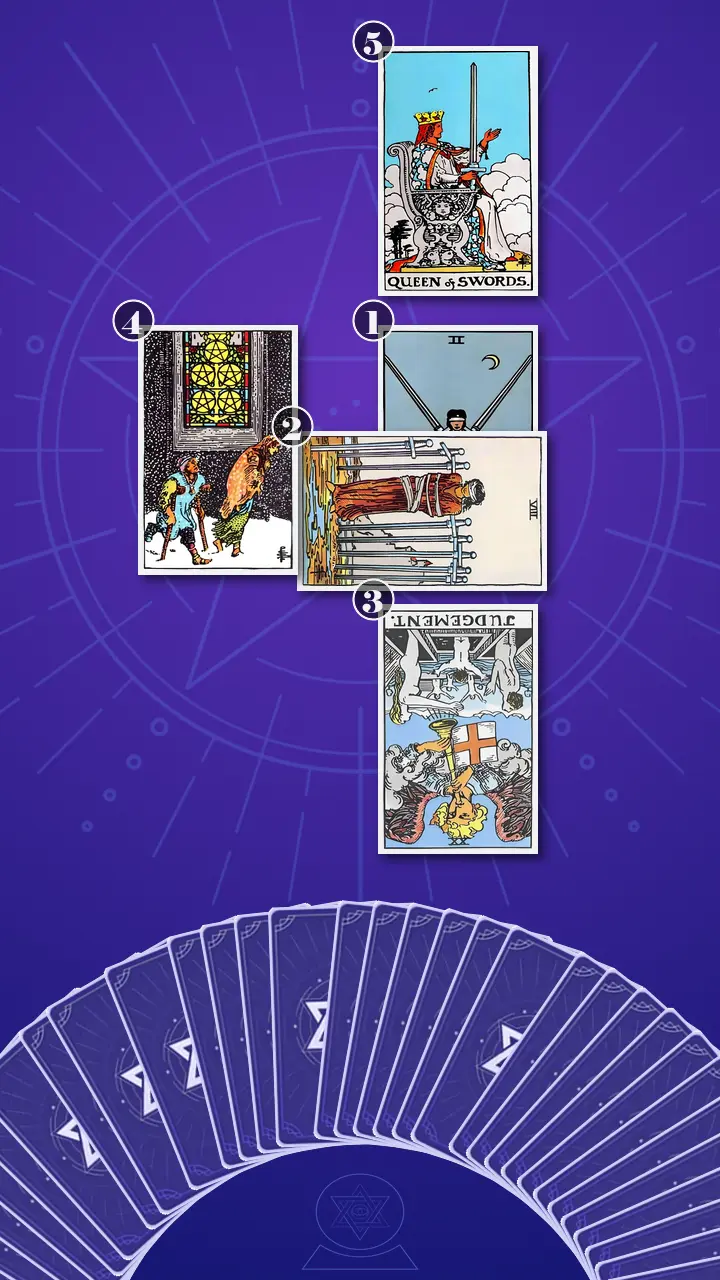
“Today,” I told her, “I’m going to use a classic spread called the Five-Card Cross.”
For you reading this: this spread is the smallest structure that still holds the whole chain we need here. It separates the live social trigger from the immediate mental clamp, then drops to the deeper fear underneath it, pulls in the older foundation story that trained the reflex, and finally points to a concrete communication shift—an answer you can actually use at a party.
I showed Jordan the shape on the table: one card at the center, one crossing it, one below, one to the left, one above—like finding a door above the pressure point.
“Card 1 is the on-the-spot moment—the first three seconds when the spotlight hits,” I said. “Card 2 is what blocks your voice, the clamp that tightens you up. Card 3 is the root driver beneath that freeze. And Card 5”—I tapped the space above the center—“is the empowered answer: the quality of speech and boundary that lets you respond as yourself.”
Reading the Map: How Tarot Works in a Social Spotlight
When I read Tarot, I’m not predicting who you’ll become. I’m tracking energy and pattern—what your nervous system does, what your mind assumes, what your history remembers, and what your voice is capable of when you stop asking for permission.
Jordan watched my hands with the kind of focus people have when they’re hoping for a sentence that finally fits. “I just want… something I can say,” she admitted. “Something that doesn’t make me feel fake.”
Position 1: The on-the-spot moment — Two of Swords (upright)
“Now flipped,” I said, “is the card representing The on-the-spot moment: what happens in you when someone asks ‘what are you?’.”
Two of Swords, upright.
“This is exactly that party second,” I told her. “At a friend’s party in NYC, someone asks ‘what are you?’ and you do the polite half-smile while your brain holds two ‘acceptable’ answers at once—job title versus real self. You look calm, but inside you’re bracing.”
The Two of Swords is a protective pause. Energy-wise, it’s Air in blockage: mental control stepping in so fast that speech gets withheld. The blindfold isn’t ignorance—it’s the moment you stop trusting your own read of the room and start guessing what answer will be safest.
I leaned in a little. “Think of the last time it happened. What did you do with your face and your voice in the first three seconds—smile, laugh, stall, go vague?”
Jordan gave a short laugh that sounded like it had teeth. “You’re right,” she said. “It’s so accurate it’s almost rude.”
That was my first signal we were in the real terrain. Not abstract. Sensory. That warm phone. Too-bright kitchen light. The body pause. Two answers colliding like tabs you can’t close.
Position 2: What blocks your voice — Eight of Swords (upright)
“Now flipped,” I said, “is the card representing What blocks your voice: the immediate mental or social pressure that tightens you up.”
Eight of Swords, upright.
“This is the mental cage,” I said, keeping my voice plain on purpose. “Mid-conversation, it feels like every possible answer will create a problem: too simple sounds boring, too honest invites follow-up questions, too vague seems suspicious. So you over-edit in real time—stacking disclaimers until you’re trapped inside your own sentence.”
Energy-wise, it’s Air in excess—thought loops becoming a fence. And the key detail in the picture is that the bindings are loose. The trap is perceived, not absolute, which matters because it means one small movement changes everything.
I asked, “What’s the specific consequence you’re trying to avoid—being judged, being misunderstood, getting interrogated, sounding unimpressive?”
Jordan’s shoulders rose like they wanted to meet her ears. “All of it,” she said. Then quieter: “Mostly… them thinking I’m not impressive. Or that I’m confused. Or—” She stopped, cheeks flushing. “Like I don’t belong.”
I let that land. “That’s the Eight of Swords talking. It convinces you there’s a single correct route to ‘being normal.’ Like a navigation app yelling recalculating because you believe there’s only one acceptable answer.”
Her breath went out heavy. Not agreement-as-performance—recognition-as-relief.
Position 3: The root driver — Judgement (reversed)
“Now flipped,” I said, “is the card representing The root driver: the deeper fear and belief underneath the freeze.”
Judgement, reversed.
As soon as I saw it, I felt the room sharpen. Not in a mystical way—more like a therapy session when you finally name the thing the whole story has been orbiting.
“This is the inner courtroom,” I told her. “The question lands and your nervous system reacts like you’ve been called to defend your identity in a courtroom. You scan for the ‘socially correct’ answer, then either default to a label you don’t fully claim or start justifying it to avoid criticism.”
Energy-wise, this is Fire turned inward—permission energy stuck behind your ribs. The trumpet in Judgement is the call to rise into your own authority; reversed, it’s like the call gets swallowed, and you wait for external approval to speak.
I heard myself slip into a line I’ve used with travelers for years, because it cuts through the noise: “Stop answering like you’re on trial.”
Jordan blinked hard. There it was—freeze, then the tiny crack where something new could get in.
“When you imagine answering honestly,” I asked, “whose verdict are you bracing for?”
She looked past me for a second, eyes unfocusing like she was rewinding a memory. “Everyone’s,” she said. Then, almost irritated at herself: “And also… mine. Like I’ll prove I’m not socially competent.”
“That makes sense,” I said. “Because if the moment feels like a performance review you didn’t consent to, of course you’ll over-edit.”
Position 4: The foundation — Five of Pentacles (upright)
“Now flipped,” I said, “is the card representing The foundation: past experiences or patterns that taught you to handle identity questions this way.”
Five of Pentacles, upright.
In this card there’s a warm window—stained glass—while people move through the cold outside. It’s not dramatic. It’s worse: it’s plausible.
“This,” I said, “is the outsider imprint. Under the surface, this question taps an older story: if you can’t present yourself in a neat, legible way, you’ll be quietly left out. So you try to earn your place by sounding coherent and easy to categorize, even when your real life is nuanced.”
Energy-wise, it’s Earth in deficiency: belonging feeling conditional. A glance, a too-fast topic change, and suddenly you’re in the room but emotionally outside it—like you’re standing in the cold trying to deserve the warm window.
Jordan’s mouth tightened. She didn’t cry; she just went still. Then she said, “I always feel like everyone else has their one sentence. Like their Instagram bio is… a weapon.”
“That’s a perfect modern translation,” I said. “Not because you’re behind. Because you’re comparing your real self to someone else’s edited headline.”
When the Queen of Swords Hands You a Sentence
“We’re turning the final card,” I said, and I felt my own tone slow down. “This one is the exit path—the empowered answer.”
Position 5: The empowered answer — Queen of Swords (upright)
“Now flipped,” I said, “is the card representing The empowered answer: the quality of speech and boundary that helps you respond in a way that feels like you.”
Queen of Swords, upright.
Immediately, Jordan exhaled like she’d been holding a breath she didn’t know she was holding. The Queen’s sword is upright—clarity—and her other hand is open—humanity. Not cold. Contained.
“This is you answering with a calm, chosen one-liner that’s true enough,” I said, “then setting a gentle boundary and pivoting back toward connection.”
In modern terms: “I’m in a multi-hat role—strategy, creative, and ops. I don’t really do labels beyond that. How do you know the host?”
Energy-wise, this is Air in balance: clean, intentional communication rather than self-protective silence.
The Aha Moment (Setup)
You know that moment in the kitchen when it’s your turn, the music is loud, and your brain starts buffering because you’re trying to pick the one label that won’t get you misread?
The Aha Moment (Delivery)
Stop trying to earn approval with the perfect label; choose one clean truth and offer it like the Queen’s upright sword—clear, contained, and yours.
The Aha Moment (Reinforcement)
Jordan’s reaction came in a chain, like her body had to process the sentence before her mind could claim it. First: a small freeze—her breath caught, fingers hovering above the rim of her water glass. Second: her gaze slid away from the cards and went slightly unfocused, like she was replaying the kitchen scene with new audio layered over it. Third: her shoulders dropped, and with them, a sound that wasn’t quite a laugh and wasn’t quite a sob—more like relief arriving late.
Then the unexpected part: her jaw set. “But if I do that,” she said, sharp for a second, “doesn’t it mean I’ve been doing it wrong this whole time?”
I didn’t flinch. “It means you’ve been protecting yourself with the tools you had. The Queen isn’t here to shame you. She’s here to upgrade your tools.”
“And,” I added, bringing in my own Venetian way of seeing conversation, “this is where my Bridge-Corridor Theory matters. In Venice, bridges connect neighborhoods—but they also decide how you cross: narrow corridor, open view, or crowded bottleneck. Your old answer strategy was a bottleneck bridge: you tried to let people cross into your life while also blocking them from misreading you, so you froze mid-step. The Queen of Swords builds a cleaner bridge: one clear plank of truth, one boundary rail, and then you guide them forward with a question.”
“Now,” I said gently, “use this new perspective and look back at last week. Was there a moment when this would’ve changed how you felt?”
Jordan swallowed. “In that kitchen,” she said. “If I’d just said one thing and stopped… I wouldn’t have spent the whole ride home rewriting it in Notes like it was a press release.”
That was the shift in real time: from spotlight freeze and post-event rumination to calm firmness and growing self-trust. Not a personality transplant. A practiced boundary.
From Insight to Action: The Two-Sentence Shield
Here’s the story the spread told, start to finish: the Two of Swords shows the protective pause when the spotlight hits. The Eight of Swords shows the mental cage that says every answer will backfire, so you over-edit and feel trapped. Judgement reversed reveals the internal courtroom—your voice waiting for permission, answering like you’re on trial. The Five of Pentacles shows why it feels so personal: an older imprint that says misunderstanding equals exclusion. And the Queen of Swords becomes the antidote: clear, chosen language with a calm boundary.
The cognitive blind spot underneath all of it is this: you’ve been treating clarity like a perfect label you must earn, instead of a boundary you can practice. You’ve also been assuming that setting a boundary will read as rude—so you choose silence or overexplaining, and then you pay for it later on the subway.
The transformation direction is simple but not easy: shift from trying to deliver a perfect, universal label to offering a clear, chosen self-definition plus a boundary about what you won’t be reduced to.
I gave Jordan a framework I call the Two-Sentence Shield—and I paired it with my Lace Communication Method, borrowed from Burano lacemaking: small, precise stitches that hold under pressure. Not a dramatic monologue. Clean threads.
- Write your Two-Sentence ShieldOpen Notes and write exactly two sentences: (1) one chosen self-definition that’s true enough for this context, (2) one calm boundary about what you won’t be reduced to. Example: “I’m in a multi-hat role—strategy, creative, and ops. Beyond that, I don’t really do labels.”Treat it like trying on a jacket: if it feels too stiff or too revealing, adjust one word—not the whole thing. Two reps out loud while you’re getting ready is enough.
- Add a boundary-plus-redirect in one breathPick one redirect question you actually like saying—“How do you know the host?” or “What brought you here tonight?”—and practice the full sequence: answer → boundary → redirect, as one steady breath.Use “open hand” tone: soften your face, steady your voice. You’re not defending; you’re connecting.
- Do the One-Sword Reality Check in the momentWhen the question hits and you feel the clamp, silently name the single feared consequence (one “sword”), like: “They’ll think I’m not impressive.” Then look for real evidence in the room—tone, facial expression, follow-up—before you keep explaining.Lower the difficulty: you only have to test one fear at a time. If you start overexplaining, use a hard stop: “Anyway—enough about me. What’s your week been like?” Then stop talking.
“This is lacework,” I reminded her. “Not a hard launch of your whole identity. Just a clean stitch that holds.”

A Week Later, the Subway Ride Was Quieter
Six days later, Jordan messaged me from the L train. Not a paragraph—just three lines, like she’d finally learned she didn’t need to litigate herself.
“Used the script.”
“Nobody died.”
“I didn’t open Notes on the way home.”
It wasn’t a fireworks ending. It was better: a small, real proof. She told me she’d still felt the heat in her cheeks when someone asked, but this time she didn’t scramble for the perfect label. She said her one clean truth, set the boundary, asked her redirect—then listened. Later, walking home, she had the flicker of “what if I sounded weird?”—and then she smiled a little, because she’d stayed with herself anyway.
That’s what I mean by a Journey to Clarity: not certainty, but ownership. Not the perfect bio, but a sentence you’ll stand behind.
When a casual party question hits and your throat tightens, it’s not that you don’t know who you are—it’s that you’re trying to be understood and stay unboxed at the exact same time.
If you didn’t have to earn anyone’s approval in that moment, what’s the one sentence you’d choose to say—just true enough—and what would you want your boundary to quietly protect?