That Required HR Field—And the One-Sentence Text to Send Tonight

Finding Clarity in the 8:47 p.m. HR Portal Glow
If you’ve ever stared at a required “Emergency contact” field on a new-job HR portal and felt your chest tighten like you’re about to ask for way more than a phone number, you’re not imagining it.
Taylor (name changed for privacy) sat cross-legged on her duvet in her London flatshare, laptop balanced in that precarious way that makes your wrists ache after ten minutes. The HR portal glowed white-blue, and the overhead light had a faint buzzing hum—like a cheap charger you keep meaning to replace. She typed a name into the “Emergency contact (required)” box, deleted it, flicked to WhatsApp, typed “Quick question…” and backspaced the whole thing again.
Her shoulders had crept up so high they were practically earrings. Each time the cursor blinked in that empty field, her chest tightened with the same reflex you get when you’re about to open an email you’re sure will disappoint you.
“Why does this one box on a form feel so loaded,” she said, half to me, half to the laptop. “Like… I want a basic safety net. But asking someone feels like I’m imposing. Like it’ll read as ‘too much.’”
I watched her thumb hover over her phone the way people hover over a cliff edge in a video game—paralyzed, but also weirdly committed to standing there. “Okay,” I said gently. “Let’s treat this like what it actually is—an adult logistics question that’s accidentally pressing on belonging. We’re not here to make you ‘more chill.’ We’re here to find clarity, and then a next step you can actually do.”

Choosing the Compass: The Decision Cross · Context Edition
I asked Taylor to take one slow breath and feel her feet through the duvet—nothing mystical, just a nervous-system handrail. While she held the question in her mind—“Do I list someone, or is that people-pleasing?”—I shuffled slowly, the sound like soft cardstock rain.
“Today, we’ll use a spread called the Decision Cross · Context Edition,” I told her. “It’s designed for moments like this—two clear options on the surface, but a deeper tug-of-war underneath.”
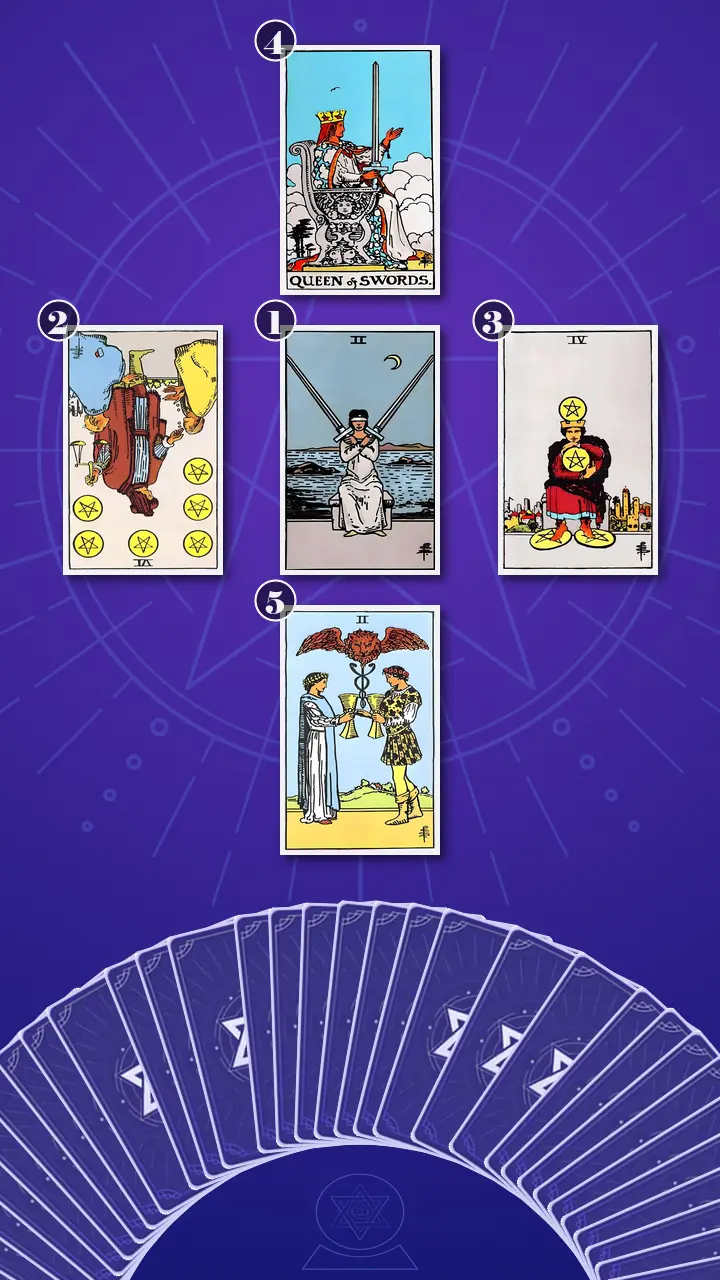
For you reading: this spread works because the question isn’t really who to list. It’s what story your brain attaches to the act of asking. The cross layout shows the stuck pattern in the center, the two options pulling left and right (people-pleasing vs self-protection), then a ‘truth/boundary lens’ above that reframes the entire choice, and a grounded next step below that reduces uncertainty without turning your life into a dramatic self-improvement arc.
In this reading, the most important positions were: the center card (what you’re literally doing), the top card (the deeper lesson about boundaries and self-respect), and the bottom card (a consent-based next step you can do within 24 hours).
Reading the Map: When “Adult Admin” Turns Into a Worth Test
Position 1: The observable stuck point
“Now turning over is the card that represents the observable stuck point: what you’re doing (or not doing) around the emergency contact decision.”
Two of Swords, upright.
I pointed to the blindfold and the crossed blades. “This is you at the HR portal trying to make a relational question solvable by logic. Keeping it ‘neutral’ by not choosing at all—tab-switching, drafting, deleting—because choosing means risking a tiny moment of awkwardness.”
The Two of Swords is blocked Air. Not a lack of intelligence—an excess of mental management. Energy gets trapped in rehearsal. It’s the feeling of drafting a simple text like it’s a legal contract—terms, conditions, indemnity clauses included.
Taylor let out a small laugh that had more bite than humor. “That’s… honestly kind of brutal,” she said. “Like you’re watching my screen recording.”
“I know,” I said. “And notice what the card is protecting you from: not a catastrophe—just the discomfort of being seen asking.”
Position 2: Option A (listing them) — where people-pleasing sneaks in
“Now turning over is the card that represents Option A: listing someone—what need, fear, or motive is driving it, and where people-pleasing might sneak in.”
Six of Pentacles, reversed.
“The moment you consider asking,” I said, “your brain converts friendship into a transaction: if they say yes, you’ll owe them endless availability. So you either overcompensate in advance or avoid asking entirely because you don’t trust the exchange to stay fair and consent-based.”
This is distorted Earth—security turning into a ledger. The scales in the image become a silent scoreboard: How much do I owe if I ask? You start pricing friendship like it’s Zone 1–2 rent, like the minute you accept support your monthly payment is emotional labor.
Taylor’s mouth tightened; she nodded once, sharp. “Yeah. I start writing like… ‘I swear it’s not a big deal and it’ll never happen and I’m so sorry to ask—’”
“Exactly,” I said. “That’s pre-paying with over-explaining. You’re trying to make the discomfort disappear by offering ‘terms and conditions’ before anyone has even agreed to anything.”
Position 3: Option B (not listing them) — where over-control sneaks in
“Now turning over is the card that represents Option B: not listing anyone—what need, fear, or motive is driving it, and where over-control might sneak in.”
Four of Pentacles, upright.
“You decide you’ll list no one because it feels safer to need nothing,” I said. “It looks like independence, but it’s also a wall: you’d rather carry the discomfort alone than risk hearing a ‘no’ and having it confirm your fear about belonging.”
The Four of Pentacles is Earth energy in excess—grip, not groundedness. The coin held to the chest is the posture of ‘I’m fine, I’ve got it.’ The walled city behind the figure is the part of you that wants an unbreachable reputation: low-maintenance, unbothered, never inconvenient.
I kept my voice soft because this card can feel like an accusation if you’re already shame-sensitive. “Independence can be a boundary,” I said. “It can also be a wall.”
Taylor’s eyes flicked away from the cards toward the window, where the glass reflected the laptop glow back at her. “I don’t want anyone to feel responsible for me,” she said, quieter. “And if they hesitate… I’ll never stop thinking about it.”
When the Queen of Swords Spoke: Consent, Not Auditioning
Position 4: The deeper lesson — the boundary lens that makes the decision clean
I slowed my hands before turning the next card. The room felt briefly quieter, like even the buzzing light had taken a breath. “We’re turning over the key card now,” I said. “The one that reframes the entire choice.”
Queen of Swords, upright.
“This is the moment you stop wordsmithing for likability,” I told her, “and send one straightforward message that names the request and includes a clean out. You’re not asking them to manage you—you’re giving them a clear option to consent or decline, and you let your dignity stay intact either way.”
In tarot language, this is Air in balance: clear, clean, boundary-literate. Not cold. Not harsh. Just accurate.
And because my other life is fragrance, I noticed something I always notice: how people try to change their intensity when they feel they’re asking for too much. “Can I ask you something slightly weird?” I said. “When you want to feel ‘easy’—the least burdensome version of yourself—what kind of perfume do you reach for?”
Taylor blinked. Then she gave a small, embarrassed smile. “Like… clean stuff. Laundry. Skin scent. Nothing that announces itself.”
That was my cue for one of my core tools—Attraction Analysis. “That preference isn’t random,” I said. “Clean-laundry scents are beautiful. But sometimes they’re also a strategy: don’t take up space in the room. Your nervous system is trying to be ‘unobjectionable’ in the same way—by sanding down the ask until it disappears.”
The Aha Moment
Setup: I could feel where she was stuck—not in the logistics, but in the meaning. She was treating a one-line form field like it was a referendum on her likability. Her brain kept toggling between two tab titles: Be safe and Don’t be too much, as if she had to choose one.
Stop auditioning for permission and use the Queen’s raised sword to speak plainly: a simple request with room for a real yes or no.
Reinforcement: Taylor went still in a three-part chain. First, a tiny freeze—her breath caught and her thumb stopped mid-scroll over her phone. Then her eyes unfocused, like she was replaying every draft she’d written that week. Then her shoulders dropped, slowly, with a long exhale that sounded almost like relief but also like grief for all the effort she’d wasted trying to be perfectly acceptable.
“But if I’m that direct,” she said, and there was a flash of defensiveness, “doesn’t it mean I’ve been doing it wrong? Like… I’ve been making everything weird.”
I shook my head. “It means you’ve been protecting yourself the best way you knew how.” I kept my tone steady, editor-clear. “The Queen isn’t here to shame you. She’s here to give you a structure that doesn’t require performance. And here’s the line I want you to keep: their answer is information—not a verdict.”
I asked her to open Notes. “Write one sentence,” I said. “Just one: ‘Hey—my new job’s HR form requires an emergency contact. Would you be comfortable being mine? Totally okay if not.’ Read it out loud once.”
She did. Her voice wobbled on the last part, then steadied.
“Now decide,” I continued. “Send now, or schedule it for tomorrow at a specific time. And boundary tip: you don’t need to justify why you don’t have family nearby. If your chest tightens and you start drafting paragraphs, pause for three slow breaths and come back to the single sentence.”
“Okay,” she whispered, looking both lighter and strangely exposed—like someone who’s taken off a coat they didn’t realize they’d been wearing for years. “I’m not asking for a relationship upgrade. I’m asking for a name on a form.”
That was the shift: from needing a yes to feel worthy to making a clear, consent-based ask and letting the answer simply be information. A small pivot, but it changes everything.
Position 5: Best next step — mutual agreement that feels ordinary
“Now turning over is the card that represents the best next step: a practical, consent-based action that reduces uncertainty and supports connection without obligation.”
Two of Cups, upright.
“This is mutual agreement,” I said. “Support that’s chosen, current, and explicit—no guessing. It’s the antidote to ‘mutual support is a debt contract.’ It’s not.”
I wrote two versions of the message on my notepad and turned it toward her.
Over-explaining version: ‘Hey sorry this is random, HR needs an emergency contact and it’s obviously not a big deal and it’ll never happen and I totally get it if it’s weird and also no pressure at all and—’
Clean version: ‘Hey—my work HR form requires an emergency contact. Would you be comfortable being mine? Totally okay if not.’
“Notice,” I said, “the clean one actually feels warmer. Because it trusts the other person to choose. That’s Two of Cups energy—mutuality as normal.”
The Two-Line Boundary Text: Actionable Advice for the Next 24 Hours
I gathered the cards into one story: you freeze (Two of Swords) because you think you need the perfect phrasing to avoid vulnerability. Underneath, you treat support like a ledger (Six of Pentacles reversed), so your system swings to armored self-reliance (Four of Pentacles). The way out isn’t choosing ‘list’ or ‘don’t list’ based on fear. It’s adopting the Queen of Swords principle—clear, consent-based communication—so the Two of Cups can land as an ordinary agreement, not a performance.
Your cognitive blind spot, Taylor’s blind spot, a lot of our blind spot: you’re acting like the goal is to get a “yes” without discomfort. But clarity comes from being willing to hear either answer without turning it into a judgment of your worth.
To make it practical, I offered her a tiny sensory tool from my work as a perfumer—one of my signature strategies: first impression management with a signature scent, not to manipulate anyone, but to anchor your own nervous system. “Pick a scent that makes you feel steady and adult,” I told her. “One spritz before you hit send. Your brain learns: this action equals groundedness, not danger.”
- The One-Sentence Consent AskChoose one person you genuinely trust (someone you already message casually). Send: “Hey—my work HR form requires an emergency contact. Would you be comfortable being mine? Totally okay if not.”If you start adding backstory or apologies, stop. Two-line text rule: if it needs more than one sentence, you’re likely managing feelings, not sharing info.
- The Sword Check (Approval vs Consent)Right before you send, ask: “Am I trying to get a yes to feel okay, or am I making a clean request?” Relax your shoulders once, unclench your jaw, then send or schedule.Treat the body cue (tight chest, urge to close the tab) as a notification, not an order. Three slow breaths, then back to the one sentence.
- Submit Within 5 MinutesIf they say yes, reply once: “Thank you. It’d only be used in a real emergency. I’ll put your name + number down.” Then submit the HR form within five minutes.Don’t give your brain time to reopen the debate. Clarity loves momentum.

A Week Later: Ownership, Not Certainty
A week later, Taylor messaged me a screenshot: her sent WhatsApp—one sentence, no apology paragraph. Under it, her friend’s reply: “Of course. Put me down.” Taylor wrote, “I submitted the form in under five minutes like you said. I didn’t let myself spiral.”
She added one more line: “I still woke up the next day with the thought, ‘What if I made it weird?’—but this time I laughed a little and let it pass. Like the thought didn’t own the room anymore.”
That’s the real Journey to Clarity: not magically never feeling awkward, but building self-trust through clean actions. Tarot didn’t predict her friend’s response. It showed her the mechanism of the spiral—and the exact lever that could interrupt it.
When a single blank form field makes your chest tighten, it’s rarely about the admin—it’s the quiet fear that needing a basic safety net will make you ‘too much’ and less welcome. If you let this be a consent-based logistics question—not a likability test—what would your clean, one-sentence ask sound like tonight?