The 'Sorry if I Overreacted' Text—and the Shame Loop Behind It

The Overground Buzz and the Warm Phone
You’re a hybrid-office person in London who can handle pressure—until someone says “you’re too sensitive” in Slack and you suddenly start tone-policing yourself like your job depends on it.
Maya (name changed for privacy) said that to me with the kind of half-laugh that tries to make the shame sound casual. She’d come straight from a tense day, hair still smelling faintly like rain and the Tube. When she sat down in my small studio space—foam panels, a kettle clicking behind us—she didn’t look dramatic. She looked… edited.
She described the exact scene I’ve heard a hundred times in different outfits: 8:47 p.m. on the Overground, wedged between coats and backpacks, fluorescent lights buzzing overhead. Her phone was warm from re-reading the same Slack thread. The “lol you’re too sensitive” sat on the screen like a stamp. And in her body: a tight throat, a sinking stomach, that urge to disappear mid-sentence—like her whole system was trying to fold itself into a smaller file size.
“I want to just say what I feel,” she told me, eyes on the floor, “but the moment someone says that, it’s like… I have to prove I’m not ‘too much’ before I’m allowed to speak.”
I nodded slowly. “That makes so much sense. Today, we’re not going to argue your sensitivity into being acceptable. We’re going to find clarity—one step at a time—so you can stay on your own side and still choose what you say.”

Choosing the Compass: The Transformation Path Grid
I slid the deck between us and asked Maya to take one breath with me—not a mystical ritual, just a nervous-system gear shift. As a radio host, I’m obsessed with transitions: how a single beat, a half-second of silence, can change the whole feel of a segment. A tarot reading works the same way when it’s done well. It’s a way to slow the moment down until you can actually see it.
“For this,” I said, “I’m going to use my own spread: the Transformation Path Grid (6) · Context Edition.”
For you reading along: this is a six-card, 2x3 storyboard that’s perfect when the pain is real but the goal isn’t prediction—it’s pattern-breaking. It moves from the trigger (the sting of ‘too sensitive’) into the bind (what freezes you), down into the root shame story, then back up through a turning-point reframe, a one-step experiment, and what integration looks like when it’s embodied.
I pointed to the empty grid space on the table. “Top row is the descent—what happens on the surface and what it taps into. Bottom row is the ascent—what changes, what you practice this week, and what it looks like when sensitivity becomes an ally instead of a flaw.”
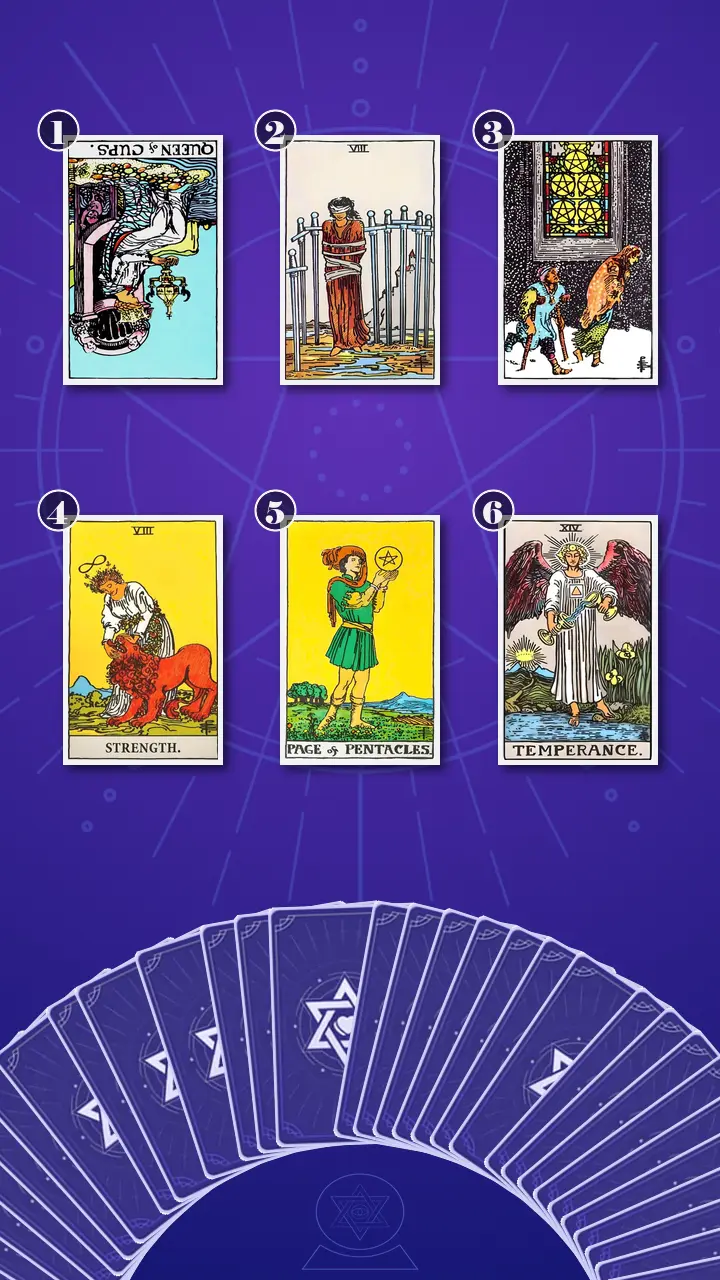
Reading the Storyboard: The Top Row (Trigger → Bind → Root)
Position 1 — The Moment It Lands: Immediate Reaction Pattern
“Now flipping over is the card that represents the moment you hear ‘you’re too sensitive’—your immediate, observable reaction pattern.”
The Queen of Cups, reversed.
“This is you going into hyper-attunement mode,” I said, keeping it plain. “Right after the comment, you scan their tone, your tone, the room’s vibe. You get extra polite. You soften your words. You start managing everyone’s comfort—then later you spiral privately in your Notes app, trying to figure out whether you’re allowed to feel what you felt.”
In the Queen, water is wisdom. Reversed, that water turns inward as self-doubt—like an emotion arrives and instead of asking what it’s telling you, you ask what’s wrong with you for having it. It’s not “too emotional.” It’s emotional responsibility turned up so high it becomes self-policing.
Maya let out a quick, bitter little laugh—surprising even herself. “That’s… brutal. But accurate.” Her fingers rubbed the edge of her phone case like she was trying to smooth a crease that wouldn’t flatten.
“Not brutal,” I said. “Specific. And specific means we can work with it.”
Position 2 — The Bind: What Locks You in the Loop
“Now flipping over is the card that represents what locks you in—the mental frame or coping move that keeps the shame story running.”
Eight of Swords, upright.
I tapped the blindfold on the image. “This is the rule your brain enforces the second you’re labeled: ‘If I push back, I’ll look irrational.’ So you freeze. You rehearse the perfect explanation, delete it, rehearse again, and either send a quick apology or say nothing—while your mind keeps replaying the scene like it’s evidence you have to interpret correctly to be safe.”
And because I live in audio, the symbol hit me in a way it always does: the Eight of Swords is like slapping a noise gate on your own voice. You’re still talking inside your head, but the gate won’t open unless you hit some imaginary “acceptable” threshold.
I looked at her and said the line I most want people to steal for themselves: Your feelings don’t need a legal defence to deserve respect.
Maya’s reaction came in layers: first her breath paused; then her eyes unfocused like she’d just re-entered a specific Slack thread; then a small exhale slid out of her chest, almost annoyed. She gave one tight nod—yes, that’s the trap—without needing to explain it.
“I literally do that,” she said quietly. “Prosecutor and defence. In my own Notes app.”
Position 3 — The Root: The Old Shame Story Underneath
“Now flipping over is the card that represents the old shame story underneath—what your nervous system learned to attach to emotional expression.”
Five of Pentacles, upright.
“This is the belonging wound,” I said. “Under the sting is an old fear: if you show emotion, there’s a social cost. Being dismissed. Being excluded. Being quietly downgraded. So you minimize fast to earn your place, even if it means your needs never make it into the room.”
The image does something cruel and honest: warmth is right there—the lit window—yet the figures keep limping past it as if it’s not for them. Shame narrows perception. It convinces you support exists… but not for people like you.
Maya swallowed. Her shoulders pulled in toward her ears, that involuntary shrinking. I watched her eyes get glassy, not with drama—more like tenderness that had been waiting under the surface for ages.
“I hate this part,” she whispered. “Because it’s not even about them. It feels… older.”
“Yeah,” I said, soft but direct. “And I want to name it cleanly: Stop shrinking to stay included. That’s not connection—that’s compliance.”
When Strength Spoke: Firm, Kind, and Unashamed
Position 4 — The Antidote: The Key Reframe
I let the room go quiet for a beat—the kettle had clicked off, and even the street noise outside the studio felt farther away.
“Now flipping over is the card that represents the key reframe—the one inner shift that interrupts the shame script without denying your sensitivity.”
Strength, upright.
Before I said anything else, I asked, “Quick check-in—what have you been listening to lately, especially after those Slack moments?”
She blinked. “Um. A lot of sad stuff. Like Phoebe Bridgers on repeat. And then angry playlists when I’m alone.”
That was my Music Pulse Diagnosis kicking in—my way of reading stress sources through the songs your body chooses when you’re not performing for anyone. “That makes total sense,” I told her. “Your system is trying to process hurt (the sad tracks) and then reclaim power (the angry ones). What’s missing isn’t feeling. What’s missing is a steady bridge between them—so you don’t have to abandon yourself in the middle.”
Sensitivity isn’t the problem; the shame story about being unlovable is. Strength is that bridge: calm self-leadership. Not arguing harder. Not shutting down. Staying with yourself.
Maya’s face tightened—and here came the unexpected reaction. “But if I do that,” she said, a flash of anger in her voice, “doesn’t it mean I’ve been wrong? Like… I’ve been making myself small for nothing?”
I didn’t rush to soothe it. “It means you’ve been surviving with the tools you had,” I said. “And now you get new tools.”
She was right on the edge of the familiar moment: phone warm from rereading the thread, throat tight, already drafting the “sorry if I overreacted” text before she’d even named what hurt.
Stop treating your feelings like a wild liability to cage; start meeting them like Strength meets the lion—firm, kind, and unashamed.
I let that land in the air like a low note held just long enough to change the room.
Her reaction came in a clear three-part wave. First: her body froze—chin lifted a fraction, breath caught, eyes wide as if the sentence had surprised her. Second: something softened—her gaze dropped to the card, then drifted, like she was replaying the last time she’d typed “No worries 😅” while her stomach sank. Third: the release—her shoulders lowered, her mouth trembled into a half-smile that looked more like relief than happiness, and she exhaled through her nose like she’d been holding a tension she didn’t know had a name.
“It’s weird,” she said, voice a little unsteady. “That feels… strong. But not aggressive.”
“Exactly,” I said. “Strength isn’t volume. It’s staying present.”
I leaned in slightly. “Now—use this new lens and think back to last week. Was there a moment when this could’ve changed how you felt? Even for ten seconds?”
She nodded slowly. “Tuesday. The kitchen. I was literally smiling at the kettle like I was fine.”
“That’s the shift,” I said. “From shame-driven self-editing to calm self-leadership. Not becoming less sensitive—becoming less self-abandoning.”
Reps, Not Reinvention
Position 5 — One Step This Week: The Small Practice
“Now flipping over is the card that represents one step this week—a small, concrete practice that builds self-trust.”
Page of Pentacles, upright.
“This is the ‘apprentice’ energy,” I said. “Not a personality overhaul. A micro-skill. Instead of trying to fix your whole sensitivity, you run a one-week experiment: one sentence, one boundary, low-stakes moments. You treat sensitivity like information—name it, learn from it, and choose one grounded request.”
Maya’s posture changed here—less collapsed, more forward. Like someone had finally handed her a template instead of a lecture.
Position 6 — Integration: Sensitivity With Containers
“Now flipping over is the card that represents integration—what it looks like when sensitivity becomes an ally with boundaries and choice.”
Temperance, upright.
“This isn’t you becoming ‘chill,’” I said. “This is you becoming skillful.” I pointed to the cups pouring into each other. “Temperance is blending honesty with regulation. And that one foot on land, one in water? Feeling deeply while staying grounded.”
I used the line on purpose, because Maya needed it to be non-moralising: Temperance is choosing the right container, not becoming less human.
She exhaled again, this time more even. “I like that. Container, not… suppression.”
The One-Page Plan for “Too Sensitive” (Actionable Advice, Not a Court Case)
I looked across the whole grid and told her the story it was clearly telling: when the “too sensitive” trigger hits (Queen of Cups reversed), you reflexively manage everyone’s comfort and doubt your own reality. Then the Eight of Swords clamps down—your brain treats their label like a verdict, and you start building a case file in your head and your Notes app. Underneath, the Five of Pentacles reveals why it’s so sticky: an old association between having feelings and losing belonging. Strength interrupts the script by teaching calm self-respect, and the Page of Pentacles insists you learn it through reps. Temperance is the end state: emotion + boundary + choice, in the right container.
The cognitive blind spot here is subtle but huge: you keep acting like the way out is to prove your feelings are reasonable—when the real shift is to validate them first, then choose one bounded sentence. That’s the transformation direction: from proving your emotions are acceptable to practising one self-validating response that treats emotions as information.
Here’s what we wrote down together—small enough to actually do, especially on a London workday:
- The 30-Second Notes App ReceiptBefore you reply to the Slack/WhatsApp/Teams moment, open Notes and write exactly one line: “What matters to me here is ___.” Stop after one sentence. Don’t add context, backstory, or evidence.If your throat tightens, set a 30-second timer and end early. Practice counts even if you write three messy words.
- The Strength Sentence (One Calm Boundary)Use one line—out loud or in text: “I get that you didn’t mean it that way—still, that landed badly for me.” (Work-safe, impact-focused.)A boundary can be one sentence and still be real. No emoji softening required unless you genuinely want it.
- Phone Face-Down + One Breath SoundtrackAfter you send (or decide not to), put your phone face-down for 60 seconds. Do a simple Breath Soundtrack: inhale 4 counts, hold 2, exhale 6—three rounds.This blocks the read-receipt spiral. If you’re on the Tube and noise spikes your nervous system, use my White Noise First Aid: low-level rain/white noise in one earbud for two minutes while you breathe.
- Temperance Container Choice (Before You Share More)If it’s bigger than a one-liner, decide: (1) who is safe enough, (2) what channel (in-person / voice note / text), (3) how much detail (headline vs full story).If perfectionism says “say it perfectly or don’t say it,” choose the minimum viable container: headline only.
And because sound is my thing, I gave her a quick BGM Prescription—not as magic, as a cue for her body: one track at ~60–70 BPM for steadiness, a simple rain/Overground-style white noise bed for decompression, and (if she likes tones) a gentle 396 Hz track as a “shame spike reset” she can pair with the 4–2–6 breath. Tools, not rules.

A Week Later: The Quiet Proof
A week later, Maya messaged me a screenshot—not of a whole conversation, just one line she’d sent in a low-stakes Slack thread. No essay. No apology. Just impact and boundary.
“My hands were sweating,” she wrote. “But I did the phone face-down thing. I didn’t die. And I didn’t spiral for three hours.”
Her bittersweet proof was small and real: she sat alone in a Pret for ten minutes after hitting send, tea cooling in front of her, heart still thumping. She felt exposed—and also strangely intact, like she hadn’t left herself behind to keep the peace.
That’s the Journey to Clarity I care about: not becoming unbothered, but becoming loyal to your own reality—calm self-leadership, one bounded sentence at a time.
When someone calls you “too sensitive,” it can feel like your throat closes and your whole body tries to disappear—because a part of you learned that staying lovable meant staying easy.
If you didn’t have to prove your feelings were “reasonable,” what’s one small, boundaried sentence you’d want to practise saying this week—just once, in a low-stakes moment?
Every reading at AceTarot is a Journey to connect with inner wisdom and empower next step.
Learn more about our Journey to Clarity.