From Bracing at Family Dinner to Steady Self-Respect: One Boundary

The Sunday TTC Ride With a Notes-App Script
If you draft “reasonable” sentences in your Notes app on the way to dinner like it’s a project plan, but your jaw still locks the moment someone says “you’re being dramatic,” you’re not alone.
Jordan arrived at my little studio space with her coat still damp from Toronto slush, phone already in her hand like it was a life raft. She didn’t sit so much as perch—shoulders slightly lifted, throat tight, that particular look people get when they’ve been rehearsing lines for hours and still don’t trust the room they’re about to enter.
“It’s Sunday,” she said, like Sunday was its own weather system. “6:18 on Line 2, heading west. I’m rereading my Notes app script. The train rattles, someone’s headphones leak sound, and I can literally feel it—this pre-emptive jaw thing. Like I’m walking into a room where the tripwire is guaranteed.”
She took a breath that didn’t quite reach her belly. “Then it happens. I finally try to say one honest thing and someone goes, ‘Okay, calm down.’ And… I forget what I was even trying to say. It’s like my tone is on trial, not my point.”
I watched her fingertips press into the phone case—white at the edges—then release. The frustration in her wasn’t loud. It was condensed. A hot flush held behind a locked door.
“You’re wanting to be heard and respected at the table,” I reflected, keeping my voice steady and plain, “and at the same time you’re bracing for that moment where you’ll be dismissed or shamed as ‘too much’ the second emotion shows up.”
Jordan nodded once, sharp. The kind of nod that says, yes, and please don’t make me prove it.
Her frustration looked like this: like trying to explain your point while someone keeps commenting on your mic volume instead of the content—so you keep adjusting settings while your message disappears. Like debugging a ticket while the comments section argues about your tone. A brain working overtime, while the body braces like it’s about to take a hit.
“Let’s make this smaller and more useful,” I said. “Not a whole new family system. Just one boundary that’s short enough to hold when your nervous system is lit up. We’re going to take a journey to clarity—something you can actually use at the table.”

Choosing the Compass: The Celtic Cross · Context Edition
I invited Jordan to put both feet on the floor and take one slow breath, not as a ritual for the universe, but as a clean handoff—from the mental courtroom into the present moment. I shuffled while she held the question: When they tell me to “calm down,” what boundary keeps me regulated?
“Today we’ll use a spread called the Celtic Cross · Context Edition,” I told her. “It’s based on the classic Celtic Cross, but tuned for this exact kind of trigger: the ‘calm down’ hook, and the way family systems respond when you try to regulate.”
For anyone reading who’s ever wondered how tarot works in a practical, non-mystical way: I treat the spread like a structured conversation. The positions keep us from getting lost in the loudest moment. This one maps the chain from your live nervous-system state at the table, back to the conditioning underneath, and forward into actionable next steps.
“The first card,” I said, tapping the center position, “shows what the dinner dynamic is activating in you right now—your live nervous-system state. The crossing card shows the immediate trigger: what ‘calm down’ hooks into and where you freeze. And later, one key position shows your best boundary posture—the regulated stance that protects you without escalating.”
Jordan exhaled through her nose like she’d been waiting for someone to stop diagnosing her character and start mapping her experience.
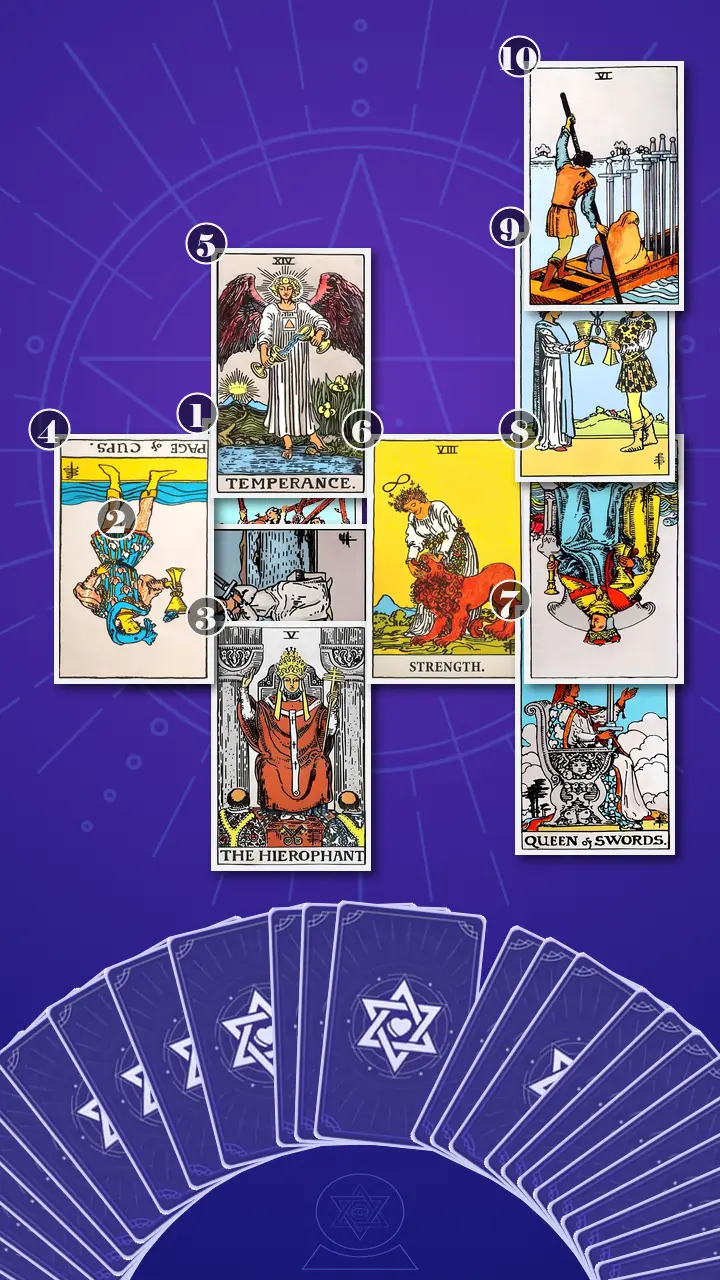
Reading the Table’s Weather: From Noise to Nervous System
Position 1: What the dinner dynamic is activating in you right now
“Now we turn over the card that represents what the dinner dynamic is activating in you right now,” I said, and laid it down. “Five of Wands, upright.”
The image is all raised sticks and overlapping motion—no coordination, no leader, no shared goal. I didn’t need to dramatize it. Jordan’s face did it for me.
“This is the table when three people jump in mid-sentence,” I said, using the life-translation plainly. “Forks clinking, two conversations at once, someone half-laughing while correcting you. It’s not one clear conflict—it’s friction. Cross-talk. A low-grade sparring match that other people treat as normal, but your body reads as a threat.”
“Yeah,” Jordan let out a small laugh that sounded like it scraped on the way out. “That’s… too accurate. It’s actually kind of cruel.”
“Cruel is one word,” I said gently. “Another word is clear.”
I named the energy dynamic the way I was taught in my family—through the elements. “This is Fire,” I said. “Not the beautiful hearth kind. The overstimulated kind. Fire in excess. It heats the room fast. And when your system is in that heat, the mind tries to regain control by doing what you’re good at: explaining.”
Jordan’s jaw flexed. She didn’t even notice it. I did.
“And the inner monologue that shows up here,” I continued, mirroring it back, “sounds like: If I just clarify one more detail, they’ll finally get it… and at the same time, If I stop talking, I’m admitting I’m wrong. It becomes connection versus permission.”
She nodded, a wince-softened nod, like she was recognizing her own pattern in real time.
Position 2: The immediate trigger and friction point
“Now we turn over the card that represents the immediate trigger and friction point—what ‘calm down’ hooks into, and what boundary decision you freeze around,” I said. “Two of Swords, reversed.”
Reversed, the blindfold slips. The body already knows. The mind is still negotiating.
“This is that exact moment you described,” I told her. “You’re getting dysregulated, but you stay seated anyway, trying to think your way into safety while your body is already signaling, this isn’t okay.”
“It’s like I’m waiting for the perfect time to set a boundary,” she said. “But there is no perfect time.”
“Exactly,” I said. “Reversed Two of Swords is a stalemate breaking. The block isn’t that you don’t know what you need. The block is postponing the boundary decision until you’re already flooded.”
I let my gaze drop briefly to her throat. “And I want to name something practical. Your jaw and throat tightening? That’s not personality. That’s data.”
This is where my Body Signal Interpretation lives: translating physical reactions into energy messages. “A tight jaw is often the body’s way of saying, I’m clamping down to stay acceptable. A tight throat can be, I’m swallowing words so I don’t get punished for them. When those show up, it’s a cue to act earlier—not argue harder.”
Jordan looked down, then back up, as if she’d just realized she had been treating her body like an inconvenience instead of an ally.
Position 3: The underlying family script
“Now we turn over the card that represents the underlying family script that set the rules for ‘acceptable’ emotion and respect,” I said. “The Hierophant, upright.”
The Hierophant always feels like a room with invisible signage: Do not raise your voice. Do not be messy. Do not challenge the vibe.
“This isn’t only about one dinner,” I told Jordan. “This is about a rulebook—often unspoken—about what counts as maturity and respect. ‘Calm down’ isn’t being offered as care. It’s being used like moral correction.”
Jordan’s shoulders lifted a fraction, and her mouth pressed tight. That old role. That old compliance.
“A question for you,” I said, “is: which family rule are you still obeying that your adult self no longer agrees to?”
She didn’t answer quickly. Her eyes went unfocused for a second—memory replay—then she swallowed. “In my family, ‘calm’ is basically… virtue. Like if you’re calm, you’re right.”
“That’s The Hierophant,” I said softly. “Belonging conditional on compliance.”
Position 4: The recent pattern your body learned
“Now we turn over the card that represents the recent pattern that taught your body what to expect at family dinners,” I said. “Page of Cups, reversed.”
“This card is the messenger of feelings,” I explained. “And reversed, it often shows feelings being mishandled—met with teasing, minimization, or a quick pivot back to ‘be logical.’”
I nodded toward the image’s strange sweetness. “It’s like you start to say, ‘That actually hurt,’ you catch a smirk or an eye-roll, and you immediately pivot: ‘It’s fine, I’m just being dramatic,’ so nobody has to deal with your reality.”
Jordan’s face changed—tightness to something more raw, like she’d been caught in the exact second she abandons herself to keep the room comfortable.
“I do that,” she said, quiet. “I hear myself do it.”
“That’s the reversal,” I said. “Not that you’re too emotional. That you’ve learned to treat your feelings like an inconvenience you must apologize for.”
She rubbed her thumb along the edge of her phone case, grounding herself without realizing it.
Position 5: Your conscious intention
“Now we turn over the card that represents your conscious intention—what kind of regulation and connection you’re trying to create,” I said. “Temperance, upright.”
The angel pours between two cups. One foot on land, one in water. Emotion and practicality in the same body.
“This is important,” I told her. “You’re not trying to become less feeling. You’re trying to find a middle option between dumping everything out and swallowing it whole.”
I used the rhythm language intentionally, the way you can feel a song’s tempo in your ribs. “Temperance is volume control, not mute. It’s a dose. A three-beat cadence your nervous system can recognize: pause → sip water → one sentence.”
Jordan’s shoulders dropped just a little—like her body heard the word dose and relaxed because it wasn’t being asked to be perfect.
“Speed is what happens when you’re trying to prove you deserve space,” I said. “Pacing is what happens when you’re protecting your space.”
Position 6: The next developmental step
“Now we turn over the card that represents the next developmental step—what becomes available if you practice regulation instead of justification,” I said. “Strength, upright.”
“Strength isn’t silence,” I said. “It’s holding the steering wheel with steady hands while the engine revs. Intensity doesn’t get to drive.”
I glanced again—jaw, throat, heat in the cheeks. “This card is very embodied. It says: notice the earliest body cue and treat that as the moment to act on your boundary, not the moment to build a better argument.”
Jordan’s hand went to her jaw like she’d only just remembered it existed. “It always starts here.”
“Then that’s your signal,” I said. “Not a moral failing. A lighthouse.”
When the Queen of Swords Cut Through the Tone Trial
Position 7: Your best boundary posture
“We’re turning over what I consider the key card for your question,” I said, and even the room felt quieter—like the rain outside paused to listen. “This position represents your best boundary posture: the regulated stance that protects you without escalating.”
The card landed face-up. Clear air. Direct gaze. An upright blade.
“Queen of Swords, upright,” I said.
“This is the boundary that keeps you regulated,” I told Jordan, “because it’s brief. It’s self-respecting. And it includes follow-through. She doesn’t argue for permission. She names what’s acceptable, and what happens next.”
I gave her the life-translation in the simplest form: “It’s like you stop delivering a five-minute explanation and instead give one sentence that protects your nervous system—then you follow through without theatrics.”
Jordan’s eyes narrowed—not in anger, in concentration. “But if I say it that bluntly, won’t it start a fight?”
Her reaction came in three beats: her breath froze for half a second, her gaze slid away as if searching for the safest possible phrasing, then she exhaled—sharp—like she was already hearing the family pushback in her head.
“That fear makes sense,” I said. “Because you’ve been trained by the room to believe you have to earn legitimacy by explaining. But the Queen of Swords is showing something different: clarity isn’t combat. Brevity is protective.”
In my practice, I often diagnose states through Elemental Balance. “Notice the elemental shift,” I said. “We began in Fire—Five of Wands—heat, friction, everyone talking. And now we’re in Air—Queen of Swords—clean edges, oxygen, a line you can see. This is how you move from reactive heat into navigable clarity.”
Jordan swallowed. “So… what do I actually say?”
Here, I let the truth land in the simplest possible shape—the kind you can hold when your body is braced. I built the setup the way her week actually feels.
If you’ve ever sat at a family table with your jaw tight, trying to keep your voice steady, and then someone drops “calm down” like a stamp of disapproval—your brain doesn’t go quiet. It goes into courtroom mode or shutdown mode.
Stop begging the room to understand your feelings and start using the Queen’s raised sword: one clear line, one clear limit, and then follow-through.
The words sat between us. Jordan didn’t nod right away. First her mouth opened slightly—surprise. Then her eyes went glassy at the edges, not full tears, just that thin film that means something real has been touched. Her shoulders, which had been hovering near her ears, sank—slowly, like a heavy coat sliding off. Her jaw unclenched in a way you can almost hear, and when she breathed out, the sound was shaky but relieved.
“But… if I stop explaining,” she said, voice smaller, “it kind of means I’ve been doing this backwards.”
“Not backwards,” I corrected gently. “Adaptively. You learned a strategy that kept you belonging. The Queen is just offering an update.”
I leaned in slightly. “Now—use this new lens. Think back to last week. Was there a moment where a single sentence and a small action would’ve changed your whole internal experience?”
Jordan stared at the card, then somewhere past it, replaying. “My aunt said, ‘Don’t start.’ And I started listing… everything. I could’ve just said, ‘I’m not discussing my tone,’ and gone to get water.”
“Yes,” I said. “And that’s the shift right there: from trying to be understood in the moment to protecting your nervous system with a pre-chosen boundary.”
It wasn’t only communication. It was identity—moving from “I have to win permission to feel” toward “I can stay connected to myself first.” From bracing to steadier self-respect.
Position 8: The social weather you’re working within
“Now we turn over the card that represents how the family system responds when you try to regulate and set limits,” I said. “King of Cups, reversed.”
I didn’t need to villainize anyone for this to be useful. “This can be the ‘calm voice as control’ dynamic,” I said. “Someone who stays composed on the surface while subtly steering the room’s emotions—shaming, correcting, redirecting.”
Jordan gave a quick, humorless smile. “That’s my dad.”
“Then you know this feeling,” I said, and offered the reframe cleanly: “Calm can be care—or it can be control. Your body knows the difference.”
I let her picture the micro-scene: “You say one honest thing. He stays measured. Slight smile. ‘Let’s not get worked up.’ And suddenly the topic is no longer what happened. The topic is you.”
I added a sentence I’ve watched set people free: “Your steadiness doesn’t automatically make them right.”
Jordan’s chin lifted a millimeter—like her spine was remembering it has a choice.
“And here’s a line to keep you out of the trap,” I said. “If they’re commenting on your tone, the topic is already lost.”
Position 9: Hopes and fears
“Now we turn over the card that represents what you deeply want—and what you fear will happen if you set the boundary anyway,” I said. “Two of Cups, upright.”
“Under all of this,” I told her, “you want mutuality. Adult-to-adult respect. You want your feelings not to be treated as a problem.”
Jordan looked down at her hands. “I’m scared boundaries will cost me connection.”
“That’s exactly why this card is here,” I said. “It’s reminding you: your boundary isn’t punishment. It’s the architecture that makes real connection possible.”
Position 10: The integration path
“Now we turn over the card that represents the integration path—the direction this takes when you consistently choose regulation-first boundaries,” I said. “Six of Swords, upright.”
The boat moves from rough water to calmer water. It doesn’t erase the past. It changes the conditions.
“This outcome isn’t ‘everyone suddenly gets it,’” I said. “It’s strategic distance. Intentional transitions. A planful exit. You protect your regulation first so your relationships have a chance to be different over time.”
Toronto gave us the perfect metaphor. “It’s like TTC doors closing,” I said. “You choosing your own route home. Fewer transfers. Less chaos. Same general destination—relationship—with kinder conditions.”
I watched Jordan’s shoulders ease again. “Leaving isn’t a punishment,” I said. “It’s a transition plan.”
The One-Sentence Boundary: Actionable Advice You Can Actually Use
I gathered the spread into one story, the way I’d do it for my own daughters and granddaughters when their lives felt loud.
“Here’s why this keeps happening,” I said. “The Five of Wands shows a noisy table that spikes your system. The Two of Swords reversed shows the moment you freeze—because you’re still trying to make everyone comfortable. The Hierophant underneath says you were taught that composure equals worth. The Page of Cups reversed shows you’ve been trained to retract feelings before they become ‘a problem.’ Temperance and Strength say regulation is pacing and embodied steadiness. The Queen of Swords is the pivot: a repeatable boundary you can enforce. And the Six of Swords says you’re allowed to choose calmer waters—through movement, timing, and transitions—not through winning the debate.”
“Your cognitive blind spot,” I added, “is thinking that the right explanation will protect you. But in this system, explanations often become fuel. The transformation direction is different: from being understood right now to staying with yourself first.”
Then I gave her the smallest, most doable next steps—because boundaries fail when they’re too poetic to say with a tight jaw.
- Pin the Queen’s lineBefore the next dinner, save a pinned note on your phone with: “I’m willing to continue if we don’t comment on my tone.”Friction plan: you’ll want to add a second sentence to sound nicer. That’s the moment to stop. Keep it one sentence.
- Pair it with a body-safe actionChoose one follow-through you can do anywhere: “I’m going to step away for a minute,” then physically leave your chair—bathroom, porch, hallway, even just to get water.Follow-through without drama is the power move. Movement tells your nervous system you’re not trapped.
- Use a 5-minute “balcony wake-up” before you walk inDo my 5-minute balcony energy awakening practice: step outside (balcony, front steps, even an open window), feel the temperature on your cheeks, unclench your jaw, and take ten slow breaths while you look at the sky—not your phone.If it’s brutal weather, do it by a cracked window. Let the outside air be your reminder: you have options and exits.
“And after,” I added, because integration matters, “use water to release what you had to hold. In the shower, let the stream hit the back of your neck and imagine the whole dinner draining off you. No analysis—just flow. Your mind will want to replay. Let your body go first.”
Jordan raised an eyebrow. “That sounds… weirdly doable.”
“That’s the point,” I said. “A boundary that works is one you can enforce while your nervous system is lit up.”

A Week Later: The Quiet Proof
Six days later, Jordan texted me a screenshot—not of a family thread, but of her own pinned note. Under it she wrote: “I said it once. Then I got up and got water. My heart was pounding, but I didn’t explain. I didn’t debate. I came back and the topic changed.”
She added one more line: “I still felt shaky. But I didn’t feel ashamed.”
Her proof wasn’t a perfect dinner. It was a new relationship with herself. Clear, but still tender: she left after dessert, took the streetcar home alone, and sat by her window for three minutes in the quiet—steady, a little sad, and proud enough to breathe deeper anyway.
When I think of her spread now, I think of how quickly Air can clear a room when it’s used with respect. Not icy. Not cruel. Just clean. A single sentence, a single movement, and a nervous system that finally believes: I can keep myself safe without becoming someone else.
When someone says “calm down,” it can feel like your whole worth at the table just got reduced to your tone—so your body braces, your jaw locks, and you start fighting for legitimacy instead of protecting yourself.
If you didn’t have to be understood right now to be allowed to feel, what’s the one sentence you’d be willing to repeat—and the one small action you’d trust yourself to take—just to stay with you?