From Boundary Guilt to a Steady No: Holding the Line on Church Texts

Finding Clarity on the TTC: The Notification That Locks Your Jaw
If your thumb hovers over Send while your jaw clenches, because you’re trying to craft the one reply that won’t trigger judgment—but the overthinking just keeps the invitation loop alive, I already know the shape of your tired.
Jordan (27, Toronto, marketing job that never really turns off) booked a session with me after another “come to church” text. She described it like a reflex: the preview appears, and her body reacts before her mind can be “reasonable.”
She told me about Tuesday at 6:12 PM on a packed TTC Line 1 car—one hand on the pole, fluorescent lights flickering like a cheap film effect, track screech slicing through the carriage. Her phone screen looked painfully bright in the dim subway. The notification preview started with: “Come to church…”
She opened the thread. Typed. Deleted. Typed again. Deleted again—like she was drafting a PR statement in Notes, except the “brand” was her entire relationship. Her shoulders rode up toward her ears, and her jaw set so hard she got that dull ache near the hinge.
“I don’t want to debate this every time,” she said, staring at her screen like it might offer a loophole. “If I’m too direct, it’s going to become a whole thing. And I’m tired of explaining myself like it’s a court case.”
I watched the way she held her breath at the end of each sentence—as if even saying the problem out loud might summon another message bubble.
“You’re trying to do two things at once,” I told her gently. “Set a boundary about church invitations and keep everything calm. That’s a real contradiction. Let’s make a map through it—something that gives you clarity and a next step you can actually use on a Tuesday commute.”

Choosing the Compass: The Celtic Cross · Context Edition
I invited Jordan to take one slow breath with me—not as a mystical ritual, but as a clean transition. A nervous system needs a doorway between “I’m bracing for impact” and “I’m choosing on purpose.”
“Today we’ll use the Celtic Cross · Context Edition,” I said, and I saw her eyebrows lift in a small, relieved way—like she appreciated that we weren’t pretending this was just a quick wording tweak.
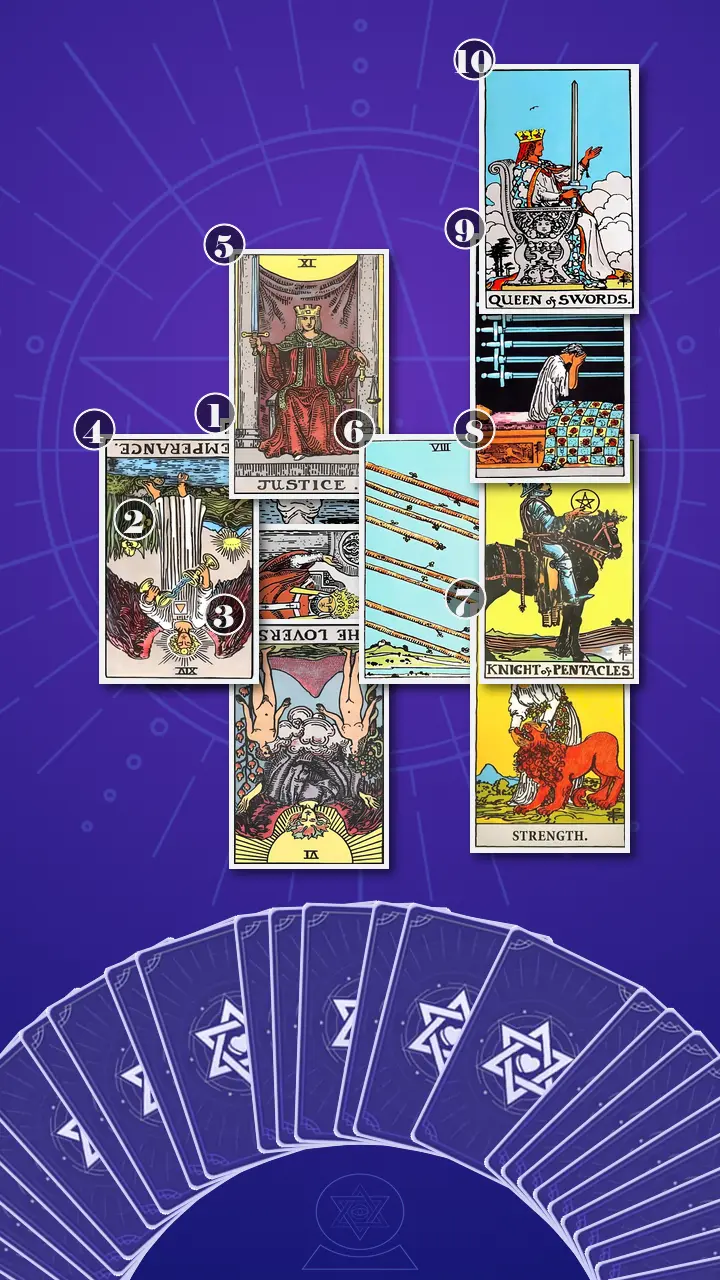
For you, reading along: I keep the full Celtic Cross structure when a problem is a loop, not a moment. Jordan’s issue isn’t only “what do I text?” It’s: immediate reaction → values conflict → repeated ping of pressure → sustainable boundary style. This version tightens two positions to fit modern messaging dynamics—cadence, persistence, and that weird sense of being “on call” for other people’s expectations.
Here’s what I told Jordan to expect: the first card would show her autopilot move the moment the text lands; a deeper card would reveal what her nervous system thinks it’s protecting; and the final card would point to the most helpful boundary style—something repeatable, not performative.
Reading the Map: When “Should” Energy Hijacks a Simple Text
Position 1: What you do in the moment the text lands
“Now turning over is the card for what you do in the moment when the ‘come to church’ text lands—the observable stuck pattern.”
Two of Swords, in reversed position.
I nodded toward the image. “This is the subway scene you described: you open the chat and rewrite the same reply three times because you’re trying to avoid sounding ‘rude.’ Then you either leave it on read or send a soft maybe, and the lack of a real answer keeps the door open for the next invite.”
In my language, the energy here is a blockage in Air: thinking becomes a locked door instead of a tool. The blindfold is you trying not to ‘see’ the conflict; the crossed swords are you defending the relationship while blocking your own clarity.
Jordan let out a short laugh that wasn’t amused—more like the sound you make when a show like The Bear nails your exact anxiety pacing and it feels a little too personal. “That’s… rude accurate,” she said. “Like, it’s almost mean.”
“It’s not mean,” I replied. “It’s specific. And specific is how we get unstuck.”
Position 2: The main obstacle crossing your boundary
“Now turning over is the card for the main obstacle—the pressure or expectation that makes a boundary hard to hold.”
The Hierophant, upright.
“This is tradition-coded pressure,” I said. “The invitation doesn’t feel like an event. It feels like a test of whether you’re still a ‘good’ or respectful person. Like a workplace ‘culture fit’ interview—but in your personal life.”
The energy here is an excess of external authority: the invisible rulebook gets louder than your actual preference. And I want to say this carefully—this card isn’t here to judge anyone’s faith. It’s here to name the dynamic inside the text: this is how it’s done, therefore declining feels loaded.
I leaned in slightly. “An invitation isn’t a test—unless you keep answering like it is.”
Jordan’s eyes flicked down to her hands; she rubbed her thumb against her ring like she was smoothing a crease no one else could see.
Position 3: The underlying values conflict your body is protecting
“Now turning over is the card for the underlying values conflict—what your nervous system is trying to protect by not being direct.”
The Lovers, in reversed position.
“This is where the RSVP becomes a relationship referendum,” I said. “Saying no feels like rejecting them. Saying yes feels like protecting closeness. So you drift into vagueness to avoid choosing—and then you resent the situation for putting love and compliance in the same bucket.”
The energy is a deficiency of alignment: you’re not matching your words to your values, because you’re busy trying to manage someone else’s feelings in advance.
My mind flashed—briefly, like a bird shadow on water—to my own family line in the Highlands: seven generations of women who could sense weather shifts in their bones, and just as easily sense when a family’s “love” had quietly turned into a set of rules. In my work, I call this Generational Pattern Reading: the way belonging gets inherited as a behavior—keep the peace, don’t disappoint, explain until they approve.
“Jordan,” I asked softly, “who taught you—without ever saying it—that closeness is something you can lose the moment you say a plain no?”
Her throat moved like she swallowed a stone. “It’s… family stuff,” she admitted. “And church is part of it. So it’s like—if I say no, I’m stepping out of the whole picture.”
Position 4: What you’ve tried before (and why it didn’t end the loop)
“Now turning over is the card for what has been attempted before—the middle ground approach.”
Temperance, in reversed position.
“This is the ‘perfect middle’ text,” I said. “Not this week. Maybe soon. I’ve been busy. It reduces friction for a second—but it turns every new invite into a renegotiation, because nothing was actually defined.”
Here the energy is imbalance: you’re trying to blend politeness with uncertainty until the message becomes… negotiable.
“Stop writing like you’re on trial for having preferences,” I told her, not unkindly. “Temperance reversed is what happens when you try to water down your no until it tastes like yes.”
Jordan’s shoulders dropped about half an inch—like her body recognized the truth before her brain wanted to argue with it.
Position 5: What you want to be true (your boundary principle)
“Now turning over is the card for what you want to be true—the principle you’re aiming for.”
Justice, upright.
“You want a boundary that feels fair,” I said. “Respectful to them, honest to you. You’re trying to replace ‘I owe you reasons’ with ‘I’m allowed to choose,’ and treat autonomy as part of mutual respect—not as a personal attack.”
This is balance in Air: clear wording (the sword) and mutual agency (the scales). Justice doesn’t ask you to be harsh. It asks you to be precise.
Position 6: What’s next in the texting reality (the trigger moment)
“Now turning over is the card for what’s next—how the messaging cadence pulls you back into the loop, and where you can interrupt it.”
Eight of Wands, upright.
“This is notification momentum,” I said. “The pace ramps up—maybe a quick follow-up, or the invite returning like clockwork. The speed itself pressures you into replying immediately and over-explaining, unless you have a short script ready.”
The energy here is an excess of Fire: movement, urgency, now now now. It’s not just what they ask—it’s how fast your body believes you must respond.
I pictured her walking through the PATH, crowd smell mixing cologne and takeout, AirPods in, a text arriving faster than expected. “This card is your clue,” I said. “The problem isn’t only what you say—it’s that you’re composing under pressure.”
Jordan exhaled, small but real. “Oh. Yeah. I write like I’m defusing a bomb.”
Position 7: Your best inner stance (how you hold the line)
“Now turning over is the card for your best inner stance—the self-energy that helps you hold the line without escalating.”
Strength, upright.
“This is warm firmness,” I said. “You send a clear no, and then you feel the urge to immediately soften it with a second text. Strength is you breathing through that urge—staying kind but not backpedaling. Letting the other person have feelings without managing them.”
The energy is balance: power without aggression. The lion isn’t the other person; the lion is your impulse to soothe, explain, rescue.
Position 8: The other side of the dynamic (what won’t stop unless you change)
“Now turning over is the card for the other side of the dynamic—what the pattern is asking of you.”
Knight of Pentacles, upright.
“This is steady persistence,” I said. “They will keep inviting because that’s their routine and their way of caring. Vague answers read as ‘eventually.’ So the only thing that changes the pattern is your own consistent, defined response.”
This is an excess of Earth energy outside you: consistent, unhurried, not dramatic—just repetitive. Against that, improvising new wording every time doesn’t work. It only keeps the door cracked.
Position 9: The hope-fear knot (what your mind does at night)
“Now turning over is the card for your hopes and fears—the knot that tightens right after you think about being clear.”
Nine of Swords, upright.
“This is 1:00 AM you,” I said, and Jordan gave a tiny, pained nod before I even continued. “After you reply—or don’t—you replay the thread at night. You over-interpret tone, punctuation, timing. Like a simple boundary could prove you don’t belong.”
The energy is an excess of Air: rumination so sharp it feels like it has edges. And this is where I want to normalize something: Feeling guilty doesn’t mean your boundary is wrong—sometimes it just means it’s new.
Jordan pressed her lips together, then released them. “That one… I needed,” she said quietly.
When the Queen of Swords Lifted Her Blade: The One Clean Line
Position 10: The most helpful boundary style to practice
I let the room go still before I turned the final card. Even over video, you can feel it—the way attention gathers when the reading has been building toward a single, necessary truth.
“Now turning over,” I said, “is the card for the most helpful boundary style to practice—the tone and structure of a response that stays consistent over time.”
Queen of Swords, upright.
“Here’s the lived version,” I told her. “You choose one respectful sentence and repeat it: you thank them once, decline plainly, and ask for the invites to stop—without debating faith or defending your identity. Then you put the phone down and don’t keep performing your boundary in follow-up texts.”
In this card, Air is finally healthy—clear-minded firmness with respectful detachment. Not coldness. Not cruelty. Just clean edges.
The Aha Moment (Setup)
You could almost see Jordan back on the TTC—lock screen lighting up, thumb hovering automatically—because her brain still believed she needed the perfect message to keep everything calm. Her body was already bracing, pre-loading a multi-paragraph explanation before she’d even decided what she wanted.
Not a long defense—choose one clean line, and like the Queen of Swords, let clarity be the boundary that does the cutting.
The Aha Moment (Reinforcement)
Jordan’s reaction came in three waves. First, a tiny freeze—her breathing stopped for a beat, like her nervous system didn’t know whether to fight or run. Then her eyes unfocused, not blank, but as if she was replaying a familiar scene: her Notes app open, three drafts stacked like receipts, each one trying to prevent disappointment.
Then the release: her shoulders lowered, slow and reluctant. Her jaw unclenched like she’d finally noticed she’d been biting down for months. She swallowed, and her voice had that thin edge of surprise. “But… if I say it that simply,” she said, and there was a flicker of irritation underneath the fear, “doesn’t that mean I’ve been doing this wrong the whole time?”
“No,” I said, steady. “It means you’ve been doing what kept you safe. The Queen isn’t here to shame you—she’s here to give you a different tool.”
I leaned closer to the camera, as if I could hand her the sentence itself. “You don’t need the perfect explanation; you need a clear sentence you can repeat. Now—use that new lens and think back to last week. Was there a moment where one clean line would have changed how you felt in your body?”
Jordan blinked fast once. “Yeah,” she said. “Sunday morning. I started writing a whole essay about my schedule and mental health. I could’ve just… answered.”
This was the hinge of her journey: not from “nice” to “mean,” but from over-managing reactions to owning a limit. A step from tight, contracted tension toward steadier self-respect—still a little shaky, but real.
From Insight to Action: Scripts, Shoulders, and a Tiny Unsubscribe Link
I pulled the whole spread together for her in one clear thread: the Two of Swords reversed showed her freeze-and-edit autopilot; the Hierophant explained why this invite felt like a values-coded belonging test; the Lovers reversed revealed the deeper habit of confusing compliance with closeness; Temperance reversed showed why “middle ground” texts became endless renegotiation; Justice named her true aim—fairness that includes her; Eight of Wands warned that speed would keep yanking her back into drafting; Strength promised she could tolerate the discomfort; and the Knight of Pentacles confirmed the external pattern wouldn’t change on its own.
The blind spot was simple and brutal: Jordan kept treating clarity like a debate. Her transformation direction was the opposite: move from “explaining to be understood” to “stating a limit once and repeating it consistently.”
Then I gave her next steps that were small enough to do on a subway platform.
- Save the one-linerOpen Notes and create a saved reply titled “Church boundary.” Keep it under 140 characters. Example: “Thanks for thinking of me—I’m not going to church. Please stop inviting me.”If “please stop” feels too sharp today, soften without adding reasons: “I’m not open to church invites, but I appreciate you thinking of me.” (Still one message.)
- Do the Strength pause before SendRight before you paste it, take 10 seconds: drop your shoulders, unclench your jaw, and exhale longer than you inhale once.Your body will read directness as danger; the longer exhale teaches it this is discomfort, not threat.
- Use my 3-minute family energy check (houseplants)After you send, put the phone face down for 24 hours (no second text). Then spend 3 minutes watering or checking one houseplant—notice leaves, dryness, light. Let that be your “I don’t rescue disappointment in real time” anchor.If you don’t have plants, use the closest equivalent: refill your water bottle, wipe the counter, or fold one load of laundry—one grounding chore to move the adrenaline through.
A Week Later: The Quiet Proof of a Boundary
Six days later, Jordan messaged me a screenshot—not of a long conversation, but of one line sent and then… nothing. “I used the saved reply,” she wrote. “My stomach flipped, but I didn’t add the second text. I watered my pothos and went for a walk.”
She added, almost as an afterthought: “It’s weird. It didn’t fix everything. But I didn’t spiral all night.”
That’s what a real Journey to Clarity looks like in modern relationships: not a dramatic showdown, but a clean sentence, a regulated breath, and the choice to let someone else have their feelings without turning yours into a courtroom exhibit.
And if tonight, a simple “come to church” text makes your jaw lock and your brain start drafting a courtroom defense, it’s not because you don’t care—it’s because part of you still believes belonging can be lost the moment you say a plain no.
If you didn’t have to prove your reasons—only name your limit—what would your one clean sentence be this time?