The Night They Called Me 'the New One'—And the One-Sentence Boundary I Used

Finding Clarity in the “New One” Label
If you’re the 27-year-old in Toronto who’s ‘socially fine’ everywhere except this one friend group—where you’re always introduced as “the new one” and your body goes tight even while you smile—I already know the exact kind of quiet exhaustion you mean.
Alex (name changed for privacy) showed up to my reading with the kind of politeness that looks like it’s holding itself together by sheer muscle. They set their phone face-down, then flipped it back up, almost automatically—like their thumb had its own nervous system.
They told me about 1:03 a.m. in their Toronto apartment: streetlight stripes across the ceiling, the phone screen warm against their palm, the group chat open like an accusation. They typed, “Hey, small thing…” then backspaced it. Again. Their throat had that tight, narrow feeling—like trying to swallow around a word that wouldn’t go down—and their stomach did the little drop it does when you miss a step on the stairs.
“I don’t want to be the person who kills the vibe,” they said. “But if I’m always ‘the new one,’ then I’m not actually in.”
What I heard underneath was the core contradiction most people don’t want to admit out loud: you want to belong and be seen as a real friend, and you’re terrified that saying one honest sentence will get you quietly demoted.
I leaned in a little, soft voice on purpose. “We’re not here to make anyone a villain,” I said. “We’re here to find the boundary that protects your dignity without turning your life into a debate. Let’s draw a map through the fog—toward clarity.”

Choosing the Compass: The Four-Layer Insight Ladder
I asked Alex to take one slow breath—not as a mystical thing, just a nervous-system reset—and to hold the question in plain language: “Their friends call me ‘the new one’—what boundary now?”
As I shuffled, I explained what I was doing the way I used to explain sea conditions to anxious passengers when I trained intuition on cruise voyages: when you can’t control the water, you learn to read the current. Tarot, to me, is a current-reading tool—symbolic, psychological, and extremely practical when you stay honest about what it’s showing.
Today I chose a spread I built for moments exactly like this: the Four-Layer Insight Ladder · Context Edition.
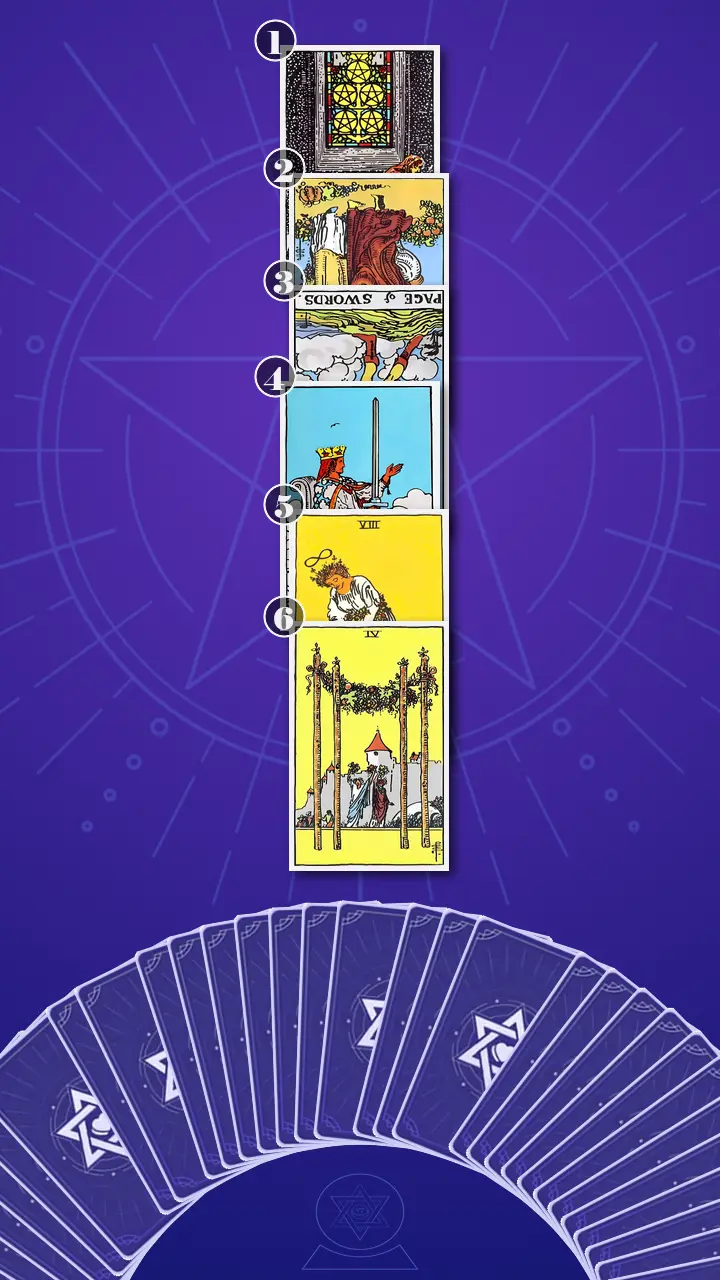
For readers who wonder how tarot works in real life: this ladder is compact on purpose. It moves cleanly from (1) what’s happening on the surface, to (2) the group dynamic sustaining it, to (3) your internal blocker, and then it pivots into (4) the boundary sentence, (5) how to deliver it, and (6) what healthy belonging looks like when it’s respected.
I previewed the structure for Alex: “The first card will name what this label is doing to you in the moment. The third will show why you freeze and overthink your texts. And the center card—position four—will give us the exact standard to set now.”
Reading the Map: When a Joke Becomes a Social Rule
Position 1 — The immediate relational scene
“Now flipped,” I said, “is the card that represents the immediate relational scene: how the ‘the new one’ label is landing and what it’s doing to your sense of belonging in the moment.”
Five of Pentacles, upright.
I didn’t dress it up. “This is the outsider card,” I told them. “Not ‘no one likes you’—more like: you’re physically in the room, but emotionally braced like you’re outside the warmth.”
I used the card’s modern-life translation so it landed where Alex actually lives: You’re at a loud birthday dinner and you’re technically invited, technically sitting at the table, but you’re placed like an extra chair at the edge—smiling, nodding, doing ‘polite laughs’ while everyone else is inside a shared history. The label ‘the new one’ lands like confirmation that you’re allowed access, not belonging.
The energy here is contraction. It’s Earth energy—belonging needs—but it’s in a deficiency state: not enough safety, not enough warmth, so your body compensates by going small and agreeable.
Alex let out a tiny laugh—short, brittle, almost involuntary. Then their face went still. That three-part reaction came fast: a micro-freeze in their shoulders, eyes flicking down to the card like they didn’t want to be seen recognizing themselves, and then a slow swallow that made their throat bob.
“It’s kind of brutal,” they said quietly. “Because it’s true. I’m there, but I’m… not in.”
Position 2 — The group dynamic underneath
“Now flipped is the card that represents the group dynamic underneath: what social pattern keeps the label in circulation.”
Three of Cups, reversed.
“This isn’t about you being ‘too sensitive,’” I said, and I meant it. “This is about a group ritual.”
I grounded it in the modern scenario: The group’s closeness runs on inside jokes, old stories, and synchronized teasing. When you enter, you’re welcomed—but in a way that still keeps you categorized. You can feel the subtle ranking: who gets follow-up questions, who gets tagged, who gets treated like a fixture vs a guest.
Reversed, the Three of Cups is social warmth in a blockage state: the toast becomes a closed loop. No one has to be malicious for that to sting—closed circles can be cozy for insiders and cold for newcomers at the exact same time.
Alex’s mouth pressed into a line, then softened. Their gaze moved off the card and toward my window, where late-afternoon light cut a clean rectangle on the floor. “So it’s not just me failing to be… fun enough.”
“Exactly,” I said. “You’re noticing a social rule that keeps you small.”
Position 3 — Your internal blocker
“Now flipped is the card that represents your internal blocker: the specific mental/communication pattern that keeps you from naming the boundary.”
Page of Swords, reversed.
Before I even spoke, Alex exhaled through their nose like they’d been caught.
I used the translation that matched their nightly loop: After the hangout, you open a text draft and do a full tone audit like it’s a work email: friendly, casual, not too intense, not too needy. You keep rewriting because you’re trying to guarantee a good reaction. The result is silence—and the label stays alive.
This is Air energy—words, meaning, perception—but in a blocked state. Your mind is trying to engineer a no-risk message. And the trap is: if you need a sentence that guarantees acceptance, you’ll never send anything. You’ll keep feeding the “Notes app full of drafts you’ll never send” archetype.
I mirrored the spiral the way I’ve watched thousands of people do it with their own hearts—like scrolling, refreshing, hoping the algorithm changes without you changing anything:
“I’ll sound needy. → But if I don’t say anything, I’m agreeing. → I’ll wait for a perfect moment.”
Alex winced, then nodded once. Their jaw tightened hard enough I could see the muscle jump. “That’s literally my brain on TTC Line 1,” they said. “Like I’m A/B testing copy. But it’s my friendships.”
“And this is why I keep a phrase ready for this card,” I said, gentle but firm. “A boundary doesn’t need a paragraph—sometimes it needs one clean sentence.”
When the Queen Lifted Her Sword in a Toronto Condo Kitchen
Position 4 — The boundary to set now (Key Card)
I slowed down here. “We’re turning the page,” I said. “This is the center of the ladder—the card that defines the boundary to set now.” The room felt quieter, like even the building’s radiator had decided to listen.
Queen of Swords, upright.
I connected it to Alex’s real life immediately: In a quiet moment—walking to the elevator, rinsing cups in the kitchen—you say, calmly: “Hey, can we drop ‘the new one’? I’d rather just be Alex.” No speech, no apology, no vibe-hosting. You keep your tone steady and stay in the conversation afterward like you belong there.
The Queen’s energy is Air in balance: clarity with a spine. Her sword is the clean preference. Her open hand is the part that says, I’m still here for connection.
And this is where my Venetian brain can’t help itself. I’ve spent my life watching how people move across bridges—literal ones over canals, and emotional ones in conversation. In my Bridge-Corridor Theory, a group label is a bridge with a toll: it decides who crosses as a person and who stays in the corridor as a category. “The new one” keeps you in the corridor. The Queen hands you a bridge back to your name.
Setup (30–50 words). Alex was trapped in that 1:00 a.m. loop—trying to craft the perfect message that wouldn’t be misunderstood, wouldn’t be “a thing,” wouldn’t risk rejection. They were treating friendship like a performance review: say it wrong and you lose access.
Delivery.
Stop auditioning for acceptance and start setting the tone—raise the Queen’s sword with one clear sentence, while keeping your hand open for real connection.
I let the sentence sit there. A small pause—like the beat after a wave hits the side of a ship, when your body checks whether you’re still steady.
Reinforcement (100–200 words). Alex’s reaction wasn’t instant relief. First, their breath stopped halfway in. Their fingers curled against their own palm, like they were bracing for impact. Then their eyes unfocused for a second—not blank, but replaying. I could almost see the condo kitchen scene behind their gaze: someone calling over the music, “This is Alex—the new one!” and Alex’s throat snapping tight like a drawstring.
Then came the shift: their shoulders lowered by a centimeter. A quiet exhale left them, not dramatic—more like air finally allowed to leave a room. Their mouth opened as if to argue, then closed. Their eyes went glassy, not quite tears, more like the nervous system admitting, Oh. That’s allowed.
They said, a little sharp at first, “But if I do that… doesn’t it mean I’ve been letting it happen?” Anger flashed—then softened into something tender. “Like I’ve been agreeing to be… less?”
I didn’t rush them. “It means you survived the room the best way you could,” I said. “And now you’re choosing a different bridge.”
I asked, “Now, with this new lens—think back to last week. Was there a moment when one clean sentence would’ve changed how you felt, even by 5%?”
Alex nodded, slow. “Thursday. King West patio. My friend said it like it was cute. I felt my chest go tight, and I laughed anyway.”
“This is the move from self-conscious contraction into calm self-respect,” I said. “Not confidence as a personality trait—clarity as a behavior.”
Position 5 — How to deliver it (embodiment)
“Now flipped is the card that represents how to deliver it: the emotional posture that makes the boundary sustainable.”
Strength, upright.
I used the modern-life scene: You feel the familiar rush—heart up, face hot—and you choose steadiness instead of snapping or over-explaining. You let a small silence happen after your sentence. If someone jokes it off, you repeat the preference once and move on, like it’s a normal social rule you’re allowed to have.
This is Fire energy expressed as regulated courage, not performance. Strength is what lets the Queen’s sentence land without you immediately trying to pay it back with jokes, a smile, or a ten-point explanation.
I watched Alex’s body as I described it. Their shoulders squared, then relaxed. They practiced a tiny inhale through the nose—like they were testing whether they could actually tolerate the two-second pause.
“The hardest part,” I told them, “is not the sentence. It’s letting the silence exist after the sentence without collapsing into apology.”
Position 6 — Integration (what healthy belonging looks like)
“Now flipped is the card that represents integration: what healthy belonging looks like when you uphold this boundary and choose reciprocal dynamics.”
Four of Wands, upright.
I anchored it in the real-life picture: You get introduced by name without a qualifier. Someone explains an inside joke instead of letting you hover outside it. You’re included in the plan-making, not just informed after. You feel relaxed enough to initiate—because you’re no longer paying for access by staying low-maintenance.
After the Five of Pentacles—outside in the snow—this card is a doorway you can actually walk through. Not because you endured enough, but because the social rules changed: name, not label. Person, not category.
Alex’s face shifted into something almost surprised. “That’s what I want,” they said. “To feel like a person. Not an add-on.”
The One-Sentence Standard: Actionable Next Steps
I stitched the ladder together for them in one clean story: You’re walking into a group that runs on history (Three of Cups reversed), and the label “the new one” keeps you in outsider energy (Five of Pentacles). Your mind tries to engineer a no-risk message (Page of Swords reversed), so you stay silent and the rule stays intact. The pivot is the Queen: one clear preference. Strength is the delivery: calm, steady, no over-explaining. And the outcome isn’t instant best-friend status—it’s data and warmth: Four of Wands belonging built through repeated, respectful norms.
“Here’s the blind spot,” I added. “You’ve been treating clarity like it has to be earned—like you need permission to request basic respect. But clarity is how you find out who can actually meet you.”
Then I gave them a plan that was intentionally small. I pulled from my own toolkit too—my Lace Communication Method from Burano: one clean thread, no tangles, no extra knots. Precision, not volume.
- Private-first boundary textToday or tomorrow, text the friend who brought you into the group: “Quick thing—can you stop calling me ‘the new one’? I’d rather just be Alex.”If your nervous system panics, don’t add context. One sentence is the point. Hit send, then put your phone down for 10 minutes.
- The one-breath rehearsal (10 minutes)Open Notes, write the exact line you’ll say out loud, and read it aloud five times—slower than you want to—while you make coffee or wash a mug.Notice where your throat/chest tightens. That’s not “dramatic”—that’s the moment Strength practices staying steady.
- Repeat-the-line (no debate) + two-second pauseAt the next hangout, if it happens again, use the same sentence: “Hey—can we drop ‘the new one’? I’d rather just be Alex.” Then pause for two seconds and rejoin the conversation.If someone says “It’s not that deep,” repeat the preference once and change the subject. You’re setting a norm, not winning a case.
As a final layer, I offered my Gondola Balance Technique: don’t try to carry the emotional load in the loudest moment. Put the boundary where your boat is steadier—one-on-one, walking to the streetcar, or early in the hangout before the room gets too performative. Adjust the “load distribution,” and your voice won’t have to fight the waves.

A Week Later: The Quiet Proof
A week later, Alex messaged me. “I sent the text,” they wrote. “My hands were shaking, but I sent it.” The friend responded: “Oh my god, I’m sorry. Totally. Just Alex.”
Bittersweet, honest proof came next: Alex told me they went to a coffee shop alone after work, ordered something sweet, and sat by the window for an hour—not celebrating loudly, just letting their body learn a new fact: they could ask to be named correctly and still be here.
That’s the whole Journey to Clarity, really. Not a personality makeover—just a shift from auditioning to self-respect, from tone-policing to one clean sentence you can repeat.
When you laugh at “the new one” with a tight throat just to keep the vibe, it can feel like you’re trading a little bit of your name for a little bit of access.
If you let yourself stop auditioning for one week, what’s the simplest sentence you’d want people to use to meet you—right where you are?
Every reading at AceTarot is a Journey to connect with inner wisdom and empower next step.
Learn more about our Journey to Clarity.