When the Table Switched Languages, I Learned the 10-Second Recap Ask

The 8:07 p.m. Pendant Light and the Polite Smile
If you’ve ever sat at your partner’s family dinner in Toronto and watched the conversation slide into another language—then stayed smiling because you didn’t want to be “that person” asking for translation (hello, code-switching at dinner), you would’ve recognized Maya (name changed for privacy) the second she walked into my café.
It was the kind of Sunday night where the street outside felt damp and metallic, and my espresso machine kept up its steady hiss like a metronome. Maya wrapped both hands around a mug I’d warmed first, like she needed proof her fingers still existed. The overhead pendant light above our little table was just a touch too bright—bright enough to make a person feel visible in the worst way.
“It happens at dinner,” she said, careful. “My partner’s family. We’ll be talking, and then mid-story it just… flips into another language. Everyone’s laughing. I’m smiling. I’m doing the right face. But I’m not actually in the room.”
I watched her throat work around a swallow, like the words were stuck behind a small, polite gate. “And I don’t know how to ask for inclusion without sounding demanding,” she added. “I don’t want to be the reason everyone has to slow down. But if I don’t say anything, I disappear. Then I resent them, and then I resent myself.”
The embarrassment wasn’t abstract—it sat on her like a too-tight collar: a fixed smile that wouldn’t relax, a stomach-drop every time the language switched again, the feeling of being a person-shaped gap at a lively table. Wanting belonging and real connection right there, while fearing she’d look rude, needy, or culturally insensitive if she asked for it.
I leaned in slightly, voice low and practical. “You’re not wrong for wanting to stay respectful. And you’re not wrong for wanting to be included. Let’s try to get you out of the ‘polite smile + wait it out’ loop and into something you can actually do in real time. We’re here for clarity—something you can carry into the next dinner, not a perfect speech you’ll never say.”

Choosing the Compass: The Mirror Spread for a Dinner-Table Problem
I asked Maya to take one slow breath—not as a ritual, just as a reset. Then I shuffled on the café’s small marble table, the cards making that soft, papery whisper that always feels like “okay, now we’re being honest.”
“For this,” I told her, “I want to use something called the Mirror Spread.”
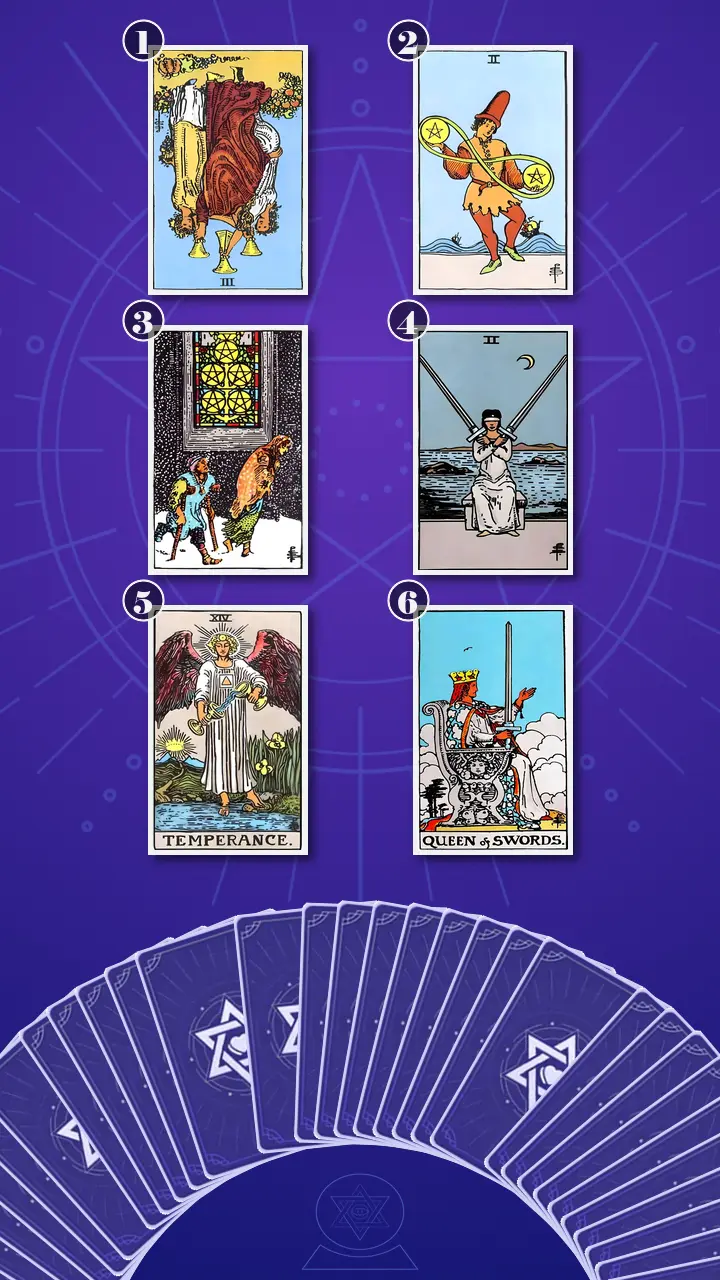
To you reading this: the Mirror Spread works especially well for relationship communication and group dynamics, because it separates two things we often mash together when we’re hurt: your lived experience and their likely pattern. It’s not a ‘predict the future’ setup. It’s a ‘how tarot works as a map’ setup—six cards that show the emotional trigger, the hidden wound, the repeating block, and then a bridge plus a next-step sentence you can actually say at a table.
I laid the cards in two columns of three—like two people leaning toward each other across a small table. “We’ll read down the left side first,” I said, “your inner arc—what it feels like, what it touches, what could repair it. Then we’ll read down the right—what’s happening on their side, what keeps the loop going, and how you speak into it.”
“Position 4,” I added, tapping the middle-right space, “is the self-silencing mechanism—the thing you do in the moment that accidentally teaches everyone you’re fine.”
“And Position 5 is the bridge,” I said, touching the bottom-left space. “The healthiest way to ask for inclusion without making it a confrontation.”
Reading the Map: When Connection Becomes a Closed Loop
Position 1 — Surface reality: what it feels like in your body right now
“Now we turn over the card that represents your surface reality—what the dinner language-switching experience feels like in your body and behavior right now.”
Three of Cups, reversed.
In modern life, this is painfully specific: You’re at a partner/friends dinner, clinking glasses and smiling, but once the table code-switches you become the person who laughs a beat late and watches for cues. The ‘celebration circle’ keeps spinning, and you’re physically in the frame but emotionally outside it—so you perform “I’m fine” instead of asking for a quick recap to re-enter.
Reversed, the Three of Cups is communal warmth with a broken feedback loop—connection is happening, but it’s not reaching you. That’s the key: the table is still toasting, still laughing, still bonded… and you’re doing the right facial expressions like you’re trying to keep up with a livestream that has lag.
Maya gave a small laugh that didn’t match her eyes. “That’s… brutal,” she said. “Like—accurate. But brutal.” Her fingers tightened around the mug, then loosened, as if she’d been caught doing something she didn’t realize she was doing.
“It’s not here to shame you,” I said. “It’s here to show you the mechanism. When you’re ‘tagged in the group photo’ but not in the group chat context, your nervous system starts improvising: smile bigger, laugh louder, sip faster, look busy. It’s an understandable survival move. It just doesn’t get you what you came for.”
Position 2 — The other side of the mirror: what drives the switching without malice
“Now we open the card that represents their side of the mirror—what’s driving the group’s language-switching pattern without assuming bad intent.”
Two of Pentacles, upright.
The translation here is almost like tech: The group is switching languages the way someone toggles between two chat threads—fast, automatic, not malicious. If you’ve ever watched two Slack threads move at once and felt your brain try to read both channels, you know this energy. The group is juggling pace, jokes, comfort, and habit. The point isn’t to stop the juggling. It’s to add a tiny structure so you can stay in rhythm.
Upright, this card is adaptability in motion—balanced, but busy. Not exclusion as a moral judgment. More like: momentum plus muscle memory.
Maya’s shoulders dropped a few millimeters. “So it’s not necessarily… about me.”
“Exactly,” I said. “This card asks: what would help you stay in the flow without demanding perfection? Because right now your brain is treating every switch as a verdict. But the cards are showing it might be a system problem—pacing—before it’s a personal rejection.”
Position 3 — The tender spot: what it activates underneath
“Now we turn over the card for the tender spot—the belonging fear or self-worth story that lights up when you can’t follow the conversation.”
Five of Pentacles, upright.
This one always makes the room feel colder. In real life: You’re sitting among friendly people, but the moment the language switches your nervous system interprets it like a social lockout. You feel like you’re outside the warm room looking in, even though you’re literally at the table.
The Five of Pentacles is the fogged-up café window card. You can see warmth. You can hear laughter. You can even smell the food. But inside your body, it’s snow.
I watched Maya’s jaw set. Her eyes went slightly unfocused, like she was replaying a moment on the TTC—fluorescent lights, phone warm in her hand, scrolling photos where she was smiling in every single one. “My brain says,” she admitted, quieter now, “They forgot me, so I must not belong.”
“That sentence is a story,” I said gently. “Not a fact. The fact might be: the language switched and you missed context. The story is: I’m not meant to be here. The Five of Pentacles isn’t calling you dramatic—it’s naming why this feels so personal. It’s not just about words. It’s about dignity.”
Position 4 — The self-silencing mechanism: how the loop keeps repeating
“Now we open the card for the self-silencing mechanism—what you do in the moment that accidentally maintains the exclusion loop.”
Two of Swords, upright.
In modern life: You notice you’re lost, and you instantly decide: ‘Don’t interrupt. Don’t make it awkward.’ You keep the polite smile, sip your drink, and wait for English to return—except it doesn’t return quickly, and now it feels ‘too late’ to ask.
This card is a block by design. The blindfold isn’t ignorance; it’s self-protection. The crossed swords aren’t aggression; they’re bracing—holding your needs behind your chest like, “Nothing to see here.”
I let myself say the line I knew would sting in the right way: “Polite silence isn’t neutral. It teaches the room you’re fine.”
For a second, Maya’s body did the exact three-step reaction I’ve seen a thousand times behind my café counter when someone realizes they’ve been swallowing discomfort as a personality trait: (1) her breath paused mid-inhale; (2) her eyes dropped to the table as if the sentence had to pass through her brain twice; (3) she exhaled—slow, almost irritated. Then a sharp nod.
“Oh,” she said, like the word got pulled from her chest. “That’s exactly what I do.”
I pictured her hands in the scene without needing to ask: refilling water glasses, clearing plates, checking her phone under the table, making herself useful so nobody would notice she’d vanished. The Two of Swords isn’t a character flaw; it’s a strategy. It just has a cost.
When Temperance Poured Between Two Cups
Position 5 — The bridge: the healthiest way to ask for inclusion
I didn’t rush this next card. The café noise seemed to thin out for a moment—the grinder quiet, the street outside muted by rain—as if the room itself wanted to listen.
“Now,” I said, “we’re turning over the card that represents the bridge: the healthiest way to ask for inclusion that respects both you and the group dynamic.”
Temperance, upright.
In modern life, Temperance is the opposite of a demand. It’s a context transfer. It’s adding captions to a conversation—not changing the show, just making it accessible.
Maya’s mouth opened, then closed again, like her brain was trying to find the old rulebook. I could almost hear the loop in her head: Don’t be difficult. Don’t be the outsider. Don’t make it a thing. She was still stuck in the belief that if she asked for inclusion, she’d be labeled the “difficult outsider”—and that label would prove she didn’t belong.
Stop treating your need as a disruption, and start offering a simple ‘pour’ of context—Temperance shows that a quick recap is the bridge that keeps everyone in the same room.
I let the sentence sit there between us, like crema settling—no stirring, no apologizing it away.
Maya’s reaction came in layers. First, a tiny flare of resistance crossed her face—almost anger. “But why do I have to ask?” she said. “Shouldn’t they notice? If they cared, wouldn’t they…?”
“That’s a fair reaction,” I said, not flinching. “And it’s the Five of Pentacles talking—the part that feels outside the warm window. But Temperance is practical. It says: if nobody has data that you’re lost, how could they adjust—especially in fast, habitual code-switching?”
Then I brought in my own lens—the one I use every day, long before tarot: espresso. “I have a diagnostic tool I call Social Espresso Extraction,” I told her. “In coffee, if you extract too long, it turns bitter. If you extract too short, it’s thin. Socially, your ask has an optimal extraction time, too.”
“Right now you’re waiting until you’re twenty minutes lost,” I continued, “and then the ask feels heavy, like you’re requesting a whole menu change. Temperance says: ask early, while it’s still light—when a 10-second recap can slide in without derailing anything. You’re not policing their language. You’re asking for a caption.”
Her body did the three-step shift again: (1) her shoulders had been up near her ears; they dropped; (2) her eyes went glossy, not crying, just… softer, like she could finally see a third option; (3) she let out a breath that sounded almost like relief with a little dizziness behind it, the way you feel after you’ve been clenching your jaw for hours and only notice when it stops.
“Okay,” she whispered. “So the bridge is… small. Not an argument.”
“Yes,” I said. “This is you moving from feeling socially erased and embarrassed to steady self-trust—one small, real-time inclusion bridge at a time.”
I leaned in. “Now, with this new lens—caption, not confrontation—can you think of a moment last week when the language switched and this would’ve changed how you felt?”
Maya blinked hard once. “At the roast chicken story,” she said immediately. “If I’d asked right when I lost it—just one time—I wouldn’t have spent the whole night pretending.”
“Good,” I said. “That’s the exact moment we build for.”
The Queen of Swords’ One-Breath Script
Position 6 — Actionable next step: what you’ll actually say
“Now we turn over the card that represents your actionable next step: the communication stance you can practice at the next dinner.”
Queen of Swords, upright.
This is work-mode clarity—brief, specific, calm. The Queen holds truth like clean glass: you can see through it. And the open hand says: I’m inviting you to meet me here.
I kept my voice plain. “This card is for anyone searching ‘what to say when the conversation switches languages at dinner’ or ‘how to ask people to translate without being rude.’ It’s not about being sharp. It’s about being clear.”
Then I gave her what I call the one-breath script, and I told her to let it be simple enough to survive a tight throat:
“I’m missing parts when it switches—could we keep it mostly in English tonight, or give me quick recaps?”
“And then,” I added, “you pause. No apology spiral. No ‘sorry sorry sorry.’ Just… data the room can use.”
Maya sat a little taller like her spine remembered its job. She mouthed the words once, silently. Then she actually said, out loud, “I’m missing parts when it switches—could we keep it mostly in English tonight, or give me quick recaps?”
Her cheeks flushed—embarrassment, yes, but also something else: the shock of taking up conversational space without being punished for it.
“A 10-second recap is not a vibe-killer,” I said, making sure she heard it as permission. “It’s a bridge.”
From Insight to Action: The Temperance Bridge at Your Next Dinner
I looked at the whole spread and stitched it into a single, coherent story—so Maya could stop treating this like a personal failing and start treating it like a solvable communication loop.
“Here’s what the Mirror Spread is saying,” I summarized. “You walk into dinner hoping for warmth (Three of Cups reversed), and when the language flips, your nervous system reads it as exclusion. But on their side, the switching is often a juggling habit (Two of Pentacles), not a statement about your worth. Underneath, you carry the tender fear of being the outsider looking in (Five of Pentacles), so in the moment you hit mute on yourself (Two of Swords). Temperance offers the repair: a small transfer of context—captions—so connection can circulate. And the Queen of Swords turns that bridge into one clean sentence.”
“Your blind spot,” I told her, “is thinking you have to choose between being ‘easy’ and being included. You’ve been protecting everyone else’s comfort by staying silent. The shift is making a small, specific inclusion request in real time—early, while it’s still light.”
“You’re not asking them to stop being bilingual—you’re asking to be looped in.”
Then I gave Maya a few next steps—small enough to do even with a tight throat. I built them with my café strategies in mind, because social space has temperature and timing, just like coffee.
- Pre-game with your partner (2 minutes)Text one clear ask the day of: “If it switches for more than a minute, can you help loop me in with a quick recap?”Keep it neutral and practical. You’re asking for teamwork, not a rescue mission.
- The early “10-second version” ask (one time only)The first time you lose the thread, say: “I missed that—can I get the 10-second version?” Then ask one follow-up question about the story so you’re back in.If your throat tightens, shorten—don’t apologize. Sip water, plant both feet on the floor, then say the sentence.
- Create a Temperance Bridge cue (tap-and-recap)Agree on one small signal with your partner (a light touch on your knee / a tap on your glass) that means “I’m lost—please recap once.”This is my “Social Thermometer” principle: the warmer the relationship, the less language you need. A tiny cue can do what a big speech can’t.
- The 10-minute “Temperance Bridge” repOpen Notes and write one sentence you can actually say at a table (not the perfect one). Example: “I’m losing the thread a bit—can I get the 10-second version?” Read it once out loud in a normal voice, then stop.If you feel silly, you’re allowed to pause right there; the goal is familiarity, not forcing confidence.
“And one more thing,” I said, because I could see her mind trying to over-engineer it. “If someone responds with, ‘Oh—sorry, we didn’t notice,’ you don’t have to perform coolness. You can say, warmly: ‘Totally get it—just loop me in when you can.’ That’s Queen of Swords energy with Temperance softness.”
She nodded. Not enthusiastic. Not magically cured. Just… oriented.

A Week Later: Ownership, Not Perfection
A week later, Maya messaged me after another dinner. The text was short—almost like she didn’t want to jinx it.
“I did it,” she wrote. “Right when I got lost. I said, ‘Can I get the 10-second version?’ My partner’s aunt smiled and literally repeated the story in English. Everyone moved on. It wasn’t a big deal.”
Then: “I still felt my face heat up. But I didn’t disappear.”
I stood behind my counter reading that, the smell of espresso rising like a small, reliable truth. This is what a Journey to Clarity often looks like: not certainty, not perfection—just one clean moment where you choose participation over self-erasure.
When the table flips languages and your throat tightens, it can feel like you have to choose between being “easy” and being included—like belonging only counts if you never need anything from the room.
If you trusted—just a little—that inclusion can be negotiated in real time, what’s the smallest, most natural sentence you’d be willing to try the very first moment you notice yourself going quiet?