From Feeling Exposed to a Simple Consent Rule: Setting Text Privacy

Finding Clarity in the 12:41 a.m. Notes Draft
If you have a perfectly reasonable boundary text drafted in Notes… that you’ve deleted three times because you don’t want to look “dramatic,” this is for you.
Jordan (name changed for privacy) sat across from me with the particular stillness of someone who’s been holding their breath for days. She told me it was 12:41 a.m. on a Wednesday in her Toronto condo bedroom when it happened—the only light was her phone screen, a cold little rectangle against the dark. She’d scrolled back to the exact message her friend had quoted. The glass felt weirdly warm under her thumb, like the phone had been working overtime with her thoughts. Somewhere down the hall the building made its quiet condo noises—pipes, a distant elevator, the hum of someone else’s dishwasher—and the silence in her room felt loud enough to press on her eardrums.
“At a hangout,” she said, eyes on the table like it might offer a loophole, “they casually went, ‘Jordan literally said…’ and then repeated my text. Like… my exact words.”
She mimed a half-laugh—Fleabag-style, a joke used as a shield—and I watched her shoulders creep upward as she did it. “I played it off. But inside, it was that stomach-drop. And then my brain did the thing: I started writing the message in Notes. ‘Heyyy, not to be weird…’ Delete. ‘Quick thing!!’ Delete. ‘Lol sorry but…’ Delete.”
Her voice flattened on the last word, like she was tired of hearing herself say it.
“So now,” she went on, “I’m either silent for days or I keep my texts… bland. Like I’m making them non-shareable. And I hate that. I want to be close with my friends. I like being honest over text. But I also feel… exposed. And I’m scared if I set a privacy boundary, I’ll look intense. Like I’m hard work.”
The betrayal wasn’t just emotional; it lived in her body. It was the feeling of realizing there’s a hidden microphone in a room where you thought you were speaking one-to-one—so you start censoring yourself and trying to control outcomes through perfect wording, instead of naming the actual rule.
I let that land for a beat, then spoke gently. “You’re not asking for something unreasonable. You’re asking for consent around your words. And we can absolutely find a way to be warm and connected and explicit. Let’s try to draw a map through this fog—one that leads to clarity, not more script-writing.”

Choosing the Compass: The Relationship Spread · Context Edition
I invited Jordan to take one slow breath in, one out—nothing mystical, just a nervous system handoff from spiraling to focusing. While I shuffled, I asked her to hold the question in plain language: “After my friend quoted my private text, how do I set a privacy boundary?”
“Today I’m going to use a spread called the Relationship Spread · Context Edition,” I said. “It’s a relationship spread on purpose—because this isn’t only about a single moment. It’s about your dynamic with this friend inside a wider social container—group chats, overlapping plans, the whole ‘who knows what’ ecosystem.”
For you reading along: this spread works well for digital privacy boundaries in friendships because it separates what you did (your freeze), what they did (their communication style), and what the container did (the group norm that turns private lines into group chat content). Then it gives us two crucial things: your best resource for addressing it without overexplaining, and one actionable next step that doesn’t rely on mind-reading.
I tapped the table lightly. “Position 1 will show your immediate reaction—what happens in your body and behavior right after you see your words repeated. Position 3 sits at the center and tells us what kind of unspoken sharing norms exist in the friendship’s world. And Position 6 is the exit card—your clearest next step for repair, consent, and future confidentiality.”
Jordan nodded, but her fingers worried the edge of her sleeve the way people do when they’re bracing for a hard truth.
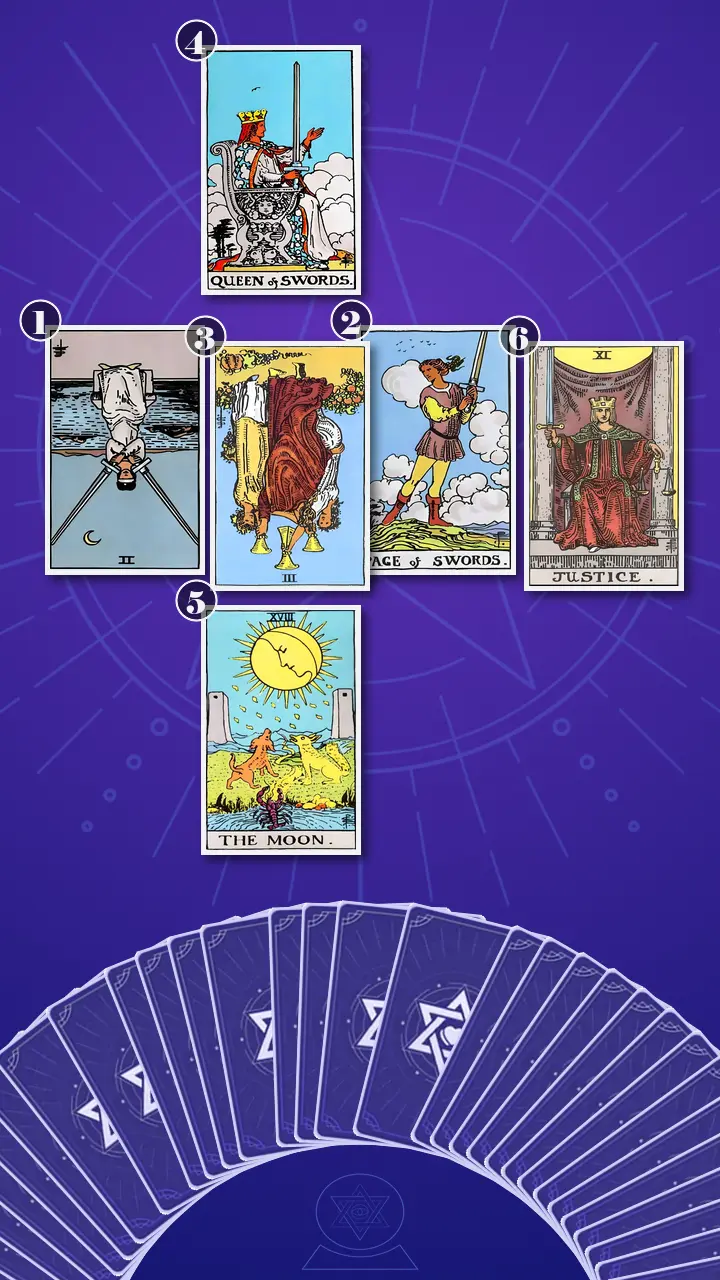
Reading the Map: From the Rewrite-and-Delete Loop to a Clear Rule
Position 1: The moment you froze
“Now we turn over the card representing your immediate reaction and the boundary-freeze behavior after the text gets quoted,” I said, and flipped the first card.
Two of Swords, reversed.
I glanced at Jordan before I even spoke—because the card already looked like her midnight. “This is that 12:30 a.m. scene,” I said. “Phone two inches from your face. Rereading the thread like it’s a legal document. Opening Notes and rewriting the opener five times—‘Hey!! quick thing’ / ‘Not to be weird’ / ‘Lol sorry but’—because you’re trying to keep the peace through perfect tone.”
“Yeah,” Jordan let out a short laugh that had a bitter edge. “That’s… too accurate. Like, rude.”
The Two of Swords is stalemate. Reversed, it becomes a leaking stalemate—the energy doesn’t stay contained, it drips out as avoidance-through-editing. The blindfold is the part of you that doesn’t want to look directly at the awkwardness. The crossed swords held to the chest are the internal argument: Do I protect closeness by staying quiet, or do I protect privacy by making it a thing?
In energy terms, this is a blockage: your words are stuck behind your teeth, and you try to regain control by drafting the “perfect” message. It gives short-term relief (no confrontation), but it costs you trust. And the longer you wait, the more every new ping from that friend makes your jaw clamp.
Position 2: How they treat words
“Now we turn over the card representing your friend’s communication style and relationship-to-information,” I said, and revealed the second card.
Page of Swords, upright.
“This is receipts culture,” I said, keeping my tone matter-of-fact. “This friend treats texts like portable information. A quote is proof, or a funny line, or something to drop into a group chat to keep the conversation moving. They’re quick, literal, and social about words. Not necessarily malicious.”
Jordan’s eyes narrowed slightly—she was trying to decide whether that made it better or worse.
“Here’s the key,” I continued. “The Page of Swords assumes sharing is fine unless told otherwise. And you’ve been hoping they’ll just get it.”
I leaned forward. “If you want to set privacy boundaries in friendships without escalating conflict, this card is a permission slip: address behavior and consent, not intent. You can literally say, ‘I’m not accusing you of trying to hurt me; I’m asking for consent before my words travel.’”
She swallowed, then nodded—small, as if she could feel a door unlocking that didn’t require a fight.
Position 3: The container that made it “normal”
“Now we turn over the card representing the social container and relational dynamic that allowed the quote to happen,” I said. The third card went down in the center.
Three of Cups, reversed.
“This,” I said, “is the group chat as a stage.”
In modern life, Three of Cups reversed looks like overlapping group chats, weekend plans, inside jokes—where bonding quietly slides into oversharing, triangulation, or gossip-lite. Not ‘evil gossip,’ but that Normal Gossip podcast flavor of: it’s funny, it’s a story, it’s a moment… until it’s your private line being performed.
“The problem isn’t only one friend,” I told her. “It’s a norm where private details become social currency. The laughs and reactions reward sharing. So you start replying with safe, neutral messages so you can’t be quoted again.”
Jordan’s posture shifted as if she’d been caught doing exactly that. “I’ve literally started writing texts like I’m drafting a corporate Slack,” she admitted. “Short. Polished. Nothing vulnerable.”
“That makes so much sense,” I said. “But notice the cost: it protects you from being ‘content’—and it also makes you lonelier.”
Position 4: Your resource—editor energy
“Now we turn over the card representing your best resource for addressing this directly,” I said, and flipped the fourth card above the center.
Queen of Swords, upright.
“This is your way out,” I said, and I watched Jordan sit a fraction taller, like her spine recognized the assignment. “Queen of Swords energy is: stop drafting a novel, start sending a subject line.”
Her upright sword is the boundary. Her open hand is the part that stays human. This isn’t coldness—it’s clarity without emotional clickbait.
“In real life,” I said, “this is you sending a clean two-sentence message. No apology tour. No courtroom exhibit list. You let it be slightly awkward because you’d rather have respect than vibe-management.”
Jordan’s shoulders dropped in a way that looked like her muscles finally got permission to stop holding the whole friendship together.
“You can be warm and still be specific,” I added. “That’s the Queen’s whole deal.”
Position 5: The blind spot—night lighting and fear-stories
“Now we turn over the card representing the blind spot: assumptions and projections that keep the boundary conversation unclear,” I said, and placed the fifth card below the center.
The Moon, upright.
The room felt quieter as it landed. Even the radiator hiss seemed to soften, like the apartment itself leaned in.
“This is the phone-glow spiral,” I said. “After the quote, you don’t just feel hurt—you feel uncertain. So your mind starts doomscrolling your own social reputation. Who saw it? Who laughed? What do they think? The Moon makes partial information feel like danger.”
I used the structure I’ve come to trust when people are stuck in this loop—because it turns a foggy emotional storm into three clean lines:
1) The fact you saw: your friend quoted your private text.
2) The story your brain writes: “Everyone thinks I’m needy. If I set a boundary, I’ll be seen as dramatic. I’ll lose the friendship.”
3) The cost of trying to control it with perfect wording: you go quiet, you share less, and resentment grows in the space where a simple agreement could have lived.
Jordan’s face went still—then her eyes softened, like she was watching herself from a distance for the first time. A quiet exhale slipped out of her nose.
“It really does feel like there’s a hidden mic,” she said, barely above a whisper. “Like anything I say could end up… everywhere.”
“Exactly,” I replied. “And this is why privacy boundaries don’t hold if they stay implied. Under Moon energy, implied rules become horror-movie lighting. We need daylight.”
When Justice Held the Line
Position 6: The clearest next step—consent, rule, consistency
“Now we turn over the card representing actionable boundary-setting guidance—the clearest next step for repair, consent, and future confidentiality,” I said. “This is the exit card.”
I flipped it, and even before I named it, I felt the shift: the sensation of a square stone floor after walking through fog.
Justice, upright.
Justice doesn’t ask you to be persuasive. Justice asks you to be clear.
Here, I brought in my own way of making boundaries memorable—my Iconic Line Diagnosis, the tool I use as an artist who lives half in modern life and half in classic cinema. “In old movies,” I told Jordan, “the line that defines the relationship isn’t usually a paragraph. It’s one sentence. A clean line. That’s what we’re writing.”
Then I grounded it in the card’s symbols. “The scales are the rule—what stays one-to-one. The sword is the follow-through—what you do if it’s crossed again. Policy, not punishment.”
And I slowed down, because this was the center of the reading.
Setup: You know that midnight loop: phone glow, scrolling back to the quoted line, drafting “Heyyy not to be weird…” in Notes, then deleting it because you don’t want to look dramatic. You’re stuck trying to win an imaginary debate about whether you’re allowed to be bothered—while the real need is simpler: a consent rule.
Delivery:
Stop trying to keep the peace by staying vague; start setting a fair rule and holding it steady—like Justice’s scales and sword.
I let the sentence sit between us for a breath.
Reinforcement: Jordan’s reaction came in layers—like a truth moving from mind to body. First, a tiny freeze: her inhale caught, and her fingers stopped moving on her sleeve. Second, the cognitive seep: her gaze went unfocused for a second, as if she was replaying every time she’d tried to be “chill” while feeling exposed. Third, the release: she exhaled low and long, and her shoulders dropped so noticeably it looked like she’d set down a bag she’d been carrying since that hangout.
Her eyes went wet, not dramatically—just the way eyes do when someone finally says the thing you’ve been circling at 1 a.m. “But if I say it that plainly,” she said, voice thin with fear, “won’t it sound like I’m accusing them?”
“That’s the Moon talking,” I said softly. “It’s the fear that clarity equals aggression. Justice says something else: consent is not an accusation. It’s a standard.”
I paused, then asked the question I always ask when someone hits this kind of clarity. “Now, with this new lens—rule plus follow-through—think back to last week. Was there a moment when this would have changed how you felt? Even by five percent?”
Jordan blinked. “When they said it out loud. If I’d had the rule already—if I’d already said ‘please don’t quote me’—I think I wouldn’t have gone hot and frozen. I would’ve had something to stand on.”
“Exactly,” I said. “This is the shift from feeling exposed and stuck to calm self-respect: you stop trying to justify your feelings like you’re in a courtroom, and you start negotiating consent like an adult friendship deserves.”
I added one more piece, because it’s the sentence I wish someone had said to all of us before group chats became the main social container: “Privacy isn’t implied in group chat culture—you negotiate it.”
The One-Page Justice Policy: Actionable Next Steps
I pulled the whole spread together for Jordan in one clean thread—because clarity isn’t just insight, it’s a sequence.
“Here’s the story the cards are telling,” I said. “You get quoted, and you go into Two of Swords reversed: freeze, rewrite, delete, go quiet—trying to keep closeness by keeping the vibe light. Meanwhile, Page of Swords says your friend keeps words moving—quoting for accuracy, humor, social momentum. Three of Cups reversed shows the real pressure: the group chat stage rewards sharing, so your private line becomes ‘content.’ Then The Moon floods in: uncertainty turns into fear-stories about how you’re seen. Your resource is Queen of Swords: editor energy—two sentences, no overexplaining. And Justice is the resolution: a fair consent rule plus steady follow-through.”
“Your cognitive blind spot,” I continued, “is thinking you need the perfect phrasing to protect yourself. But the spread is clear: the protection isn’t in perfect tone. It’s in explicit terms. The transformation direction is from implied privacy and mind-reading to negotiated consent and consistency.”
Jordan frowned slightly. “Okay, but… I genuinely feel like I can’t even find five minutes to do this without spiraling. I’m slammed at work. And if I send it and they reply ‘wow ok,’ I’ll be wrecked all day.”
I nodded. “That’s real. So we make it smaller and we choose timing. The boundary works best when you’re not sending it from a braced nervous system.”
Then I gave her a plan that matched the missing Earth in the spread: concrete, timed, and under 25 words.
- The 7-minute Notes draft (under 25 words)Set a 7-minute timer. In Apple Notes, write one boundary text under 25 words you could actually send: “Hey—please don’t quote or forward my texts. If you’re not sure, ask me first.”If you feel yourself adding a third sentence, stop. That’s the “keep the vibe light” reflex. Return to the rule.
- Your private follow-through (policy-not-punishment)Write one follow-through sentence for yourself (not for them): “If it happens again, I’ll stop sharing personal stuff over text and switch to in-person for a while.”Keep it proportional. One request, one protective change. You’re not punishing closeness—you’re making closeness possible.
- Facts vs. stories (The Moon reset)Make a 2-column note: “What I know for sure” vs “What I’m imagining.” Put the quote event in the first column; put “everyone thinks I’m dramatic” in the second.Do it for 2 minutes only. Your brain wants to investigate the whole social web; you’re allowed to choose peace over perfect information.
I looked at her and said the sentence I say when people start turning a boundary into a trial. A boundary text is not a court case. It’s a rule.
And because I’m an artist—and because Justice always makes me think of museums, not just courtrooms—I offered her my Gallery Communication reframe as a final anchor: “In a gallery, we don’t argue about whether the ‘no photos’ sign is too intense,” I said. “We just… follow the rule. Your words deserve that same kind of respect. Consent is the vibe. Clarity is the container.”

A Week Later: Ownership, Not Certainty
A week later, I got a message from Jordan.
“Sent it,” she wrote. “Two sentences. I didn’t add ‘lol.’ My hands were shaking, but I did it.”
Then: “They said they didn’t realize, apologized, and asked what I’d prefer going forward.”
It wasn’t a movie finale. It was better than that—small, real proof. Clear but still a little tender: she slept through the night for the first time in days, and in the morning her first thought was still “What if I sounded dramatic?”—only this time, she read her own text again and felt her shoulders loosen instead of her stomach dropping.
This is the Journey to Clarity I trust most: not from chaos to perfection, but from feeling exposed and stuck in the rewrite-then-delete spiral to calm self-respect through explicit consent rules and steady follow-through.
When you want to stay close but your words start feeling like group content, you don’t just feel betrayed—you feel like you’ve lost control of how you’re seen, so you go quiet and call it “being chill.”
If you didn’t have to justify your feelings at all, what’s the simplest consent rule you’d want around your texts—just one line you could stand by?