From Group-Chat Dread to Self-Respect: Setting One Clean Limit

Finding Clarity in the TTC Buzz
If you found out your ex was coming to the hangout through a casual group chat text—like it was nothing—and your stomach still dropped, you're not being dramatic.
Taylor said that to me almost word-for-word the second we got on the call. She was in Toronto, fresh from a day that had felt like three days, still wearing her office makeup in that “I forgot to be a person after 5 p.m.” way. I could hear the faint mechanical hush of her condo building through her mic, like the city was breathing behind her.
“It was 8:41 on Line 1,” she told me, voice tight but controlled. “Fluorescent lights. That TTC buzz. I’m holding the pole with one hand and scrolling with my thumb, and then it’s like… ping. ‘Oh btw, my ex might come.’ Like it’s a weather update.”
As she spoke, I watched her swallow. Not the casual kind. The kind where you can tell there’s a whole sentence stuck in the throat, waiting to be allowed out.
“I want to protect my peace,” she said, and her fingers did that restless thing people do when they’re trying to keep their body quiet. “But I’m also trying not to be the person who makes it a thing. I don’t want everyone picking sides. I’m not asking anyone to hate my ex. I just don’t want surprises.”
The unease she described wasn’t an abstract feeling—it had a texture. It sounded like a phone that wouldn’t stop vibrating on a table. It looked like a tight smile that holds for two hours and then collapses into an emotional hangover. It felt like sitting at a table you’re already invited to, but still trying to take up as little space as possible.
“That makes so much sense,” I told her, keeping my voice soft and level. “Group hangouts need language, not mind-reading. And tonight, we’re not here to make anyone the villain. We’re here to find clarity—so you can set one clean boundary that protects you without turning the friend group into a courtroom.”

Choosing the Compass: Celtic Cross · Context Edition
I asked Taylor to put both feet on the floor and take one slow inhale—nothing mystical, just a nervous system reset. I shuffled while she repeated her question in plain language: “After they invite my ex to our hangout, what boundary do I set?”
“Today I’m going to use the Celtic Cross · Context Edition,” I said. “It’s a classic spread, but we’re reading it ethically: not as a fixed prediction, but as a chain—present tension, underlying trigger, your values, the communication move, the social environment, and then the most sustainable boundary you can actually live by.”
For anyone who’s ever Googled how tarot works in the middle of a life mess: this is why I like this structure for friend-group boundary stress. It doesn’t just tell you what you feel. It shows you why you’re stuck, and where the next step is most likely to work.
“A few positions matter most for this,” I previewed. “The first card will name what the hangout feels like in your body. The crossing card will show what keeps you from saying the boundary in real time. The conscious goal card will clarify your standard—what ‘respect’ means for you. And the near-future card will give us the sentence. The one you can repeat.”
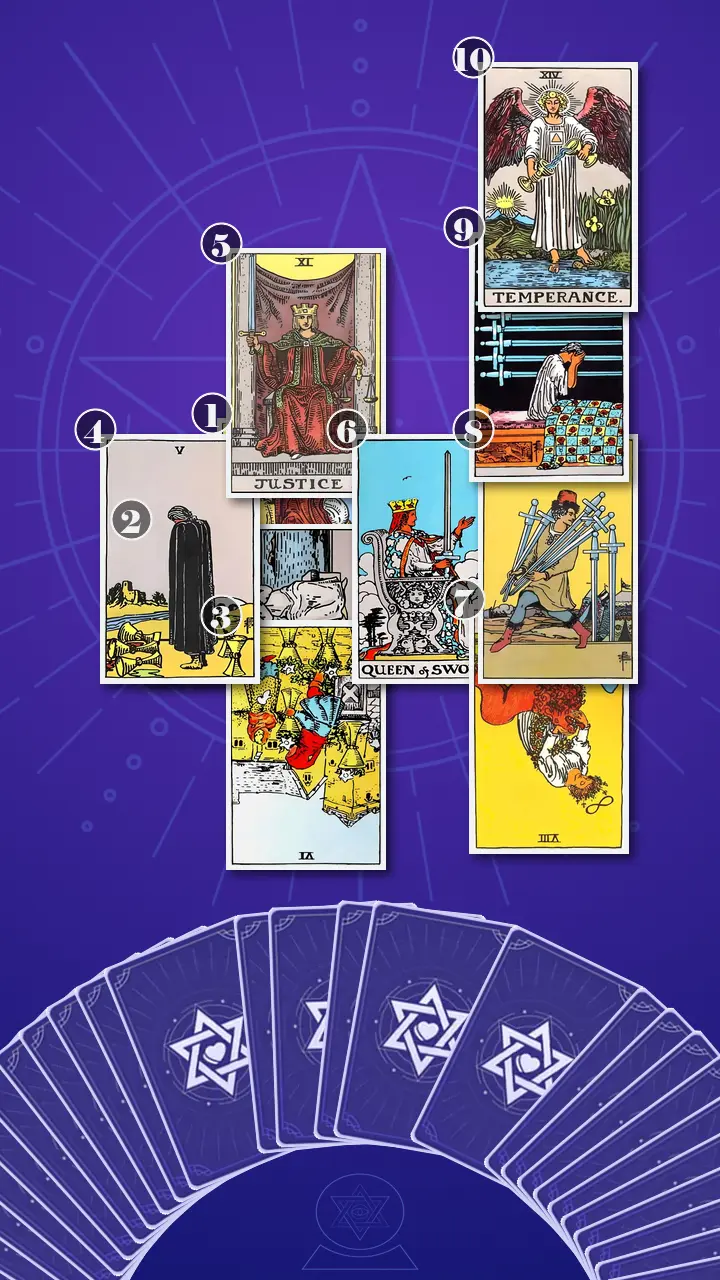
Reading the Map: When “Keeping It Chill” Becomes Work
Position 1: The lived reality in your body right now
“Now flipping over,” I said, “is the card that represents the lived reality of the hangout situation and how the group dynamic feels in your body right now.”
Three of Cups, reversed.
“This is the card of friendship toasts—except reversed, the toast turns into a performance,” I said. “It’s like walking into a ‘casual’ hang and realizing you’re not actually hanging out. You’re auditioning. You’re tracking where your ex is standing, who hugged them, whether your laugh sounds normal.”
Taylor let out a small laugh that startled even her—short, bitter, too accurate to be funny.
“That’s… kind of brutal,” she said, blinking fast. “Like, yes. I’m there, but I’m not there.”
“Exactly,” I said. “Reversed Cups energy is distorted connection. Too much social harmony on the outside, not enough emotional safety on the inside. The risk here is the emotional hangover: you overcompensate with friendliness so nobody thinks you’re bothered, then you go home wiped out and resentful for days.”
Outside my own window in New York, late light hit the edge of a framed print I’d made—gold leaf on black paper, my version of a Klimt echo. I caught myself thinking how easy it is to confuse closeness with proximity. Three people can be raising cups in the same frame and still not be protecting each other.
“One of my rules,” I told her gently, “is this: If you have to perform being fine, the hangout isn’t neutral. That’s not you being sensitive. That’s your body telling the truth.”
Position 2: The immediate challenge—the thing that blocks the boundary
“Now we’re looking at the immediate challenge: what keeps you from stating a boundary in real time,” I said.
Two of Swords, reversed.
“This is the ‘stuck decision’ card,” I explained. “The blindfold is the part of you that thinks if you don’t look directly at it, it won’t become real. The crossed swords are your body bracing for conflict while your mouth stays closed.”
And I spoke it in the exact internal logic I’ve heard a thousand times—from friends, from clients, from the younger version of myself who used to treat every awkward conversation like a moral referendum.
“If I say something, I’m dramatic. If I don’t, I’m petty. If I go, I’m ‘fine.’”
I paused, then grounded it into a scene with her life in it.
“Notes app open. Cursor blinking. You type ‘I’m uncomfortable,’ delete ‘uncomfortable,’ replace it with ‘just checking…’ You read the group chat tone—everyone sprinkling ‘lol’ like it’s seasoning—and meanwhile your shoulders are up around your ears and your throat feels tight like you’re swallowing a whole paragraph.”
Taylor exhaled—small, involuntary, like her body had been waiting for someone to name it without judgment. She nodded once, slow.
“That’s exactly what I do,” she said. “Draft forever. Send nothing.”
“Reversed Two of Swords is blocked Air,” I said. “Not a lack of intelligence. Not a lack of maturity. A blockage in language—because you’re trying to protect belonging by staying silent, and it’s feeding the spiral.”
Position 3: The underlying root—the past-based trigger
“Now we’re looking at the underlying root: the past-based trigger that makes this invite feel bigger than ‘just a hangout’,” I said.
Six of Cups, reversed.
“This is the past showing up in the present, but not in a sweet way,” I told her. “It’s regression. It’s your nervous system being yanked back into an old storyline where you’re expected to play the ‘nice ex’ role—polite, agreeable, unbothered—because that used to keep things smooth.”
Taylor’s eyes flicked up and left, the way people look when they’re replaying an old scene they didn’t expect to re-enter.
“It’s not even that I miss them,” she said quietly. “It’s… I hate who I become. The version of me that’s trying to do everything correctly.”
“That’s the split,” I said. “Past-you learned one set of social rules. Present-you has different values. A boundary here isn’t about punishment. It’s about letting your present self be in charge.”
Position 4: The recent emotional residue still shaping you
“Now we’re looking at the recent emotional residue shaping your reaction to this invite,” I said.
Five of Cups, upright.
“This card acknowledges disappointment and grief,” I told her. “Not dramatic grief—real-life grief. The kind where one variable eclipses everything else. You’re at a hangout with friends, but the moment your ex is in the frame, your attention goes to what hurts. It narrows.”
I watched Taylor’s jaw work once, as if she was trying not to admit something tender.
“If I’m honest,” she said, “I keep telling myself I should be over it. But the surprise part… it makes me feel stupid. Like I didn’t matter.”
“Five of Cups says: don’t debate whether you’re ‘over it,’” I said. “Name what you’re protecting—your peace, your dignity, your nervous system. Those are allowed.”
Position 5: Your conscious standard—what fairness looks like
“Now we’re at your conscious standard: what ‘respect’ and ‘fairness’ look like for you in shared friend spaces,” I said.
Justice, upright.
The room always feels a little quieter when Justice shows up. Not because it’s scary—because it’s clean. It has posture.
“This is the pivot,” I told Taylor. “Justice isn’t about controlling who your friend sees. It’s about standards. Reciprocity. Clear expectations.”
“So I’m not… being possessive?” she asked, and I heard the self-doubt trying to sneak in like a cat at 2 a.m.
“No,” I said. “Here’s the reframing: invites are consent-based logistics, not emotional tests. Like checking dietary restrictions before booking a tasting menu. You don’t do it because someone is ‘difficult.’ You do it because that’s how you host like an adult.”
I let the sentence land, then gave it the line it deserved.
A heads-up isn’t drama—it’s consent for the setting.
Taylor’s shoulders dropped half an inch, like her body finally stopped treating this as a character flaw.
“Okay,” she said, slower now. “So the issue isn’t my feelings. It’s the lack of transparency.”
“Exactly,” I said. “Justice asks for a policy. Something neutral, repeatable, fair.”
The Queen’s Sentence: Clarity Beats Performance
Position 6: Near-term direction—the clearest way to communicate it
I held the deck a beat longer than usual. “We’re turning over the key card,” I told her. “This is the near-term direction: the most helpful way to communicate the boundary clearly and cleanly.”
Queen of Swords, upright.
“This is the boundary-setter,” I said. “Not cruel. Not cold. Just precise. She’s the part of you that stops negotiating your reality inside your own head.”
Taylor’s mouth opened like she was going to agree—then she shut it and her brows pulled together.
“But if I say it that directly,” she blurted, and there it was: the unexpected flare of anger, hot and protective. “Doesn’t that make me controlling? Like I’m making them pick sides?”
I didn’t rush to soothe it away. Anger is often just self-respect arriving late to a meeting it was never invited to.
“Let’s slow down,” I said. “Controlling is telling people what they’re allowed to do. A boundary is telling people what you will do. Queen of Swords doesn’t say, ‘Don’t invite them.’ She says, ‘If the setting includes them, I need a heads-up so I can choose. If I’m surprised, I’ll opt out.’”
Her breath caught—one second of stillness, like a browser tab freezing.
Setup (I could almost see it): she was already halfway there—phone warm in her hand, group chat open, trying to write a text that wouldn’t “kill the vibe” while her stomach quietly dropped at the words: “your ex might swing by.”
Delivery (I said it, and then I let the silence do its work):
Stop trying to be ‘cool’ by staying silent; choose clarity and say it plainly—like the Queen of Swords holding her sword upright, not hidden.
Reinforcement: Taylor’s reaction came in a chain—three small movements that told me everything. First, her shoulders went rigid, and her breath paused in her throat like she’d been tapped on the sternum. Then her eyes unfocused for a second, like she was replaying every time she’d done the “thumbs-up” in a group chat to avoid seeming needy. Finally, she let out a shaky exhale and her hands unclenched in her lap, fingers spreading as if she’d been gripping something invisible for weeks.
“I hate how much I’ve been trying to win people over with my silence,” she said, voice thinner now, more honest. “Like… if I’m chill enough, I’ll still belong.”
That’s when my own signature lens clicked in—one I use because I’m an artist, yes, but also because films are where we’ve all watched boundaries play out in a way life rarely lets us rehearse.
“This is a Casablanca moment,” I told her. “Not the romance part. The airport part. The part where the protagonist realizes: if I keep performing what the room wants, I lose myself. The Queen of Swords is the person who can stand under the bright lights, with all the noise around her, and choose one clean line anyway. Not to punish anyone. To keep her dignity intact.”
I leaned in, gentle but direct. “Now, with that new lens—tell me: last week, was there a moment when this could have changed how you felt? A message you didn’t send? A hangout you forced yourself to attend?”
Taylor blinked hard. “Saturday,” she whispered. “Queen West. I went even after I knew. I stayed longer than I wanted. I laughed too loud. And then I couldn’t sleep.”
“That’s the step,” I said. “This isn’t just about one hangout. It’s your shift from managing everyone else’s comfort to stating one clear, time-bound boundary in plain language—and letting others choose how to respond.”
The Staff: Self-Trust, Group Norms, and the 1 a.m. Spiral
Position 7: Your internal stance—how steady your self-trust feels
“Now we’re looking at your internal stance: how steady (or shaky) your self-trust feels while setting the boundary,” I said.
Strength, reversed.
“This doesn’t mean you’re weak,” I told her. “It means you’ve been equating strength with endurance. Like the ‘strong’ version of you is the one who can tolerate discomfort in silence.”
Taylor nodded, but her expression tightened again—recognition with a little grief in it.
“Reversed Strength says: your calm confidence is harder to access when you anticipate judgment,” I continued. “So you swing between over-accommodating and shutting down.”
“Yeah,” she said. “I either say nothing… or I write a whole essay and then feel exposed.”
“The real Strength here is gentle containment,” I said. “A calm entry ritual. One sentence. One follow-through.”
Position 8: The external social environment—how the group operates
“Now we’re looking at the external social environment: how others’ communication style or group norms are shaping the situation,” I said.
Seven of Swords, upright.
“This is the ‘handle it quietly’ vibe,” I told her. “Not necessarily malicious—just indirect. People optimizing for convenience, hoping nobody calls it out. The plan changes, the guest list shifts, and the emotional logistics land on you.”
Taylor’s lips pressed together. “That’s exactly the group,” she said. “Like everything is a soft launch. Nothing is official until you’re already there.”
“Then your boundary is not you being high-maintenance,” I said. “It’s you asking the room to be transparent.”
Position 9: Hopes and fears—the spiral at night
“Now we’re at what you’re afraid will happen if you set the boundary, and what you hope will happen if you don’t,” I said.
Nine of Swords, upright.
“This is the 1:08 a.m. card,” I said, and Taylor gave me a look like I’d read her browser history. “Blue phone glow. Night Shift on. You rewrite the same line five ways. You imagine three different reactions. You hold your breath like that will prevent the outcome.”
She covered her mouth with her hand, half embarrassed. “It’s so accurate it’s annoying,” she said.
“Nine of Swords isn’t a personality flaw,” I told her. “It’s a nervous system strategy. Your brain is trying to protect you by running simulations. The question it keeps circling is: do you want the group’s approval more than your own self-respect?”
Her eyes watered—not a breakdown, just the thin film of being seen.
Position 10: Integration—the sustainable boundary you can live with
“Now we’re looking at integration: the most sustainable boundary to hold, defined by what you will do and how you will protect your peace,” I said.
Temperance, upright.
“Temperance is the settings menu,” I told her. “You’re not deleting the whole app. You’re changing your notification settings. You’re turning off ‘surprise ex’ alerts.”
“So I don’t have to blow up the group,” Taylor said, more to herself than to me.
“You don’t,” I agreed. “Temperance says: middle path, consistent follow-through. A boundary that protects you and reduces drama because it’s calm and repeatable.”
And I said the line I most wanted her to keep: “Your boundary is what you’ll do—not what you’ll convince them to do.”
From Insight to Action: The Two-Sentence Boundary
I leaned back and let the whole spread click into one story.
“Here’s what I see,” I said. “The present situation (Three of Cups reversed) is that ‘friendship’ has started feeling like performance. The blockage (Two of Swords reversed) is you trying to protect belonging by staying silent—drafting in Notes, rehearsing, never sending. Underneath, the past gets reactivated (Six of Cups reversed), and you carry recent disappointment (Five of Cups) that makes surprises hit harder. But your conscious goal is so clear: Justice. Fairness. Consent-based logistics. Then the key opens: Queen of Swords—one clean sentence. And the integration is Temperance: a sustainable boundary you can repeat without turning this into an ultimatum.”
“Your cognitive blind spot,” I added, “is thinking you have only two options: either be chill and swallow it, or be ‘dramatic’ and make it a whole thing. The cards are showing a third option: calm clarity. Not a speech. Not a vibe. A policy.”
“And because I’m me,” I said, letting my artist side slip in as something practical, “I want to give you a communication structure I call the Gallery Wall Label—it’s my version of ‘say it clean.’ In a gallery, a label is short, neutral, and it tells you what you’re looking at. Your boundary text should do the same.”
- Write the Two-Sentence Policy (Queen of Swords)Open Notes. Set a 10-minute timer. Write exactly two sentences: (1) the boundary condition, (2) what you will do if it is not met. Example: “Hey—quick heads-up: I’m not comfortable being surprised by [Ex] at hangs. If they’re coming, please tell me before I’m on my way so I can decide; if it’s a mixed hang, I’ll sit this one out.”Read it out loud once and delete every apology word (sorry/just/I don’t want to be annoying). If your chest tightens, treat that as data—not a reason to add paragraphs.
- Set a Time Boundary You Can Keep (Strength + Temperance)If you decide to go anyway this week, choose one limit ahead of time: “I’ll stay 45 minutes max.” Put a phone alarm labeled “leave kindly.” When it goes off, you say a simple exit line (“I’m heading out—good to see you!”) and you go.Leaving on time is not rude; it’s follow-through. Treat it like catching a streetcar: you don’t argue with the schedule.
- Use the Heads-Up Rule (Justice)Send one logistics question instead of a debate: “Is [Ex] definitely coming tonight? If yes, I’m going to pass—no hard feelings.” Repeat the standard once if they push back: “I’m good with people being friends; I just need transparency so I can consent to the setting.”DM the inviter, not the whole group. And don’t send it while you’re already in your coat—clarity works better than urgency.
Taylor stared at her screen for a long second, then let out a breath that sounded like the first time someone turns the volume down in a loud bar.
“It’s weird,” she said. “The two sentences feel… doable. Scary. But doable.”
“That’s the Queen,” I said. “You don’t need a perfect explanation. You need a repeatable sentence.”

A Week Later: The Quiet Proof
Six days later, Taylor messaged me a screenshot. Two sentences. No apology spiral. She’d sent it as a DM, not a group announcement. Under it, she wrote: “My heart was pounding, but I did it.” She skipped the big hang, then sat alone in a coffee shop for an hour—relieved, a little lonely, and still proud.
That’s what a Journey to Clarity often looks like in real life: not fireworks, not everyone behaving perfectly—just one person choosing self-respect over performance, and discovering the world doesn’t end when they take up honest space.
And if I leave you with anything from Taylor’s spread, it’s this: when you’re trying to protect your peace and keep your place in the group at the same time, your body ends up doing the negotiating—tight chest, tight smile, and a night of replaying everything you didn’t say.
If you didn’t have to manage anyone else’s comfort for one evening, what’s the single, time-bound boundary sentence you’d actually want to live by?