From Camera-Dodging at Brunch to a Calm Ask-First Consent Rule

Finding Clarity in the Mid-Bite “Do That Again” Moment
If your friend says “Wait—do that again” mid-bite because it’ll be cute for TikTok, and your body goes stiff before your brain even answers—yeah.
Maya (name changed for privacy) slid into the chair across from me like she’d been carrying a slightly-too-heavy tote bag for weeks and only just set it down. She was 27, lived in New York City, worked in marketing—exactly the kind of person who can write a brand voice guide in her sleep and still feel totally tongue-tied when the problem is her own life.
She didn’t come in furious. She came in with that controlled, compressed energy—like she’d been bracing for impact so long she couldn’t tell where her shoulders ended and the tension began.
“It’s dumb,” she said, and then immediately shook her head like she was trying to erase the word. “It’s not dumb. It’s just… brunch TikToks. My friend is always filming. And I don’t want to be in them. But I also don’t want to be… the buzzkill.”
As she spoke, I watched her jaw work in small, unconscious clenches. Even here, with no phone in sight, her body was doing the same thing it did at the table: preparing to disappear.
She painted me the scene without even realizing she was doing it with timestamp precision. 11:58 a.m., West Village. Espresso machine hissing like a steam vent. Iced coffee sweating onto the table, the sticky ring of condensation catching on your forearm when you shift. The fluorescent glow of a phone screen washing over her face as her friend lifted it and said, “Wait—do that again.” Mid-bite. Mid-sentence. Mid-being-a-person.
“I do that chair-angle thing,” she admitted. “Like… an inch. So I’m not in frame. And I keep smiling so I don’t kill the vibe.”
Her unease wasn’t an abstract feeling. It was a tight jaw like a clamp, shoulders inching upward like a flinch you couldn’t stop, and a split-second freeze that made the whole brunch feel like performing on a stage you never agreed to step onto.
“You want a clear privacy boundary,” I said, keeping my voice steady and un-dramatic, “but the fear of seeming uptight makes you dodge the camera instead of naming the rule.”
She exhaled through her nose—half laugh, half wince. “Yes. Exactly. I’m not trying to be a buzzkill. I just don’t want to be content.”
I nodded. “Okay. Then our goal today is simple: we’re going to turn that tight, rehearsed internal debate into one clean consent rule you can actually say out loud. A little journey to clarity—so brunch can be brunch again, not a silent test of belonging.”

Choosing the Compass: A Relationship Spread for Privacy Boundaries
I asked Maya to take one slow breath in and make her exhale slightly longer than her inhale—nothing mystical, just a nervous-system handbrake. While she did that, I shuffled slowly, the sound of cards tapping together like a metronome: steady, not urgent.
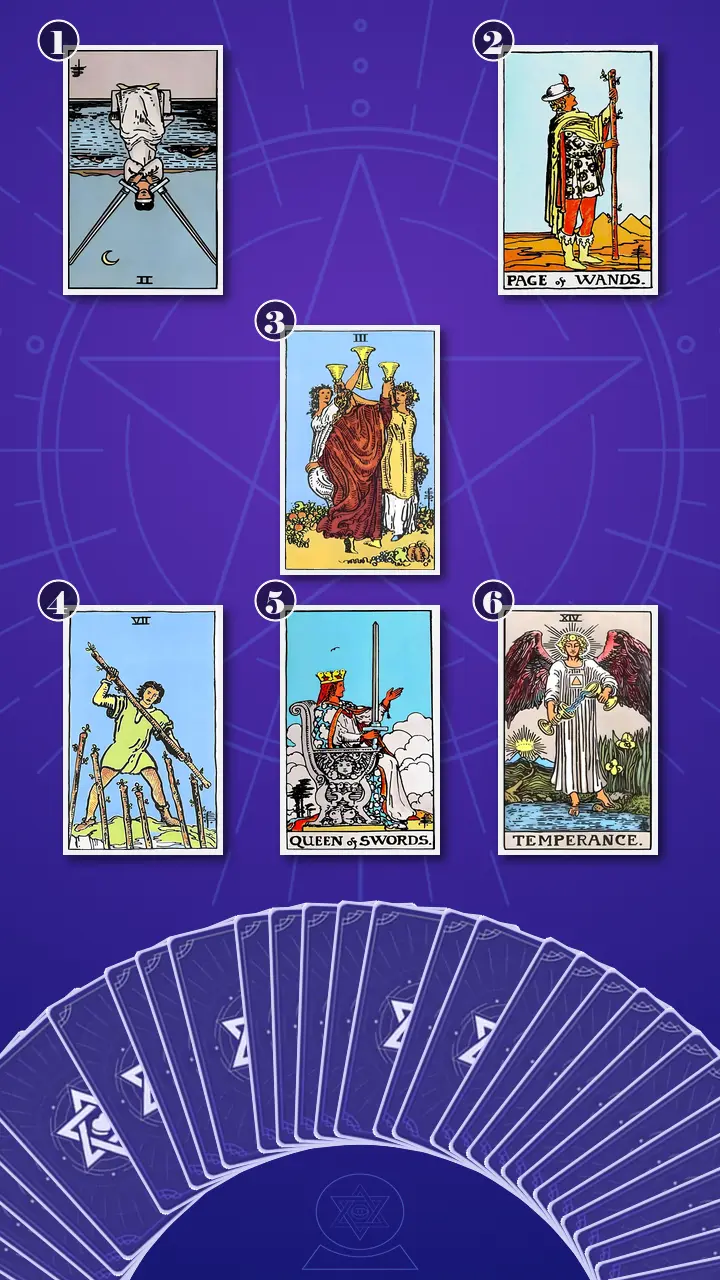
“Today we’ll use something I rely on for messy, modern friendship dilemmas,” I said. “A Relationship Spread—a 2x3 grid.”
For readers who wonder how tarot works in a situation like this: I’m not using the cards to declare who’s ‘right’ or ‘wrong.’ I’m using them as a structured mirror. This spread is perfect for a boundary conversation because it separates six things that usually get tangled: your automatic reaction, the other person’s energy, the shared vibe pressure, the boundary itself, the exact communication style that works, and what maintenance looks like over time.
I pointed to the empty grid space on the table. “Top row is what’s happening. Bottom row is what you do next. And the center cards—especially the communication card—tell us how to be clear without making it a whole dramatic thing.”
Reading the Map: When “Keeping It Chill” Becomes a Trap
Position 1 — Your present internal response (the freeze-and-dodge loop)
“Now we turn over the card that represents your present internal response and the specific in-the-moment behavior that keeps the situation stuck,” I said. “Freezing, dodging the camera, not speaking up.”
Two of Swords, reversed.
“This is the chair-angle move,” I told her. “The neutral face, the polite half-laugh, the tiny physical retreat that’s supposed to prevent awkwardness.”
And because tarot is only useful when it lands in real life, I translated it exactly as it showed up for her: At brunch you’re doing a full internal calculation while keeping your face neutral: you smile, angle your chair away, and try to stay ‘easygoing’—but you’re basically eating on a stage you never agreed to. You don’t say no; you just disappear from the frame and hope that counts as a boundary.
Reversed, the Two of Swords isn’t “indecision” as a personality trait. It’s an energy blockage—Air under strain. Too much thinking, not enough speaking. The blindfold is the part of you that tries to pretend you can ignore the issue into non-existence. The crossed swords over the chest are your body armor: jaw tight, shoulders up, voice lowered.
Maya stared at the card, then let out a small laugh that tasted like burnt coffee. “That’s… too accurate. Like, kind of brutal.”
“I know,” I said gently. “But it’s not a moral failing. It’s a strategy you built to keep belonging intact.”
I paused. “Here’s the hard truth in the kindest framing: silence isn’t neutral. It’s a quiet yes you didn’t mean to give.”
Her throat bobbed. She gave me a tight nod and a quiet, almost embarrassed, “Oh… yeah,” followed by a noticeable exhale—like her body had been waiting for someone to name the pattern without judging her for it.
Position 2 — Your friend’s likely motivation (so you don’t have to mind-read)
“Now we turn over the card that represents your friend’s likely motivation and energy around filming and posting,” I said. “So we can respond without demonizing.”
Page of Wands, upright.
“This is ‘content-first momentum,’” I explained. “Like hitting record on a Story without checking who’s in the background. It’s spark-chasing energy: playful, fast, assuming everyone’s in unless someone opts out.”
I used the exact modern translation the card was pointing at: Your friend treats the table like a tiny set: quick takes, trending audio, “Wait do that again,” and they assume everyone’s on board unless someone says otherwise. It’s playful and spontaneous—until your comfort becomes collateral damage because nobody paused to ask.
Energetically, this isn’t malicious Fire. It’s impulsive Fire. The deficiency isn’t “care.” It’s “pause.” Consent gets skipped because the spark feels urgent.
Maya’s eyes softened in a way that surprised her. “So… it’s not that she’s trying to expose me. She’s just… chasing the moment.”
“Exactly,” I said. “You’re not anti-content. You’re pro-asking-first.”
Position 3 — The shared vibe pressure (why it feels high-stakes)
“Now we turn over the card that represents the friendship dynamic and the social ‘vibe’ pressure that makes consent harder to name,” I said.
Three of Cups, upright.
“This is the real heart,” I told her. “You actually love these people. You like the group chat energy. You like celebrating. So the boundary doesn’t feel like a logistics request—it feels like stepping out of the circle.”
The card’s real-life scene was painfully clean: This is the part where you genuinely love your friends: the shared laughter, the ‘we’re making memories’ feeling, the warm group chat energy. That’s why it stings—because you’re not trying to reject them. You’re trying to stay in the circle without being turned into content.
“You’re not trying to opt out of friendship,” I said, using contrast framing, “you’re trying to opt out of being posted.”
Maya’s mouth twitched into a small, almost embarrassed smile. “Yes. That’s exactly it.”
Position 4 — The boundary you actually need to hold (without apology)
“Now we turn over the card that represents the privacy boundary that actually needs to be established,” I said. “What is and isn’t okay, in principle.”
Seven of Wands, upright.
“This isn’t a fight card,” I said. “It’s a steadiness card.”
The scenario came in like a saved reply you finally use: The phone comes out and everyone else leans in. Instead of doing the polite vanish, you stay steady and say, calmly, “Please don’t film me.” No big speech. No vibe-policing. Just holding your ground while the moment tries to sweep you along.
Energetically, this is Fire in balance: not aggression, not collapse. Just a spine.
I leaned in slightly. “Here’s the move: a boundary you can repeat beats a boundary you can only say perfectly.”
Somewhere behind us, in the real world outside my office, a radiator clicked and settled. It felt like punctuation.
Maya nodded slowly. The dread in her face didn’t disappear, but it reorganized into something more practical—an “I can do that” look.
When the Queen Raised Her Sword and Opened Her Hand
Position 5 — The most effective wording (Key Card: the bridge)
I let my fingers rest on the next card for a beat. “Now we turn over the card that represents the most effective communication style and wording approach for setting the boundary without escalation.”
The room went quiet in that specific way it does when the truth is about to be simple.
Queen of Swords, upright.
“This is clarity without cruelty,” I said. “An upright sword—clean, direct. And an open hand—firm, but not shaming.”
Then I grounded it in the exact modern-life scenario the card demanded: You stop drafting a perfect message in your head and say one clean consent rule out loud: “I’m happy to do a photo, but I’m not okay being in TikToks unless you ask me first.” Then you stay present—no nervous laughter, no debate invitation, no over-justifying your right to privacy.
In my previous life on Wall Street, I watched people lose weeks to “perfect wording” while ignoring the structure of the deal. The market didn’t care about your tone; it cared about your terms. This card always brings me back to that: fairness isn’t a vibe—it's a structure. Consent is a structure.
And this is where my own framework clicked in: I call it Negotiation Alchemy—blending BATNA logic with intuitive signaling. “Maya,” I said, “you’re treating this like you need to present a case. Like you need to persuade a jury to grant you the right to privacy.”
“Yeah,” she whispered, and her eyes dropped to the table like she’d been caught doing it.
“But Queen of Swords says: you’re not presenting a case. You’re stating a rule.”
Stop trying to be ‘chill’ by staying silent; be clear with the raised sword and an open hand—one clean sentence that sets the rule.
The sentence hung there. Maya’s reaction happened in a chain, not all at once: first a physiological freeze—her breath caught and her fingers went still on the rim of her water glass. Then cognition seeped in—her gaze unfocused, like she was replaying every brunch montage in her head and finally seeing the pattern as a pattern. Then the release: her shoulders dropped a fraction, and she let out a shaky exhale that sounded like relief trying to act casual.
“But if I say it like that,” she said, and the first note of anger flashed through her voice, “doesn’t that mean I’ve been… letting it happen? Like I’ve basically been agreeing?”
I didn’t rush to soothe it away. “That reaction makes sense,” I said. “Because the moment you realize silence has been doing the negotiating for you, it can feel like you’ve betrayed yourself.”
I kept my tone calm, and I watched her jaw unclench by a millimeter. “But here’s the real pivot: this isn’t about blame. It’s about agency. Consent is the boundary—not your personality. Clear words aren’t ‘uptight’; they’re the permission slip that keeps the friendship real.”
I gave her a small, practical invitation—the kind that doesn’t require confidence, just willingness. “Now, with that new lens, think back: last week, was there a moment when the phone came up and your jaw tightened—when this one clean sentence could’ve changed how you felt in your body?”
Maya swallowed. “Yeah,” she said quietly. “When she did the ‘brunch dump’ thing and I literally lowered my voice so you couldn’t hear me on video. I hated myself for that.”
“That right there,” I said, “is the shift from unease-driven freezing to calm, consent-forward clarity. Not overnight. But one sentence at a time.”
Position 6 — Integration and a sustainable consent system
“Now we turn over the card that represents how to maintain the boundary over time and what a healthy, balanced agreement could feel like,” I said.
Temperance, upright.
“This is the system,” I told her. “Not a showdown.”
The card translated itself into social choreography: You and your friend land on a simple rhythm that makes brunch feel easy again: ask before filming, accept a clean yes/no, and check before posting if you’re in the background. It’s not a dramatic talk—it’s a shared workflow that keeps creativity alive without making your privacy negotiable in real time.
Energetically, Temperance is balance: your comfort and her creativity both held. One foot on land, one in water—privacy grounded, friendship still warm.
Maya’s eyes looked brighter, but not naïve. “So it’s like… version control,” she said, surprising herself. “We agree on the workflow, so it’s not chaos every time.”
“Exactly,” I smiled. “Temperance is version control for boundaries.”
From Insight to Action: The Ask-First Brunch Protocol
I leaned back and gave her the integrated story in plain language: “Here’s why you feel stuck. When the phone comes out, your Two of Swords reversal kicks in—you freeze, you dodge, you try to keep the peace. Your friend’s Page of Wands energy moves fast and assumes participation. The Three of Cups says you care about staying in the circle, which is why the pressure hits so hard. The Seven of Wands asks you to hold one simple boundary in real time. And Queen of Swords is the delivery: clear, short, not over-explained. Temperance is the long game—making it a system, not a moral statement.”
“Your cognitive blind spot,” I added, “is thinking the boundary will become your personality. Like asking for consent means you’re ‘not fun.’ But the cards are blunt about this: consent is a rule, not a character trait.”
She made a face—half agreement, half panic. “Okay, but… I literally can’t always do it in the moment. Like sometimes it’s loud and everyone’s looking and my brain just… blue-screens.”
“Good,” I said, not because she was struggling, but because she was being honest. “Then we build support around the moment. We don’t rely on adrenaline to remember.”
I offered her three low-drama next steps—actionable advice, not a lecture:
- Write the 12-word consent scriptBefore your next hangout, open Notes and save: “Please don’t film me unless you ask first. Photos are fine.”Expect the “this feels dramatic” thought—treat it as a cue to go shorter, not longer.
- Send the pre-hang text (Temperance move)Text your friend the day before: “I’m down for pics, but I’m not okay being in TikToks unless you ask me first.”Make it logistics, not morality. Specific beats vague: say “don’t post me” if that’s what you mean.
- Use the one-repeat rule in the momentIf the phone comes out, say your line once. If they keep filming, repeat the exact same sentence one more time—word-for-word—then return to normal conversation.A boundary you can repeat beats a boundary you can only say perfectly. Two times max, then change the subject.
And because she was a marketer—someone who understood cues—I added one of my quieter tools: Dress Code Cryptography. “On the day you plan to say it,” I said, “wear one small ‘boundary’ signal just for you. A clean black top. A crisp stripe. Something that reminds your nervous system: today I’m in Queen of Swords energy—clear and kind.”
She laughed, but it was a relieved laugh. “That’s… annoyingly helpful.”

A Week Later: The Quiet Proof
A week later, Maya messaged me a screenshot from her Notes app. Just the sentence. Under it, two checkmarks.
“I did it,” she wrote. “Pre-texted her. Then she pulled her phone out at brunch and I said it out loud. My voice was weird for like half a second, and then it wasn’t. She said, ‘Oh my god, of course—tell me anytime.’ And then we just… kept eating.”
In the follow-up line, she added something that mattered more than the friend’s reaction: “I didn’t scan for the phone the whole time. I was actually there.”
That’s the real Journey to Clarity in situations like this—not forcing yourself to become fearless, but moving from contracted self-monitoring to calm, consent-forward self-respect. One clean sentence. One repeat if needed. One system that protects both privacy and friendship.
When a phone comes up at the table and your jaw tightens, it’s not you being “difficult”—it’s you trying to protect privacy while still fighting for belonging in the same breath.
If you let consent be the rule (not a whole personality), what’s the one sentence you’d want to have ready the next time the camera shows up?