From Afterthought Invite Anxiety to Calm Self-Respect: The Queen Reply

Finding Clarity in the 8:06 p.m. “You coming?” Buzz
If you’re a late-20s Toronto professional who gets a last-minute “you coming?” text and immediately opens Maps like it’s a courtroom exhibit—welcome to afterthought invite anxiety.
Taylor (name changed for privacy) sat across from me with their phone face-down on the table, like it might vibrate again and restart the whole loop. They were 28, a junior marketing manager, and the kind of person who could run a campaign calendar like clockwork—yet somehow a two-word group chat ping could turn a weeknight into a stress test.
They described it so precisely I could picture it: 8:06 PM on a Wednesday in a tiny Toronto apartment. The kettle clicks off. The air smells like instant ramen. Their screen buzzes—you coming?—and the glow feels harsh, like fluorescent light in a place that’s supposed to be warm. Their shoulders jump. Their throat tightens. Google Maps opens before they’ve even decided if they want to go, the TTC time estimate turning into a negotiation with reality.
“It’s not even that I always want to go,” they said, voice flattened like they were trying to make it smaller. “It’s that I’m tired of feeling like I’m always on standby.”
I watched their fingers worry at the edge of their sleeve. There was a familiar contradiction in every tiny movement: they wanted to feel included and valued, but they were scared that asking for clearer plans would make them look needy—or start conflict they couldn’t control.
The uncertainty wasn’t abstract. It lived in their body like a tight little knot under the sternum, as if their nervous system was paying surge pricing: the later the invite, the more it cost them to say yes.
“We can work with this,” I told them gently. “Not by decoding every pixel of subtext, but by finding clarity—what works for your time and energy, and how to say it cleanly. Let’s draw you a map out of standby mode.”

Choosing the Compass: The Relationship Spread · Context Edition
I’m Laila Hoshino. By day, I guide people through a Tokyo planetarium—ten years of teaching how celestial motion becomes something you can actually trust. By night, I use that same respect for rhythm and timing in tarot. Because most of our pain isn’t caused by not knowing—it’s caused by trying to force a decision before the timing is right, or letting someone else’s timing become the law of your life.
I asked Taylor to take one slow breath in, one breath out, and to hold their question in a single sentence: “What’s my next step with this friend-group last-minute invite pattern?” Then I shuffled—not as a mystical performance, but as a way to transition the mind from spiraling into seeing.
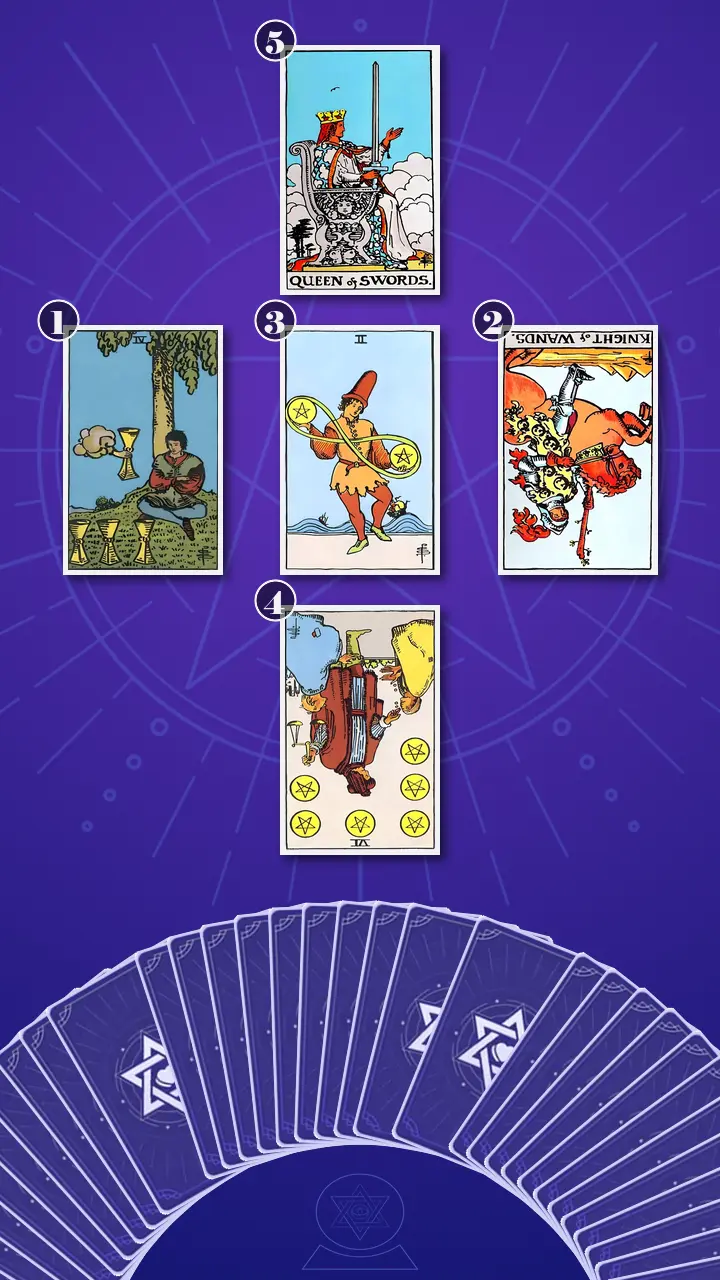
“Today I want to use a spread I call Relationship Spread · Context Edition,” I said. “It’s a five-card cross: you / them / the dynamic / the core issue / the next step.”
For you reading this: I choose this spread when someone’s stuck at a relationship crossroads but the situation is small and modern—one text, one micro-moment—yet emotionally loaded. The cross format makes the interpersonal tension visible left-to-right, and the vertical axis separates what’s quietly weighing you down from what you can actually do next. It stays simple enough for actionable advice, but deep enough to get past “Should I go?” into “What pattern am I participating in?”
“Card 1 will show your immediate reaction—the freeze,” I explained. “Card 2 shows their approach style without mind-reading intent. Card 4 is the underlying imbalance that keeps recreating the afterthought feeling. And card 5 is the grounded next step: what you can say or do right now that you’ll respect tomorrow.”
Reading the Map: Five Cards, One Pattern
Position 1 — Your present stance: the pause after the text
“Now we’re looking at the card that represents your present stance: the immediate emotional reaction and the observable ‘pause’ behavior after receiving the last-minute text,” I said, turning over the first card.
Four of Cups, upright.
It was almost painfully on-the-nose. I pointed to the figure’s crossed arms and the cup being offered from the cloud-hand. “This is that exact moment: you’re on the couch at 7:30 PM, hoodie on, dinner half-started, and the ‘you coming?’ text lands less like an invitation and more like evidence you weren’t in the first draft of the plan. So you keep the thread open and scroll old messages like you’re building a case.”
“In energy terms,” I continued, “this is withdrawal as protection. Not because you don’t want connection—because you want connection that doesn’t make you feel disposable.”
Taylor let out a small laugh that had a bitter edge. “That’s… yeah. It’s accurate in a way that’s almost rude.”
I nodded. “Sometimes the Four of Cups sounds rude because it names the part of you that’s tired of auditioning. It’s not drama. It’s your nervous system recognizing a pattern and bracing.”
Position 2 — Their approach: the invite style without assuming intent
“Now we’re looking at the card that represents their approach: the style/energy behind the invitation,” I said, flipping the second card.
Knight of Wands, reversed.
“This is ‘already-out-the-door’ energy,” I said. “High hype, low context. The invite feels like a drive-by ping from someone mid-walk to the bar—momentum first, consideration later.”
I kept my voice practical. “Reversed doesn’t mean they’re a villain. It means the energy is scattered and inconsistent. In Toronto, last-minute isn’t neutral. It runs into TTC service alerts, winter slush, surge pricing, and the fact that your weeknights are your only real recovery time.”
Taylor’s eyes narrowed, not angry—more like something finally clicked into a shape. They’d been trying to solve it as a personality question: Do they care? But the Knight of Wands reversed asked a different question: What is their planning style, and what does it cost you?
“This can be their style,” I said, “without being your obligation.”
Position 3 — The shared dynamic: the loop that turns a text into a stress test
“Now we’re looking at the card that represents the shared dynamic: the repeating pattern that turns a simple invite into a stressful decision point,” I said.
Two of Pentacles, upright.
I almost smiled. “This is the live spreadsheet your brain runs.”
And I narrated it the way Taylor had described it: “You switch between Google Calendar and Google Maps and the iMessage group chat. Your thumbs hover over reply. You scan who’s already said ‘I’m there’ like it’s a stock ticker—even if the chat is muted, you still check it.”
“The Two of Pentacles is adaptability,” I said, tapping the infinity loop ribbon. “But here, it’s adaptability on repeat. Check calendar → check Maps → check chat → feel pressure → decide last-minute → promise yourself you’ll handle it differently next time.”
I glanced up. “Here’s the pivot: This isn’t about decoding them—it’s about choosing what you can actually hold tonight. Plans wobble like boats in choppy water, and you keep trying to stabilize the whole sea with one decision.”
Taylor nodded, and this time the recognition came with a small, reluctant smile—an “I literally do this” expression that loosened their shoulders by half an inch.
Position 4 — The core issue: the imbalance that keeps recreating the afterthought feeling
“Now we’re looking at the card that represents the core issue to address: the specific imbalance or boundary gap that keeps recreating the last-minute ‘afterthought’ feeling,” I said, turning the fourth card.
Six of Pentacles, reversed.
“This is where the sting becomes structural,” I told them. “The scales are flipped. The exchange is uneven—notice, effort, flexibility.”
Then I offered the contrast I use when someone has been swallowing resentment until it turns into distance: “It’s like a terms-of-service problem. You’re paying in flexibility and emotional labor, but the ‘service’ you receive is inconsistent.”
I let it land, and then I mirrored the two-line inner monologue that lives inside so many ‘easygoing’ people:
What you show on the outside: “No worries, I’ll see if I can swing it.”
What you swallow on the inside: “Why do I have to rearrange my night to be considered?”
“And the cost,” I added, “isn’t just emotional. It’s concrete: the last-minute Uber you didn’t plan to take, the missed dinner, the no decompression time after a meeting-heavy day. Don’t pay for belonging with your nervous system.”
Taylor went still in a three-beat sequence I’ve learned to respect: first, their breath paused. Then their eyes unfocused, like they were replaying a specific night. Then they exhaled long and low, the kind of sound that says, Oh. Yeah. That’s the pattern.
“I hate that I keep score,” they admitted. “Like I’m tallying effort on Splitwise in my head.”
“It makes sense,” I said. “Scorekeeping is what happens when fairness isn’t spoken. The solution isn’t to become colder. It’s to become clearer.”
Position 5 — Next step: the most grounded, self-respecting move
The room felt quieter as I reached for the fifth card—like when the planetarium lights dim and you can tell a constellation is about to appear. “This is the advice position,” I said. “The next step you can take without turning it into a whole emotional thesis.”
Queen of Swords, upright.
Her sword was raised—not as a threat, but like a clean line against a bright sky. “This card is calm directness,” I said. “Minimal words. Maximum truth. Boundaries that are information, not punishment.”
As I spoke, a familiar concept from my research mind slid into place—one of my diagnostic lenses. “I sometimes call this Cosmic Redshift Communication,” I told Taylor. “In astronomy, redshift is how we notice distance increasing. In relationships, the ‘redshift’ isn’t always cruelty—it’s subtle signals: less notice, more vagueness, you being looped in late. This last-minute text isn’t a verdict on your worth. It’s data about their planning style and about the distance created by inconsistency.”
“And the Queen,” I continued, “is how you stop chasing the signal and start setting your terms.”
For a moment, Taylor looked like they were about to argue with the idea—not out loud, but in their face. Their eyebrows lifted, their mouth tightened. The unspoken thought was readable: But if I do that, won’t I lose them?
When the Queen Cuts Through Standby Mode
Setup: Taylor was trapped in that familiar loop—reacting to someone else’s momentum, trying to craft the perfect reply, and treating the invite like a referendum on whether they still belonged. If the text was late, their mind made it personal; if their reply was “too much,” they feared they’d be dropped.
Delivery:
Stop treating their last-minute text like a verdict on your worth, and start using the Queen’s raised sword to state what works for you—cleanly and without over-explaining.
I let the silence stretch for a heartbeat, the way you do when you want a sentence to become a handhold.
Reinforcement: Taylor’s reaction arrived in layers. First, their eyes widened slightly, like the line hit a place they’d been guarding. Then their jaw unclenched—almost imperceptible, but I saw it in the softening at the corners of their mouth. Their shoulders dropped and they swallowed, throat working as if the boundary had been stuck there for months.
Then came the complicated part: relief mixed with a flash of heat behind the eyes. Not tears exactly—more like the body’s surprise at being allowed to stop performing. Their fingers, which had been tightly interlaced, loosened and separated on the tabletop. They sat a little straighter, as if their spine recognized the Queen before their brain fully trusted her.
“Okay,” they said, and their voice sounded different—less apologetic. “So… one sentence. Not an essay. Not a vibe.”
“Exactly,” I said. “Clarity is not cruelty.”
I leaned in, gentle but direct. “Now, with this new lens—think back to last week. Was there a moment a last-minute invite hit, your chest clenched, and you started running scenarios? How would it have felt to treat it as data, not a verdict?”
Taylor stared at the Queen of Swords, then nodded once, slow. “Tuesday. 7:40. I literally opened Maps like I was… trying to prove something.”
“That’s the shift,” I said. “From uncertainty-driven FOMO and people-pleasing to calm self-respect and direct boundary-setting—even if the invite stays messy.”
The One-Page “Queen Reply”: Actionable Next Steps You Can Send Tonight
I gathered the spread into one story, because that’s what tarot does best when it’s used practically: it turns scattered feelings into a coherent explanation.
“Here’s what I see,” I said. “You start in the Four of Cups—protecting yourself because the invitation doesn’t feel nourishing. Their Knight of Wands reversed energy brings speed without steadiness, and that pushes you into the Two of Pentacles: juggling commute, energy, food, tomorrow’s meetings, and your fear of being forgotten. Underneath, the Six of Pentacles reversed shows the real issue: the exchange is uneven, and you’ve been paying the last-minute tax to stay included. The Queen of Swords is your way out: clear terms, one clean sentence, and one real alternative. That’s how you leave standby mode.”
“Your cognitive blind spot,” I added, “is that you keep treating a boundary like it’s a referendum on your likability. But a boundary is just scheduling information—your weeknight rule. The transformation direction is simple: stop reacting to last-minute invitations, and start stating a clear boundary and offering a concrete alternative you can genuinely commit to.”
Then I gave Taylor—and you—something you can actually do in under two minutes.
- Save the “Queen Reply” in NotesOpen your Notes app and save one copy‑paste text titled “Queen Reply.” Use it the next time you get “you coming?” so you don’t improvise while spiraling: “Can’t make it tonight last‑minute. If you want to plan ahead, I’m free Fri—want to pick a time by tomorrow?”Keep it to 1–2 sentences. No apology padding. One clean sentence beats a perfect paragraph.
- Do a 10‑second “body vote” before you replyBefore you type, scan: jaw, throat, chest, shoulders. If you feel tight, choose the shorter reply and don’t negotiate with yourself. If you feel open and genuinely curious, you can offer a conditional yes: “I can do 8:30–10. If that works, I’ll come by.”Set a 90‑second timer if you need it. If you start spiraling, put the phone face‑down for 5 minutes and come back—your reply doesn’t have to be a performance.
- Run a “Social Star Map” for one proactive plan this weekPick one person in the group (not the whole group) and send one concrete plan that fits your real rhythm: “Want coffee Saturday? I can do 11 or 1.” This is you creating gravitational pull instead of waiting to be tugged by last‑minute momentum.Make it small and specific. You’re not trying to control spontaneity—you’re choosing a social orbit you can sustain.
When Taylor looked up, they didn’t look “fixed.” They looked like someone who’d just been handed a handle for a door they’d been pushing on for months.

A Week Later: Ownership, Not Certainty
A week later, Taylor messaged me. Not a paragraph—just a screenshot and one line: “I sent the Queen Reply. I didn’t add anything. My hands were shaking, but I didn’t backspace.”
They’d declined a last-minute invite on a Thursday and offered a real alternative for Saturday. The group didn’t collapse. Nobody exiled them. One friend responded with, “Fair—let’s do Sat.” Another didn’t reply at all, which was its own kind of information.
And in the bittersweet way real change happens: Taylor told me they slept a full night for the first time in weeks—but on Friday morning, their first thought was still, “What if I’m wrong?” This time, they noticed the thought… and it didn’t get to drive.
That’s the Journey to Clarity I trust most: not certainty, but ownership. You stop negotiating your worth in the reply. You start describing your terms.
When a two-word “you coming?” text can hijack your whole evening—tight throat, clenched chest, brain running scenarios—it’s not because you’re needy; it’s because you’re tired of only feeling included when you’re endlessly available.
If you trusted your own time a little more than their last-minute momentum, what would your cleanest one-sentence reply sound like tonight?