From Two Tabs and Deadline Pressure to a 30-Day Plan You Can Steer

The 11:37 p.m. Two-Tabs Spiral
If you keep telling yourself “I just need one more conversation” and then you end the day with more tabs, more screenshots, and zero commitment, that’s the Two Tabs Problem.
Alex (name changed for privacy) joined my call from Toronto with her laptop propped on a duvet, the glow making her room look a shade colder than it probably was. Somewhere behind her, a neighbour’s TV leaked through the wall in that muffled, late-night way—like the building itself couldn’t quite sleep. She kept rubbing her sternum with two fingers, as if she could physically press the decision back into place.
“It’s literally two tabs,” she said, half a laugh that didn’t land. “Offer email. Startup incubator page. Offer email again. I’ve rewritten the pros-and-cons doc so many times it feels… embarrassing.”
I watched her swallow before the next sentence, the tiny pause people do when their body is already bracing. “I don’t want to be reckless,” she added, “but I also don’t want to be boring. And the deadline—every time I think about it—my chest goes tight and my stomach just… starts running.”
That pressure wasn’t abstract. It was tactile—like wearing a seatbelt too tight, the kind that cuts across your breathing when you lean forward. And underneath it, the core contradiction was clear: wanting to take the job offer, versus fearing you’ll miss the startup incubator window and regret it.
“Okay,” I said gently, the way I do in the planetarium when someone asks if a meteor is ‘coming for us’—naming fear without feeding it. “Let’s get you out of the loop where your brain keeps trying to predict the perfect timeline. Our goal tonight is simpler: finding clarity that you can actually act on—one move, one week, one month.”

Choosing the Compass: The Decision Cross Tarot Spread for a Career Crossroads
I invited her to take three slow breaths—one hand on her upper chest, just to notice what her nervous system was already saying. Not as a ritual for luck, but as a reset: a way to stop treating the question like a fire alarm and start treating it like information.
“For a job offer vs startup incubator decision paralysis,” I told her, “I like a Decision Cross tarot spread. It’s not built to predict outcomes. It’s built to compare two paths clearly, surface the shared cost no one wants to admit, and then point to the lever that unlocks agency.”
For you reading this: that’s the point of the Decision Cross. When you’re stuck at a career crossroads—security vs possibility—the most helpful reading isn’t a promise. It’s a map. This layout goes: the present stalemate (center) → option A vs option B (left/right) → the overhead weight you’ll carry either way (above) → the inner pivot that creates clarity (below) → the practical next step that keeps you steady (bottom).
“We’ll start with what your indecision looks like in real life,” I said, “then we’ll look at what each option actually asks of you—not in theory, but on a Tuesday afternoon. Then we’ll name the thing that could turn either choice into burnout. And then—this is the key—we’ll find the move that helps you steer.”
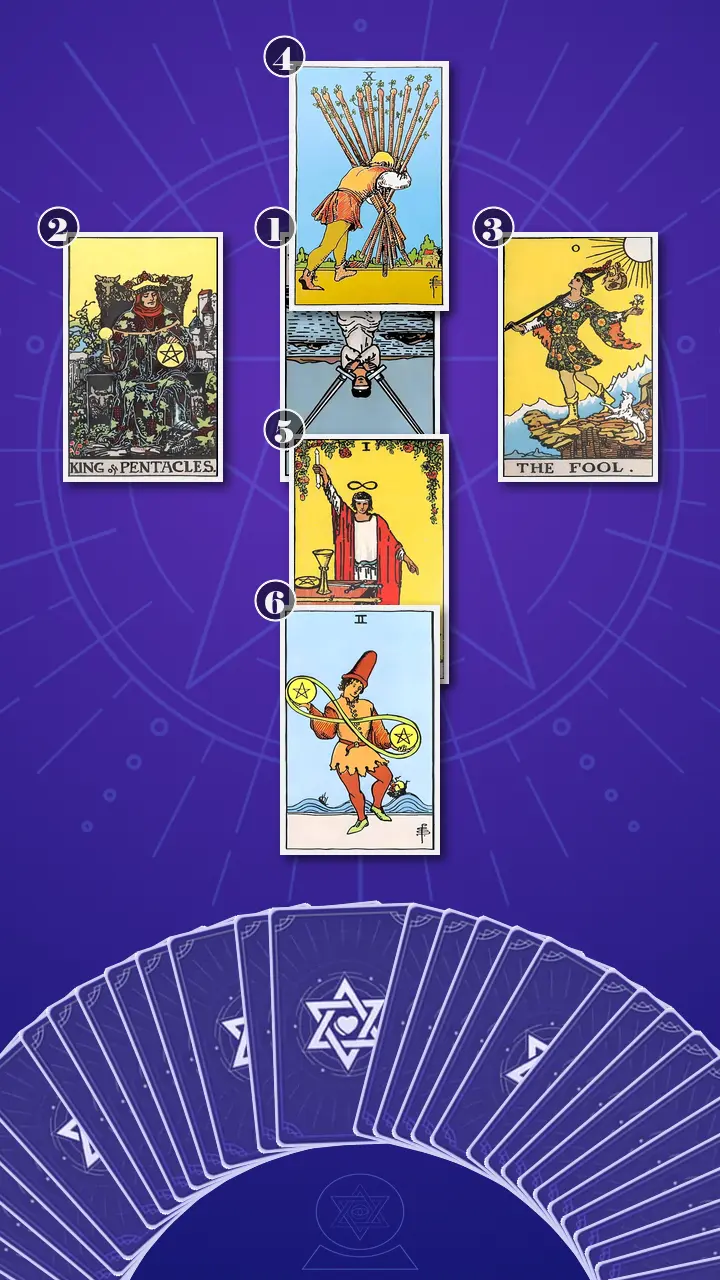
Reading the Map: Job Offer vs Startup Incubator, Without Fortune-Telling
Position 1: The Loop You Call ‘Being Strategic’
“Now turning over the card that represents your current crossroads energy and the specific way indecision is showing up day-to-day,” I said.
Two of Swords, reversed.
I didn’t even have to reach for mystical language; this card is practically modern by default. “This is you in a Toronto condo elevator at 8:12 AM,” I said, “thumb hovering over your email app. You reopen the offer PDF twice before brushing your teeth. On the ride down, you switch to the incubator page and reread the same alumni story you read last night.”
She let out a short, bitter laugh. “That’s… rude,” she said. Then, quieter: “It’s accurate.”
“More tabs isn’t more clarity—it’s more anesthesia,” I said, careful not to shame it. “The reversed energy here is a blockage: your mind is trying to protect you by keeping you blindfolded. As long as you’re ‘still evaluating,’ you don’t have to risk being the person who chose wrong.”
I watched her jaw flex once, then soften. “The big question this card asks,” I continued, “is: what’s the exact moment you usually bail back into research—right after you draft the email, after someone asks ‘so what are you doing?’, or when the deadline reminder hits your calendar?”
She stared at the card on my desk through the camera like it was a mirror. “Right after I draft,” she admitted. “I get to the send button and my body freaks out. So I go… collect more data.”
Position 2: Path A, the Offer With a Container
“Now turning over the card that represents Path A: what accepting the job offer teaches you, supports, and asks of you.”
King of Pentacles, upright.
“This is the fixed-rate plan,” I said, “predictable payments, fewer surprise fees. The version where you sign the offer and immediately know what Monday looks like: onboarding schedule, benefits, a salary number you can plan Toronto rent and savings around.”
The energy here is balance, almost an ease. “Notice how effortless the pentacle looks in his hand,” I pointed out. “This path could reduce daily uncertainty so your nervous system can unclench. It’s not ‘selling out.’ It’s choosing a container where you can build steadily.”
I asked her, “If you fast-forward only to day ten—what would feel genuinely easier? And what would feel quietly constricting?”
“Easier: I’d stop checking my bank account like it’s going to vote,” she said. “Constricting… I worry I’d go numb. Like I’d stop being brave.”
Position 3: Path B, the Public Beta Version of You
“Now turning over the card that represents Path B: what joining the startup incubator teaches you, supports, and asks of you.”
The Fool, upright.
“This is you walking into the incubator space on day one with a tote bag, your laptop, and an idea that’s not fully formed,” I said. “Everyone’s introducing themselves with founder energy, and you feel a rush—then the immediate drop: ‘What if I’m not ready to be new at this in public?’”
The Fool’s energy is expansion—but not comfort. “It’s not asking you to be fearless,” I told her. “It’s asking you to be a beginner on purpose. To learn by doing, and let the early version be messy without making that mean you’re naive.”
Her shoulders rose like she’d been caught holding her breath. “That’s the part,” she said. “I can handle hard work. I hate looking unprepared.”
“That’s an identity pressure point,” I said, “not a capability issue.”
Position 4: The Shared Cost You’ll Pay Either Way
“Now turning over the card that represents the shared cost: what you’ll have to carry, release, or take responsibility for no matter which path you choose.”
Ten of Wands, upright.
I didn’t soften it. “No matter what you pick, your first month could quietly turn into a prove-yourself marathon,” I said. “Job path: you say yes to every extra project to justify the hire. Incubator path: you self-impose hustle—pitch deck, MVP, founder socials, networking—until your brain is fried.”
The energy here is excess. Too much responsibility, too little support. “If the choice requires you to carry everything alone, it’s not a choice—it’s a burnout contract,” I said.
She nodded, but her eyes went glossy in that practical, pissed-off way. “But if I don’t carry it,” she said, “what if it falls apart?”
That was the real fear surfacing: that choosing wrong would prove she didn’t control her future.
“In astronomy,” I said, letting my own world into the room, “we don’t keep satellites stable by asking them to try harder. We keep them stable by designing their orbit—support systems, course corrections, thrusters. If you try to white-knuckle either path, Ten of Wands shows up. If you design support and boundaries early, you can actually see where you’re going.”
And then I said the sentence that usually lands right here, right between romance and reality: “You’re not picking a fate. You’re picking a season you can shape.”
When the Magician Spoke: From Certainty-Seeking to Agency-Based Decision-Making
Position 5: The Clarity Lever
“We’re turning over the core of the reading now,” I said, and I meant it. Even through a screen, the air shifted—like a theatre right before the lights go down.
“Now turning over the card that represents the clarity lever: the mindset and agency move that unlocks self-trust and breaks the loop.”
The Magician, upright.
“This is the moment you stop treating the decision like a personality test and start treating it like a build plan,” I said. “A clean page titled ‘First 30 Days.’ Tools already on your table: your product skills, your network, your savings runway, your ability to learn fast, your ability to ship.”
Then I brought in my own diagnostic lens—the thing I use at the planetarium when I’m explaining why one moon looks ‘stuck’ while another moves: Orbital Resonance. “Sometimes,” I told her, “two paths aren’t about ‘safe vs risky.’ They’re about energy synergy. In orbital resonance, timing and alignment matter—if you keep forcing a trajectory that doesn’t match your actual bandwidth, you burn fuel fast. The Magician asks: which option matches the rhythm you can sustain, and which one lets your existing tools actually do work immediately?”
Setup: I could feel how she’d been trapped in the same loop for days—like it was 11:38 PM again, laptop balanced on her thighs, offer email on one side, incubator page on the other, heart doing that tight, jumpy thing because whichever she clicked felt like it would become “the story.”
Stop waiting for certainty; start using the tools on your table—the Magician makes clarity by acting, not by predicting.
She froze for half a beat—breath paused, fingers hovering near her trackpad like she was about to close a tab and couldn’t. Then her eyes unfocused, as if her brain replayed every draft email, every reopened spreadsheet, every “what do you think?” text she’d sent. Finally, a long exhale slid out of her like she’d been holding it since Monday; her shoulders dropped, and she put her palm flat against her chest like she was checking whether it was still tight.
“But… if I act,” she said, voice thin with a sudden edge, “doesn’t that mean I could act wrong?”
“It means you become someone who can correct,” I said. “Clarity doesn’t arrive as certainty—it arrives as agency: the plan you can execute, review, and adjust with integrity.”
I kept my tone calm, practical. “Right now you’ve been running A/B tests in your head with zero data,” I added, because it was true. “Action is how you get real feedback.”
“Now,” I asked her, “with this new lens—can you think of a moment from last week when this would’ve changed how you felt?”
She blinked fast, like she was trying not to cry out of sheer annoyance. “Yesterday,” she said. “I drafted the acceptance email. Again. And instead of sending it, I opened Reddit and read three threads that made me feel worse.”
“That was your nervous system asking for a plan,” I said, “not a prophecy.”
And that’s the emotional shift right there: from contracted, deadline-driven pressure toward grounded self-trust. Not because the outcome is guaranteed—because she can steer.
Position 6: The Rhythm That Keeps You From Relapsing Into Tabs
“Now turning over the card that represents your next move: a grounded first step you can take immediately after deciding to support integration.”
Two of Pentacles, upright.
“This is your weekly operating system,” I said. “After you decide, you build a simple first-month rhythm that prevents a relapse into tab-flipping. Two non-negotiables—one stability anchor, one growth anchor—and permission to recalibrate without calling it failure.”
The energy here is balance in motion. “The waves don’t stop,” I told her, “but your balance gets better with a simple stance. Commit, then calibrate—without turning every wobble into a verdict.”
The One-Page “First 30 Days” Draft: Actionable Next Steps for a Job Offer Deadline
I stitched the whole spread into one story for her, the way I’d narrate a constellation so the pattern becomes obvious.
“Here’s what I see,” I said. “You’re not stuck because you’re not smart. You’re stuck because you’re trying to make the decision eliminate risk. Two of Swords reversed is the over-research loop: ‘there is a correct move and I have to find it first.’ King of Pentacles says the job offer gives you a steady container—less nervous-system noise, more consistent building. The Fool says the incubator gives you initiation—learning by doing, being new in public. Ten of Wands says the real danger is over-carrying either choice alone. And The Magician—your pivot—says clarity comes from choosing what you can actively shape with your hands and calendar.”
“Your cognitive blind spot,” I added, “is thinking you need more information when what you need is a design: boundaries, a first deliverable, and one real message sent into the world.”
Then I gave her a tight plan—small enough to start, real enough to change her state. I also pulled one of my communication tools from the planetarium world: Career visualization via elevator movement. “In the morning,” I told her, “before you open anything, stand still and picture the condo elevator doors closing. You don’t need to know the entire building. You just choose the next floor you’re willing to practice for 30 days.”
- The 12-Minute First-30-Days DraftOpen a note titled “First 30 Days: Job” and “First 30 Days: Incubator.” Set a 12-minute timer. Write exactly 7 bullets for each: day-1 admin, week-1 deliverable, week-2 relationship-building, week-3 learning focus, week-4 review, plus one boundary and one support you’ll ask for. Controllables only.Stop when the timer ends—unfinished is allowed. You’re building a steerable draft, not a forever identity.
- The One-Email Clarification MoveSend one message today that reduces uncertainty without reopening the whole debate: email the hiring manager one concrete question (start date flexibility or team expectations), or email the incubator one concrete question (time commitment or deliverable cadence).If you feel your chest tighten before hitting send, name it as “deadline bracing,” not “a sign.” Then press send anyway and let the reply become real data.
- The 48-Hour “No New Tabs” Boundary (Space Debris Clearing)For the next 48 hours, you can re-read what you already have, but you don’t open new Reddit threads, alumni stories, or salary rabbit holes. When you reach for a new tab, do one outward action instead: draft the email, calendar the call, or block your week-one schedule.If 48 hours feels intense, do a 12-hour version first. Think of it as clearing space debris—tiny distractions that keep your decision orbit unstable.
“And one more thing,” I said, because it mattered with Ten of Wands overhead. “Use the Solar Sail Principle: don’t fight resistance head-on—use it. If family, friends, LinkedIn, whatever, is creating pressure, turn that into structure. Put your two non-negotiables on your calendar like meetings: one stability anchor (sleep/money/admin) and one growth anchor (build/network/learn). That’s how you keep momentum without burning out.”

A Week Later: The Quiet Proof of Finding Clarity
A week after our session, I got a message from her while I was walking through the planetarium lobby, past a poster of Saturn’s rings. “I did the 12-minute draft,” she wrote. “Then I sent one email—just one question about team expectations. I didn’t open Reddit. I thought I’d feel panicked, but I mostly feel… steadier.”
She added, almost begrudgingly: “It’s weird. I’m still not 100% sure. But I’m not stuck. I can work with this.”
That’s the Journey to Clarity I trust—the kind that doesn’t demand a perfect forecast, just an honest start and a way to steer. In celestial terms, you don’t need the whole sky solved tonight. You need the next navigable heading, and the willingness to adjust when new data arrives.
When the deadline gets close, it can feel like your chest is bracing for impact—because not choosing isn’t neutral anymore, but choosing feels like it might expose you as someone who doesn’t fully control her future.
If you treated this as choosing a 30-day practice (not a forever identity), what’s one small first step you’d be willing to take that would let you steer the option you pick?