From Apartment-Hunt Panic to Grounded Choices: A Gentler Way to Apply

The 12:40 a.m. Listing Spiral in a Toronto Sublet
If you keep refreshing rental emails like it’s a heart-rate monitor—and every delayed reply feels like silent rejection—this isn’t just housing stress, it’s The Moon-level uncertainty messing with your sense of belonging.
Taylor said that to me almost as a joke, but her laugh came out thin. It was 12:40 a.m. where she was—Toronto—wedged into a tiny sublet room with a desk that looked borrowed from a previous decade. Her laptop fan had that anxious whir laptops get when you’ve got too many tabs open. The streetlight glare outside her window threw pale stripes across the wall like prison bars you didn’t ask for.
On her screen, she’d lined up her usual six-tab ritual: Condos.ca, PadMapper, the TTC trip planner, a crime map, Google reviews, and the Ontario Standard Lease PDF. Her drafted email to an agent sat unsent in Gmail, the cursor blinking like it was tapping its foot.
“I’m not just picking an apartment,” she said, and I watched her swallow like her throat had gone dry. “I’m picking whether I get to feel safe.”
As she spoke, her body kept giving her away: the tight chest, the shallow breathing, the jaw clenched so hard I could almost hear it through the screen. There was a restless urge behind her eyes—the urge to keep searching even when exhausted, as if one more listing could finally unlock certainty.
It felt, to me, like watching someone try to sleep while holding a door shut from the inside. Not because anyone was actually breaking in—but because the muscles remembered what it was like to be afraid.
“Let’s name the real contradiction,” I told her gently, the way I would with a niece or a longtime client. “You’re craving a stable home base and belonging. And at the same time, you’re scared that any commitment will replay abandonment and instability.”
Her eyes flicked to the unsent email again. “Exactly. The second I’m about to apply, my brain starts looking for reasons to run.”
I nodded. “Then our goal tonight isn’t to force you into a decision on camera. It’s to find clarity—so you can recognize the old story without acting it out.”

Choosing the Compass: The Celtic Cross · Context Edition
I asked Taylor to put both feet flat on the floor, just for ten seconds, not as a mystical ritual—more like letting her nervous system learn that the room wasn’t moving. “One slow inhale,” I said. “And on the exhale, unclench your jaw a millimeter. That’s enough.”
While she breathed, I shuffled my worn deck in my own space. I’m Esmeralda Glen—sixty-seven, Scottish Highlands in my bones even when I’m on a video call with a Toronto UX designer who has an Ontario lease PDF bookmarked like a threat. My family’s been the kind of healers who notice seasons and storms and what they do to the human heart. Over the years, I’ve learned to treat fear like weather: real, informative, and not always accurate about what’s actually happening outside.
“Today,” I said, “we’ll use a spread called the Celtic Cross · Context Edition.”
For you reading along: I choose this structure when the question needs a full chain—not just ‘What should I do?’ but why this feels like this. It maps the present trigger into the root insecurity, then shows what past script is repeating, what you consciously long for, what’s likely to happen next if you keep using the same coping strategy, and finally the healthiest direction of integration.
I gave Taylor a quick preview so she’d feel held by the process: “The first card will show your current emotional reality—what the panic feels like right now. The crossing card shows the main obstacle pattern—where control turns into gripping or freezing. And the last card will point to the integration direction: how this resolves internally when you choose balance over extremes.”
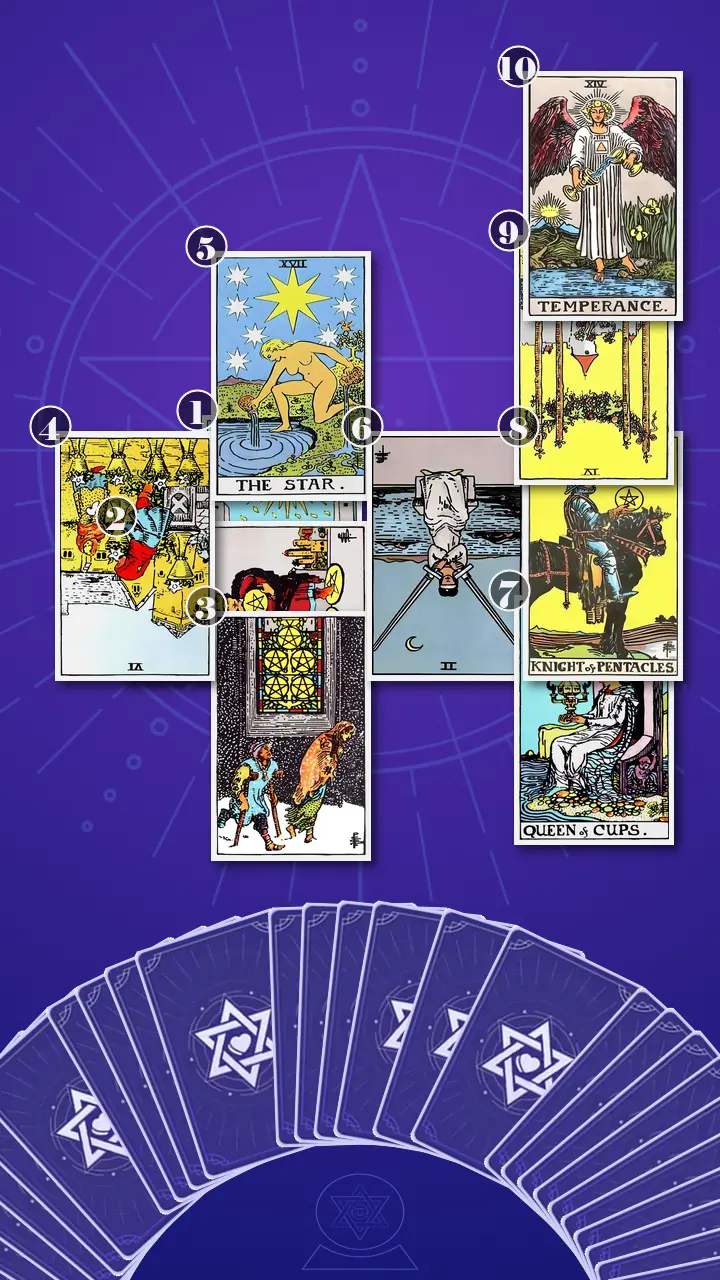
Reading the Fog: How Tarot Works for Apartment Hunting Anxiety
I laid the cards in the cross-and-ladder shape, like a compass with a staircase rising beside it. Taylor leaned closer to her webcam, as if proximity could make uncertainty less slippery.
Position 1 — Current emotional reality: The Moon (upright)
“Now flipped open,” I said, “is the card that represents your current emotional reality of the apartment hunt: what the panic feels like in the present moment.”
The Moon, upright.
Her eyes widened—not dramatically, just enough to tell me her body recognized it before her mind could label it.
“This is the card of fog,” I said. “Not because you’re doomed—because not everything is visible yet, and your nervous system hates incomplete information.”
I turned the symbolism into her actual life, exactly where she lived: “This is like when you leave a viewing and, before any reply arrives, your mind fills the silence with a full storyline of rejection or danger, and you react to the storyline as if it’s already true.”
The Moon’s energy here isn’t ‘too much emotion’—it’s projection. A slow inbox becomes a personal no. The agent’s auto-reply becomes a breakup text. That missing ‘Seen’ indicator on iMessage starts feeling like a verdict. Your brain tries to protect you by translating ambiguity into threat.
“It’s like my nervous system has a spam filter,” Taylor muttered. “And everything gets auto-sorted into ‘danger.’”
“Exactly,” I said. “And I want you to notice something: The Moon shows two instincts—one domesticated, one wild—both howling at the same light. Part of you says, ‘I’m fine, this is normal adult stuff.’ Another part is younger and terrified, and it gets louder at night.”
She nodded, once, sharply—like it hurt to be seen so clearly.
Position 2 — Primary obstacle pattern: Four of Pentacles (reversed)
“Now flipped open,” I said, “is the card that represents your primary obstacle pattern: how control, gripping, or instability shows up when you try to choose.”
Four of Pentacles, reversed.
I didn’t need to dramatize it. This one always lands with a thud.
“This is like when you try to lock down every variable—budget, safety, neighbors, commute—so you never have to feel exposed,” I told her, “but the rigidity makes it harder to move forward.”
Reversed, this card is control that stops being structure and starts being constriction. The energy isn’t balanced; it’s blocked. It’s your chest holding a coin so tightly it can’t rise to breathe.
I used the body-first snapshot I’ve learned is kinder than lecturing: “The jaw clench. The hunched shoulders. The cursor hovering over ‘Submit’ while your other hand refreshes the inbox. It’s the moment you tell yourself, If I can just find the one missing detail, I won’t have to feel exposed.”
Taylor let out a tight laugh that sounded half like a wince. “That’s… rude. Like, accurate, but rude.”
“Information can be care,” I said, letting the line sit between us. “It can also be a hiding place.”
She went still for a beat, then her eyes dropped to her desk. Recognition, not shame—that’s what I was aiming for.
“The risk,” I added, “is the swing. You grip for perfect certainty until you can’t breathe, and then you want to bolt—‘forget it, none of these are safe.’ That swing is why the process feels like an emergency.”
Position 3 — Attachment foundation: Five of Pentacles (upright)
“Now flipped open,” I said, “is the card that represents your attachment foundation: the core insecurity about home and belonging that the search activates.”
Five of Pentacles, upright.
Her face changed in a way I’ve seen a hundred times—soft, wary. Like the room got colder.
“This is the fear of being left outside,” I said. “Not as a dramatic storyline—more like a body memory.”
I made it specific: “This is like when you logically know you can find a place, but your body reacts as if stability is scarce and you’re about to be shut out again.”
The energy here is deficiency—the felt lack of warmth, even when there’s a lit window nearby. It’s the part of you that reads a slow reply as ‘You don’t belong’ instead of ‘They’re busy, the market is procedural.’
Taylor pressed two fingers against the notch at the base of her throat. “That’s the spot,” she said quietly. “It’s like… a lock.”
“A lock can be protection,” I said. “But it can also keep you from receiving what’s available.”
Position 4 — What past is repeating: Six of Cups (reversed)
“Now flipped open,” I said, “is the card that represents what past is repeating: the old home and attachment script that gets re-triggered by the search.”
Six of Cups, reversed.
The room on her side looked the same, but something in Taylor’s posture shifted, like she’d stepped into a different hallway in her own mind.
“This is like when you aren’t only evaluating a living room,” I told her. “You’re scanning for the emotional promise that you’ll finally feel settled—and you panic when no place can guarantee that.”
I used the intercut timeline technique, because it’s one of the fastest ways to stop the present from being sentenced by the past.
“Picture this,” I said. “Present-day: you’re in a condo hallway under bright LED lights, politely smiling, feeling like you’re auditioning to be allowed to live somewhere.”
“And then—flashback fragments,” I continued, gentle but clear. “Not necessarily a single dramatic scene. It can be smaller: packed boxes. A sudden move. Adults arguing behind a door. Or just that quiet feeling of, ‘I don’t belong here.’ The trigger isn’t the apartment. The trigger is the word home.”
Taylor got very quiet. Her eyes unfocused for a second, as if a memory played on a screen behind her pupils. Then she exhaled, slow, and her shoulders dropped a fraction.
“Okay,” she whispered. “So it’s not… the building. It’s the script.”
“Yes,” I said. “And here’s the separation line I want you to practice—two sentences, not a deep dive.”
“This feels like when…” I prompted.
She swallowed. “This feels like when I was nineteen and my living situation changed fast and I couldn’t control it.”
“Good,” I said softly. “Now: What is different now is…”
She blinked hard. “I have income. I have legal protections. I have choices. I’m not alone.”
In my family, we call that ‘splitting the weather from the season.’ A storm can sound like every storm you’ve ever survived. But it isn’t proof you’re back in the same year.
Position 5 — Conscious desire: The Star (upright)
“Now flipped open,” I said, “is the card that represents your conscious desire: what you’re genuinely hoping a home will provide emotionally and practically.”
The Star, upright.
The energy changed immediately—like a window cracked open in a stuffy room.
“This is like when you stop trying to win the ‘perfect apartment’ and instead ask what kind of space and routine will help you sleep, eat, and feel steady while you transition,” I told her.
The Star is balance. Not because life becomes easy, but because nourishment becomes consistent. In terms you’d appreciate if you’ve ever spiraled through apartment hunting anxiety: The Star asks, “What would make this process 10% kinder on you this week?” Not impress your peers. Not prove adulthood on Instagram. Kinder on your nervous system.
Taylor’s mouth trembled into something close to a smile. “Ten percent kinder feels… possible.”
“It is,” I said. “The Star doesn’t demand a miracle. It offers a rhythm.”
Position 6 — Next-phase pressure point: Two of Swords (reversed)
“Now flipped open,” I said, “is the card that represents the next-phase pressure point: how the decision moment is likely to unfold if you keep using the current strategy.”
Two of Swords, reversed.
I tilted my head. “Split-screen,” I said, and she laughed a little because she knew exactly what I meant.
“This is like when you keep two ‘acceptable’ options in play but avoid contacting either agent decisively, because choosing feels like losing and uncertainty feels safer than commitment,” I told her.
This card reversed is overload—Air energy that can’t find a clean channel. It’s protection-through-not-looking that stops working. You try to keep feelings out of the decision to stay ‘rational,’ but the unacknowledged fear leaks out as endless tabs, stalled emails, and sleepless nights.
“That’s exactly it,” she said. “I keep thinking: safety vs freedom. Like… if I choose, I’m trapped.”
“Then we practice movement without total commitment,” I said. “One reversible action. One clarifying question. One follow-up email. Not because you’re weak—because you’re thawing a freeze response.”
Position 7 — Your role and inner resources: Queen of Cups (upright)
“Now flipped open,” I said, “is the card that represents your role and inner resources: the part of you that can hold feelings without letting them run the process.”
Queen of Cups, upright.
“This is like when you can say, ‘I feel scared and I want reassurance,’ and still take one practical next step without shaming yourself for having the feeling,” I told her.
The energy here is mature Water—containment, not suppression. The Queen doesn’t dump the cup on the table, and she doesn’t pretend the cup is empty. She holds it carefully and stays seated.
This is where my own Nature Empathy Technique slips in naturally: people think intuition is fireworks. Most of the time it’s weather. A subtle pressure shift. A change in the wind. Your body saying, “This email thread is activating,” and you listening without being hijacked.
“I’m not very intuitive,” Taylor said reflexively, like she’d been trained to distrust herself.
“You are,” I replied. “You just call it ‘overthinking’ because that’s the only language you were given for sensitivity.”
Position 8 — External reality: Knight of Pentacles (upright)
“Now flipped open,” I said, “is the card that represents your external reality: what the rental market and process is asking from you, separate from attachment storylines.”
Knight of Pentacles, upright.
“This is like when you follow a simple system—viewing schedule, application checklist, one follow-up email—so the search stops feeling like an emotional free-fall,” I told her.
The energy here is steady Earth. Procedural. Sometimes slow. And crucially: not personal.
I watched her take that in. Toronto’s rental market can feel like a machine that doesn’t care, because it is—a set of steps, a timeline, paperwork. The Knight reminds you: a slow reply is often a slow process, not a judgment of your worth.
“So… if they don’t respond quickly, it’s not automatically a no,” Taylor said, sounding like she was trying on a new belief the way you try on a coat in a store—unsure if it fits.
“Exactly,” I said. “And your job is to stay consistent anyway.”
Position 9 — Hopes and fears: Four of Wands (reversed)
“Now flipped open,” I said, “is the card that represents your hopes and fears: the belonging milestone pressure and the fear of not arriving or not being welcomed.”
Four of Wands, reversed.
Taylor rolled her eyes before I even spoke. “Instagram,” she said.
I smiled because she’d done my work for me. “Yes. This is like when you don’t just want a key; you want the feeling of ‘I made it,’ and the fear is that you’ll never reach that threshold—or won’t be welcomed on the other side.”
Reversed, this card shows belonging becoming performative. Home as milestone. Home as proof. Home as a curated kitchen shot with a candle and a plant. And the danger is that you start raising your standards mid-search, not because you need more, but because you need the apartment to prove you’ve arrived.
“A home is a container you shape, not a gate you have to be granted,” I said. “And we’re going to come back to that.”
When Temperance Spoke: Mixing Two Cups at the Decision Point
I turned the final card over slowly. Not for drama—for respect. “We’re flipping the card that represents the integration direction,” I said, and even through the screen I felt Taylor hold her breath.
Position 10 — Integration direction: Temperance (upright)
Temperance, upright.
“This is like when you can tour a place, feel the trigger, take a breath, ask your questions, and still move forward—without needing the apartment to instantly fix your sense of safety,” I told her.
Temperance is the Integrator: one foot on land, one in water. Practical steps, emotional regulation. Facts and feelings poured back and forth until they become something you can live in.
And this is where I brought in my own way of seeing—my family’s old Highland habit of noticing rhythms, not just outcomes. “Temperance is seasonal thinking,” I said. “Not ‘one decision will determine my entire life.’ More like: ‘I’ll build stability the way you build spring—one warmer day at a time, with some cold snaps still included.’”
Setup. I leaned forward. “You know that moment after a viewing when you’re back on the TTC, phone warm in your hand, and your brain starts writing a whole rejection story before the agent even replies—so you open five tabs instead of sending the application.”
Delivery.
Stop treating the lease like a verdict on your worth, and start mixing facts and feelings like Temperance’s two cups—slow enough to stay present, steady enough to move.
I let the silence do its work. On Taylor’s side of the screen, the cursor in her unsent email kept blinking, patient and indifferent.
Reinforcement. Taylor’s reaction didn’t come out as immediate relief. It came as a three-step chain. First: she froze—breath paused, shoulders high, eyes fixed on something just past the camera. Second: her gaze went slightly unfocused, like she was replaying every time she’d treated a housing decision like a moral test. Third: her face tightened with a flash of anger.
“But if I stop treating it like a verdict…” her voice sharpened, “doesn’t that mean I was wrong? Like I made it all bigger than it needed to be?”
“No,” I said, steady. “It means you were doing what you learned to do to survive uncertainty. We’re not judging the old strategy. We’re updating it.”
I guided her into a practice that matched the card—simple, paced, and choice-respecting. “Let’s do a nine-minute Temperance Mix right now,” I said. “Stop anytime if it spikes anxiety. Set a timer.”
“Minute one to three: write three Facts about your top option. Verifiable. Boring. Like—rent amount, lease length offered, distance to the TTC.”
“Minute four to six: write three Feelings. One-word labels and where they live in your body. Like—‘dread in throat,’ ‘hope in stomach,’ ‘tightness in chest.’”
“Minute seven to nine: choose one next micro-step that’s reversible. One question email. One document request. One viewing booking.”
“And the rule,” I added, because the Four of Pentacles needed a boundary, “is no extra tabs after the timer. If you want to research more, schedule it for one specific fifteen-minute window tomorrow.”
Taylor nodded slowly. I watched her shoulders lower as if someone had finally told her she could exhale without making the commitment ‘real.’
Then I asked the question that turns insight into ownership: “Now, with this new perspective, think back to last week. Was there a moment—maybe on Line 1 after a viewing—when this could have helped you feel different?”
Her eyes filled, not with drama, with recognition. “Yeah,” she said. “I was standing outside a building. Cold air. Traffic. And my hand literally paused over ‘Submit.’ If I’d done facts and feelings instead of Street View at midnight… I think I would’ve sent it.”
“That,” I said softly, “is the shift. This isn’t about a perfect apartment. It’s about moving from panic and mistrust to grounded self-trust—proof you can care for yourself during uncertainty, not only after it ends.”
From Spiral to Structure: Actionable Next Steps That Don’t Punish You
I took a breath and looked at the whole spread the way I look at a coastline from a hill—patterns first, details second.
“Here’s the story the cards are telling,” I said. “The Moon shows the present: ambiguity turning into danger stories. Four of Pentacles reversed shows the coping: gripping for certainty until you freeze. Under that is Five of Pentacles—the old fear of being outside the warmth. Six of Cups reversed names what’s repeating: a younger chapter of you still trying to prevent sudden instability. But The Star shows what you truly want: steadiness and repair. The Queen of Cups shows you have the inner capacity to hold fear without shaming it. The Knight of Pentacles reminds you the market is procedural, not personal. And Four of Wands reversed calls out the milestone pressure—home as performance. Temperance ties it together: a balanced decision process that mixes facts and feelings and moves one paced step at a time.”
“Your cognitive blind spot,” I added carefully, “is believing you need a perfect guarantee of safety before you can act. That’s not how renting works. And it’s not how nervous systems learn trust.”
“The transformation direction,” I said, “is exactly what Temperance teaches: you stop trying to extract belonging from a lease, and you build a ‘good-enough’ decision process that proves you won’t abandon yourself mid-choice.”
Then I offered her a small toolkit—practical enough for a UX designer, gentle enough for a tender nervous system. I also threaded in one of my own strategies, because a body needs a method, not a pep talk.
- 15-Minute Decision Container (After Each Viewing)In your Notes app right when you get back on the TTC or step outside: write (1) your top 3 verifiable facts, (2) one body sensation you noticed, (3) one question to verify. Then close all tabs until your next scheduled check-in.If your brain bargains for “just five more minutes,” that’s your cue to stop and schedule a specific 15-minute research window tomorrow.
- The “1 Non-Negotiable + 2 Flex” Rule (One Week Only)Choose 1 practical non-negotiable (e.g., within budget) and 2 flexible preferences (e.g., floor level, paint color). Keep the rule visible while browsing—on a sticky note or the top of your Notion tracker.When you feel yourself turning the spreadsheet into a courtroom, reread the rule and ask: “Is this a real need, or an anxiety-proofing demand?”
- Walking Meditation With Environmental Sounds (The “Sound Rail” Reset)Right after you send one email or ask one clarifying question, take a 3-minute walk—hallway, sidewalk, around the block. Put your attention on three layers of sound: (1) far sounds (traffic), (2) mid sounds (voices, HVAC), (3) near sounds (your steps, your coat). Let the sounds “hold” you while your body comes down from adrenaline.This is not about calming down perfectly. It’s about teaching your body: “I can act, and then I can return.”
Before we ended, I offered one more small practice from my own lineage—modern, not mystical. “At bedtime,” I said, “do a three-minute energy review. Not a life audit. Just: What did I do today that moved me forward? Where did I tighten? What do I want to protect tomorrow—my sleep, my time, my self-respect?”
That’s energy protection, in plain language: choosing what gets access to you, especially at midnight.

A Week Later: Ownership, Not Certainty
Seven days later, Taylor texted me a screenshot: a sent follow-up email. Nothing poetic—just a boring template and a timestamp.
“Did the facts + feelings thing,” she wrote. “Sent it before opening Street View. Felt weirdly proud. Still scared, but… I didn’t spiral for three hours.”
Her next message came the following morning: “Slept through the night. Woke up and my first thought was still ‘what if I picked wrong?’—but this time I kind of smiled? Like, okay, that’s the old script. Adult me is handling the email.”
That’s the quiet proof Temperance promises: not perfect calm, but a steadier ability to stay present. A home becomes something you can build and adjust—one paced step—rather than a referendum on whether you’ll be left.
When the application button feels like a verdict, it makes sense that your chest tightens—because part of you isn’t choosing a place, it’s bracing for the old moment where “home” stopped feeling guaranteed.
If you didn’t need this lease to prove you’re safe or wanted—what would your next, tiniest “facts + feelings” step look like today?