From Acceptance-Email Anxiety to Self-Trust: A 48-Hour Decision

The Tab That Never Closes in a Zone 2 Kitchen
You’ve had the fellowship acceptance email open in a tab for three days, and somehow you’ve built a spreadsheet more detailed than your actual job description.
Alex (name changed for privacy) said that to me like it was a joke, but their body didn’t laugh with it. We were on a video call, and behind them I could see the narrow slice of a Zone 2 flat kitchen—one overhead light that made everything look a little too honest, a mug that had gone cold, and the faint vibration of London traffic through a cracked window.
“It’s always the same scene,” they told me. “9:40-ish. Laptop open. Acceptance email right there. I start typing, then… I flip to Monzo, then the fellowship FAQ, then my company’s PTO policy, then I’m on LinkedIn like I’m trying to hurt my own feelings.”
As they spoke, their jaw worked like it was chewing something tough. Their chest rose high and fast—wired-but-tired. Not the clean stress of a deadline you can meet. The sticky kind. The kind that keeps you scrolling because your brain is trying to buy safety with more information.
“I want the fellowship,” Alex said, and their eyes flicked away from the camera as if the wanting itself was exposing. “But I also want my life to not implode. If I leave and it doesn’t work out, it’ll prove I don’t have good judgement. If I stay… I’ll hate myself later. So I keep… not sending the reply.”
The anxiety wasn’t abstract; it sat on them like a too-tight collar—tight chest, tight jaw, the cursor blinking like a metronome keeping time with every what if.
“Okay,” I said, keeping my voice warm and plain. “You’re not broken. You’re in choice paralysis—your nervous system is treating ‘Reply’ like a trapdoor. Let’s make this less mystical and more useful. We’ll use the cards to draw a map through the fog and find clarity you can actually act on.”

Choosing the Compass: The Decision Cross · Context Edition
I asked Alex to put their phone face-down for a moment—not as a ritual, just a boundary. “Give your brain fewer inputs,” I said. “We’re not here to win an argument with fear. We’re here to listen well enough to choose.”
While I shuffled, I watched their shoulders climb and fall as they tried to breathe in a way that didn’t feel like performing calm. I get it. I spent years on a trading floor where people mistake tension for competence. Switching careers at 33 forced me to learn a quieter kind of strength—one that doesn’t require certainty, just follow-through.
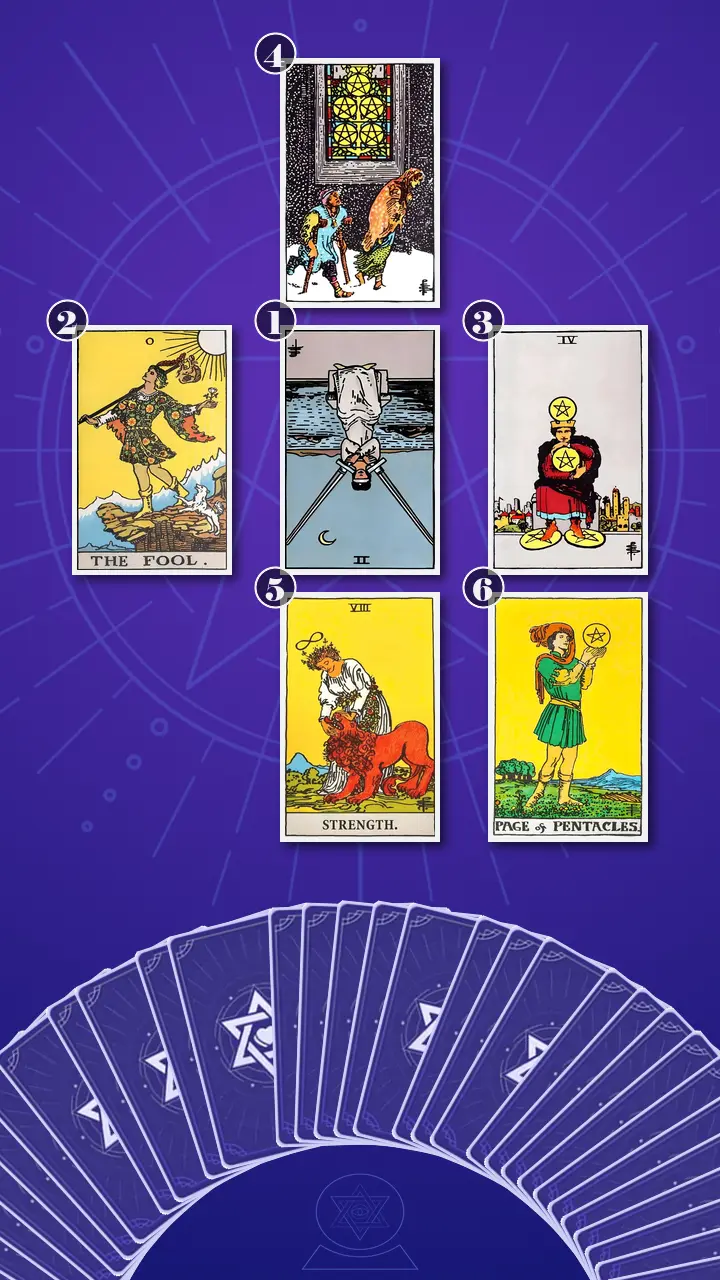
“For this,” I told them, “I’m using a spread I like for high-stakes fork-in-the-road moments: the Decision Cross · Context Edition.”
For anyone reading along—this is how tarot works best in situations like ‘fellowship vs job.’ Not as a prediction machine, but as a structured way to compare two paths, surface the hidden driver behind the pressure, and land on next steps. The layout is simple on purpose: center card for the stuck point, left/right for the two options, then a vertical axis that reveals what’s underneath and what stabilizes you.
“Card 1,” I said, “will show the exact way you’re stuck—on-screen and in your body. Card 2 is the fellowship path: what it asks of you and unlocks. Card 3 is keeping the job: what it protects and what it costs. Card 4 reveals the hidden fear amplifying the stakes. Card 5 is the inner bridge—how to choose from self-trust instead of panic. Card 6 gives one grounded action you can do this week.”
Alex nodded, still wary, like someone who’s been burned by advice before. “I just… don’t want a pep talk,” they said.
“Same,” I replied. “We’ll do clarity, trade-offs, and a plan.”
Reading the Map: Six Cards, One Email
Position 1: Current stuck point — Two of Swords (reversed)
“Now flipped,” I said, “is the card representing your current stuck point: the specific, observable way indecision is showing up around replying to the acceptance email.”
Two of Swords, reversed.
It couldn’t have been more literal if it tried. I described the scene it always brings up in modern life: 12:14 AM. Five tabs open—the email draft, the fellowship FAQ, the notice period/PTO policy, Monzo, and a pros/cons spreadsheet you keep reformatting. You type one sentence, delete it, and tell yourself it’s “responsible” when it’s actually avoidance of finality.
Reversed, this card is the stalemate cracking. Not solved—cracking. Air energy (thought, analysis) is overactive and blocked at the same time: too many mental blades crossing at your chest, protecting your heart from the consequences of choosing.
“You’re not indecisive,” I told Alex. “You’re trying to make a risky choice feel risk-free.”
They let out a short laugh that tasted like bitterness. “That’s… awful. And accurate.” Their hand drifted up and rubbed their jaw like they’d just remembered it was theirs.
I kept going, gently sharp. “Your brain is using spreadsheets as a shield. If you can find one more variable, you don’t have to choose yet. Control versus relief.”
Alex exhaled—small, but real. The kind of exhale that says, I’ve been caught, and thank god.
Position 2: Option A (Fellowship) — The Fool (upright)
“Now flipped,” I said, “is the card representing Option A—the fellowship: what this path teaches, demands, and unlocks in terms of growth and identity.”
The Fool, upright.
I told Alex what I see in this card when it’s not about recklessness, but about permission: when you imagine saying yes, there’s a flicker of lightness—like you’re allowed to learn in public again. New mentors. A new environment. Being a beginner without having to look established all the time.
The energy here is Fire in its earliest form: a spark of curiosity outrunning control for a second.
Alex’s eyes softened. “That’s the thing,” they admitted. “When I picture it, I feel… taller. And then I feel sick, like I’m about to step off something.”
“That makes sense,” I said. “The Fool doesn’t ask you to erase fear. It asks you to move with a light pack—values first, outcomes later.”
Position 3: Option B (Keep the job) — Four of Pentacles (upright)
“Now flipped,” I said, “is the card representing Option B—keeping the job: what this path protects, costs, and stabilizes in daily life.”
Four of Pentacles, upright.
I translated it in the most grounded way I could: you look at your monthly outgoings and your body settles because the salary is predictable. The routine is predictable. Keeping the job feels like tightening the lid on a jar—everything contained, everything manageable.
This is Earth energy in a balanced form and in its shadow. Balance looks like wise stability. Shadow looks like constriction: control becoming a lifestyle because it calms the nervous system.
“The card doesn’t shame you for wanting stability,” I told them. “Rent is real. But it does ask: where does stability resource you, and where does it shrink your world?”
Alex nodded, slow. Their mouth pulled to one side. “My job isn’t awful,” they said. “Which somehow makes leaving harder.”
“Exactly,” I replied. “You’re not escaping a fire. You’re choosing growth.”
Position 4: Hidden driver — Five of Pentacles (upright)
“Now flipped,” I said, “is the card representing the hidden driver: the deeper fear or unmet need amplifying the stakes of the decision.”
Five of Pentacles, upright.
As soon as I saw it, I felt the temperature of the whole reading change. This card is a London night you know in your bones: cold drizzle, the kind that soaks through your sleeves. And there’s a warm-lit place right there—a café, a pub, even a Tesco Express under fluorescent light—yet you keep walking because being seen needing warmth feels like exposure.
“Under the debate,” I said, “is a colder fear: ‘If I leave, I’m on my own.’ Not just money. Support. Belonging.”
Alex’s gaze unfocused for a second—like a memory replayed in the background. Their breathing paused. Then their shoulders dropped a millimetre, as if the body recognized the real problem and stopped yelling for more spreadsheets.
“I don’t ask for help,” they said quietly. “I ask for opinions. But not help.”
“That’s this card,” I replied. “When fear is driving, ‘more info’ turns into ‘more tabs.’ And when shame is driving, you walk past the warm window and tell yourself you’re fine.”
I let it land, then added the reframe I’ve learned to treat as strategy, not sentiment: “Support is a strategy, not a weakness.”
When Strength Led the Lion to “Send”
Position 5: Key guidance — Strength (upright)
I said, “We’re turning the central page now. This is the card representing key guidance: the inner capacity to embody so the choice comes from self-trust rather than panic or scarcity.”
The room felt quieter, even through the screen—like London itself had paused between trains.
Strength, upright.
Setup: It’s late, the acceptance email is still open, and you’re flipping between the fellowship FAQ, your bank app, and the same pros/cons doc. Jaw locked. Chest tight. Like pressing “send” would set off a chain reaction you can’t undo.
Stop waiting for the fear to disappear and start leading it gently, like Strength’s calm hands guiding the lion.
Alex reacted in three distinct beats. First, a physical freeze: their lips parted, then closed; their hand stopped mid-air above the keyboard, suspended. Second, the idea seeped in: their eyes shifted slightly to the side, as if they were watching themselves on those nights—tab-hopping, bargaining, bracing. Third, the release arrived—small but unmistakable: a breath that came from lower in the ribcage, and a slow unclenching along the jawline.
And then—an unexpected edge. Alex frowned. “But… if that’s true,” they said, voice tightening, “doesn’t that mean I’ve been doing it wrong? Like I’ve wasted days. I should’ve just been stronger.”
I didn’t let that shame take the wheel. “No,” I said, steady. “It means you’ve been trying to solve a nervous-system problem with a spreadsheet. That’s not a character flaw. It’s a strategy that worked short-term.”
I leaned in, and this is where my old life always flashes across my mind: on Wall Street, no one waits for uncertainty to vanish. You build controls. You size your risk. You create a plan strong enough to hold a volatile day.
“Here’s my way of translating Strength into something you can do,” I told them. “I call it Transition Roadmapping—like preparing a company for an IPO. You don’t guarantee the market. You prepare governance, cash runway, and a credible story. That’s self-trust: not certainty, but structure and follow-through.”
“Okay,” Alex whispered, and their voice sounded less like pleading and more like testing the floor with a toe.
“Let’s do a ten-minute Strength check right now,” I said. “You can stop anytime—this is data gathering, not committing.” I guided them: phone face-down, one hand on chest and one on belly, six slow breaths. Then two lines on paper: Fear is trying to protect me from ____. And: What I need to feel basically safe is ____ (numbers/people/routine).
Finally, I had them open a blank email and draft one sentence for each reality: “I’m accepting because…” and “I’m declining because…” No polishing. No perfect tone.
Alex stared at the screen, then typed. Their shoulders dropped—maybe five percent—on one of the sentences. They noticed it before I said anything.
“There,” I said softly. “That drop? That’s Strength. Not fireworks. Not certainty. A body that stops bracing for one option.”
I asked them, immediately, “Now—using this new lens—think back to last week. Was there a moment you could’ve led the fear instead of obeying it? A moment you could’ve taken one small step instead of opening another tab?”
Alex nodded, eyes damp but not falling apart. “Tuesday,” they said. “I could’ve emailed HR one question. I didn’t because I thought it would make it real.”
“That’s the bridge,” I said. “This is the shift from fear-driven analysis paralysis and reassurance-seeking to grounded self-trust and calm follow-through.”
Position 6: Actionable next step — Page of Pentacles (upright)
“Now flipped,” I said, “is the card representing your actionable next step: one grounded move that creates clarity and support within the next week.”
Page of Pentacles, upright.
This is the builder. The apprentice. The part of you that stops trying to predict every expense for two years and instead makes a simple three-month plan.
I described the modern-life version: opening a clean note, writing a three-line budget, booking a 15-minute call, drafting a two-sentence script. The inner monologue changes from What if everything goes wrong? to What’s my next doable step?
“Make the plan that can hold you—then choose inside it,” I said, and watched Alex’s face shift into something like capability.
The Plan That Can Hold You (and the Email Drafts That Prove It)
I pulled the whole story together for them, the way I would in a boardroom when the data is real but the decision is still human: You began in an Air-lock—Two of Swords reversed—using analysis to avoid vulnerability. The fellowship is The Fool: growth, beginnerhood, meaning. The job is Four of Pentacles: real stability, real containment, and the risk of a smaller life. Under it all is Five of Pentacles: a fear of being unsupported, which turns a career decision into a survival test. Strength is the bridge: not forcing fear away, but leading it. And Page of Pentacles is how it becomes real—one grounded move, then another.
“Your cognitive blind spot,” I told Alex, “is that you’re treating this like you need a guaranteed future to be allowed to choose. But the real lever is choosing the option you can support with a plan—and with support from other humans.”
Then I gave them next steps that were small enough to actually do, but structured enough to stop the loop.
- The 48-hour containerPut a calendar block in the next two days titled: “Reply sent (either way).” During that window, create two email drafts: one “Yes” and one “No.” Paste in a one-paragraph trade-offs statement for each: “For the next 6 months, I’m choosing…”Set a timer (20 minutes). If you feel your chest tighten, pause for 3 slow breaths—this is a draft round, not The Decision.
- The One-Question Logistics Ask (warm-window test)Email HR (or check your contract) with one specific question only: notice period, unpaid leave options, or benefits timing. Keep it purely logistical—no spiralling context.If shame spikes, remind yourself: support is a strategy, not a weakness. You’re allowed to ask for information without oversharing.
- The Strength check + opening-bell sendBefore you choose, do a 90-second body reset: unclench jaw, drop shoulders, exhale longer than you inhale. Then read your two draft emails out loud once. When your body gives you the 5% shoulder-drop, send that one. If you want a container, do it first thing in the morning like an “opening bell” simulation: sit upright, feet on the floor, voice steady, one clean action.For 24 hours, try a “calm channel”: no LinkedIn checking. If you slip, just notice and close it—no self-scolding.
Because Alex’s fear also had a very practical CV-shaped costume, I added one optional piece from my own toolkit: “If you accept,” I said, “we can do a quick Profile-as-Prospectus refresh on LinkedIn later—so you’re telling a coherent story about this pivot instead of letting your anxiety write the narrative.”

A Week Later, the Quiet Proof
Seven days later, I got a message from Alex: “I sent it.”
Not a paragraph. Not a post. Just two words, and then: “My hands shook for like ten seconds. Then I made tea and it tasted like tea again.”
They told me they’d emailed HR one question (and survived), asked a friend to sanity-check a three-month budget (and weren’t judged), and—most surprisingly to them—stopped doom-scrolling LinkedIn for a day. “It was loud in my head at first,” they wrote, “but then it got… quiet enough to hear myself.”
That’s the journey to clarity I trust: not certainty, but ownership. Not a perfect future, but a plan you can hold and a nervous system that doesn’t have to sprint in circles.
And if you take nothing else from Alex’s reading, take this: When a yes-or-no email feels like a referendum on your judgement, your body will try to buy safety with endless planning—tight jaw, tight chest, one more tab, one more ‘just in case.’
If you stopped asking “Which future is guaranteed?” and asked “Which option can I support with a real plan and one real person in my corner,” what would your next tiny step be today?