RateMyProfessors at 2 a.m.: From approval-checking to self-led criteria

The 2:13 a.m. RateMyProfessors Spiral
If you’ve ever re-sorted RateMyProfessors by “most recent” at 2 a.m. during course registration week because you need one last sign it’s a “safe” choice—this is you.
Jordan (name changed for privacy) joined my Zoom call from Toronto with the kind of posture I’ve learned to recognize before someone even says a word: shoulders slightly up, chin forward, eyes doing that unfocused dart like they’re still scanning tabs in their head. Behind her, the room was almost completely dark except for a desk lamp that threw a tired cone of light across a laptop. I could hear the faint radiator click through her mic, and every few seconds there was that tiny charger buzz—like the apartment itself was reminding her she’d been plugged in too long.
“I don’t even want the best professor,” she said, voice low so she wouldn’t wake roommates. “I just want to not regret it.”
She told me how her phone becomes an emotional support device after midnight: course planner open on the laptop, RateMyProfessors on the phone, a Reddit thread on the side. The behavior looked like research, like being responsible. But the feeling underneath it was more like bracing for impact—like she couldn’t click “Enroll” until the internet signed off on her future.
I mirrored back what I was hearing in the simplest terms, because clarity starts with naming: “You want to choose like a confident adult… but you’re bracing for the moment a ‘wrong’ choice makes you look incompetent.”
Her jaw tightened on cue, as if the sentence had found the exact knot. The anxiety wasn’t an abstract cloud—it was a physical sensation, like trying to fall asleep while holding a live wire: restless hands on the phone, teeth pressed together, wired-but-tired in a way that keeps sleep just out of reach.
“Exactly,” she exhaled. “It’s like… if I pick wrong and struggle, everyone will see I’m not cut out for this.”
I let that land without rushing her out of it. “That makes sense,” I said. “When a choice feels public, your brain starts demanding a guarantee. But we can work with this. Let’s try to draw a map through the fog—something practical that helps you separate useful info from the kind that hijacks you.”

Choosing the Compass: Four-Layer Insight Ladder · Context Edition
I asked Jordan to take one slow breath—not as a mystical ritual, just as a clean transition. When you’re stuck in decision fatigue, even five seconds of pause is a doorway. While she breathed, I shuffled, listening for the point where my own hands stopped moving like a metronome and started moving like they were paying attention.
“For this,” I told her, “I’m using a spread I built for situations exactly like yours: the Four-Layer Insight Ladder · Context Edition.”
And since I know some readers want the mechanics, I explained it plainly: this isn’t about predicting whether a professor will be “good” like a weather app. It’s about tracking an internal approval mechanism—how external validation starts steering choices, especially when the stakes feel visible. This spread keeps the card count minimal, but separates the layers that usually get tangled together at 2 a.m.: the surface habit, the emotional fuel, the underlying authority script, the internal resource, the turning point, and one concrete next step.
“We’ll read it like a ladder,” I said. “The first card shows the surface loop—what you actually do. The second is the emotional driver—what the loop is trying to soothe. The center is the underlying script about authority and worth. Then we climb: a hidden resource, the key shift, and finally one next action that breaks the late-night cycle.”
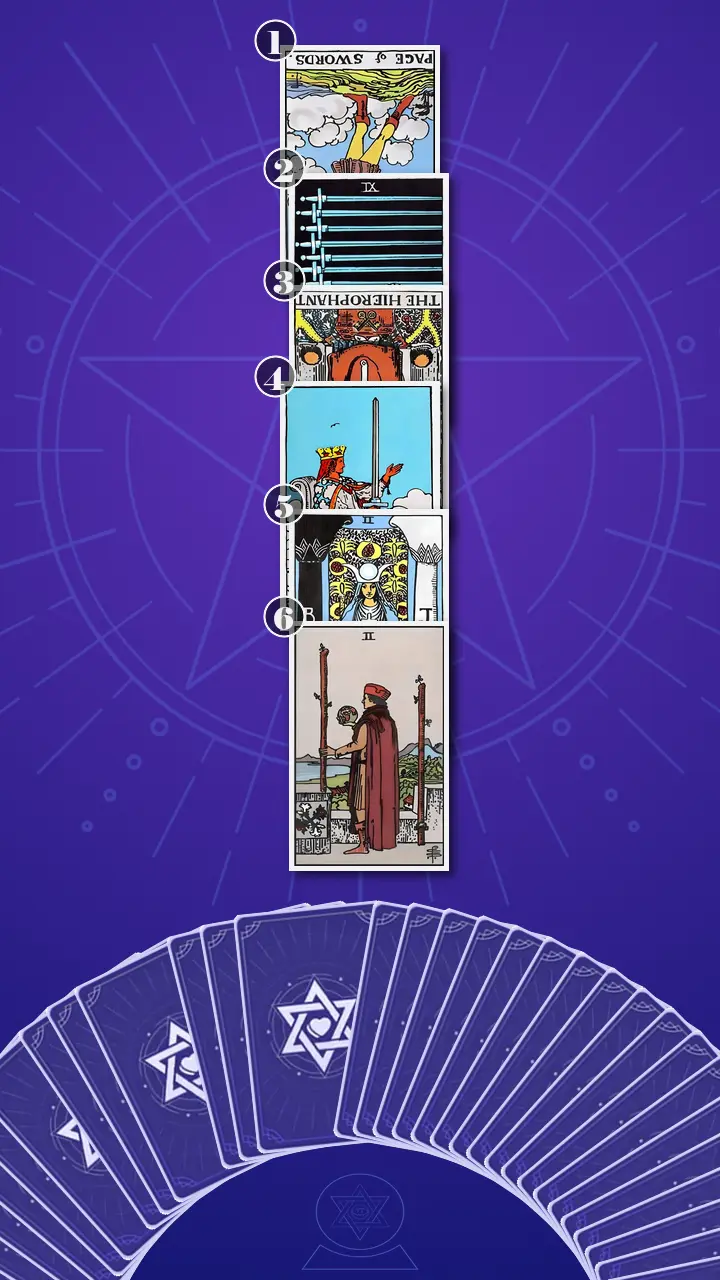
Reading the Map: Card Meanings in Context
Position 1 — Surface pattern: the observable 2 a.m. loop
“Now we’re turning over the card that represents your surface pattern: the observable 2 a.m. approval-seeking behavior loop and how it hijacks choice,” I said, and flipped the first card.
It was Page of Swords, reversed.
I pointed to the Page’s raised sword and sideways glance—alert, quick, watchful. “This is the card of mental curiosity,” I said, “but reversed, it becomes surveillance. It’s information-hunting that looks like clarity and responsibility while it quietly keeps you stuck in doubt.”
And I used the modern translation out loud because Jordan needed to feel how specific this was: “It’s 2 a.m. and you’re lying in bed with one eye on your course planner and the other eye on RateMyProfessors, re-reading the same reviews like they might transform into a permission slip. You’re not learning new information—you’re trying to neutralize the feeling of making a visible mistake.”
Jordan gave a small laugh that sounded like it had a sharp edge. “That’s… uncomfortably accurate,” she said. “Like, kind of rude. I literally re-sort by most recent.”
I nodded. “Research isn’t the problem—research as a permission slip is.”
I used the echo that always lands with people in this loop: “It’s like refreshing a tracking number that won’t update until morning. The package isn’t moving—but your anxiety is doing the shipping. You keep thinking, If I find one more data point, I can relax… and then you look up and you’re more wired.”
I named the energy dynamic so it didn’t feel like a character flaw: reversed Page is a blocked Air energy—restless, vigilant, scanning. “In excess, it becomes hypervigilance. In deficiency, it becomes trust-collapse. Either way, your mind stays ‘on’ like background tabs you can’t close.”
As I said that, Jordan’s hand moved off-screen toward where her phone probably was. Then she stopped herself. That pause—tiny, almost invisible—was our first micro-win.
Position 2 — Emotional driver: what the loop is trying to soothe
“Now we’re turning over the card that represents the emotional driver: what feelings and mental pressure the behavior is trying to soothe in the moment,” I said.
Nine of Swords, upright.
The imagery is blunt: someone sitting upright in bed, dark room, nine swords hanging like a row of neon signs you can’t turn off. I kept my voice steady. “This is the card of night-rumination—your brain replaying worst-case scenarios like trailers you never asked to watch.”
I tied it directly to her lived moment: “The room is quiet, but your brain is catastrophizing: ‘What if I pick wrong and fall behind?’ You open ratings like it’s a soothing ritual, but every new comment adds a fresh reason to worry—so you stay wired, not reassured.”
Jordan swallowed, eyes fixed on the card. “One bad review shouldn’t matter,” she whispered. “But it does.”
“One bad review hits harder when it secretly sounds like a review of you,” I said—not as drama, as a clean explanation of the nervous system. “Nine of Swords is not ‘you’re doomed.’ It’s ‘your threat radar is on.’ It’s your brain rehearsing: If I struggle, I’ll be exposed.”
I watched her face soften into that particular expression of recognition: relief mixed with embarrassment, like being caught doing something you’ve pretended is normal. Her shoulders dropped a fraction, but her foot kept bouncing—body saying, Yes, and I’m still scared.
Position 3 — Underlying script: the authority rule beneath the behavior
“Now we’re turning over the card that represents the underlying script: the belief about authority, worth, and ‘right choices’ that keeps the approval pattern running,” I said, and slid the next card into view.
The Hierophant, reversed.
I’ve always thought the Hierophant looks like a scene from an old courtroom drama—formal robes, set rules, the sense that the ‘right’ answer is pre-approved. Reversed, that authority gets complicated. “This is the part of you that treats an institution—or a crowd—as a judge,” I said. “But it’s also the part of you that resents that judge.”
I gave her the translation I knew would sting in a useful way: “You treat a professor’s rating like a gatekeeper to legitimacy: if the crowd approves, you’re ‘safe’; if not, you feel like you’re breaking a rule. At the same time, part of you hates that strangers get to be the judge—so you oscillate between dependence and irritation.”
Jordan’s mouth tightened, then she let out a breath through her nose. “I hate that I care,” she said, then immediately, quieter: “And I can’t stop caring.”
“Exactly,” I said. “That’s the Hierophant reversed in one sentence.”
I made the scene analogy explicit, because this card wants the script visible: “It’s like you’ve turned RateMyProfessors into a courtroom where strangers are the jury. And you’re not just trying to pick a class—you’re trying to get a verdict that says: approved, competent, allowed.”
Her gaze went unfocused for a second—memory replaying: a friend saying “that prof is brutal,” a screenshot sent to a group chat, waiting for the “looks good” reply. Then she looked back at me with a flash of anger that surprised even her. “But if I don’t do that,” she said, “what am I supposed to trust?”
I didn’t rush to comfort. I stayed with the question. “That,” I said gently, “is why we have the next cards.”
Position 4 — Hidden resource: the inner tool you already have
“Now we’re turning over the card that represents your hidden resource: an internal capacity that can help filter opinions without being ruled by them,” I said.
Queen of Swords, upright.
This card always changes the air in the room. The Queen sits with an upright sword and a forward-facing gaze—no apology, no flinching. “This is discernment,” I said. “Not cynicism. Discernment.”
I read her the modern-life scenario exactly as the Queen demands: “Instead of absorbing every review raw, you open Notes and write one clean filter question—like ‘Do I learn better with structure or flexibility?’ Then you read only to answer that question, set a timer, and stop. The reviews become data, not a verdict on your worth.”
Jordan physically sat up straighter, like her spine recognized the permission before her mind did. She opened her Notes app—she didn’t even realize she was doing it until she glanced down and half-smiled.
“Boundaries with information are self-respect in a modern outfit,” I said. “And the Queen of Swords isn’t asking you to stop caring. She’s asking you to stop treating every anonymous comment like breaking news.”
Her jaw unclenched as if the muscles were finally tired of holding court. “So I’m allowed to be selective,” she said.
“You’re allowed to decide what evidence counts,” I replied. “That’s not controlling. That’s adult discernment.”
And in my own mind, I flashed to a studio critique from my early NY art-school days—ten voices, ten opinions, one piece of work that still had to be mine. The Queen’s lesson was the same: feedback is input, not identity.
The High Priestess’ Veil: Finding Clarity Without a Verdict
Position 5 — Key shift: the inner reorientation that restores self-trust
“Now we’re turning over the card that represents your key shift: the inner reorientation that restores self-trust and reduces dependence on outside approval,” I said.
The moment before I flipped it, the call went unusually quiet—no radiator click, no keyboard sound, just the soft hum of two cities at night.
The High Priestess, upright.
I showed Jordan the veil behind her, the scroll in her lap, the stillness that looks almost defiant in a world designed around refresh buttons. “This isn’t ‘intuition’ as in magical vibes,” I told her. “This is pattern recognition that only works when you stop flooding yourself with noise. The High Priestess is your private inner library. It doesn’t update every second, but it’s more accurate over time.”
Then I anchored it to her real life, the way her thumb moves: “You close the tabs for a moment and sit in the quiet long enough to hear your own standards: what pace, feedback style, and structure actually help you learn. You notice your body’s response when you imagine each option, and you let that be part of the decision—without needing unanimous online approval.”
Setup: I could feel how hard this was for her, because at 2:07 a.m. the mind wants a guarantee more than it wants growth. “Right now,” I said, “you’re stuck in the belief that you must choose perfectly, because a wrong choice would feel like proof. And that pressure makes the only thing that feels safe… a verdict from outside.”
Delivery:
Stop treating ratings as a verdict and start treating your inner knowing as the veil you can step behind to read what actually fits.
I let silence do what silence does—let a sentence echo long enough to be heard.
Reinforcement: Jordan’s reaction came in a chain, not a single emotion. First her breathing stopped for half a beat, like her body froze at the idea of not outsourcing the decision. Then her eyes went slightly unfocused—memory replaying: the fifth schedule screenshot, the “FINAL_final_v3,” the moment she almost hit “Enroll” and backed out. Then her face changed, small and involuntary: her eyebrows lifted a fraction, and her eyes went glossy, not with tears yet, but with the edge of them.
“But if I do that,” she said, a flicker of anger cutting through, “doesn’t it mean I was… wrong? Like I wasted all this time?”
I kept my voice warm and exact. “No,” I said. “It means you were trying to feel safe. It means your brain built a system for survival—approval-as-safety. We’re not shaming the system. We’re updating it.”
This is where I brought in my own diagnostic lens—the one I’ve used since I was a kid obsessed with old films and later, as an artist trying to find the frame that makes a story make sense. “Think of this like an Einstein thought experiment,” I told her. “We don’t need more data yet. We run a clean mental experiment to see what’s true for you.”
“Seven minutes,” I continued, “a High Priestess pause before you open any ratings site: (1) Put your phone face-down. (2) Write two lines: ‘In this class, I need ___’ and ‘I don’t do well with ___.’ (3) Imagine each option for ten seconds and note what your body does: tighten, soften, or neutral. If you feel overwhelmed, stop early—neutral is still data.”
Jordan looked down at her desk, then actually flipped her phone over. I heard the soft tap. The glow disappeared from her face, and the room on her side of the screen suddenly looked gentler—less like a spotlight, more like a bedroom again.
“Okay,” she said, and her voice was quieter in a different way—less defeated, more grounded. “When I imagine Section A… my shoulders go up. When I imagine Section B… I feel kind of neutral. Not excited. Just… not clenched.”
“That’s data,” I said. “And it’s yours.”
Then I made the pivot explicit, because this is the hinge of the whole reading—the moment we move from being rated to being resourced: “This is the shift from ‘I need approval to choose’ to ‘I choose by my criteria, then I review my experience and adjust.’ That’s how self-trust is built—through small experiments, not perfect predictions.”
Jordan sat back, like she’d been holding herself forward for hours and just realized she could rest. There was a tiny dizziness in her expression too—what happens when clarity arrives and you realize it also comes with responsibility. Not punishment. Responsibility.
Holding the Globe: A Next Step That Breaks the Loop
Position 6 — Next step: a concrete, low-risk action
“Now we’re turning over the card that represents your next step: a concrete, low-risk action that puts self-led criteria into practice and breaks the late-night loop,” I said, and flipped the final card.
Two of Wands, upright.
The figure holds a globe and looks toward the horizon—like someone who has options and knows they’ll never get 100% certainty before choosing. “This is planning and commitment,” I said. “Not forever. Just commitment long enough to generate real feedback.”
I translated it into a modern beat that Jordan could actually do: “You choose one direction based on your top two criteria, then take one proactive step in daylight: enroll, email a question, skim the syllabus, or add office hours to your calendar. You’re not trying to predict the perfect outcome—you’re building options through action and adjusting with real experience.”
Jordan’s fingers hovered over her keyboard, and I watched her do the internal tug-of-war—control (more tabs) versus safety (sleep, stability). “I always want to keep it ‘unlocked,’” she admitted.
“That makes sense,” I said. “Keeping it unlocked feels like protection. But the Two of Wands is reminding you: Make the choice, then let real experience—not imagined judgment—be your feedback.”
From Permission Slip Detox to Actionable Advice
I leaned back and stitched the ladder into one clean story for her—because after six cards, what people need is a narrative they can carry into real life.
“Here’s what your spread is saying,” I told Jordan. “At the surface, your mind goes into watch-mode (Page of Swords reversed) and treats information like a sedative. Underneath, the fuel is nighttime threat rehearsal (Nine of Swords): the fear that a hard class will look like a personal verdict. The root is an authority script (Hierophant reversed): you’ve half-agreed to a rule that says the ‘right’ choice must be blessed by an external crowd, even while you resent that crowd. But you already have the resource to cut through it (Queen of Swords): boundaries, filters, choosing what evidence counts. And the turning point (High Priestess) is reclaiming inner authority—quiet criteria before public noise. Then the landing (Two of Wands) is a small commitment that creates real data.”
“The cognitive blind spot,” I added, “is thinking the problem is lack of information. The spread says the deeper issue is where authority lives. The transformation direction is simple but powerful: outside opinions become one input, not the final authority.”
Then I gave her next steps designed for real life—low friction, clear boundaries, no grand speeches. I also used my own communication strategy here, because Jordan didn’t need more willpower; she needed a structure that slowed her mind. “If your thoughts get slippery at night,” I said, “we’re going to make them physical—like an artist does. I call it a Manuscript Mindmap: mirror-writing one short line to force your brain to slow down and focus.”
- Set a Queen of Swords timerTonight, give yourself 10–15 minutes of ratings research on one site only. When the timer ends, physically close the laptop and put your phone across the room.Expect your brain to protest (“This is irresponsible”). Treat that as the loop talking, not a fact. If you notice your jaw clench or you re-open the same review, that’s your stop cue—not a cue to dig deeper.
- Do a 7-minute High Priestess pause (the “quiet list”)Before you open any reviews, put your phone face-down and write two lines: “In this class, I need ___” and “I don’t do well with ___.” Then do a 60-second tighten/soften/neutral check: imagine Section A for 10 seconds, Section B for 10 seconds, and label each response.If body signals feel vague, keep it to the three labels only. If you feel flooded, stop and come back in daylight—neutral is still data.
- Make a Two of Wands commitment that’s reversible on purposeChoose one class using only your top two criteria, then take one action within 24 hours: enroll, draft an email to the professor/TA, skim the syllabus, or add office hours to your calendar. Create a “Review Later” note for week 2: workload, clarity, how you feel in class.Lower the stakes with a rule: “I commit for two weeks, then reassess with real data.” If emailing feels intense, draft it and schedule-send for morning.
Before we ended, I offered one extra tool—not required, just supportive. “If the night spirals are loud,” I said, “try putting on a single track you associate with focus—something like Mozart K.448 at low volume. Not as a magic fix. As a cue to your nervous system: we’re shifting from refresh to read.”

A Week Later: Ownership, Not Certainty
A week after our session, Jordan emailed me a screenshot—not of RateMyProfessors, but of her calendar. Two office-hour blocks were color-coded in, and next to them: “Week 2 Review Later.” Her message was one line: “I did the High Priestess pause, picked the neutral one, and hit enroll before midnight.”
In a follow-up note, she admitted something that made me trust the change even more: she still felt a flicker of “what if I’m wrong?” the next morning. But it didn’t turn into a spiral. She said she made coffee, sat alone by her window for ten minutes, and let the doubt pass without reopening the reviews.
That’s what I love about a real Journey to Clarity: it rarely looks like fireworks. It looks like a jaw unclenching. A phone turned face-down. A choice made without a jury.
When a choice feels like it’s happening under a spotlight, it makes sense that you keep reaching for strangers’ approval—because the real fear isn’t the class, it’s the moment a ‘wrong’ pick might look like proof you’re not enough.
If you trusted—even just 5% more—that your criteria are allowed to matter, what’s the smallest decision this week you’d make from your own quiet list first?