From Paying Fast to a Fair Money Rule: My Post-Date Venmo Pivot

The Venmo Request That Hit Before the Door Even Closed
“It’s not the money—it’s the vibe of being invoiced.”
Alex (name changed for privacy) said it like she’d been holding the sentence behind her teeth for weeks. Twenty-nine, mid-level marketing in New York, stable job, not-stable cost of living—yet somehow early dating still had her doing post-date math like it was part of the romance. She wanted to feel chosen and cared for, but she was scared that naming a money boundary would make her look petty. Hard to love. “Dramatic.”
She described Thursday night like a clip she couldn’t stop replaying: 9:42 p.m., walking up the narrow stairs to her Chelsea walk-up, mezcal and lime still clinging to the back of her throat. Keys clattered into the bowl by the door. The kitchen was dark except for the blue glow of her screen when she flipped her phone back over—because of course she did.
The Venmo notification popped up like an emotional jump-scare. And her body answered before her brain could. Jaw tight. Chest tight. Thumb already moving. She hit Pay the way you hit “Agree” on a Terms of Service you didn’t read because you just want the app to open.
“I pay immediately to keep it… smooth,” she said, eyes on her hands. “And then I lie in bed and spiral, like—did I even like him? Or am I just annoyed? Am I overreacting? Why does it feel like I’m being audited after every date?”
I nodded, not in a “here’s the mystical answer” way, but in the way you nod when someone finally says the quiet part out loud. “Let’s make this less about decoding what their Venmo request means and more about finding clarity around what you will and won’t do. We’re not here to win a vibe war. We’re here to stop paying for peace.”

Choosing the Compass: The Relationship Spread · Context Edition
I had Alex take one slow breath with me—nothing ceremonial, just a nervous-system handoff from the group-chat spiral to something we could actually use. I shuffled until the cards felt steady in my palms, like a deck becoming a map.
“For this,” I told her, “I’m using the Relationship Spread · Context Edition.”
And for anyone reading who’s ever googled ‘Venmo request after a date boundary’ at 1 a.m.: I chose this spread because the issue isn’t just money. It’s the pattern—how a repeated ‘after-the-date invoice’ vibe changes closeness, respect, and attraction. This layout keeps the classic you/them/dynamic structure, then pivots into what matters most here: boundary definition, clear communication, and sustainable follow-through. Not prediction—practice.
“The first card shows your automatic response,” I said. “The second reflects their money operating system—without us turning into mind-readers. The center shows the loop you two are creating together. Then we go to your boundary blueprint, your wording style, and finally the system that keeps you out of resentment.”
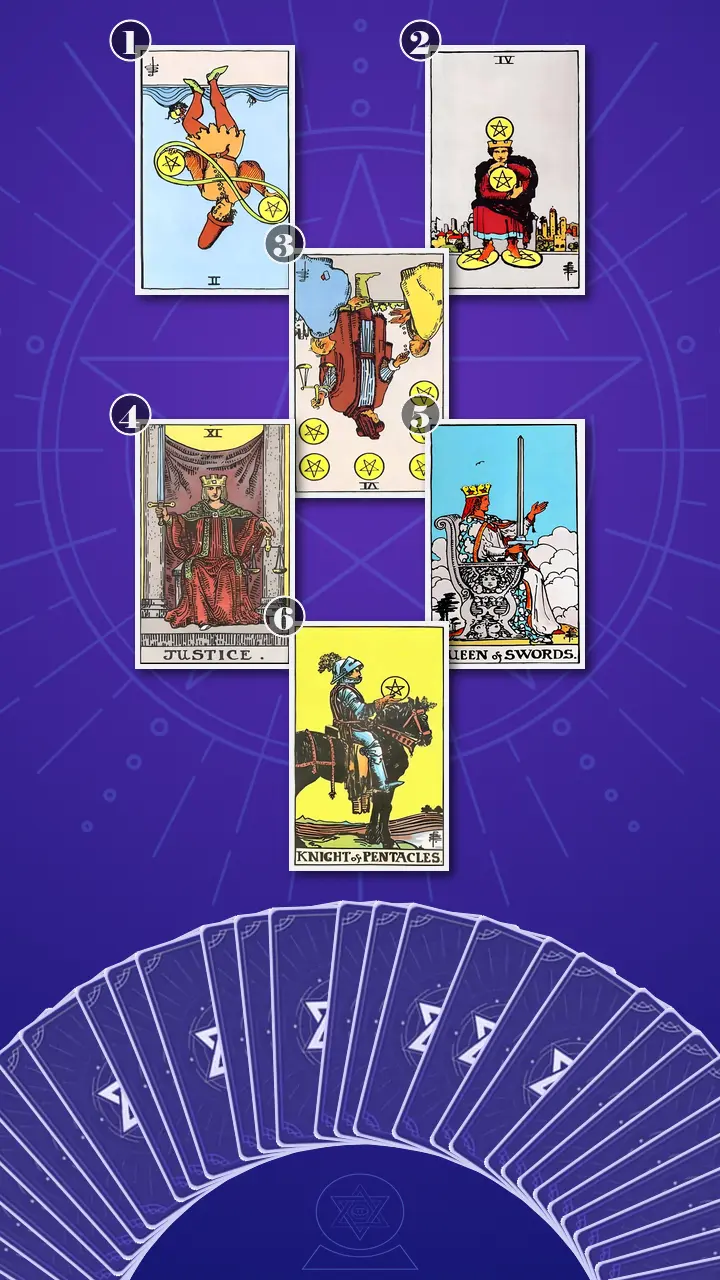
Reading the Map: Coins, Control, and the Loop That Keeps Repeating
Position 1: Your current pattern around paying and reacting
“Now flipped over is the card representing your current pattern around paying and reacting.”
Two of Pentacles, reversed.
In modern life, this is the moment Alex already described perfectly: the split-second after you get home in NYC and your brain tries to juggle romance, budget, and self-image at once. Venmo request appears. You want to stay the ‘easygoing’ version of yourself, so you pay instantly—then you re-run the night like a spreadsheet, trying to prove you’re not “too much” for caring.
Reversed, the energy is a blockage: too many tabs open, the laptop overheating. The juggler isn’t playful anymore—she’s wobbling. The fun-date energy tips into budgeting and self-protection, like spinning plates you can’t let crash.
Alex gave a small laugh that wasn’t funny. It came out sharp, then died off. “That’s… brutal,” she said. “Because I literally do that. I pay in under a minute. And then I’m in Notes like it’s my unofficial therapist substitute.”
I kept my voice warm, but clear. “That reflex—pay fast—makes sense as protection. It prevents awkwardness in the moment. But it also buys you a different cost: resentment, self-doubt, and the private accounting afterward.”
Position 2: Their likely money mindset/approach
“Now flipped over is the card representing their likely money mindset that’s shaping this pattern.”
Four of Pentacles, upright.
This is someone who treats spending like risk exposure. Clean accounting helps them feel safe and in control. That doesn’t automatically make them selfish or a villain in a Cut essay; it’s simply a tight-grip style.
Upright, the energy is a balance that can lean into excess: security is prioritized over warmth. The coin on the chest in the classic image is almost too perfect—resources held close, emotions held close. The question isn’t “Are they bad?” The question is: does their version of “fair” leave room for generosity and attunement, or do you always end up feeling managed?
Alex’s shoulders crept up, then she forced them down. “It’s like… he’s not mean. It’s just so… itemized.”
Position 3: The shared money dynamic you two create together
“Now flipped over is the card representing the shared dynamic—what these repeated Venmo requests create between you two.”
Six of Pentacles, reversed.
I watched Alex’s breathing change as soon as she saw it—quick, shallow, like her chest was trying to protect its own ledger.
Here’s the scene this card describes: even if you split down the middle, the energy can still feel off—like you’re being graded for how quickly you comply. The repeated requests create a quiet hierarchy: one person sets the system, the other adapts. That’s why the resentment isn’t irrational. It’s information.
And this is the line I want anyone stuck in “is it normal to request money after every date?” discourse to hear: Equality on paper isn’t the same as care in real time.
Alex’s face did a three-part shift—first a tiny freeze (breath held, fingers hovering as if she still had her phone in her hand), then an unfocused stare like she was replaying a specific Venmo notification, then a soft exhale that sank her shoulders.
“It’s like a post-date Jira ticket,” she said quietly. “Technically organized. Emotionally… dead.”
“Exactly,” I said. “That’s reversed Six energy. Transactional, measured, worth-math. And it traps you in the internal ledger voice: ‘If I pay fast, I’m chill. If I say something, I’m dramatic.’”
When Justice Spoke: Scales, Sword, and the Bridge Between You
Position 4 (Key): Your healthy money boundary—what ‘fair’ means for you
“Now flipped over is the card representing your healthy money boundary—what ‘fair and respectful’ means for you in practice.”
The room got unusually quiet, the way it does on a ship at night when the corridor noise drops and you can suddenly hear the ocean doing its slow, massive breathing. I’ve guided people through hard conversations on transoceanic voyages—people who could discuss mergers calmly but couldn’t say, ‘I need this to feel mutual.’ The silence before the truth always sounds the same.
Justice, upright.
Setup. Alex was stuck in the most exhausting kind of decision fatigue: trying to decode what a Venmo request “says” about her desirability and his character, while her body kept flashing the same alarm—tight jaw, tight chest, a restless urge to fix it with the quickest payment possible. She wanted to be courted, but she feared that naming the boundary would collapse the whole vibe.
Delivery.
Not ‘keep the peace by paying silently’—choose a clear standard, hold it like Justice’s scales, and speak it with the clean edge of the sword.
I let that land. No extra words. Just air.
Reinforcement. Alex blinked hard once. Her mouth opened like she had an argument ready—then closed. Her eyebrows pulled together, not in confusion, but in that flash of resistance that’s really grief: grief for how long she’d been trying to be “low maintenance” while privately tallying costs like a performance review she never agreed to be in. Her breath caught (freeze), her gaze went slightly distant (the memory replay), then she exhaled in a shaky release that softened her shoulders.
“But if I do that,” she said, voice tighter at first, then steadier, “doesn’t it mean I’ve been… training this? Like I did it to myself?”
“It means you were protecting yourself the only way you knew,” I replied. “Justice isn’t about blame. It’s about structure. The boundary isn’t punishment; it’s a policy you can repeat.”
Then I brought in my own lens—my Bridge-Corridor Theory, born from Venice and refined in every awkward human passageway I’ve ever watched. “In Venice,” I told her, “a relationship isn’t one straight road. It’s corridors and bridges. Money moments are bridges: short crossings where you either connect cleanly—or you hesitate, wobble, and drop the weight into the water. Paying instantly is you sprinting over the bridge so no one sees you hesitate. Justice asks you to pause at the bridge entrance and put up a simple sign: ‘This is how I cross.’ If someone wants closeness, they’ll cross with you.”
I looked at her. “Now, with this new perspective, think back to last week. Was there a moment—maybe right when you saw the request—where this insight could’ve made you feel different?”
She swallowed. “Yeah,” she said. “I would’ve realized it wasn’t a personality test. It was… data. And my boundary is the thing I actually control.”
“That’s the pivot,” I said, and I meant it as a clinical observation and a kindness. “From tense resentment and self-doubt fueled by silent scorekeeping to calm self-respect through explicit, repeatable money agreements. Stop decoding the request. State the agreement.”
The Queen’s Clean Line: Clarity That Doesn’t Apologize
Position 5: How to communicate the boundary clearly
“Now flipped over is the card representing how to communicate the boundary—tone, wording style, emotional posture.”
Queen of Swords, upright.
This card is your nervous system learning it doesn’t have to write a dissertation to deserve respect. In real life: instead of a 12-message draft to your friends and silence toward your date, you send one short text that’s calm and adult. A reusable template—copy/paste, not reinvent-your-personality.
I said it plainly, the way I’d coach someone on a cruise ship to speak to their partner over the hum of engines: “Clarity isn’t harsh. It’s kind—because it’s usable.”
I offered Alex a two-line script and watched her thumbs hover in the air as if she could feel the keyboard already.
“Hey—quick note on dates. I’m happy to split, but I don’t do Venmo requests after. I prefer splitting at the table or alternating. What works for you?”
Her stomach visibly flipped—then she exhaled. “It’s… so short,” she said, half amazed. “I always start with ‘I don’t want this to be weird…’”
“That’s the essay trying to pre-empt judgment,” I said. “Queen of Swords doesn’t negotiate your right to have a preference. She just states it.”
The Slow, Boring System That Stops the Spiral
Position 6: A sustainable next step you can actually maintain
“Now flipped over is the card representing your sustainable next step—the system that keeps you out of resentment.”
Knight of Pentacles, upright.
This is where we trade vibes for a plan you can maintain when you’re tired. Not a dramatic confrontation. A steady rhythm: budget-friendly first dates, splitting at the table, alternating—whatever feels aligned—repeated until your nervous system stops bracing for the Venmo buzz.
It’s the “boring” montage that’s actually soothing: choosing a low-stakes spot where the check is easy, bringing it up before phones come out, repeating the same line next week. Consistency over intensity. A boundary you can repeat beats a rule you can only follow on a good day.
From Decoding to Agreement-Making: Actionable Advice for the Next Two Dates
I leaned back and stitched the story together for her—past to present to next step.
“Here’s what the spread shows,” I said. “You’re in a loop of reactive juggling (Two of Pentacles reversed): you pay fast to keep things smooth, then privately spiral. They may be running a tight-control money system (Four of Pentacles): clean accounting equals safety. Together, that creates a transactional dynamic (Six of Pentacles reversed) where you feel measured instead of met. The solution isn’t more analysis—it’s Justice: define fairness as a repeatable agreement, communicate it with Queen of Swords clarity, and follow through with Knight of Pentacles consistency.”
The cognitive blind spot was clean: Alex kept treating money as a secret test of desirability. “If I can just interpret this correctly, I’ll know if I’m worth choosing.” But the transformation direction was even cleaner: shift from silent scorekeeping to stating a simple, repeatable money agreement—and letting their response inform attraction or exit.
Then I offered her a small set of next steps, designed to be doable in NYC life, not fantasy-life:
- The 10-Minute “Justice Script” DrillOpen Notes and write one sentence you can repeat: “I’m happy to split, but I don’t do after-the-date Venmo invoices—let’s split at the table or alternate.” Then write the paragraph you want to add and label it “Anxiety DLC.” Choose one follow-through for the next date: ask before the check comes, pick a venue where splitting is clean, or pause before paying any request.If your chest tightens, stop early. The goal is a usable line, not forced confidence.
- The Two-Sentence Boundary Text (Queen of Swords)Before the next date—or at least before the next check—send: “Quick note on dates: I’m happy to split, but I prefer handling it at the table or alternating rather than Venmo requests after. What works for you?”Use my Burano-inspired Lace Communication Method: one clean edge, no extra frills. If you start justifying, delete the second paragraph.
- The 10-Minute Venmo Pause RuleIf a post-date request arrives anyway, don’t pay immediately. Set a 10-minute timer. Then respond once: “Hey—I prefer handling it at the table. Let’s do that going forward.”Think of it as the Gondola Balance Technique: you’re redistributing emotional load so you’re not carrying ‘keeping it smooth’ alone.

A Week Later: The Quiet Proof of Finding Clarity
A week later, Alex messaged me a screenshot—cropped tight, no drama. Two sentences. No emojis trying to soften the impact. She’d sent the Queen of Swords text before date four.
His reply was simple: “Totally fair. Let’s just split at the table.”
She wrote, “I slept through the night. Woke up and my first thought was still ‘What if I sounded intense?’—but then I laughed. Quietly. Alone in a coffee shop. It felt… lighter.”
I thought about how often people mistake clarity for conflict. This was the opposite. This was a small, grounded shift from paying-for-peace to self-respect—money as shared logistics, not a secret referendum on worth.
And if tonight you’re trying to be the “chill” version of yourself while your body is keeping a full spreadsheet in your chest, remember: it’s not romance that’s failing—you’re just tired of paying for peace.
If you didn’t have to prove you’re easygoing, what simple money agreement would let you stay present on the date—and what would it be like to let their response give you clean information?