From Venmo-Request Anxiety to Self-Respect: The One-Sentence Ask

Finding Clarity in the Venmo Request Spiral
You covered brunch because they “forgot” their wallet, smiled like it was fine, and now you’re stuck in a Venmo request spiral because you don’t want to look petty.
Jordan sat across from me on my screen—NYC light in her apartment doing that late-afternoon thing where it looks golden, but everything still feels a little too sharp. She kept rubbing the side of her jaw like it was sore. When she spoke, it came out casual on purpose.
“It was West Village brunch. Like… loud-laughing, clinking-glasses, the check folder hits the table and suddenly it’s a social test,” she said. “They did the pocket pat, the half-laugh—‘I forgot my wallet.’ And I just… tapped my card. I literally said, ‘It’s fine.’”
Her eyes flicked away, like she could still see the moment replaying on a wall behind me. “Now I’m on the train with Venmo open, thumb hovering over Request, and my jaw locks. Why is a simple Venmo request so hard?”
The unease wasn’t abstract. It lived in her body: tight jaw, chest held like she was bracing for impact. The money wasn’t the point, but the charge on her banking app felt like a tiny bug left in the system—small number, loud ping.
“We can work with this,” I told her, keeping my voice warm and plain. “Not by psyching yourself up to become a different person—just by getting you from looping to clarity. Let’s draw a map for the next step, the kind that protects self-respect without picking a fight.”

Choosing the Compass: The Celtic Cross · Context Edition
I asked Jordan to take one breath where the exhale was longer than the inhale. Not as a ritual—more like shifting gears before you merge into traffic. While she held the question in mind—They forgot their wallet at brunch. What’s my next step?—I shuffled slowly, listening for where her energy tightened when she said “petty.”
“I’m going to use a spread called the Celtic Cross · Context Edition,” I explained, turning slightly toward the reader as much as toward Jordan. “It’s useful when a single moment—like the check at brunch—feels small on paper but huge in your nervous system.”
“A classic Celtic Cross gives us the full chain: what’s happening now, what blocks the next step, what fear is underneath, and what outcome guidance looks like when you choose your values. The ‘Context Edition’ part is important here because one position is tuned specifically to the other person’s follow-through—so you don’t have to mind-read. You get data.”
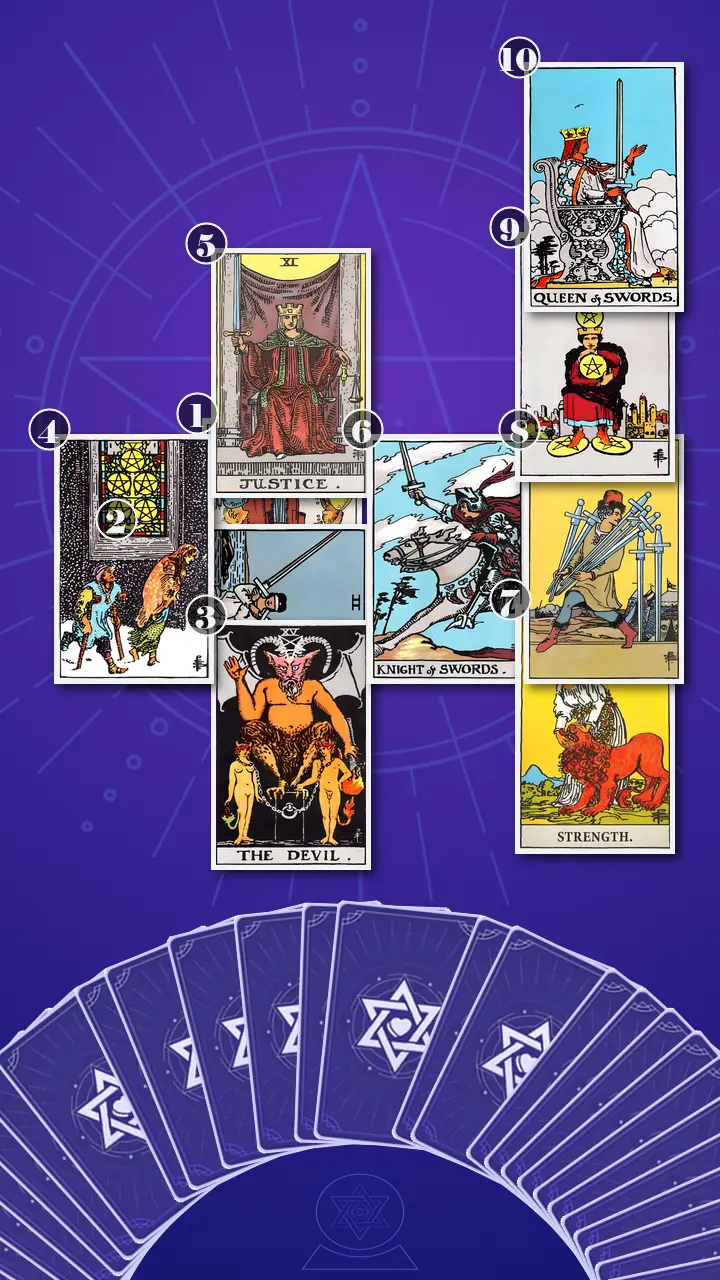
I pointed to the layout on my table. “Card 1 will name the real dynamic under the brunch moment. Card 2 will show why the follow-up feels risky enough that you freeze. And the last card—position 10—will give the cleanest, most self-respecting next step.”
Reading the Map: When Fairness Turns into Silent Resentment
Position 1: The observable reciprocity pattern
“Now flipping over,” I said, “is the card that represents what is actually happening right now in the relationship dynamic—the observable reciprocity pattern revealed by the brunch moment.”
Six of Pentacles, reversed.
I tapped the little scales in the image. “This is the card of giving and receiving. Reversed, it’s an imbalance—not dramatic, not evil, just… uneven.”
“In modern life, this is you at brunch: the check hits, you instinctively tap your card to keep things smooth. Then you’re walking home, you open your bank app, and suddenly it’s not ‘just brunch.’ It’s the realization that you were placed in the reliable role without anyone checking if you consented to it.”
Jordan let out a small laugh that had a bitter edge. “Okay. That’s… painfully accurate.” Her smile didn’t reach her eyes. She pressed her tongue against the inside of her cheek like she was trying not to grind her teeth.
“Fairness isn’t a vibe,” I said, gently, because she needed it named without shame. “It’s follow-through. This card is basically receipts with feelings attached. The scale is telling us: the fact happened—your card paid. And your body noticed.”
Position 2: The immediate challenge (why you freeze)
“Now flipping over is the card that represents the immediate challenge—what makes the next step feel awkward or risky.”
Two of Swords, upright.
“This is choice paralysis,” I said. “But more specifically: it’s a blockage in Air energy—thinking as a stand-in for action.”
“Modern scenario: you open your texts, start typing a Venmo request, and then you freeze—because every version sounds either too chill to be taken seriously or too direct to feel ‘nice.’ So you close your phone and tell yourself you’ll handle it later. And the unsent message becomes background stress for days.”
Then I mirrored her internal monologue out loud, the one she’d been living in like a tiny courtroom on loop: “If I say it, I’m dramatic. If I don’t, I’m a doormat.”
I could almost see it—the camera-close-up: cursor blinking, phone warming in her hand, chest braced like a seatbelt locking.
Jordan’s reaction came in a three-beat chain: her breath held for a second; her gaze unfocused, like she was replaying her Notes app drafts; then she exhaled through her nose, small and reluctant. A quiet nod. “Yeah,” she said. “That’s exactly it. I’m not even… deciding. I’m just… freezing.”
“That’s not your personality,” I told her. “That’s a body strategy. Your system is protecting comfort in the moment, not protecting you from actual danger.”
Position 3: The deeper root (why money feels emotionally loaded)
“Now flipping over is the card that represents the deeper root—the hidden driver that makes money-boundaries feel emotionally loaded.”
The Devil, upright.
Even through a screen, the atmosphere shifted—like the room got quieter. I’ve spent years watching people on ships cross oceans and cross their own internal lines. The Devil always shows me where someone is paying a hidden fee.
“The loose chains are the key symbol here,” I said. “You’re not actually trapped. You’re staying in a pattern because the fear of judgment feels stronger than the inconvenience of silence.”
“In modern life: you’re not worried about the money—you’re worried about what it would mean to ask. Your brain starts bargaining: ‘If I’m the easygoing one, they’ll keep inviting me.’ The real cost isn’t the brunch total; it’s the quiet trade of self-respect for approval.”
Jordan swallowed. Her shoulders lifted, then dropped. “So… I’m paying an approval subscription fee.”
“Exactly,” I said, and I let myself have one restrained inner flashback: a cruise deck at midnight, a guest smiling too hard at a cocktail party while someone ‘joked’ past their boundaries. Same mechanism, different venue. “Don’t buy belonging with silence,” I added softly. “The Devil loves that deal.”
Position 4: Recent past context (why this hit harder)
“Now flipping over is the card that represents recent past context—what’s been building up that makes this moment land heavier.”
Five of Pentacles, upright.
“This is that cold, outside-the-window feeling,” I said. “Not necessarily literal money lack—more like the emotional sting of being socially ‘with people’ but practically on your own.”
“Modern scenario: the wallet moment hits an older nerve—being the person who fills the gap. You remember other times you covered costs, smoothed logistics, or carried the awkwardness, and you get that familiar drop in your stomach—like you’re outside the warm circle even while you’re literally in the group.”
Jordan’s eyes went shiny for a second. She blinked fast, like she hated that reaction. “I hate that it gets to me.”
“It makes sense that it gets to you,” I said. “This card shows the history that amplifies your reaction. It’s not weakness. It’s pattern recognition.”
Position 5: Conscious desire (your fairness standard)
“Now flipping over is the card that represents your conscious desire—what you want to be true here and the standard you’re trying to uphold.”
Justice, upright.
“I love this card for you,” I told her. “Justice isn’t about punishment. It’s about alignment. Scales plus sword: fairness plus clarity.”
“Modern scenario: you can feel two truths at once—you want to be fair, and you want to be respected. Justice here looks like treating money as a practical detail—‘this is what was paid’—and letting that clarity protect the relationship from unspoken resentment.”
Jordan nodded more firmly this time. “Yes. Like… I’m not trying to ‘get’ them. I just want it even and clear.”
“Exactly,” I said. “You’re not asking for a favor—you’re naming a detail.”
Position 6: Near-future energy (constructive direction)
“Now flipping over is the card that represents near-future energy—the most likely constructive direction for your next step.”
Knight of Swords, upright.
“This is momentum,” I said. “Air energy moving forward. And in your situation, it’s the antidote to the Two of Swords freeze.”
“Modern scenario: on your lunch break, you stop negotiating with your own anxiety and send the simple message. No paragraphs, no emojis to soften it, no explaining your whole philosophy of fairness—just the amount and the method. The relief isn’t that it’s solved; it’s that you finally moved.”
I spoke the line I’ve watched save people from a thousand tiny spirals: “A one-sentence ask beats ten perfect drafts that never get sent.”
Jordan’s lips pressed together—then, a tiny surge of determination. Like she wanted to open Venmo right now.
Position 7: You in this (the inner resource you can embody)
“Now flipping over is the card that represents you in this—the inner resource you can embody so you don’t abandon yourself while navigating the awkwardness.”
Strength, upright.
“Strength is calm courage,” I said. “Not loud. Not aggressive. This is balance—warmth in tone, firmness in content.”
“Modern scenario: your heart rate jumps as you draft the request. You feel the urge to turn it into a joke—‘haha sorry I’m annoying’—because joking feels safer than needing. Strength is you dropping your shoulders, unclenching your jaw, reading the message out loud once, and letting it sound like an adult, not an apology.”
Jordan rolled her shoulders back as if her body understood before her brain did.
Position 8: Environment (their contribution / external pattern)
“Now flipping over is the card that represents the environment—the external behavior pattern you’re responding to.”
Seven of Swords, upright.
“This is ambiguity,” I said. “Not a verdict. A signal. It’s the energy of dodging, omission, or relying on vagueness to stay comfortable.”
“Modern scenario: you hear ‘I forgot my wallet’ and you’re left holding uncertainty. Not just the bill—also the question of whether there will be follow-through without prompting. This card says: don’t spiral into proving intent. Collect data.”
I leaned in. “Data, not drama. You don’t need to prove they’re a ‘user.’ You need to observe what they do when you make a clean request. If they pay quickly—clear. If they dodge again—also clear.”
Jordan’s face shifted from suspicion to something steadier: curiosity. Less “What does this mean about me?” and more “What happens next?”
“Clarity is kinder than guessing,” I said.
Position 9: Hopes and fears (the push-pull)
“Now flipping over is the card that represents your hopes and fears—what you’re afraid it will mean if you speak up.”
Four of Pentacles, upright.
“This is your self-protection,” I said. “A contraction around resources—money, time, emotional access. It makes sense. After an imbalance, your instinct is to clamp down.”
“Modern scenario: you catch yourself thinking, ‘I’ll just stop inviting them out.’ It feels protective, but it also feels like withdrawing without giving reality a chance to show itself. This card says: protection is valid, but protection works best when paired with communication—not silent distance.”
Jordan exhaled. “I’ve already started doing that,” she admitted. “Less warmth. Less… anything.”
“That’s the coin held tight to the chest,” I said. “Understandable. But it doesn’t give you the information you actually want.”
When the Queen of Swords Spoke: Turning Vibes into Facts
Position 10: Integration and best next step
I let my hands rest for a moment before flipping the final card. The room felt still in a way I’ve come to recognize—like the second before a ship’s announcement, when everyone instinctively quiets because the next sentence will tell them what to do.
“Now flipping over,” I said, “is the card that represents integration and the best next step—the most empowering response that protects self-respect and clarifies reality.”
Queen of Swords, upright.
“This is Air mastery,” I told her. “Clean boundaries. Calm truth-telling. No punishment, no pleading. The open hand says, ‘Here is the fact.’ The sword says, ‘Here is the line.’”
Jordan’s eyes narrowed slightly, like the part of her that feared conflict wanted to argue first. I could see the setup playing in her nervous system exactly as the blueprint predicts: subway, Venmo open, thumb hovering, jaw locked because she can’t find a version that won’t make her seem petty.
Stop swallowing the awkwardness to keep the vibe; speak one clean truth and let the Queen’s clear blade set the boundary.
There was a pause after I said it—on purpose. I let the sentence hang like a bell tone that keeps ringing after you stop striking it.
Jordan’s reaction arrived in layers. First: a micro-freeze—her lips parted, breath caught, eyes widening a fraction. Second: the meaning landed—her gaze dropped to somewhere off-screen, as if she was watching herself at the table saying “it’s fine,” then watching herself later clenching her jaw alone. Third: emotion moved—she blinked, hard, and her shoulders lowered like she’d been carrying a bag she forgot she was holding.
Then the “unexpected reaction” came: a flash of anger, clean and honest. “But why is it my job to make it normal?” she said, voice sharper than before. “Like—if they forgot their wallet, shouldn’t they just… handle it?”
I nodded, slow. “Yes. And that anger is a boundary trying to form. The Queen of Swords isn’t saying you have to do their job. She’s saying: if you want clarity, you don’t get it through hoping they read your mind. You get it through one clean ask, and then their follow-through tells you what’s real.”
I softened my tone, moving deliberately into what I call Social Role Switching—a tool I learned in cross-cultural spaces, where the same sentence can land wildly differently depending on the mode you’re in. “Right now you have two modes available,” I told her. “Supportive Mode for your own nervous system—so you can stay kind to yourself while you do the awkward thing. And Assertive Mode for the message—so the request is clear, neutral, and non-negotiable.”
“Assertive doesn’t mean harsh,” I added. “It means you don’t abandon yourself to protect the vibe.”
“Here’s the reframe you need to hear,” I said, aligning the Queen with Justice and the Seven of Swords. “A clear ask isn’t ‘making it weird.’ It’s choosing self-respect over mind-reading—and letting their follow-through tell you what’s real.”
I watched her unclench her jaw—literally. “Okay,” she said, quieter. “I can do one sentence.”
“Before we leave this card,” I asked, “use this new perspective and look back at last week. Was there a moment—the train, your desk, the group chat—where this would’ve changed how you felt?”
Jordan laughed, this time with relief. “Tuesday night on the 4/5 train. Venmo open. I literally exited the app like it burned me.”
“That’s the shift,” I said. “This isn’t just about $38.50. It’s a move from tight, looping second-guessing toward grounded clarity. From protecting the vibe through silence to protecting self-respect through a clear, neutral ask.”
The Clean Ask Protocol: Actionable Next Steps for Asking to Be Paid Back
I gathered the spread into one story for her: “The Six of Pentacles reversed says the brunch moment revealed an unequal exchange. The Two of Swords shows the freeze—your body bracing against discomfort and calling it ‘being chill.’ The Devil shows the deeper bargain: buying belonging with silence. Justice is your north star—fairness without drama. The Knight of Swords says: one timely message. Strength says: warm tone, firm content. The Seven of Swords says: get data from follow-through, not from guessing. The Four of Pentacles says: don’t withdraw in silence—use the tightening as a signal to set a boundary.”
“Your blind spot,” I told her gently, “is thinking that if you do it perfectly, you can prevent awkwardness and prevent rejection. But clarity doesn’t prevent reaction—it prevents confusion. The transformation direction here is simple: treat money as a practical detail, and boundaries as normal.”
Jordan frowned. “But I barely have five minutes. My day is insane.”
“Then we make it cruise-ship simple,” I said, pulling in my Maritime Social Protocol—the way you keep things smooth in tight quarters without building resentment. “On a ship, you don’t wait until disembarkation day to argue about a tab. You settle the practical detail early, calmly, and you keep it moving. Same here.”
- The One-Sentence Rule (2 minutes)Open Venmo and write one factual line: “Hey— I covered brunch on Sunday ($X). Can you Venmo me when you get a sec?” No apologies, no jokes, no paragraphs.If your chest tightens and you start editing past 60 seconds, put your phone down, take three slow breaths, then come back and keep the exact same sentence.
- The 10-Minute Send Window (calendar it)Pick one specific window within 24 hours—like 12:40 PM on your lunch break—and treat it like a calendar task: “Send request.” Draft, read once out loud, hit send.Your brain will demand a ‘perfect tone.’ Treat that as the signal to go shorter, not longer.
- Do Not Disturb After Sending (20 minutes)After you hit Request (or send the text), put your phone on Do Not Disturb for 20 minutes so you’re not refreshing for validation.This protects Strength energy: kind, steady, not spiraling.
“And if they respond weird?” Jordan asked.
“Then the spread still did its job,” I said. “Because you’ll have reality. If they pay quickly: great, it was probably carelessness. If they dodge, minimize, or get snippy: that’s information about reciprocity—and you can decide how close you want them.”
I offered her a ready-to-use script from my toolkit, the one that works when people overstep: “Make eye contact if you’re in person. Slow your speech. And use an ‘I need’ statement. In text form, it becomes: ‘I need us to settle brunch—can you send $X on Venmo?’ Same calm energy.”

A Week Later: The Quiet Proof
Six days later, Jordan sent me a message. It wasn’t long. It didn’t need to be.
“I did it,” she wrote. “One sentence. No emoji. Put my phone on DND. They paid in like five minutes and said, ‘Omg sorry, totally slipped.’ I slept through the night.”
She added, almost as an afterthought: “I still woke up and thought, ‘What if that was rude?’—but then I laughed. Because it wasn’t rude. It was normal.”
This is what a real Journey to Clarity looks like in modern relationships: not a dramatic confrontation, not a perfectly soothed nervous system—just a clean action that restores your self-respect and gives you honest data.
We’ve all held a perfectly chill smile in public while our body quietly tightens—because asking for something fair feels like it might cost us belonging.
If you trusted that one calm, neutral sentence could protect your self-respect without starting a fight, what would your exact clean ask sound like?