The 'No Worries :)' Smile—And the One-Sentence Lateness Boundary

The 7:12 p.m. WhatsApp Hover
If you’ve ever said “It’s fine!” at a café while your jaw was clenched and you were quietly tracking minutes like a spreadsheet, you’re not chill—you’re self-editing.
Taylor (name changed for privacy) showed up on my screen from London with the kind of “I’m totally okay” smile that doesn’t reach the shoulders. She’s 28, a project coordinator, the person who’s always ten minutes early and somehow still ends up in the same loop: waiting, rehearsing, swallowing.
As she talked, I could picture the scene like it was projected on the planetarium dome behind me: 7:12 p.m., outside a café by Liverpool Street Station. Cold air on her cheeks. The espresso machine hissing through the door every time it opened. Her phone warm from her thumb hovering over WhatsApp, checking the typing bubble like it’s a weather radar.
“They’re late again,” she said. “And I don’t even want to make it a thing. But… it keeps happening. I always end up apologizing for being annoyed.”
I watched her mouth form a polite, practiced line—while her fingers kept worrying the edge of her sleeve. The annoyance wasn’t loud. It was contained. Compressed. The kind that lives behind the molars. Like holding a complaint behind your teeth until your jaw aches, because you’re scared that if you let it out, it’ll make you sound “difficult.”
“If your mouth says ‘no worries’ but your body says ‘absolutely not,’ believe your body,” I told her gently. “We’re not here to turn you into a confrontational person. We’re here to help you find clarity—so you can protect your time without turning it into a fight.”

Choosing the Compass: How Tarot Works When You’re Feeling Stuck
I was sitting in a small staff room at the Tokyo planetarium after closing—projectors cooling down with a soft mechanical sigh, the faint scent of dust warmed by stage lights. When I read tarot, I treat it the way I treat astronomy for visitors: not as fate, but as a map of patterns and timing. A way to stop arguing with your own nervous system and start noticing what repeats.
I asked Taylor to take one breath in through the nose, out through the mouth—nothing mystical, just a clean reset. While she held the question in her mind—“They’re late again—what past taught me to swallow my annoyance?”—I shuffled slowly, letting the sound do what it always does: pull the attention out of spiraling thoughts and into the present moment.
“Today, we’re using a spread I designed called the Four-Layer Insight Ladder · Context Edition,” I said. “It’s compact, but layered. It’s not about predicting whether they’ll finally be on time. It’s about excavating why your body locks up and your voice disappears—then building one practical next step you can actually use this week.”
For you reading along: this is exactly why this spread fits a situation like this. When you’re stuck in conflict-avoidant politeness—especially around lateness—you don’t need more motivation. You need the inner storyline: trigger → learned rule → fear → rebalancing shift → boundary practice. That’s how you stop the “No worries :) / resentment pipeline.”
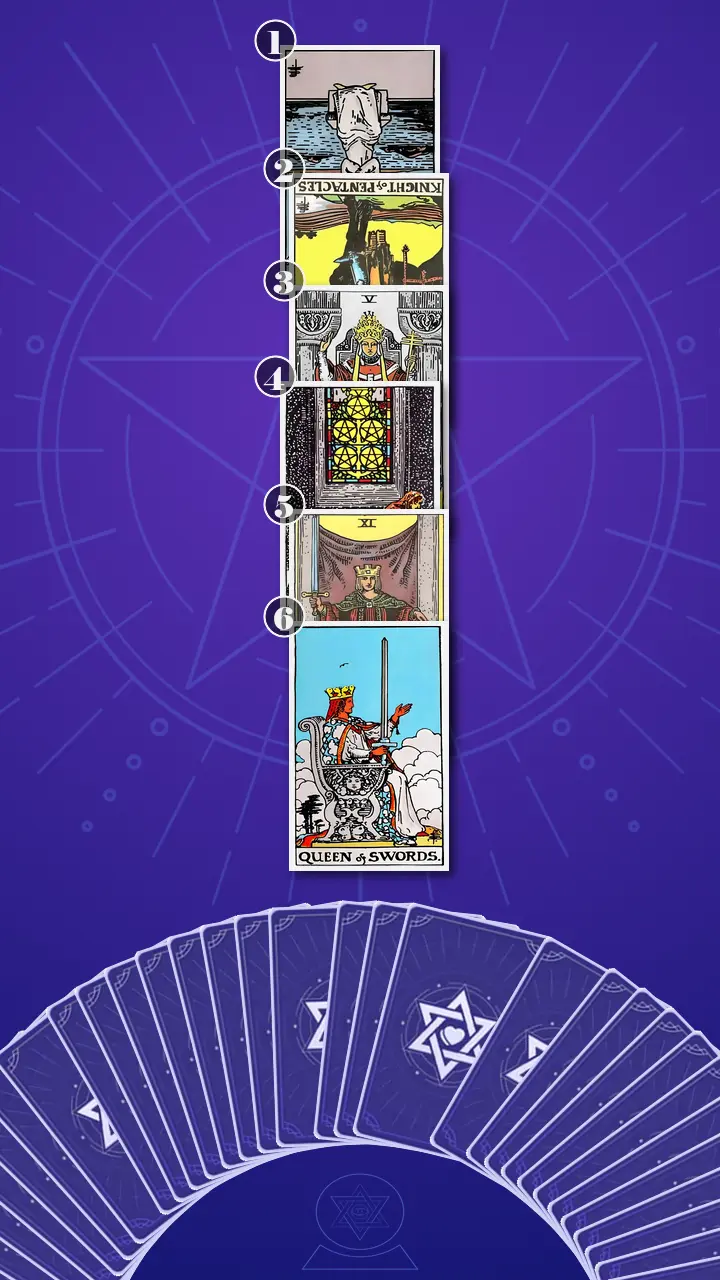
I showed her the ladder layout—six cards, stacked like steps. “The first card is the present pattern: what you do in the moment. A few steps down we’ll hit the past lesson—your old rulebook. The lower steps show the underlying fear, then the rebalancing key, and finally your next-step script.”
Reading the Map: The First Card and the Habit of Self-Silencing
Position 1 — The present pattern: what you do in the moment when you feel annoyed
“Now we turn over the card representing the present pattern: what you do in the moment when you feel annoyed,” I said.
Two of Swords, reversed.
Even over video, I felt Taylor react—like her body recognized the image before her brain caught up. And it made sense: this is the card for the internal stalemate, the blindfold you put on yourself so you don’t have to name what you already know.
“This is so specific it’s almost rude,” I said, keeping my voice warm. “It’s you sitting at a café table in London with your drink already ordered, watching the agreed time pass. They’re not there. You feel the irritation rise—then you instantly clamp down. Smile ready. ‘No worries!’ locked and loaded. Later you replay the whole thing and draft the message you ‘should have’ sent, but in the moment you go quiet and make yourself smaller.”
In terms of energy, this is blocked Air: truth and communication wanting to move, but getting stopped at the throat. Reversed, it’s not peaceful. It’s strained—like you’re forcing calm on top of a system that’s already producing a clear signal.
I leaned in and used the internal monologue structure I’ve heard from so many people who ask, “Why do I say ‘no worries’ when I’m actually annoyed they’re late?”
“You want to say: ‘Hey, I’ve been waiting.’ You say: ‘All good? :)’ And your body says: tight jaw, tense shoulders, clenched stomach.”
Taylor let out a short laugh—sharp at first, then a little bitter. “Yeah,” she said. “That’s… brutal. Like, it’s fine, but it’s also not fine.”
“Exactly,” I said. “And you’re not wrong for having the feeling. The card isn’t calling you dramatic. It’s showing you the cost of keeping your mic muted.”
Position 2 — The trigger texture: what about lateness activates the pattern
“Now we turn over the card representing the trigger texture—the detail that flips the switch,” I said.
Knight of Pentacles, reversed.
“This is the ‘waiting-mode freeze,’” I told her. “Your entire evening gets stuck because the other person moves like the schedule is optional. You refresh messages, check the door, and freeze between texting and not texting. You start managing logistics—backup plans, extra check-ins—just to avoid the discomfort of asking for basic consideration.”
Reversed, the Knight’s energy is a drag. Not steady patience—more like a delay that makes you feel you’re not allowed to proceed with your own plan. That’s why this trigger stings: it doesn’t just waste minutes. It puts your autonomy on hold.
“It’s like buffering,” Taylor said quietly, surprising herself with how fast the metaphor came out. “Like my night won’t load.”
“Yes,” I said. “And the longer it buffers, the more pressure you feel to stay ‘nice’ about it—because now it would be ‘a thing.’”
Position 3 — The past lesson: the rule you learned about expressing displeasure
“Now we turn over the card representing the past lesson—the rule you learned earlier about needing respect,” I said.
The Hierophant, upright.
“This is your old rulebook,” I said. “The moment you feel annoyed, an old script wakes up: Don’t be rude. Don’t be high-maintenance. Don’t make it awkward. It’s the voice that makes you soften your message, add a smiley, and act like you’re fine—because being ‘good’ used to mean being agreeable.”
In energy terms, The Hierophant can be supportive structure—or it can become a cage. Here it reads like a borrowed standard: politeness as a KPI. Harmony as something you’re graded on. In a workplace, that gets rewarded. In a relationship, it can quietly erase you.
Taylor’s eyes flicked up and away, like she was looking at a memory on the wall behind her. “My mum was… very ‘don’t embarrass anyone,’” she said. “And at work it’s like—whoever stays pleasant wins.”
“Right,” I said. “So when you feel annoyance, your system doesn’t treat it like information. It treats it like a moral failure.”
Position 4 — The underlying fear: what you think happens if you stop swallowing it
“Now we turn over the card representing the underlying fear—the thing your politeness is protecting you from,” I said.
Five of Pentacles, upright.
The image is cold even when you’ve seen it a thousand times: figures outside a warm-lit window, believing they can’t go in.
“Under the annoyance is a colder thought,” I said, mirroring the train-home feeling I hear so often from London clients. “If I say something, they’ll decide I’m too much and I’ll be left out. So you tolerate the disrespect to stay connected. You don’t just fear conflict—you fear the social temperature dropping. Fewer invites. A shift in how you’re seen.”
This is where Taylor’s face went still for a beat—like a buffering wheel in her eyes. Then her breath changed.
She swallowed once. Her shoulders lifted, as if bracing for the imaginary consequence. Then they dropped, just a fraction, with a soft exhale.
“It’s embarrassing,” she said. “It’s not even the twenty minutes. It’s… I’m scared I’ll be labelled intense.”
“That’s not embarrassing,” I told her. “That’s human. Five of Pentacles is belonging anxiety wearing a coat. And once we name it plainly, we can stop letting it drive the whole car.”
When Justice Held the Scales Steady
Position 5 — The rebalancing key: the mindset shift that restores fairness without a scene
I let the room get a little quieter before this card—like the planetarium right before the first stars appear, when the audience finally stops shifting in their seats.
“Now we turn over the card representing the rebalancing key,” I said. “The turning point.”
Justice, upright.
Taylor leaned closer to her camera without realizing it.
Here’s the setup, the exact stuck place I could feel her living in: outside the café, watching the time slide past the plan, thumb hovering over a text she keeps rewriting so she won’t sound “difficult.” She’s trying to find a version of the truth that can’t be criticized—because somewhere deep down, she thinks the price of belonging is silence.
Stop treating fairness as ‘making a scene,’ and start treating it as basic balance—like Justice holding the scales steady.
For a full second, Taylor froze. Her lips parted slightly, then closed. Her eyes didn’t blink—like her brain had paused the video to process the sentence.
Then I saw the reaction chain move through her in layers: first, a tiny inhale that stopped halfway (that moment of “oh—no, I can’t do that”). Second, her gaze softened and unfocused, like she was replaying a recent scene—the café table, the WhatsApp drafts, the “No worries :)” that tasted like swallowing a penny. Third, the release: her shoulders slipped down, and she let out a breath that sounded like she’d been holding it since the agreed meet time.
“But if I say it,” she blurted, and there was a flash of irritation—not at me, but at the implication. “Doesn’t that mean I’ve been… wrong? Like I’ve been letting people walk all over me?”
I nodded, slowly. “It doesn’t mean you were wrong,” I said. “It means you were using the tools you had. Two of Swords reversed is self-protection. The Hierophant is a learned script. Five of Pentacles is fear trying to keep you warm. Justice isn’t here to shame you—it’s here to rebalance.”
And this is where my own lens—part astronomer, part tarot reader—clicked into place.
“I’m going to use one of my relationship diagnostics,” I told her. “I call it the Binary Star System.”
“Okay,” she said, half-laughing through the last of that held breath.
“In space, two stars can get into a phenomenon called tidal locking—one body gradually adjusts until it always shows the same face to the other,” I explained. “In people terms: you become so adapted to keeping the relationship comfortable that you only ever show the ‘easygoing’ face. Meanwhile, the other side of you—the part with needs, timing, standards—gets kept in the dark. That’s why resentment builds. Not because you’re petty. Because half of you isn’t allowed in the room.”
Taylor’s eyes went shiny, not in a dramatic way—more like someone had finally stopped arguing with themselves. She rubbed her jaw once, absentmindedly, like she’d only just noticed it was tight.
“So Justice is… letting both sides exist,” she said. “The ‘I like you’ side and the ‘my time matters’ side.”
“Exactly,” I said. “Truth and relationship, held at once. Annoyance isn’t drama—it’s information about impact.”
I leaned in and asked the question that matters after a turning point: “Now, with this new frame—fairness as balance—can you think of a moment last week when this would’ve changed how you felt, even by five percent?”
She stared past her screen. “Thursday,” she said. “Liverpool Street. I was waiting and I literally typed, deleted, typed again. I could’ve just… said it. One sentence.”
“That’s the shift,” I told her. “From jaw-clenched, self-editing resentment to calm self-respect—without needing a perfect performance.”
The Queen’s Voice: Clean Air Boundaries You Can Actually Say
Position 6 — The next step this week: a practical way to communicate that honors your time
“Now we turn over the card representing the next step this week,” I said. “How you integrate this in real life.”
Queen of Swords, upright.
“This is the opposite of the blindfold,” I told her. “Eyes up. Words clean. No emotional bargaining. You communicate like an adult who trusts her own perception: short, direct, calm. If they’re late, you say the thing without apologizing for having the need.”
In energy terms, this is clean Air—not frozen, not defensive, not spiraling. Just accurate.
And I gave her the line I’ve seen change everything for people who ask, “How do I tell a friend they’re late without starting a fight?”
“You don’t need a perfect speech,” I said. “You need one clean sentence.”
Then I offered a few script options—different firmness levels, same clarity—while watching her shoulders slowly come down as if her body could finally stop bracing for the moment.
“Option A, soft and simple: ‘Please text before the meet time if you’re running late.’
Option B, with a clear boundary: ‘I can wait 10 minutes—then I’ll head off.’
Option C, for when you’re done waiting: ‘I’m heading out now; let’s reschedule when timing’s better.’”
She nodded—small, but certain. “I can say A,” she said. “Maybe B.”
“Good,” I said. “And here’s your anchor while you’re waiting: do a 30-second body check—unclench your jaw, drop your shoulders—and ask, ‘What do I need right now: clarity, a cutoff, or a reschedule?’ Your body is your boundary alarm.”
From Insight to Action: The Justice Line and the 10-Minute Plan B
I stitched the whole ladder together for her—past to present to next step—because insight without integration just becomes another Notes app draft titled “don’t send.”
“Here’s the story the cards told,” I said. “In the moment, you go into Two of Swords reversed: you self-silence to keep the vibe smooth. The trigger is Knight of Pentacles reversed: delays that put you into waiting mode and make you feel guilty for proceeding. Underneath that is The Hierophant: the old rulebook that says ‘good people don’t cause friction.’ And the glue holding it all together is Five of Pentacles: the fear that one honest sentence could cost you belonging. Justice is the pivot—fairness as balance, not a scene. And Queen of Swords is the implementation: clean wording, clear limit, steady tone.”
“Your cognitive blind spot,” I added, “is that you’ve been treating your needs like they’re inherently inconvenient. That’s why you keep trying to be uncriticizable. But the transformation direction is simple: move from minimizing (‘It’s fine’) to naming impact and boundary in real time, in one sentence.”
Then I gave her actionable advice—what to do when someone texts “on my way” after the meet time, how to set a boundary about lateness without sounding demanding, and how to enforce a time boundary without being petty.
- Send the expectation-setting text (before the meet-up)Text: “Quick one—if you’re running late, can you let me know before the meet time? If I don’t hear, I’ll head off after 10 mins and we’ll reset.”Expect the internal flinch. Keep it boring and factual—if you start adding explanations, shorten the sentence instead.
- Use the 10-minute cutoff + Plan B rule (during the wait)If they’re 10 minutes late with no update, send one neutral check-in: “Hey—still on?” Then put your phone face-down and do one Plan B action: order, start without them, or leave.If 10 feels too strict, start with 15. Consistency is built through repetition, not one heroic moment.
- Say the Justice Line (when they arrive late)Out loud, calm tone: “I waited 20 minutes—next time please message me before the start time if you’re running late.”Fair doesn’t have to be loud. Don’t negotiate your right to have a standard—state it, then move on.
Because of my astronomy background, I also offered her one optional framework from my own toolkit—the Social Star Map. “Not for control,” I said, “but for focus.”
“Pick one social plan this week where you’ll practice clean Air boundaries,” I suggested. “Not every friendship, not every date. One. Like plotting one clear star instead of trying to navigate by every light in the city. Your nervous system learns faster when the experiment is small.”

A Week Later: The Quiet Proof of Self-Respect
Six days later, I got a message from Taylor.
“Did it,” she wrote. “Sent the text before meeting. My heart was racing, but I didn’t add explanations. They replied ‘Yes of course, sorry!’ and… it was fine. Not magical, just fine.”
Then, almost as an afterthought: “Still felt a bit shaky after. Like—what if I sounded harsh? But I slept properly for once.”
That’s what I mean when I talk about a Journey to Clarity. Not a dramatic transformation montage. A small, steady proof: her body learned that one calm boundary sentence didn’t end the relationship—and it didn’t end her belonging.
And I’ll leave you with this, because it’s the part that matters beyond Taylor’s screen and my planetarium lights: When you’re watching the minutes tick past and you can feel your jaw lock, the real ache isn’t the delay—it’s how fast you start proving you’re ‘easy’ by swallowing what mattered to you.
If you didn’t have to over-explain or justify it, what’s the one calm sentence you’d want to say the next time they’re late?
Every reading at AceTarot is a Journey to connect with inner wisdom and empower next step.
Learn more about our Journey to Clarity.