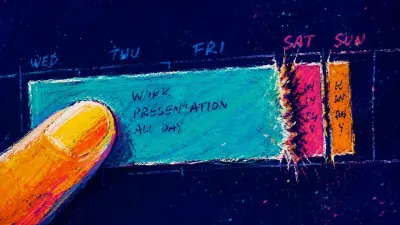
They Added Me to the Trip Spreadsheet - And I Sent One Clear Text

The Spreadsheet That Started Feeling Like a Contract
You’ve stared at a group trip spreadsheet longer than you’ve stared at your own budget, because you were added without being asked—and now it feels like consent-by-assumption.
When Alex showed up to my little scent studio space (a converted room above a boutique near Queen West), she didn’t look dramatic. She looked… compressed. Like someone had tightened a drawstring around her day. Her phone was already in her hand, screen smudged, brightness too high for February light.
“It’s stupid,” she said, but her tone didn’t match the word. Her jaw did that subtle clench people get when they’ve been swallowing sentences all week. “They added me to the trip Google Sheet. I’m listed under the cabin split. There’s a tab for rides. And everyone’s like, booking things. And I’m just… hovering.”
She described it like a loop: lunch break, iced coffee turning lukewarm, sun glare washing out the tiny cells. Thumb hovering over her row. She types, deletes, closes the tab—then reopens it the second Slack goes quiet. Her hands get buzzy when she picks up the phone, like her nervous system thinks she’s about to touch a hot stove.
What she wanted was simple: a clear boundary about the group trip. What she feared was also simple: being seen as “difficult,” losing her place in the group, making it “a thing.”
Pressure is an abstract word until you see it land in the body. On Alex, it looked like a tight band across the chest and a jaw held like a clenched zipper—like her whole upper body was trying to keep one honest sentence from getting out.
I nodded, slow and steady. “This isn’t stupid. It’s the modern version of being volunteered in public. Let’s not treat this like a personality flaw. Let’s treat it like a clarity problem.”
I poured her water and said, “We’ll map what’s happening, why it’s so sticky, and what to say next—without making you perform ‘perfect wording’ to earn your right to have limits.”

Choosing the Compass: How Tarot Works in a Group-Chat World
I asked Alex to take one breath in through the nose, and a longer breath out—nothing mystical, just a nervous-system downshift. While she exhaled, I shuffled. Not as a spell, but as a focusing tool: a way to keep the question in one place long enough to see it clearly.
“For this,” I said, “I want to use the Celtic Cross · Context Edition.”
For anyone reading along: this spread is useful when a situation has two layers at once—an outer layer you can see (the spreadsheet, the iMessage reactions, the ‘Booked!!’ screenshots) and an inner layer you can feel (belonging fear, people-pleasing, decision fatigue). This version keeps the classic diagnostic arc—present → challenge → root → social environment—then pivots into a practical boundary move (what to say, how to say it) and an integration direction (what “healthy” looks like without making unrealistic predictions).
I pointed to the layout as I placed the cards: the center cross for the immediate wobble, and the right-hand column like a lighthouse staff—self, environment, hopes/fears, and the steadier outcome available if you follow through with clarity.
“We’re going to pay special attention to three positions,” I told her. “The present loop you’re stuck in, the belief underneath it, and the next-step card—the actual boundary move you can take this week.”
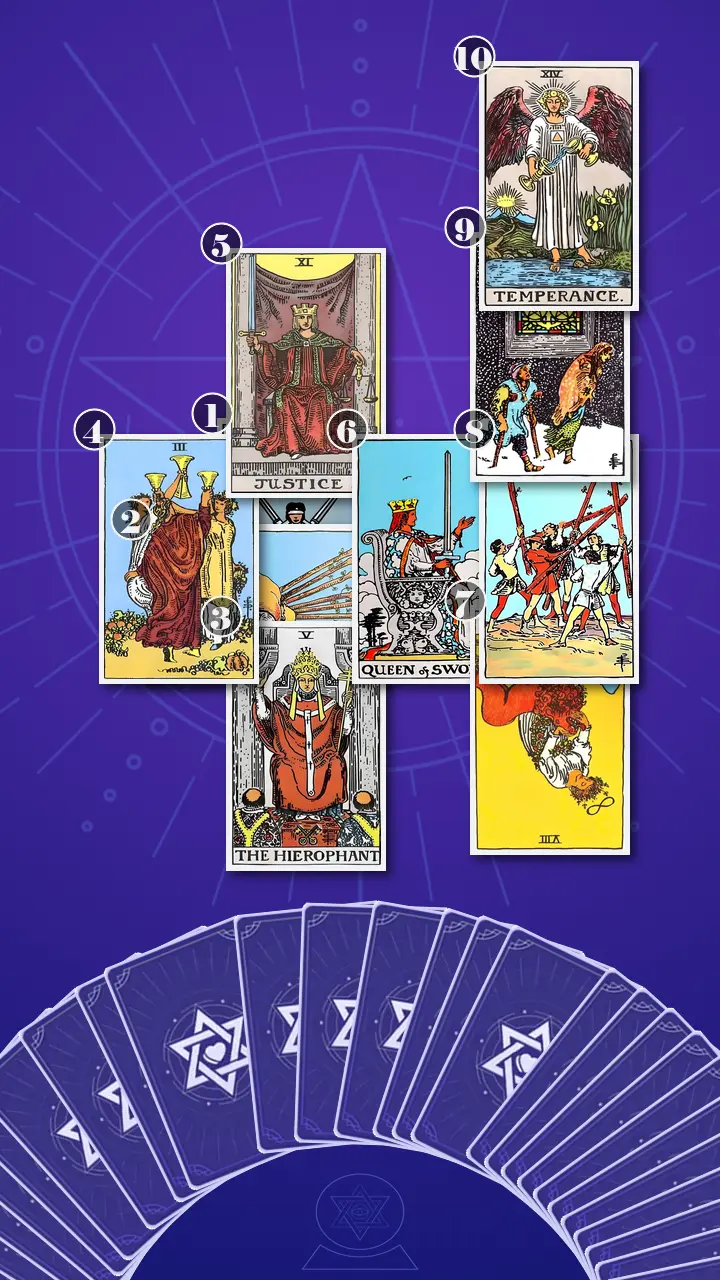
Reading the Map: From Consent-by-Assumption to a Clear RSVP
Position 1 — The current situation in real time
“Now flipped over,” I said, “is the card representing the current situation as it shows up in real time (what you’re doing with the spreadsheet and chat).”
Two of Swords, upright.
I tapped the blindfold gently on the card with my nail. “This is the card of ‘I’ll decide later’—but later never actually arrives.”
I kept it specific, because that’s what makes tarot useful: “You keep the trip Google Sheet open on your phone like it’s a puzzle you can solve with the right timing. You hover over your row, add a tiny ‘not sure yet’ note, then close it—because committing to a clear yes/no feels more dangerous than the mounting tension of not deciding.”
Energetically, Two of Swords is Air held too tight—a blockage. Not lack of intelligence. Not lack of care. Just a self-protective freeze. “You’re protecting yourself from conflict by not choosing,” I said, “but the weird part is: the pressure keeps building anyway.”
I asked the question the card always asks: “What decision are you already making by staying silent?”
Alex let out a small laugh—sharp at the edge, not happy. “That’s… kind of brutal.” Her shoulders lifted for a second, then dropped. “Because it’s true.”
I said the line I’ve watched change people’s posture in real time: “Ambiguity feels polite—until it becomes a yes you never chose.”
Position 2 — The immediate challenge or friction point
“Now we’re looking at the immediate challenge or friction point (what makes a boundary feel hard to state).”
Ten of Wands, upright.
“Here’s why you freeze,” I said, and I let my voice go matter-of-fact—calm analyst, not pep talk. “The challenge is the invisible workload you’ve already been handed: splitting costs, being available for dates, responding quickly, and quietly becoming ‘helpful’ so nobody can accuse you of being difficult. The trip starts to feel like unpaid project management, and that weight makes you freeze.”
Ten of Wands is Fire in excess: too much responsibility, too many assumed tasks. The wands block the figure’s view—like over-commitment narrowing your options until you can’t even see the simple answer anymore.
I gave Alex a split-screen: “On one side, there’s you ‘being polite’—blank cells, ‘not sure yet,’ silence. On the other side, the sheet is quietly assigning you costs and roles. And in the middle is your body doing the same thing every time: tight chest, buzzing hands, jaw braced.”
Alex winced and nodded. “Ugh, yes—that’s exactly what happens.”
“It’s not that you can’t set a boundary,” I said. “It’s that you’ve been carrying it long enough that the boundary now feels like dropping something heavy in a quiet room.”
Position 3 — The underlying root
“Now flipped over is the underlying root (the belief or fear that keeps you from being direct).”
The Hierophant, upright.
I felt Alex’s attention sharpen—like she recognized the silhouette before she recognized the meaning.
“Underneath it all is a rule you didn’t consciously choose: in this friend group, being added to the spreadsheet means you’re ‘in,’ and being ‘in’ means being easygoing. So your discomfort gets treated like a personal flaw instead of a normal consent check.”
The Hierophant is structure, norms, “the right way.” In this reading, it’s the unspoken oath: chill friends don’t make requests. That’s not morality—just social code. And social code can feel like law when you’re scared of being sidelined.
As a perfumer, I’m trained to notice what people don’t name. In scent, it’s the base note that changes everything. In groups, it’s the norm everyone pretends is “just how it works.”
“This is where my Social Pattern Analysis kicks in,” I told her. “Your friend group isn’t optimizing for care. It’s optimizing for speed. Shared doc culture, quick decisions, ‘Booked!!’ momentum. That system rewards the people who respond fastest—not the people who respond most truthfully.”
“So if you wait to find ‘perfect wording,’” I continued, “the system fills in the blanks for you.”
Alex stared at the card, then said quietly, “So it’s not just me being… high-maintenance.”
“No,” I said. “It’s you trying to survive a norm you never consented to.”
Position 4 — The recent past that set up this dynamic
“Now we’re looking at the recent past that set up this dynamic (how the group momentum got here).”
Three of Cups, upright.
“This started because you genuinely like these people. You remember the last good night out—laughing, photos, that feeling of being part of something. So now your boundary feels emotionally loaded, like it might ‘ruin the vibe,’ even though you’re just trying to state a normal limit.”
Three of Cups is warmth in balance. It’s the part of this story that matters: you’re not trying to reject anyone. You’re trying to protect connection from resentment.
“A group stays joyful only when everyone’s in it by choice,” I said, pointing at the circle dance. “Not by pressure.”
Alex’s mouth softened for the first time. “Exactly. I don’t want to make it a thing.”
“We won’t,” I said. “We’ll make it a sentence.”
Position 5 — Your conscious aim
“Now flipped over is your conscious aim (what you’re trying to achieve with the boundary).”
Justice, upright.
This card always feels like a room getting brighter. Clean lines. Scales. A sword that isn’t for fighting—just for precision.
“Your conscious goal is simple: explicit terms. Dates you can do, money you can spend, and what role you’re willing (or not willing) to play in planning. You’re not trying to win—you’re trying to make the agreement real so you don’t end up resentful later.”
Justice is Air in balance: fairness, consent, clear agreements. I said, “This is a ‘terms and conditions’ moment, not a confession.”
I slid a notepad toward her. “Two columns. Left side: ‘What the group is assuming I’ll do.’ Right side: ‘What I’m actually available for.’ Circle one mismatch.”
Alex exhaled—an actual, audible release. Her shoulders dropped like she’d been holding them up for a photo. “Oh,” she said. “This is a logistics problem, not a personality trial.”
My mind flickered to my first years in perfumery school in Paris—how my instructors corrected us: don’t argue with the formula, clarify it. Don’t add more notes to hide a mistake; remove what doesn’t belong. “Justice is that,” I told her. “It’s editing for truth.”
Position 6 — Your best next boundary move (Key Card)
I paused before turning the next card. The room felt quieter—not mystical, just focused. Even the heater clicking on sounded loud for a second.
“We’re flipping the card for your best next boundary move (a clear, workable message or stance you can take this week),” I said. “This is the antidote position.”
Queen of Swords, upright.
“Your best next move is a short message that doesn’t audition for approval. Example: ‘I can do Friday–Sunday only, and I can’t be on planning duty. I’m happy to split the Airbnb within $X/night.’ Then you let that be true—no five-paragraph apology tour.”
Energetically, this is Air used correctly—clean, directed, cutting through noise without being cruel. It’s not cold. It’s not mean. It’s accurate.
Setup: In my mind I could see Alex exactly where she’d described it—lunch break, sun glare on the phone, jaw set while she tries to draft the one message that won’t make anyone mad. She’s stuck believing a boundary has to be both perfectly worded and perfectly received.
Stop trying to sound endlessly agreeable and start speaking like a clear blade: one sentence, one limit, one truth—Queen of Swords.
For a beat, Alex didn’t move. Then a three-step reaction rippled through her like a delayed notification.
First: her breath stopped mid-inhale, just for a second—like her body froze on the idea of sending something that couldn’t be “interpreted nicely.”
Second: her eyes went a little unfocused, as if replaying every unsent draft, every “maybe,” every time she’d tried to soften herself into acceptability.
Third: her shoulders slid down, slow. Her fingers—tight around the water glass—loosened. She blinked hard once, and her voice came out smaller, but steadier. “But if I do that,” she said, a flash of heat in it, “doesn’t it mean I’ve been doing this wrong? Like… I’ve been making it harder for everyone?”
I didn’t rush to soothe her. I let the truth land without punishing her with it. “It means you’ve been trying to buy safety with over-explaining,” I said gently. “And it makes sense. You were protecting belonging. But the Queen of Swords is asking for a different deal: belonging with clarity.”
I leaned in. “Now—use this new lens and think back to last week. Was there a moment the chat got noisy, and a two-sentence boundary would’ve changed how your body felt?”
Alex’s eyes flicked to her phone like it was a memory vault. “Monday,” she said immediately. “When they were talking about adding another night. I felt my chest get tight. I started typing this whole… paragraph. And then I deleted it and just put a ‘not sure yet’ comment.”
I nodded. “That’s the shift right there. This isn’t just about one trip. It’s the move from pressure-and-guilt to steadier self-respect—one clean sentence at a time.”
And because I’m Luca, and scent is my language, I added my own frame: “In perfumery, we control sillage—the trail a scent leaves in a room. Not to be smaller, but to be intentional. Your boundary text is sillage control. Two sentences. Clear trail. No cloud.”
Position 7 — How you’re showing up internally
“Now we’re looking at how you’re showing up internally (self-image, confidence, and the emotional cost).”
Strength, reversed.
“Internally, you’re not lacking logic—you’re bracing for the emotional heat of someone reacting. You rehearse a boundary, imagine a teasing reply or an eye-roll reaction, and delete it. Then you compensate by being extra helpful in the doc so you don’t have to face the moment of stating your needs.”
Strength reversed is courage in deficiency—not because you’re weak, but because you’re trying to do courage while also doing emotional caretaking for everyone else. The real difficulty isn’t the trip. It’s the moment after you speak.
I watched her throat move as she swallowed. She nodded, but softer. “Oh… I’m not broken,” she said. “I’m just scared of the moment after I hit send.”
“Exactly,” I replied. “Discomfort isn’t proof you did something wrong. It’s often just the cost of changing an old pattern.”
Position 8 — The social environment
“Now flipped over is the social environment (group norms, chat dynamics, and what they’re likely optimizing for).”
Five of Wands, upright.
“The environment is chaotic coordination: multiple opinions, fast replies, and people optimizing for speed. The group chat moves like a swarm—if you don’t state your needs clearly, the loudest momentum fills in the blanks for you.”
Five of Wands is Fire in excess again—heat without a single direction. Not necessarily malicious. Just loud. This is why “waiting for the right moment” doesn’t work: the moment doesn’t get quieter. It gets faster.
“So your boundary isn’t a disruption,” I said. “It’s a stabilizer. You’re putting a container around your participation.”
Alex made a face like she’d been caught doing something exhausting. “It feels like I have to respond to everything,” she admitted.
“You don’t,” I said. “You need one message that states your terms. Then you stop context-switching like your nervous system is a customer support desk.”
Position 9 — Hopes and fears
“Now we’re looking at hopes and fears (what you want the boundary to protect, and what you fear it will trigger).”
Five of Pentacles, upright.
“Your fear is social winter: being subtly iced out, talked about as ‘high-maintenance,’ or replaced in the plan. Even before anyone responds, you imagine the trip photos without you and feel that sharp pang that says, ‘If I’m not easy, I’m not included.’”
This is the fear underneath the people-pleasing: exile. Not dramatic exile—quiet exile. The kind that happens in emoji reactions and inside jokes and “oh, we thought you weren’t coming.”
I said it plainly: “Belonging you have to earn by saying yes isn’t really belonging—it’s rent.”
Alex’s eyes went glossy for half a second. She looked away, then back, like she was testing whether she was allowed to agree with that.
“I hate how accurate that is,” she whispered.
“Good,” I said softly. “Accuracy gives us options.”
Position 10 — Integration outcome
“And finally, this card represents integration outcome (the healthiest relational dynamic available if you follow through with clarity).”
Temperance, upright.
Temperance is the card I always feel in my hands before I even explain it—because it’s literally my job to blend without losing structure.
“Integration looks like a boundary that’s both warm and consistent. You state the same limit the same way, without renegotiating every time guilt pings. The result isn’t ‘everyone is thrilled’—it’s a steadier, cleaner connection because nobody is guessing what you actually agreed to.”
Temperance is balance, measured transfer. Not a wall. Not a collapse. One foot on land, one in water: grounded enough to stay steady, warm enough to stay human.
“A good boundary doesn’t end the vibe—it keeps resentment from moving in,” I said, and I watched Alex’s face soften again, like she could picture that kind of friendship.
From Insight to Action: The Two-Sentence Text That Holds Your Place
I pulled the whole story together for her, because that’s what a good Celtic Cross does: it turns scattered stress into a coherent chain.
“Here’s the arc,” I said. “You’re stuck in Two of Swords—silence that feels safer than choosing—while Ten of Wands keeps adding weight through assumed responsibilities. Underneath, The Hierophant is whispering, ‘This is how we do things; don’t be weird,’ and Three of Cups reminds you you actually care about these people. Justice reframes it: this is about fair terms, not being liked. Queen of Swords gives you the boundary sentence. Strength reversed tells us the real work is tolerating the emotional heat after you speak. And Temperance is the integration: warmth plus consistency—your limit, repeated, without renegotiating from guilt.”
“The blind spot,” I added, “is thinking you need to manage their feelings in order to keep your place. That’s the trap. The transformation is exactly what we named: shifting from earning belonging through compliance to practicing belonging with clarity.”
Then I gave her what she came for: actionable advice she could do before the next notification spike.
Clarity isn’t cold; it’s clean. And to make it clean, I asked her to use what I call sillage control—my perfumer’s version of boundary-writing. You want your message to leave a clear trail, not fill the room with anxious extra notes.
- Write the Two-Sentence Version in NotesOpen Notes and write: (1) your limit (days/budget/role), (2) what you can do. Example: “I can do Friday–Sunday only, and I can’t be on planning duty. I’m happy to split the Airbnb within $X/night.” Copy/paste it into the group chat.If you feel the urge to add a third apologetic paragraph, pause and ask: “Am I clarifying—or am I trying to manage their feelings?”
- Lock One Concrete Constraint TodayChoose one constraint to make real (two nights max, budget cap, or “not doing the planning doc”). Put it in numbers or dates—factual, not emotional—and let that be the container for your participation.Numbers are easier to state than feelings. You can add one warm line (“Love you guys / excited for you”) without adding justification.
- Send It in Daylight + Practice the 60-Second No-Checking RuleBefore 7 PM, set a 10-minute calendar block labeled “Trip text.” Hit send, then put your phone down for 60 seconds—no monitoring the chat for immediate reactions.If your hands get buzzy, do one long exhale, then do one grounding action (wash a mug, walk to the end of the block). Teach your nervous system: “I can handle the after.”
As a final touch—because my practice is sensory as well as verbal—I offered a tiny ritual that wasn’t about magic, just association. I spritzed a blotter with a bright, cleansing citrus accord and handed it to her. “This is your reset,” I said. “One breath after you hit send. Let your body learn a new pairing: boundary → clean air, not danger.”

A Week Later: The Quiet Proof
Six days later, Alex texted me a screenshot.
Two sentences in the group chat. Daylight timestamp. No apology tour. Just terms—and one warm line at the end.
Under it, a few reactions: a heart, a thumbs up, someone replying, “Totally works. Thanks for clarifying!” Not euphoric. Not cinematic. Just… normal. And that was the miracle.
She wrote: “I sent it and then I walked to get groceries like you said. My chest did the tight thing for like two minutes, and then it went away. I didn’t spiral all night.”
I thought about how often people think finding clarity means feeling fearless. Most of the time it’s smaller than that: a jaw unclenches. A phone goes face down. A boundary becomes an agreement instead of a drama.
When you’re afraid a simple limit will get you labeled “difficult,” your body ends up holding the trip like a weight—tight chest, clenched jaw—because silence feels safer than risking being misunderstood.
If you let belonging come from clarity instead of compliance, what’s the one limit you’d name in one sentence—just to see how it feels to be real?
Every reading at AceTarot is a Journey to connect with inner wisdom and empower next step.
Learn more about our Journey to Clarity.