From Dread to Steady Repair: Learning to Speak After the First Fight

The 12:36 a.m. Notes App Trial
If the first real fight turns your brain into a blank screen—and you suddenly can’t access a single coherent sentence—welcome to the conflict freeze.
Taylor (name changed for privacy) sat across from me in my little studio space on the Upper West Side, still wearing the day on her body. Not metaphorically—physically. Her shoulders were pinned up near her ears the way they get after a full day of “I’m fine” in a fast-paced office. Her phone stayed face-up on her knee like an emergency exit.
She described Thursday night as if she were reading from a transcript she’d memorized against her will: 12:36 a.m., radiator clicking like a metronome, street noise leaking through the window, Notes app open, cursor blinking. Draft-delete. Draft-delete. Her jaw ached from clenching, and her hands felt oddly numb, as if her body had decided it didn’t need fingers for whatever came next.
“The fight was small,” she said, staring at a point just past my shoulder. “But it felt like a test I failed. In the moment I just… go blank. And I hate that about me.”
I watched how her throat moved when she swallowed—tight, cautious, as if even air needed permission. Dread sat on her chest with the steady weight of a winter coat you can’t take off indoors: not panic, not tears—more like your nervous system quietly whispering, One wrong sentence and you’re done.
“So the question isn’t ‘How do I become perfect at conflict overnight,’” I said gently. “It’s: what past script makes you freeze the second a relationship shifts from easy to serious—and how do we find clarity and a next step you can actually use in real time.”

Choosing the Compass: A Tarot Spread for Conflict Freeze
I asked her to take one slow breath—not as a mystical act, but as a practical one. A tiny bridge from the buzzing present into a quieter, more observant state. While she exhaled, I shuffled the deck in a steady rhythm, the way I used to handle fragile artifacts in the field: slow enough to respect what might surface, firm enough not to flinch from it.
“Today,” I said, “we’ll use a spread I designed for moments exactly like this: the Four-Layer Insight Ladder · Context Edition.”
For readers who wonder how tarot works in a situation like “why do I freeze during arguments with my partner,” this is the point: we’re not predicting whether Taylor’s relationship will last. We’re mapping a pattern. This Ladder is built for deep inner work—moving from the visible shutdown after the first fight into the protective function underneath it, then down to the older conditioning, and finally back up into something actionable: a repair move you can practice. Minimal cards, complete arc.
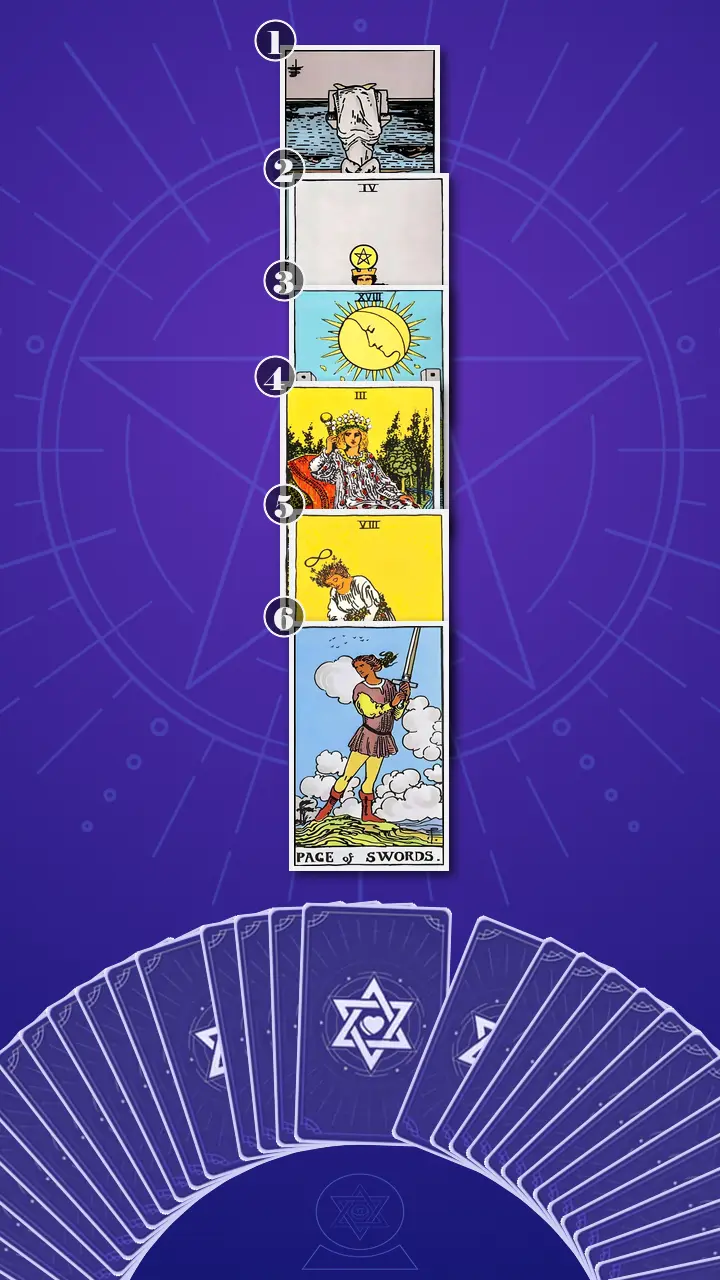
“We’ll read it like a staircase,” I continued. “The first card shows your freeze in the most observable way. The next reveals what the freeze is trying to protect. The third is the past script—what your nervous system learned long ago and now replays automatically. The fourth shows what you needed then. The fifth is the bridge—your turning point. The sixth gives a practical next step: the language of repair.”
Reading the Map: What Your Body Does Before Your Mind Can Explain
Position 1 — The freeze moment now: the most observable shutdown behavior after the first fight.
“Now we turn over the card that represents the freeze moment now—what it looks like on the outside, right after the first real argument,” I said.
The Two of Swords, in reversed position.
In the old Rider–Waite–Smith image, the figure is blindfolded, arms crossed, swords held like a barrier over the heart. Reversed, that neat containment doesn’t stay neat—it collapses into overload, silence, and a frantic attempt to make the moment end.
And immediately, Taylor’s real life translated the symbol for us: You’re standing in your kitchen after the first fight, phone in hand like a shield. They ask, “So what are you feeling?” and your mind blanks. Your throat tightens, your jaw locks, and you default to a neutral face and a small shrug. You say “I don’t know” not because you don’t care, but because your system is trying to end the danger fast—by ending the conversation.
“This is what people call going blank,” I said. “But I want to name it more precisely. This is your voice getting quarantined. Like your nervous system is running an old spam filter—flagging normal conflict as danger and sending your words straight to quarantine.”
Energetically, this is blockage: not a lack of feelings, but a lack of access. Air energy (thought, language) stalls and collapses into a shutdown that looks like composure from the outside.
Taylor let out a small laugh—too quick, too bitter to be amusement. “That’s… so accurate it’s kind of cruel,” she said. “I literally stare at my phone. Like it’s going to give me the right answer.”
I nodded. “You can pitch a campaign update in a glass-walled conference room with a steady voice. But in intimacy, the stakes feel different. At work, you’re rewarded for polish. In a relationship, you’re afraid that one wrong sentence will be judged as who you are.”
And there it was—the core contradiction in motion: wanting to stay connected and handle conflict like an adult versus fearing that one wrong sentence will lead to rejection or punishment.
“Here’s a small but powerful reframe,” I told her. “If you can name the freeze, you’re already back in the room.”
Position 2 — What the freeze is trying to protect: the immediate self-protection strategy behind the shutdown.
“Now we turn over the card that represents what the freeze is trying to protect,” I said. “What it’s ‘saving’ you from in the moment.”
Four of Pentacles, upright.
In the image, everything is held. Feet locked. Arms locked. A pentacle pressed to the chest like a vault door. The city in the background looks close, but unreachable—connection exists, but you’re guarding yourself against it.
In Taylor’s life, it sounded like this: You sit on the edge of your bed, back straight, shoulders tense, holding your feelings like you’re holding a drink you can’t afford to spill. You keep your voice measured and your face composed because you believe being ‘easy to deal with’ is what keeps you respected—and keeps you chosen. You’d rather swallow the feeling than risk them seeing you as needy or messy.
“This card is control as safety,” I said. “Not because you’re manipulative—because you’re trying to preserve dignity. Four of Pentacles is emotional ‘password manager’ energy. Everything is locked down so nothing can be stolen. But it also means nothing can be shared.”
Energetically, this is excess Earth: too much self-containment. A tight grip meant to prevent loss.
“So when tension rises,” I continued, “you do what has worked short-term: you become composed, agreeable, low-maintenance. You try to make yourself… not a problem.”
Taylor’s eyes dropped to her hands, as if she’d only just noticed what they were doing. Her fingers were curled inward, knuckles pale. “Yeah,” she whispered. “I can handle hard work, but I can’t handle someone being disappointed in me.”
In archaeology, when we find a hoard—coins buried under a floor—it’s rarely greed. It’s fear. Someone once learned that what they loved could be taken. This Four of Pentacles felt like that: a private stash of selfhood buried where no one can touch it, including the person who wants to love you.
Position 3 — The past script: the learned association your system runs during conflict.
“Now we turn over the card that represents the past script,” I said. “The automatic story your nervous system fast-forwards to when conflict begins.”
The Moon, upright.
The Moon is not a lie detector; it’s a fog machine. Two towers frame uncertainty. A dog and a wolf react to the same light, one trained and one feral—both alarmed. A path winds forward, but you can’t see where it ends, so the mind fills in an ending for you.
In Taylor’s life, it becomes brutally modern: One sigh, one sharper sentence, one ‘we need to talk’ text—and your brain starts writing the ending: they’ll lose respect, they’ll pull away, you’ll be the girl who ‘can’t communicate.’ Even if they’re still engaged and willing to repair, your body reacts like you’re about to be abandoned. So you freeze, because your system is trying to survive a future that hasn’t happened.
“Here’s the Moon’s structure,” I said, keeping my tone plain—because this part needs clarity, not poetry.
“Trigger line. Instant storyline. Body alarm. Silence.”
It’s like an intrusive prediction feed: breakup / weeks of coldness / loss of respect. Not because your partner said those things—but because your nervous system learned long ago that someone else’s displeasure could become punishment, withdrawal, or humiliation.
“You learned to read the room quickly,” I added. “That skill probably protected you once. The Moon shows it misfiring in intimacy: uncertainty feels like danger, so your body tries to disappear.”
Taylor went still. Then her eyes unfocused, as if she were watching an old scene replay on the inside of her eyelids. A long pause—no performative nodding, just quiet recognition.
“My brain does that,” she said finally. “It’s like… I’m navigating NYC at night with a fogged windshield. I don’t have enough information, so my mind turns it into a worst-case itinerary and calls it preparation.”
“Exactly,” I said. “That’s the Moon. Preparation that costs you your present.”
Position 4 — What you needed then: the missing support or resource that would have made conflict feel safer.
“Now we turn over the card that represents what you needed then,” I said. “The missing ingredient—the support that would have made conflict feel safer when this script was written.”
The Empress, upright.
Her posture in the card is the opposite of bracing: open, grounded, at ease. Wheat fields. Softness that isn’t weakness—more like a stable floor.
In Taylor’s modern translation: You realize you’ve been trying to do conflict like a solo project: no pauses, no reassurance, no softness—just ‘be calm and handle it.’ The Empress version of repair looks like sitting down, slowing down, hearing, “I’m not leaving—let’s figure this out,” and letting that be normal. Not a special favor. Just the environment where your voice can come back online.
“I want to be careful here,” I said. “The Empress isn’t about blaming your past or making a villain out of anyone. It’s about naming a gap.”
“You learned to manage tension alone,” I continued. “And now your body expects loneliness during conflict—so it shuts down to conserve itself. Like a phone going into Low Power Mode mid-call: it’s trying to preserve battery, but it throttles the features you actually need—words, nuance, connection.”
Energetically, the Empress is balance returning: warmth, pacing, co-regulation. The medicine isn’t “be tougher.” It’s “make repair physically safer.”
Taylor’s face softened in a way that wasn’t dramatic, just human. “My friends talk about boundaries like it’s… easy,” she said, voice quiet. “And I’m sitting there like I missed a class everyone else took.”
“The Empress would say,” I replied, “you didn’t miss a class. You were taught a different curriculum: stay composed, don’t be a burden, handle it privately.”
When Strength Spoke: Soft Bravery Instead of Silence
Position 5 — Bridge to change: the key inner capacity that helps you stay present instead of shutting down.
“Now we turn over the card that represents the bridge to change,” I said. “The energy that unlocks movement.”
The room felt quieter as I turned it—one of those small hushes that happens not because anyone is being theatrical, but because the nervous system recognizes a hinge point.
Strength, upright.
In the image, the woman doesn’t dominate the lion, and she doesn’t run from it. She stays with it. Soft hands. Steady presence. The infinity symbol above her head: patience, repetition, practice.
In Taylor’s life, the translation is almost disarmingly simple: Mid-conflict, you notice the shutdown wave rising: eyes want to drop, hands want to go numb, throat wants to close. Instead of forcing a perfect response, you do one regulated thing: one breath, shoulders down, and you say, “I’m freezing and I need a minute, but I’m still here.” You don’t disappear. You don’t perform. You stay—softly brave—and that’s what changes the whole pattern.
“This is regulated courage,” I said. “Strength is not ‘winning’ an argument. It’s holding steady like a good moderator: calm tone, clear boundaries, no disappearing. Soft bravery is the opposite of a mic drop—it’s a mic unmute.”
Then I brought in my own lens—the one I’ve refined over decades of studying how humans carry old agreements forward. I call it Emotional Historiography: reading a relationship through time the way an archaeologist reads a site through layers.
“Taylor,” I said, “your freeze isn’t happening in a vacuum. It’s a layer. When Strength shows up here, it’s asking you to stop treating every conflict like a verdict on your worth. In history, communities didn’t survive because they never fought. They survived because they built repair rituals—ways to return to the table after a rupture.”
Her eyebrows drew together, a flash of resistance. “But if I need a script,” she said, “doesn’t that mean I’m… bad at this? Like, other people can just talk.”
There it was—an unexpected reaction, not relief but protest: the fear that learning equals failure.
“No,” I said firmly, gentle but unmistakable. “It means you’re doing what adults have always done when something matters: you build structure. You don’t improvise a treaty in the middle of a battle.”
She exhaled, sharp and shaky, as if she’d been holding her breath since the first fight.
And now—the aha moment, exactly where Strength belongs.
Because you know that moment after the first fight where you’re staring at your phone like it’s going to hand you the right words—and your throat feels locked, but your brain won’t stop drafting.
Stop treating silence as safety and start practicing soft bravery, because Strength is built when you hold the lion with steady hands instead of locking your voice behind a blindfold.
She froze for half a beat—like her whole system paused to see if it was allowed to accept that sentence.
First: a physical stillness. Her breath caught high in her chest, and her fingers stopped fidgeting with the edge of her sleeve.
Second: the cognitive shift. Her gaze went unfocused again, but this time it wasn’t a flashback—it was like she was replaying last week’s argument with a new subtitle track. Not “I failed,” but “I went into quarantine.”
Third: the emotional release. Her shoulders lowered a fraction, not collapsing—just unclenching. Her eyes went bright at the edges. “So it’s not that I don’t have words,” she said, voice thinner now. “It’s that my body thinks words are dangerous.”
“Yes,” I said. “And if your body thinks conflict equals punishment, then our first job isn’t eloquence. It’s safety.”
I set a small timer on the table between us—two minutes. “Right now,” I said, “we practice the pause, not the performance.”
She put one hand on her chest. The other pressed into her thigh, grounding. One slow breath in. One slow breath out. The radiator clicked again, like a witness instead of a threat.
“Write one line you could say in a fight,” I instructed. “Just one.”
She typed with hesitant thumbs, then read it out loud, the words wobbling slightly as they left her throat: “I’m freezing and I need one minute, but I’m still here.”
Her face tightened—nausea flickering through her expression—so I nodded. “That’s enough. Stop early if you need to. Your only job is to practice the pause.”
Then I asked the question that turns insight into memory: “Now, with this new lens—Strength, not silence—can you think of one moment last week when naming the freeze would have changed how you felt, even by ten percent?”
Taylor’s eyes filled, but she didn’t cry. “When he sighed,” she said. “I heard it as disappointment. And my brain went straight to, ‘He’s done.’ If I’d said, ‘I’m freezing, give me one minute,’ I think I could’ve stayed.”
“That’s the bridge,” I said. “This isn’t about a perfect sentence. It’s about moving from conflict-driven shutdown and shame to regulated courage and honest, paced repair—one minute at a time.”
Air Returns: The Page Who Ships a Message in Beta
Position 6 — Next repair step: one concrete way to communicate or act differently the next time tension appears.
“Now we turn over the card that represents your next repair step,” I said. “One practical way to communicate differently the next time tension shows up.”
Page of Swords, upright.
The Page stands on uneven ground, sword raised—not to attack, but to practice. Wind moves through the scene. It’s not serene. It’s workable.
In modern life: Instead of writing a five-paragraph follow-up in Notes, you send a clean two-liner: “Hey, I want to revisit earlier. I felt overwhelmed and I don’t want to disconnect—can we talk tonight?” Then in the conversation, you ask one simple question that slows everything down: “What did you hear me saying when I said that?” It’s not perfect. It’s practice—and it’s enough to rebuild safety.
“This is ‘beta mode’ communication,” I told her. “You’re allowed to be learning and still ship a clear message. Drafts feel safe. Repair is what builds trust.”
And here I brought in one of my simplest tools—what I call Pictogram Dialogue. In excavations, we sometimes find early writing: not elegant literature, but clear symbols carved so a message survives time. When you’re triggered, you don’t need a novel. You need a symbol.
“One feeling,” I said, holding up a finger. “One request. One question. That’s it. Three pictograms. Simple enough that your nervous system can do it even when the Moon fog rolls in.”
Taylor nodded—small, steady. Practical momentum. The kind you can feel in your stomach before you can defend it intellectually.
The One-Page Repair Plan (So You Don’t Have to Improvise)
I leaned back and stitched the spread into a single, coherent story—the sort of narrative that answers why, not just what.
“Here’s what your cards are saying,” I summarized. “When the first fight hits, the Two of Swords reversed shows your words disappearing—your nervous system blindfolding you to survive. The Four of Pentacles explains the strategy: clamp down, stay dignified, don’t spill anything that could cost you respect. Underneath, the Moon reveals the older script—uncertainty becomes a breakup forecast, and your body reacts to an imagined future as if it’s already happening. The Empress shows what was missing when that script formed: steadiness, co-regulation, permission to pause. Then Strength becomes your bridge—soft bravery, naming the freeze, staying present. And the Page of Swords brings it into the real world: small, curious, clear communication reps.”
“Your cognitive blind spot,” I continued, “is thinking the moment demands a perfect performance. That’s the old Moon-script making conflict feel like a public trial. The transformation direction is different: from ‘I have to say the perfect thing right now’ to ‘I can name my freeze and ask for one small pause, then come back.’”
“And one more thing,” I added, using my Covenant Evolution frame—commitments viewed historically. “In early-stage dating, it’s common to treat the first fight like a verdict: compatible or doomed. But most healthy relationships treat it like version 1.0 of a shared agreement. You’re not failing. You’re negotiating a new covenant—one where repair is part of the deal.”
Then I offered actionable advice—small, specific, doable in New York real life, not in an imaginary calm universe.
- The 20-Second Pause-and-Return ScriptOnce a day, in a low-stakes moment (replying to an email, ordering coffee, choosing what to watch), take one slow breath and say out loud: “Give me a moment to find my words.” You’re training your throat to stay online when pressure shows up.Expect the inner cringe. Make it smaller: you’re practicing pacing, not drama. If you forget, just do it the next day—Strength is built by repetition.
- Your Freeze Sentence (Sticky Note Version)Put one line in your phone (or on a sticky note): “I’m freezing. I need one minute. I’m still here.” Read it out loud twice when you’re alone, so it’s available when you’re activated.If your body spikes—tight throat, nausea, shaking—stop early. The win is practicing the pause, not forcing yourself through a full conversation.
- Pictogram Dialogue: One Feeling / One Request / One QuestionNext time you need repair, send a short text (no dissertation): “Hey—can we talk tonight? I felt overwhelmed and I want to understand each other.” In person, use: “I felt [one feeling]. Can we [one request—slow down / sit down / lower voices]? What did you hear me saying when I said that?”If you over-explain, set a rule: three sentences max. After you send it, put your phone face down for 5 minutes and do something sensory (stretch, wash dishes) instead of rereading your message 20 times.

A Week Later: Ownership, Not Certainty
Six days later, Taylor texted me a screenshot—no dramatic paragraph, just proof. A two-line message she’d sent at 7:41 p.m.: “Hey—can we talk tonight? I felt overwhelmed and I don’t want to disconnect.” Under it, her partner’s reply: “Yes. Thank you for saying that. I’m here.”
She added one more line: “I was still scared. I still wanted to disappear. But I said the sentence anyway.”
I thought, as I often do, about how civilizations don’t become stable because fear vanishes. They become stable because people build reliable ways to return after rupture. Taylor hadn’t solved intimacy forever. She’d done something rarer and more real: she’d stayed present for one more minute and discovered her voice didn’t have to be perfect to be worth hearing.
When the first fight hits, it can feel like your throat locks and your whole worth gets put on trial—like one imperfect sentence could cost you belonging.
If you didn’t have to say the perfect thing in real time, what’s one honest sentence you’d be willing to try next time—just to stay in the room with yourself?