From Screenshot Betrayal to Self-Respect: Setting One Clean Boundary

The 11:36 p.m. Screenshot You Can’t Unsee
If you’ve ever been DM’d a group chat screenshot with your name in it and felt your stomach drop while your brain went straight into “Notes app draft mode,” this is for you.
Alex joined my session from a London flat where the night had that particular kind of quiet—dark room, one streetlight leaking through the blinds, and the radiator clicking like it had opinions. Their phone glow made the ceiling look faintly blue. They pinched the screenshot bigger and smaller with their thumb like it might eventually turn into a different story. Somewhere outside, a siren went past and faded.
“I’m not mad,” they said, and their laugh came out thin. “I just don’t know how to unsee it.”
I watched their jaw work as if they were chewing on a sentence they couldn’t swallow. Every time the screen lit up, their chest tightened in a small, involuntary way—like their body had already decided this was unsafe, even while their mind was still trying to negotiate.
They told me what had happened: a friend had sent them a screenshot from a separate WhatsApp thread. Alex’s name was there, turned into entertainment. Now they were stuck between two impulses that were both trying to protect them: protect my self-respect with a clear boundary versus don’t be seen as dramatic and lose my place in the group.
“I keep typing something,” Alex admitted. “Then I delete it. Then I just reply ‘lol’ in the group like I’m fine. I’m exhausted from pretending I’m chill.”
The betrayal in their voice wasn’t loud. It was private—like a bruise under clothing. It felt to them like standing outside a room and hearing their name through the door: frozen between barging in and walking away.
“Okay,” I said gently, keeping my voice steady on purpose. “We’re not going to force a perfect answer tonight. We’re going to draw a map. The goal is clarity—what you will and won’t participate in—so you can take the next step without bargaining with your own dignity.”

Choosing the Compass: The Celtic Cross · Context Edition
I’m Hilary Cromwell—Cambridge emeritus, trained archaeologist, and (unexpectedly, for my former colleagues) a working tarot reader. I don’t use tarot as a verdict. I use it as a structured way of thinking when your nervous system has turned your phone into a courtroom.
I asked Alex to take one slow breath, not as a mystical ritual, but as a switch: from spiraling to observing. While I shuffled, I said, “Hold the question in one line: I saw the screenshot—how do I set a boundary?”
For this, I chose the Celtic Cross · Context Edition. It’s ideal when the problem isn’t just the event (the screenshot), but the whole relational ecosystem around it: what happened, what blocks you, what values got hit, what the environment will do, and what a sustainable response looks like.
If you’ve ever Googled “how tarot works,” this is one of the clearest demonstrations: a spread is basically a decision framework. Each position asks a specific question. The cards don’t replace your judgment; they give your judgment somewhere to land.
I told Alex what to expect: “The center card will name the screenshot reality. The crossing card shows what freezes you. We’ll look beneath to the root value wound. Then we’ll find the tone you’re aiming for—the boundary you wish you could state cleanly—and we’ll end with an integration path that looks like something you can actually do this week.”
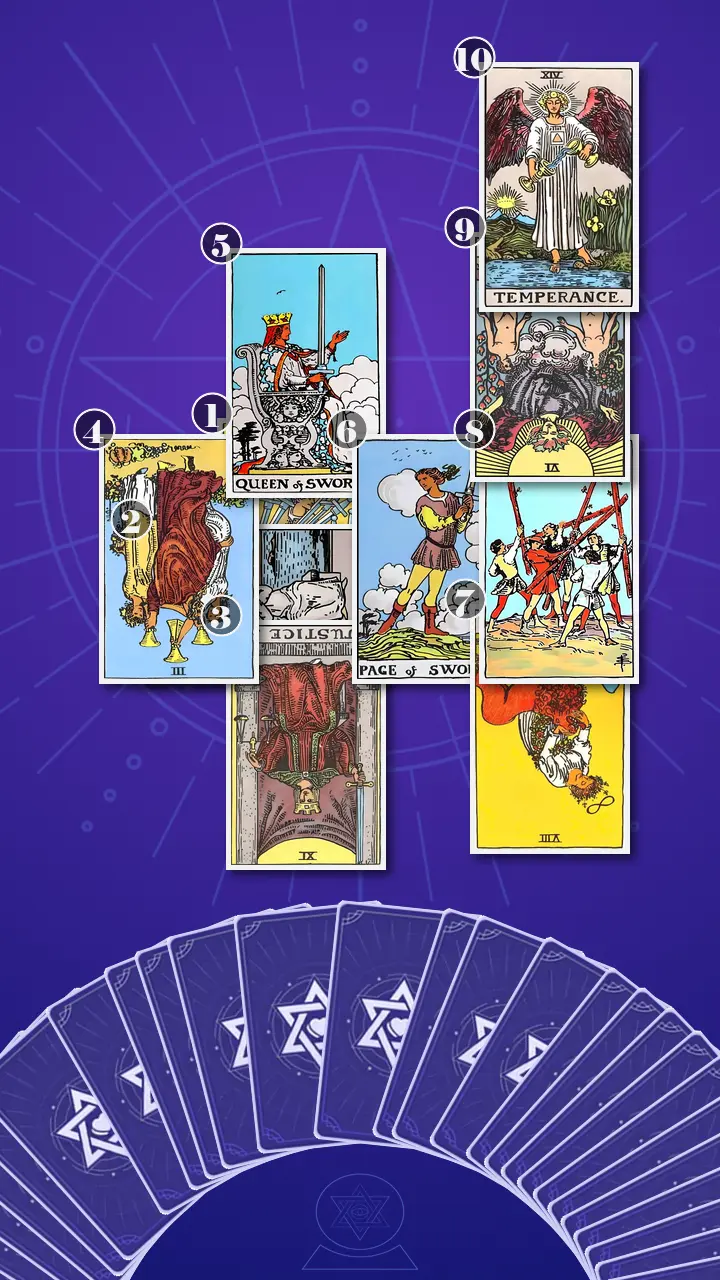
Reading the Map: What the Screenshot Confirmed
Position 1 — The screenshot moment: the immediate trust-breach reality
“Now we’re looking at the card that represents the screenshot moment: the immediate trust-breach reality and what it’s doing to your sense of safety in the group.”
Seven of Swords, upright.
In modern life, this card is painfully literal: realizing the real conversation is happening in a separate chat—and you’re left managing the social consequences without having had a voice in the moment.
The energy here is a blockage through indirectness. Not only did someone say something behind your back; they did it in a place designed to keep you out. The sideways glance in the card—the “did anyone notice?” look—mirrors that extra sting: it wasn’t just careless, it was calculated enough to be offstage.
I asked Alex, “When you picture walking into the next hangout, what exactly feels unsafe—being laughed at, being minimized, or being kept out of the real conversation again?”
Alex didn’t answer right away. Their fingers tightened around their mug, then loosened. “It’s… the idea they can talk about me like that, and then just invite me for pints like nothing happened. Like I’m supposed to play along.”
“Right,” I said. “The screenshot didn’t create the betrayal. It revealed it.”
Position 2 — What blocks boundary-setting right now: the freeze
“Now we’re looking at the card that represents what blocks boundary-setting right now: the specific hesitation, freeze response, or competing impulse.”
Two of Swords, reversed.
This is the blindfold slipping. Neutrality stops working. Reversed, it’s not ‘calm’—it’s paralysis dressed as maturity.
And immediately, I could see it in Alex’s face: that tiny flinch of recognition that’s almost a wince.
I described the scene I’d been hearing between their words: the phone glow in the dark room, toggling between the screenshot, the group chat, and a DM thread—type → delete → retype—like their thumb is trying to edit reality.
One-line inner monologues kept repeating beneath their silence:
“If I say it like this, they’ll twist it.”
“If I say nothing, I’m basically agreeing.”
“If I stay neutral, at least I keep my spot.”
The energy is deficiency in decisiveness—not because Alex lacks courage, but because they’re trying to make the boundary so perfectly worded that nobody can misinterpret it. That’s a fantasy. And it’s costing them sleep.
Alex let out a quiet exhale, then gave a small nod—exactly the kind that says, yeah… that’s exactly what I’m doing. Then they surprised me with a bitter little laugh.
“That’s… kind of brutal,” they said. “Like, rude how accurate that is.”
“Not rude,” I replied, soft but firm. “Useful. Because it means we’re not guessing. We’re naming the loop.”
Position 3 — The root value wound underneath: the rule that got broken
“Now we’re looking at the card that represents the root value wound underneath: what ‘rule’ was broken and why it hits so hard.”
Justice, reversed.
Justice reversed is that sickening feeling of an uneven standard: accountability missing, respect inconsistently applied, the rules changing depending on who’s speaking.
In Alex’s world, it wasn’t just gossip. It was the question: What are the rules here, and do they apply to me too?
The energy is imbalance. The scales are tilted. The group has—explicitly or implicitly—normalized a kind of “we talk about people when they’re not here” culture. And because it’s wrapped in humor or “banter,” nobody has to take responsibility for impact.
This is where my archaeologist’s brain always kicks in. In a dig, you don’t argue with the layer; you date it. You ask what it tells you about the settlement’s rules—what was allowed, what was punished, what was rewarded. Relationships have strata too.
“Alex,” I said, “this isn’t just about a screenshot. It’s about a broken covenant. Not in the dramatic sense—just the basic social contract: ‘If you have an issue with me, bring it to me directly.’ You’re feeling the pain of realizing that contract might not exist in this group.”
They swallowed. Their eyes went briefly unfocused, like they were replaying months of little moments they’d filed away as ‘fine.’
Position 4 — Recent group pattern: the clique energy before the screenshot
“Now we’re looking at the card that represents the recent group pattern leading up to this: earlier moments of clique energy, indirectness, or subtle exclusion.”
Three of Cups, reversed.
Friendship, reversed, can turn into performance. It can turn into bonding through commentary—closeness purchased by picking a target.
The energy here is excess in social intensity but deficiency in genuine care. It looks like: inside jokes that aren’t actually funny to everyone, side chats, and that subtle feeling that belonging has conditions.
I asked, “What were the last three ‘small off’ moments you brushed past to keep the vibe smooth?”
Alex’s shoulders rose, then dropped. “There were… jokes. Like, little digs. And I’d laugh because I didn’t want to be the sensitive one.”
“That’s the archaeology of it,” I said. “This didn’t start last night. Last night just preserved the artifact.”
When the Queen of Swords Stops the Audition
Position 5 — Your conscious intention: the boundary tone you want
I slowed my hands before turning the next card. The room felt quieter, as if the air itself leaned in. “We’re about to flip the card that represents your conscious intention for the boundary: the tone you want—firm, fair, calm—and what you’re trying to protect.”
Queen of Swords, upright.
Alex stared at the image the way you stare at a person you’ve needed for a long time but didn’t know you could ask for.
Here’s the setup that mattered: you know that moment—past 11 PM, phone at 12%, zooming in on reactions like they’re evidence—hovering over “send” but terrified you’ll sound “dramatic.” That’s where Alex has been living: in the exhausting space between truth and performance.
Stop auditioning for approval and start holding your line—like the Queen of Swords, keep your sword upright and your hand open: clear, calm, and not bargaining with your self-respect.
I let that sit for a beat. No extra explanation. No softening. Just a clean sentence, the way the Queen holds herself: firm line, no punishment tone.
Alex’s reaction came in a three-part wave. First, their body froze—a small inhale that didn’t fully land, their fingers hovering above their phone like they’d been caught mid-scroll. Second, their gaze went distant, as if their mind rewound every time they’d tried to be “easygoing” to stay invited. Third, emotion hit the surface: their jaw unclenched, then clenched again, and their eyes went bright in that specific way that isn’t tears yet, but is close.
“But if I say it like that,” Alex said, and there it was—the unexpected flare—“won’t they just… hate me? Like, I’ll be the vibe-killer. The dramatic one.”
I didn’t rush to reassure them. I’ve learned—both in seminars and in soil—that if you don’t give a fragile thing a moment of air, it collapses.
“This is where my ‘emotional historiography’ lens matters,” I said. “You’re treating this one boundary as if it will rewrite your entire social history in a single night. But relationships change in chapters. This card is a marker layer. It’s not you being cruel; it’s you naming the era you’re no longer willing to live in.”
Then I offered the practical anchor—because insight without a next breath is just another late-night spiral.
“Let’s do a ten-minute version of what I call a One-Breath Boundary,” I said. “Not in the group chat. In a blank note. One sentence that begins with: ‘I don’t participate in…’ Then one sentence about access: ‘If it happens again, I’ll step back from this chat or plans for a while.’”
Alex nodded, but their face still held that dizzy, newly-clear vulnerability—like the moment after you stop clenching a fist and realize your hand is shaking.
“Now,” I continued, “use this new perspective and look back at last week. Was there a moment—at the pub, in the chat, in a joke—where this would’ve changed how you felt?”
They stared at the Queen again, then whispered, “Yeah. There was a joke on Saturday. I laughed. And I hated myself for it.”
“That,” I said, “is the shift from managing everyone’s reactions to naming what you will and won’t participate in. It’s the first step from that frozen, outside-the-door feeling to steadier self-respect.”
Clarity Is Kinder Than Mind-Reading
Position 6 — The most constructive next step: one clean question
“Now we’re looking at the card that represents the most constructive next step: a near-term communication move that creates clarity without escalation.”
Page of Swords, upright.
This is the opposite of building a case. It’s a question that fits on one screen. It separates facts from mind-reading.
In modern terms: instead of collecting more evidence at 1 AM, Alex sends one clear message that requests a real conversation—ten minutes, quick coffee, short call.
I said, “Think of it as a product requirement, not a legal brief. ‘Here’s what I saw. Here’s what I need. Can we talk?’”
Alex’s shoulders eased a millimeter. “A message that fits on one screen,” they repeated, almost like they were testing the weight of it.
Position 7 — Your internal stance: self-doubt that shapes your voice
“Now we’re looking at the card that represents your internal stance: the self-doubt or courage that shapes how you speak and what you tolerate.”
Strength, reversed.
Strength reversed is what happens when gentleness turns into self-silencing. You try to be so calm that you erase yourself.
The energy is deficiency in inner steadiness, but not because you’re weak—because you’re trying to stay lovable while being firm. That’s a hard double task.
I asked Alex to do a tiny body check: “Put your feet on the floor. Notice your jaw. Notice your shoulders. If your only strategy is ‘stay chill,’ your nervous system ends up doing the talking.”
Alex’s hand went to their chest without thinking. “That’s… yes. I keep trying to sound detached so nobody can dismiss me.”
“And yet,” I said, “detachment isn’t the price of respect.”
Position 8 — The group’s climate: the chaos you can’t control
“Now we’re looking at the card that represents the group’s current climate: dynamics you can’t control but can plan for.”
Five of Wands, upright.
This is the group chat pile-on energy: everyone typing at once, nobody owning impact. It’s ten notifications in two minutes. Jokes, minimizing, “I didn’t mean it like that,” side DMs trying to recruit you into private alliances.
The energy is excess friction. The temptation is to become the moderator, the manager, the person who must respond to everything in real time so the story doesn’t get away from you.
“You don’t have to answer everything in real time,” I told Alex. “Your job is not to manage their reactions. Your job is to manage access.”
Alex nodded slowly, like that sentence gave them permission to stop gripping their phone like a steering wheel.
Position 9 — Hopes and fears: belonging vs alignment
“Now we’re looking at the card that represents the belonging dilemma: what you hope happens versus what you fear you’ll lose by setting the boundary.”
The Lovers, reversed.
This isn’t about romance. It’s about misalignment—and the fear that choosing yourself costs connection.
The energy is conflict: you want genuine closeness, but you’re scared what you actually depend on is access. Invitations. Tags. Being ‘in.’
I said, “Ask yourself: are you trying to protect connection—or are you trying to protect access?”
Alex’s mouth tightened. “That’s… awful,” they said quietly. “Because I think it’s access.”
“Not awful,” I corrected. “Information. And you deserve relationships where your integrity doesn’t threaten your belonging.”
Position 10 — Integration path: a sustainable, regulated boundary
“Now we’re looking at the card that represents the integration path: how boundary-setting can look when it’s sustainable, regulated, and aligned with your values.”
Temperance, upright.
Temperance is calibration. It’s not explode or disappear. It’s: one clear statement, one observable next step, then watch behavior—not promises.
The energy is balance. One foot on land, one in water: your dignity in one hand, your humanity in the other.
This is where I sometimes borrow one of my own strategies—what I call Amphora Balance. In excavation, you find vessels designed to hold and pour without spilling everything at once. In relationships, it’s the same: you don’t pour your entire emotional inventory into a group chat. You pour measured truth. You keep some of yourself in reserve until respect is proven.
Alex exhaled again—longer this time. The room’s quiet felt less like dread and more like space.
The One-Page “Access Settings” Plan
I leaned back and gave Alex the integration in plain language: “Here’s the story these cards tell. The screenshot (Seven of Swords) didn’t just hurt—it confirmed a behind-the-scenes culture. You froze (Two of Swords reversed) because you’re trying to craft a bulletproof message that prevents backlash. Underneath, you’re reacting to an uneven standard of respect (Justice reversed) and a longer pattern of performative closeness (Three of Cups reversed). You’re aiming for clean, self-respecting speech (Queen of Swords), and the next step is one direct question (Page of Swords). Your internal wobble is understandable (Strength reversed), the environment will be noisy (Five of Wands), and the real choice is alignment over access (Lovers reversed). The sustainable path is Temperance: measured truth, measured engagement.”
Then I named the blind spot gently but clearly: “Your cognitive blind spot is thinking you need to manage their reaction in order to deserve respect. That turns boundary-setting into an audition. The transformation direction is the opposite: name your line, then let behavior determine access.”
“So what do I do?” Alex asked. “Like… literally. What do I say after seeing a group chat screenshot?”
“We keep it boring and specific,” I said. “And we make it hard for the situation to turn into a ‘you-problem’ by refusing to overexplain.”
- Write the Two-Line Boundary (240 characters max)Open a blank note (not WhatsApp). Write exactly two lines: (1) what crossed the line (“I saw a screenshot where I was being talked about.”), (2) your participation rule (“I don’t participate in chats where I’m discussed like that. If it happens again, I’ll step back from this chat/plans for a while.”).Aim for “clear enough,” not bulletproof. If you start adding justifications, underline them—then delete them.
- Send One Page-of-Swords Question (one-screen message)Message the one person you trust most in the group: “I saw a screenshot where I was being talked about. I’m not okay with that. Can we talk for 10 minutes tomorrow about what happened and what needs to change so I can feel safe in this group?”If you feel pulled into paragraphs, pause and ask: “What am I actually asking for?” Clarity is kinder than mind-reading.
- Set a 24-Hour Notification Boundary (Temperance Calibration)After you send the message, mute the group chat for 24 hours. Create one reply window (e.g., 6–7 PM only) for the next two days so you don’t respond from adrenaline or at 1 AM.Expect noise (Five of Wands). You’re allowed to be slow. Managing access works better than managing reactions.
Before we ended, I offered Alex one more tool—my Pictogram Dialogue approach—because group conflicts get messy when language gets fancy. “If you get pulled into a debate,” I said, “reduce your boundary to three simple symbols in your head: Eye (what I saw), Stop sign (what I’m not available for), Door (what access looks like next). That’s it. No essays.”

A Week Later: The Quiet Proof
A week later, Alex messaged me. Not a long update—just one line: “I sent the one-screen question. Then I muted the chat and went for a walk instead of waiting for replies.”
They said they slept through the night for the first time in days—then admitted, honestly, that the next morning their first thought was still, what if I’m wrong? But this time, they wrote, “I smiled a bit. Because even if I’m wrong about their intentions, I’m not wrong about what I’m available for.”
That’s the Journey to Clarity in real life: not certainty, but ownership. The Queen of Swords doesn’t guarantee a perfect outcome. She guarantees you stop abandoning yourself to keep the invite.
When you’ve seen the screenshot, the worst part isn’t even the words—it’s the way you start editing yourself to stay invited, like belonging has a price tag and you’re the one expected to pay it.
If you didn’t have to manage anyone’s reaction for a day, what’s the simplest line you’d be willing to hold—just to see what their behaviour tells you?