When 'You're Too Much' Made Me Go Quiet-And I Practiced Safe Visibility

Finding Clarity in the 8:47 Victoria Line Draft
If you’ve ever been told “you’re too much” and immediately started tone-policing your own texts like your personality needs a compliance check… yeah, this is for you.
Taylor (name changed for privacy) appeared on my screen from London, earbuds in, coat still on like she hadn’t fully arrived back in her flat yet. The light behind her was that familiar, tired city glow—streetlamp orange leaking through a gap in the curtains.
“It was such a casual comment,” she said, and I watched her throat move like she was swallowing something that didn’t go down clean. “Like… we were laughing, I finally felt relaxed, and then she went, ‘You’re too much sometimes.’”
As she spoke, I could see the pattern in her body before she even named it: shoulders held slightly up, breath parked high in the chest, her jaw set in that way people get when they’re trying to be ‘normal’ at full volume.
She told me about the Tube ride home—phone warm in her hand, carriage lights buzzing overhead, the station announcements slicing in and out like interruptions in her own thoughts. She drafted the message three times. The first version had warmth and exclamation points. The second version was “more normal.” The third version was basically a receipt.
“And then I sent the third one,” she admitted. “And it felt… safe. But also like I’d just edited my whole personality.”
What sat in the room with us wasn’t just embarrassment. It was shame—shame that felt like a tight band across her chest, like she was speaking through a permanent volume limiter she never agreed to install. Under it, I could hear the contradiction pulling her in two directions at once: she wanted to be fully expressive, but she was terrified that visible intensity would get her rejected again.
I leaned a little closer to the camera, softening my voice the way I do when someone is bracing for impact. “I’m really glad you brought this here,” I said. “Because a single comment like that can turn into a whole internal rule-set overnight. Let’s treat today like a map-making session. Not to tell you who you have to be—but to help you find clarity about what got hooked, and what your next step can be without disappearing.”

Choosing the Compass: How This Tarot Spread Works (and Why It Fits)
I asked Taylor to take one slow breath in, and then an even slower breath out—nothing mystical, just a way to let her nervous system come back online before we touched the tender parts. While she held the question in mind—what past rejection made me self-edit?—I shuffled, the cards making that clean, papery whisper that always reminds me of flipping through star charts before a planetarium show.
“Today I’m going to use a spread I designed for this exact kind of ‘inner pattern’ question,” I told her. “It’s called the Four-Layer Insight Ladder · Context Edition.”
If you’re reading this and wondering how tarot works in a situation like this: I’m not using the cards to predict what Taylor’s friend will do next. I’m using them the way I use a sky map with visitors in Tokyo—an organized view of patterns. Tarot gives structure to what’s otherwise a fog of replayed conversations, self-blame, and decision fatigue around “how to be.”
This spread is a 2-by-3 grid that moves like a staircase: from what you do on the surface, down into the earlier wound and the belief that keeps the loop running, and then back up into a practical way forward. It’s built for self-exploration and actionable advice—especially when you’re stuck at a social crossroads between “be yourself” and “be safe.”
“The first card,” I said, “will show the exact self-editing move you make right now—what happens in the minutes after a comment lands.”
“The middle row takes us deeper,” I continued. “One card will point to the older rejection template—where you learned that shrinking buys belonging. And the next card will show the core fear: what you think rejection would prove about you.”
“Then the bottom row is the integration layer: the inner medicine that rebuilds self-trust, and one concrete step you can practice this week so your expression has boundaries instead of apologies.”
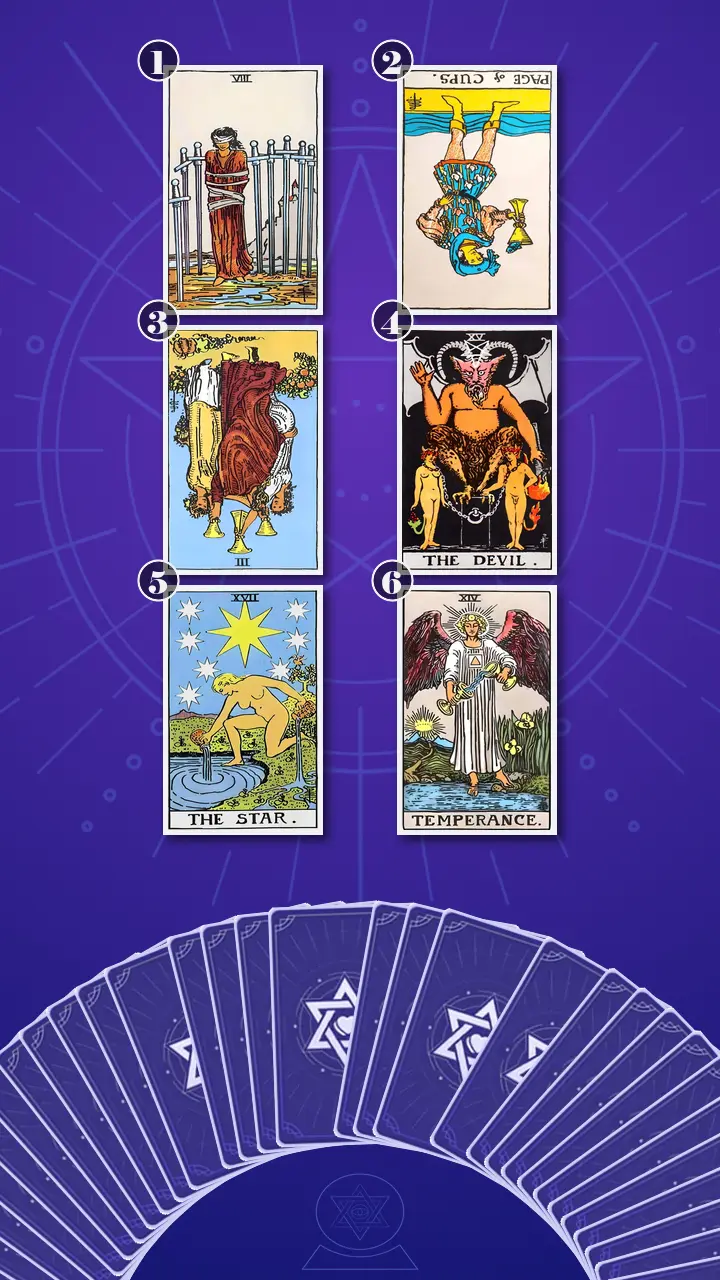
Reading the Map: Card Meanings in Context
Position 1: The Observable Self-Editing Pattern
“Now we turn over the card that represents the observable self-editing pattern in the present: what you do right after hearing ‘you’re too much’,” I said.
Eight of Swords, upright.
“This is the screen-recording version of the loop,” I told her. “You’re on the Tube home, phone warm in your hand, and you catch yourself rewriting a message into something smaller. You remove the emoji, swap ‘I’m genuinely excited’ for ‘nice,’ and hit send with a tight chest—relieved you won’t be judged, then immediately lonely because you didn’t actually show up.”
In terms of energy, the Eight of Swords isn’t a literal prison—it’s restriction as a strategy. Air energy (thought, analysis, language) goes into excess. Your mind tries to manage social risk by narrowing the bandwidth of you. And it works—briefly. It gives short-term relief. But it also keeps the belief alive: the real me is unsafe.
I tapped the card lightly. “See the blindfold? That’s you not getting to see all the options. And the bindings are loose—meaning: the restriction feels absolute, but it isn’t fixed in fact.”
Taylor let out a small, bitter laugh—quick, almost automatic—then immediately looked down like she regretted making noise. “That’s… honestly kind of cruel,” she said. “It’s like you just described my Notes app.”
“I know,” I said gently. “And I want to name something that often gets missed here: You didn’t become ‘too much.’ You became monitored. That’s different. Monitoring is a learned survival move.”
Position 2: The Immediate Sting (What the Comment Touched)
“Now we turn over the card that represents the immediate trigger and emotional sting: what the comment touches in you right now,” I said.
Page of Cups, reversed.
“This one hurts in a very specific way,” I said, keeping my tone steady. “It’s like you’re about to send a voice note because you’re genuinely happy—your tone is bright, your laugh is real. Then you hear the echo of ‘too much,’ delete it, and send a flat thumbs-up or ‘haha’ instead, pretending you didn’t care that much.”
As reversed energy, the Page of Cups is Water that gets blocked right at the source: sincerity starts to rise, and then self-consciousness slams a lid on it. It’s not that your feelings are wrong. It’s that your system has learned to treat warmth as risky, like it’s ‘cringe’ or childish to want closeness.
I let the contrast sit in the air. “Warmth isn’t immaturity,” I said. “It’s a signal. And that comment didn’t just critique your volume—it mishandled your sincerity.”
Taylor’s thumb moved unconsciously, like it was hovering over an invisible voice-note button. Then it stilled. She winced—small, controlled—and her eyes glossed for half a second before she blinked hard.
“I was about to be real,” she said quietly, and her voice lowered as if the room might judge her too. “And then I pictured her face. Like… ‘oh my God, calm down.’ So I made myself presentable.”
“Exactly,” I said. “And I’m going to ask you something that sounds simple but changes everything: What were you actually offering in that moment? Not what you were accused of. What were you offering—affection, excitement, honesty?”
“Excitement,” she whispered. “I was excited to tell her something good.”
That small naming—excitement—was the first crack of light in the loop.
Position 3: The Earlier Rejection Template (Where You Learned to Shrink)
“Now we turn over the card that represents the earlier rejection template: the kind of past social moment that taught you to shrink to stay included,” I said.
Three of Cups, reversed.
“This is the memory-card,” I told her. “Flashback energy: a group chat or a night out where your enthusiasm got labelled ‘extra’ and it became a running joke. You remember the heat in your face and the decision you made on the spot: ‘I’ll be less. I’ll be easier. I’ll stay in the circle.’”
The reversed Three of Cups is belonging turned conditional. The ‘circle’ doesn’t hold you; it measures you. And once you’ve learned that groups can turn warmth into a punchline, your body starts scanning for risk the way a phone scans for weak signal—constantly, automatically.
Taylor’s gaze went slightly unfocused, like she was scrubbing through old footage. Her cheeks flushed, and I saw her swallow again.
“Uni,” she said. “Freshers week. I was… I don’t know, I was loud-happy. And someone said I was ‘extra,’ and everyone laughed. Not mean-laughed. Just… laughed. But I remember thinking, ‘Oh. Okay. Don’t do that again.’”
“That’s the template,” I said softly. “Not because you were wrong—because your nervous system learned: joy can cost you connection. And that learning gets reactivated fast when someone says ‘too much.’”
I paused, then added the boundary truth that the reversed Three of Cups always demands: “Belonging that requires self-erasure isn’t belonging.”
Position 4: The Core Block (The Belief That Turns Feedback Into a Verdict)
“Now we turn over the card that represents the core belief/fear that locks the pattern: what you think rejection would prove about you,” I said.
The Devil, upright.
Even through a screen, I felt the gravity of this card drop into place—heavy, undeniable, but also strangely practical, like a contract clause you finally notice in the fine print.
“This is the shame-control loop,” I said. “One comment becomes an internal manager. You start acting like you’re on probation—monitoring your tone, your enthusiasm, your needs—because somewhere inside you believe rejection would prove you don’t belong. You trade visibility for control and call it ‘being chill.’”
In The Devil, the energy isn’t just fear; it’s attachment. Specifically: attachment to being approved of as a form of safety. The chains in the card are the rule-set: be palatable, be controlled, never be ‘a lot’. And the most important detail is the one people miss: the chains are loose. They feel heavy, but they’re not welded shut.
Taylor went still. Her throat tightened visibly. She glanced at her phone like she wanted to close it—not because she disagreed, but because she recognized herself too clearly.
“That’s exactly it,” she said, slower now. “Like… I’m waiting to be approved to speak normally again.”
“Yes,” I said. “And here’s a line I want you to borrow this week, especially when you feel yourself spiraling: A reaction is information—not a verdict. The Devil tries to turn it into a verdict. But it’s data, not destiny.”
Position 5: The Transformation Key (Inner Medicine)
“Now we turn over the card that represents the healing reframe and inner resource: what helps you rebuild self-trust after rejection,” I said. “This is the core of the whole reading.”
The room felt quieter even though neither of our rooms changed. In my Tokyo office, the small model of Saturn on my shelf caught a sliver of light from the desk lamp—ringed, steady. On Taylor’s side, the city hum softened under the window, like London itself was listening.
The Star, upright.
Before I said anything else, I watched Taylor’s face. She was braced for another instruction to “be less,” like that’s the only option the world ever offers women with big feelings.
Here’s the setup I see in so many people at this exact moment: you know that Tube-ride loop where you type the enthusiastic version, delete it, retype it “cooler,” then hit send and feel weirdly hollow—like you just edited your own personality for safety. You start believing the hollow feeling is the price of belonging.
Stop treating your light as a liability; pour yourself back into your life like The Star—steadily, openly, and without asking permission to exist.
There was a pause after I said it—one of those pauses that doesn’t feel empty, it feels like a sentence landing in the body before it lands in the mind.
Taylor’s reaction came in a chain, not a single emotion. First: a physical freeze—her breath stopped mid-inhale, shoulders lifted like she’d been caught doing something wrong. Second: her eyes went slightly wide and unfocused, like she was replaying every time she’d apologized for enthusiasm. Third: the release—her exhale dropped low, and her shoulders finally fell.
Then, unexpectedly, her brow tightened. “But… if I do that,” she said, a flash of anger under the tenderness, “doesn’t that mean I’ve been wrong this whole time? Like I’ve wasted years being small for people?”
I nodded, because the anger made sense. “It doesn’t mean you were wrong,” I said. “It means you were adapting. The Star doesn’t shame you for surviving. It just offers a different North Star.”
And this is where I brought in the lens I use both in astronomy education and in my occult research—my Zodiac Gravity Field framework. “In a sky, not every body belongs in the same orbit,” I said. “Different houses—different social contexts—have different gravity. Some spaces amplify you. Some compress you. The Star isn’t asking you to become a different person. It’s asking you to stop using the most fragile rooms as your reference point.”
“So it’s not ‘be dimmer,’” Taylor said, voice quieter but steadier. “It’s… pick better rooms.”
“Exactly,” I said. “Safe visibility. One trusted person. One context where you feel even five percent more like yourself. That’s how you rebuild self-trust.”
I let my sentences widen here on purpose—less clipped, more spacious—because The Star is spaciousness. “Now,” I asked her, “with this new lens, can you think of a moment last week when you edited yourself—and how it might have felt different if you treated their reaction as information, not a verdict?”
Taylor looked up and to the left, thinking. “I had this voice note,” she said. “I deleted it. If I had kept it… I think I would’ve felt proud of myself, even if she didn’t love it. Like… at least I’d be on my own side.”
That was the shift happening in real time: from shame-driven shrinking toward self-acceptance and boundary-led self-trust. Not a dramatic makeover. A steadier internal reference point.
Position 6: The Integration Step (Boundaries Instead of Self-Erasure)
“Now we turn over the card that represents a concrete integration step: how to express yourself with boundaries instead of self-erasure this week,” I said.
Temperance, upright.
“This is the ‘how,’” I told her. “And I love it because it refuses the false choice you’ve been stuck in: either be loud and risk rejection, or be small and feel unseen.”
Temperance is pacing. It’s mixing water between cups—modulation as skill, not silencing. One foot on land, one foot in water: emotion and practicality together.
“Temperance isn’t shrinking,” I said, and I watched Taylor’s posture adjust as if her body recognized permission. “It’s pacing. It’s one honest sentence at a time. It’s stating a preference without cushioning it. It’s learning that clarity can hold intensity without dumping it or deleting it.”
Taylor nodded, slow and real. “That feels… doable,” she said. “Not easy. But doable.”
The One-Page Star Map: From Shame-Loop to Actionable Next Steps
I pulled the whole ladder together for her, like connecting constellations for someone who’s only been seeing scattered points.
“Here’s the story your spread tells,” I said. “In the present, the Eight of Swords shows you tightening your expression the moment you sense social danger—rewriting, deleting, flattening. The Page of Cups reversed shows the specific sting: your sincerity got treated like cringe, so your warmth started hiding. The Three of Cups reversed points to an older group moment where joy became a liability and you learned ‘shrink to stay in.’ The Devil reveals the lock: you started confusing being liked with being safe, so one comment becomes a rule you live under. Then The Star arrives as medicine—self-acceptance and safe visibility. Temperance turns it into practice: pacing, boundaries, and clarity.”
“Your blind spot,” I added, “is that you’ve been treating feedback as a verdict on your worth, instead of as information about capacity and context. And the direction of transformation is exactly this: moving from ‘I must be less to be liked’ into ‘I can be fully me and choose the right contexts and boundaries for my energy.’”
I gave her three micro-steps—small enough to start even on a tired weekday, specific enough to interrupt the loop in real life.
- Build your “Social Star Map” (10 minutes in Notes)Make a 2-column list: Places I shrink vs Places I soften. In the “soften” column, write one name + one context (e.g., “Laura — walks in Victoria Park”).If your brain says “this is cringe,” label it as the old rule-set. Start with just one person. One safe orbit is enough to begin rebuilding self-trust.
- Send one Unedited Line (one sentence, no apology)This week, send one message that includes a single unedited emotional cue: “I was actually really excited to tell you that.” No “lol,” no disclaimer. Choose a low-stakes person or context.If anxiety spikes after you hit send, put your phone face-down, breathe for 30 seconds, and come back when you’re regulated. Remember: a reaction is information—not a verdict.
- Use the Temperance pacing script (one preference, said plainly)Practice one direct preference without softening: “I’d rather do Saturday afternoon than Friday night.” Or, if someone says you’re “too much” and you feel safe enough to ask: “Can you tell me what specifically felt like too much?”Start tiny. If your throat tightens, slow down—don’t disappear. You can always say, “I’m going to think about this and come back to it.”

A Week Later: The Quiet Proof
Seven days later, Taylor messaged me—just a screenshot and one line: “I sent the unedited sentence.”
It was a simple text to a friend from her “soften” column, sent on a walk near Victoria Park. The reply she got wasn’t fireworks. It was steady: “I’m really glad you told me. Yes, tell me the full story.” She said her shoulders dropped so hard she laughed at herself—half relief, half disbelief.
Not perfect. Not immune. The next morning she still had the first thought—what if I did too much?—but this time she noticed it, exhaled, and didn’t delete herself to soothe it.
That’s the kind of clarity I trust: not certainty, but ownership. A slow return from shame-driven shrinking into self-acceptance, paced expression, and boundaries that let you stay warm without becoming a performance.
When you’ve been called “too much,” you don’t just edit a message—you hold your breath around your own personality, hoping belonging won’t cost you another piece of yourself.
If you let “being fully you” be the starting point—not the risk—where would you want to pour one small, honest sentence this week?