From Apology Essays to Clean Boundaries: The Justice Edit

Finding Clarity in Compulsive Overexplaining and Apologizing: The Warm LED Kitchen
If you work in a fast-paced Slack/email job and a one-word reply can send you into a full-on “just to clarify” essay (classic tone anxiety), I already know the kind of night you’re having.
Jordan (name changed for privacy) sat at my small table with her tote bag half-open, a stack of old papers peeking out like they’d been waiting years to breathe. Outside her downtown Toronto condo window, the city was doing its usual bright, indifferent thing—streetlights on, condo towers blinking back. Inside, warm kitchen LEDs made everything look softer than it felt. The kettle hissed, and her phone was literally warm from her palm because she’d been gripping it like a handrail.
“I found these,” she said, sliding over a few folded notes—careful handwriting, little hearts, the vibe of please don’t be mad. “I used to write apology notes as a kid. And now… I still do it, just on iMessage.”
She turned her screen toward me. An iMessage thread. A short reply: “sure.” Her throat moved like she was swallowing something sharp. Her thumbs hovered above the keyboard, twitchy, restless, already reaching for the next paragraph.
“After any tiny tension,” she said, “I send these long messages. Context. Clarifying. Apologizing. I don’t even know what I’m apologizing for half the time.” She laughed once—quick, a little bitter. “I want to be direct without sounding like a villain, but my body acts like if I’m misunderstood, I’m… in trouble.”
The feeling in her wasn’t abstract. It was physical: a tight throat and chest, like her breath had to squeeze past a locked door, and hands that kept moving toward the phone to add “one more message,” the way you keep tugging at a sleeve you can’t get comfortable.
I nodded, letting that land without rushing to fix it. “I hear you,” I said. “And I don’t think this is about you being ‘bad at communication.’ This is about your nervous system treating ambiguity like a fire alarm.” I poured the tea. “Let’s make a map for this—something practical. A journey to clarity, not perfection.”

Choosing the Compass: The Four-Layer Insight Ladder Spread
I asked her to put both feet on the floor and take one slow breath in through her nose—nothing mystical, just a clean shift from spiral to presence. While she did that, I shuffled, steady and unhurried, the way I learned to move through storms back home in the Scottish Highlands: you don’t argue with the weather; you watch the pattern and choose your next step.
“Today,” I said, “we’ll use a spread called the Four-Layer Insight Ladder · Context Edition.”
For you reading this: I choose this kind of spread when the question isn’t “what will happen?” but “why do I keep doing this, and how do I change it?” It separates the present loop, the trigger, and the root belief, then moves into resource, reframe, and a next step you can actually try this week. It’s a contextual tarot spread for communication anxiety—more like a diagnostic and habit-change tool than a verdict.
“The first card will show what the overexplaining loop looks like right now,” I told Jordan. “The second will name the split-second trigger. The third will trace it back to the old rule underneath. Then we’ll find your stabilizer, your reframe, and a concrete practice.”
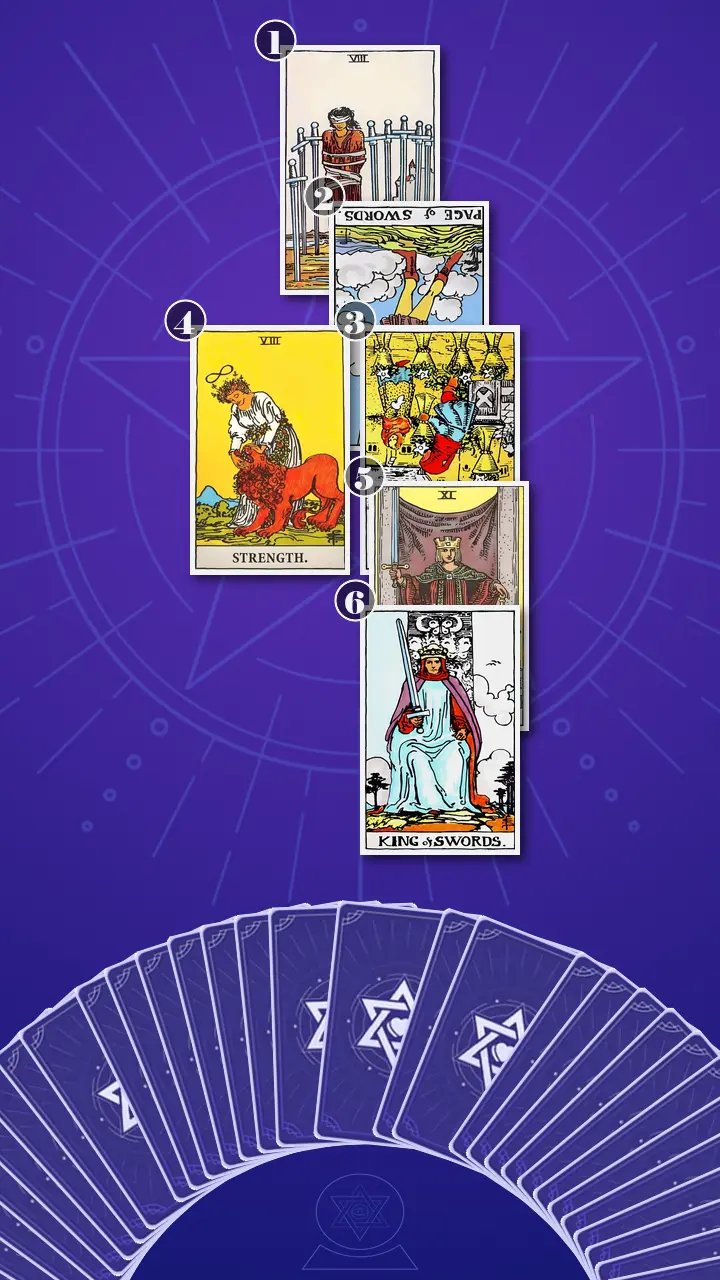
Drafts, Wind, and Old Paper Hearts
Position 1: The current overexplaining loop
“Now turning over the card that represents the current overexplaining loop (what it looks like in real life right now),” I said.
Eight of Swords, upright.
“This is the card of a self-made cage,” I told her. “Not because the world is actually trapping you—but because your mind is.”
I tapped the image gently. “Your translation is painfully modern: ‘You’re staring at a draft in Notes, rewriting the same sentence 12 times because you’re convinced there’s only one ‘safe’ phrasing. You keep adding context to avoid being misunderstood, but every extra line makes you feel more trapped.’”
In this position, the Eight of Swords is a blockage state of Air—thought energy tightening into a knot. “Saying less” feels like danger. So you edit and edit until you’re not communicating anymore—you’re managing risk.
Jordan let out a small, incredulous breath and gave me a look that said, how are you in my phone. Then she did the unexpected thing: she smiled, but it didn’t reach her eyes. “That’s… too accurate,” she said. “Like, a little cruel.”
“Accurate doesn’t have to be cruel,” I said softly. “It’s a mirror, not a sentence.”
Position 2: The trigger moment that flips you into explanation mode
“Now turning over the card that represents the trigger moment that flips you into explanation mode (the split-second impulse),” I said.
Page of Swords, reversed.
“Here’s the choke point,” I told her. “This is hyper-vigilant interpretation—the moment tone becomes a threat.”
And I used the only framing that ever really lands with people who live inside Slack and iMessage.
Split-screen: on the left, your phone screen—‘Seen 2:14 PM’, the typing bubble appears and disappears, then a single ‘ok.’ On the right, your internal courtroom monologue: Okay, what did I do? What’s the accusation? Let me pre-answer the questions. Thumb hovering, jaw clenched, and a countdown in your body: If I don’t fix this in 60 seconds, it’ll be ruined.
I quoted her modern-life scenario almost word for word because it deserved to be named: “A friend replies with ‘sure’ or a coworker sends ‘ok.’ Your brain instantly fills in a story… and you start firing off clarifications—extra context, reassurance, softening phrases—trying to outrun judgment before it arrives.”
Reversed, the Page’s energy becomes a deficiency of groundedness and an excess of vigilance—Air turned to static. It’s not that you’re too sensitive. It’s that you’re scanning for danger where there might only be… brevity.
Jordan nodded sharply—once, like something clicked into place against her will. Her lips parted, then closed. “Oh wow,” she whispered. “It’s literally the moment I see ‘ok.’ I don’t even think. I just—react.”
Position 3: The childhood-rooted belief behind the apology reflex
“Now turning over the card that represents the childhood-rooted belief behind the apology reflex (the old rule you learned),” I said.
Six of Cups, reversed.
I didn’t have to invent a metaphor; it was already on the table between us—the folded paper, the careful handwriting, the ritual of being “good.”
“This,” I said, “is the old belonging strategy returning.” And I let the line be gentle, but exact: “You didn’t learn clarity. You learned pre-emptive appeasement.”
Her modern-life translation fit like a key: “You find your childhood ‘sorry’ notes and recognize the same energy in your adult texts… your body reacts like you’re back in a world where being misunderstood meant consequences.”
Reversed, the Six of Cups shows legacy software still running. It used to keep you safe. It’s glitchy now.
This is where my own work always turns a little “generational,” because patterns rarely start with the person sitting in front of me. In my family, we call it Generational Pattern Reading: noticing what got inherited as a survival skill and what needs updating.
“Jordan,” I said, “who taught you—without saying it out loud—that being lovable meant being agreeable?”
Her throat tightened so visibly it was like watching a knot pulled. She looked down at the notes, then away. “My mom wasn’t… mean,” she said carefully. “But moods mattered. If someone was upset, you fixed it fast.”
“That makes so much sense,” I said. “Your brain learned: if I smooth it over quickly, I stay connected.”
Position 4: The inner resource that helps you tolerate discomfort without overexplaining
“Now turning over the card that represents the inner resource that helps you tolerate discomfort without overexplaining,” I said.
Strength, upright.
“This is the moment we stop trying to white-knuckle our way into better habits,” I told her. “Strength isn’t silence. It’s self-leadership.”
I gave her the modern-life scenario she needed: “You feel the spike—hands reaching for the phone to add ‘one more message’—and you don’t bully yourself into being chill. You notice the urge, breathe slowly, and let the discomfort exist without turning it into paragraphs.”
In terms of energy, this is balance: Fire not as aggression, but as courage—warmth in the chest that helps you stay present while your mind is screaming for the follow-up text.
I watched her fingers. They’d been flexing, restless, like they wanted to reach for the phone. On “Strength,” her hands paused. She took a small exhale she didn’t seem to plan. Her shoulders lowered about half an inch. A micro-shift, but real.
When Justice Spoke: Proportional Truth, Not a Closing Argument
Position 5: The reframe that restores balance
“Now turning over the card that represents the reframe that restores balance (what to replace overexplaining with),” I said. And before the card even fully settled on the table, the room seemed to quiet—kettle off, traffic muffled, the kind of pause that feels like fresh snow outside the door.
Justice, upright.
“This is the bridge,” I told her. “The move from trying to be understood perfectly… to insisting on being treated fairly.”
I nodded toward her phone. “Your message doesn’t need a full Google Doc when the situation is a single Slack ping. Justice is the proportionality test: I can be fair without being exhaustive. Truth isn’t longer. Truth is cleaner.”
Jordan’s eyes narrowed a little, like part of her wanted to argue. She sat up straighter. “But if I don’t explain,” she said, “they’ll assume the worst.”
Setup (the stuck moment): I could feel her caught in that familiar snap—the short reply lands, her throat tightens, and before she even decides what she wants to say, Notes is open and she’s typing “Just to clarify…” like her safety depends on one more paragraph.
Delivery (the line that changes the angle):
Stop putting yourself on trial in every message; choose proportional truth, like Justice’s scales and single sword.
She reacted in a three-beat chain—so fast it was almost invisible unless you’ve watched this kind of pattern for decades.
First, a physiological freeze: her breath caught, her thumb stopped mid-hover as if the air itself got heavier. Second, the cognition seeped in: her gaze unfocused for a second, like she was replaying a week of texts and hearing how much of them were actually courtroom exhibits. Third, the emotion arrived—not purely relief, not purely sadness: a sharp blink, eyes glassy, and then a tiny flare of anger. “But… doesn’t that mean I was wrong?” she said, voice tight. “Like I’ve been doing it wrong for years?”
I kept my voice calm. “It means you were surviving,” I said. “And now you’re updating the contract.”
“Here’s the thing,” I continued, and I could feel my grandmother’s old Highland certainty behind my words—firm, never cruel. “A boundary isn’t stronger because it comes with footnotes. You’re not asking to be understood perfectly—you’re asking to be treated fairly.”
Then I gave her the practice—because Justice is only useful when it becomes behavior. “We’re going to do what I call the 10-minute Justice Edit,” I said. “And you can stop anytime if it makes you feel more activated.”
“Open your draft. Set a 10-minute timer. Rewrite it into exactly three lines: (1) the fact, (2) the ask or boundary, (3) one neutral closer. No apologies unless you actually harmed someone. Then put your phone face-down and do one grounding thing—wash a mug, step onto the balcony, feel your feet.”
Her shoulders sank further, and she looked almost dizzy with how simple it sounded. “If your body spikes with panic,” I added, “you’re allowed to pause and not send. This is practice, not a performance.”
I leaned in slightly. “Now, with this new perspective, think back over the last week—was there a moment when you wrote a mini closing argument just to be treated kindly? How would those three lines have changed how you felt in your body?”
She swallowed, and this time the swallow looked like release. “Yesterday,” she said. “A stakeholder said ‘ok’ on Slack and I sent… so much. Like I was defending my character.” Her mouth pulled into a small, embarrassed smile. “I could’ve just said the fact and the ask.”
“That,” I said, “is the shift: from compulsive apology-drafting and courtroom-style overexplaining to calm, proportional truth-telling with steady self-respect. Not coldness. Not withholding. Just… clean.”
Position 6: The next step you can apply this week
“Now turning over the card that represents the next step: a concrete communication practice you can apply this week,” I said.
King of Swords, upright.
“This is ‘clarity without cruelty,’” I told her. “The King doesn’t overexplain because he’s not asking permission to have a need.”
I gave her the modern-life scenario she’d been craving: “You edit your message like a calm leader: one point, one ask, no disclaimers. You send: ‘I can’t make it tonight. Let’s do next week,’ and you don’t add an apology paragraph. You let your consistency—not your overexplaining—be the proof.”
We did a quick leader-edit montage together—delete three disclaimers, keep one ask, send. Not harsh. Just finished.
Jordan actually picked up her phone and whispered, half to herself, “I’m not asking permission to exist in the conversation.” Then she looked up at me, surprised by her own steadiness.
The Justice Edit: Actionable Next Steps You Can Actually Try
I tied the whole ladder together for her in one simple story: the Eight of Swords showed how her mind turns messaging into a trapped, edited performance; the Page of Swords reversed revealed the trigger—tone anxiety that turns a short reply into imagined criticism; the Six of Cups reversed explained why it hits so hard, because the old rule was be good, be small, fix it fast. Strength gave her the capacity to tolerate the discomfort without sprinting into apology. Justice rewrote the standard—proportional truth. And the King of Swords turned it into practice—clean, bounded speech.
The cognitive blind spot was clear: she believed more context would guarantee safety, but it was actually outsourcing her self-respect to other people’s reactions. The transformation direction was just as clear: from proving her goodness through explanations to practicing clean, concise truth-telling and letting her consistency speak.
Before we finished, I added one of my most grounded tools—what my family calls a Home Energy Diagnosis, but I keep it practical. “When you’re in explanation mode, your whole body is trying to ‘fix’ the environment,” I told her. “So we’re going to redirect that care somewhere that doesn’t cost you dignity.”
Here are the actionable next steps I gave her—small, realistic, and built for real relationships and real phones:
- The 20-Minute Single-Send PauseSend one clear message, then set a timer for 20 minutes where you do not send any follow-up unless the other person asks a direct question.Your body may protest (tight throat, urgency). Treat that as proof you’re interrupting a reflex—not proof you’re wrong. Aim for 60 seconds of delay if 20 minutes feels impossible.
- The Three-Line “Justice Sentence” TemplateCreate a phone shortcut note titled “My Three-Line Template”: (1) Fact. (2) Ask/boundary. (3) Neutral closer. Use it once this week for a real text (work, friendship, dating—anywhere you’d usually overexplain).If you fear sounding cold, add warmth with one sentence—not an essay. Clarity can be warm. It just doesn’t have to be endless.
- The 3-Minute Plant Check (Home Energy Reset)After you hit send, put your phone face-down and spend three minutes with one houseplant: notice the leaves, the soil, the light. If it needs something simple (rotate it, wipe a leaf), do that—then stop.This satisfies the “fix it” impulse without fixing people. It’s also a physical cue to end the loop: you’re done, the message stands.

A Week Later: A Short Text That Didn’t Collapse the World
A week later, Jordan messaged me—ironically, with fewer words than she would’ve used before. “Did the three-line thing,” she wrote. “Felt like my throat was going to close up. Didn’t send the follow-up. Nobody died.”
Then she added, “Also, I replaced one ‘sorry’ with ‘thanks.’ It felt illegal. But… better.”
I could picture it: a quiet Toronto evening, phone finally set down, a mug rinsed and left to dry, and that strange bittersweet mix—clearer, but still tender. She wasn’t floating in perfect confidence; she was practicing ownership.
That’s what this Journey to Clarity looked like in real life: not a personality transplant, but a new standard—proportional truth, steady self-respect, and connection that doesn’t require self-erasure.
When the vibe shifts—even slightly—your throat tightens and your hands reach for your phone like you need one more paragraph to prove you’re not “too much” and not in trouble.
If you didn’t have to prove your goodness in words, what’s one clean, three-line truth you’d let stand on its own this week?