From Calendar-Invite Anxiety to Bounded Yeses: Building Self-Trust

The 3:18 p.m. Google Calendar Trapdoor
If a shared calendar invite makes your chest tighten before you even read the details, you’re not “dramatic”—you’re in commitment anxiety mode.
Jordan (name changed for privacy) logged into our call from a Toronto condo office nook, the kind with a desk that’s also a shelf that’s also a compromise. It was 3:18 p.m. on a Wednesday for them—the laptop fan doing that constant little whirr, Slack pinging twice like it had opinions, and Google Calendar open in week view with that blue-white glare that somehow feels louder than sound.
They described the exact loop with the precision of someone who’s embarrassed they can’t out-design their own nervous system: the invite slides in, they click it, they scroll Mon→Sun three times, drag a “deep work” block thirty minutes later “just in case,” and then… nothing. No Accept. No Decline. Just closing the tab like that counts as a decision.
“It’s just a calendar invite,” they told me, voice steady but tight in the throat. “But it feels like a contract.”
As they spoke, I watched their jaw set harder on the word contract. Their hands kept hovering near the trackpad, restless, like part of them wanted to hit Accept just to stop the pressure—and another part wanted to protect their week like it was a fragile glass thing.
The contradiction was already pulsing in the room between us: wanting connection and coordination vs fearing loss of autonomy and control. The way Jordan said it was simpler: “I want to say yes without feeling like I’m losing myself. But if I answer fast, I panic. If I don’t answer fast, I feel guilty.”
The anxiety didn’t look like panic; it looked like bracing—like trying to swallow while someone’s gently pressing a thumb into the center of your chest. A tight chest, a clenched jaw, and that particular kind of mental noise that makes your calendar feel less like a tool and more like a wall.
I softened my voice on purpose. “You’re not broken for this. Your system is trying to protect something. Let’s make it less mysterious.” I let a beat pass. “We’ll use Tarot the way I use it in my Jungian work: as a mirror for patterns. Not prediction—clarity. We’re going to draw you a map through this fog.”

Choosing the Compass: The Four-Layer Insight Ladder (Tarot Spread for Commitment Anxiety)
I asked Jordan to take one slow breath and place their phone face down—nothing ceremonial, just a clean transition. While I shuffled, I invited them to hold the exact micro-moment in mind: the invite arriving, the hover over Accept, the split-second where their body reacts before their thoughts do.
“For this,” I said, “I want to use a spread I call the Four-Layer Insight Ladder · Context Edition.”
For anyone reading who’s ever wondered how tarot works in a practical, modern way: a good spread is like choosing the right lens. Jordan’s question wasn’t “What will happen?” It was: Shared calendar invite—what is my commitment anxiety protecting? So we needed a structure that separates layers—behavior, meaning-story, what’s being guarded, and then the integration + next step.
This ladder layout is minimal on purpose (six cards), but it’s specific. Card 1 shows the immediate freeze. Card 2 shows the mental frame—the invisible “Terms & Conditions” the brain auto-adds. Card 3 names what the anxiety is protecting. Then we cross over: Card 4 reveals the healthy need under the defense, Card 5 is the integration point (the bridge), and Card 6 gives a grounded practice Jordan can try this week.
I placed the cards in two columns like rungs: three down the left (the tightening spiral), then three down the right (the release path). “We’ll read down the left first,” I told them, “then step across.”
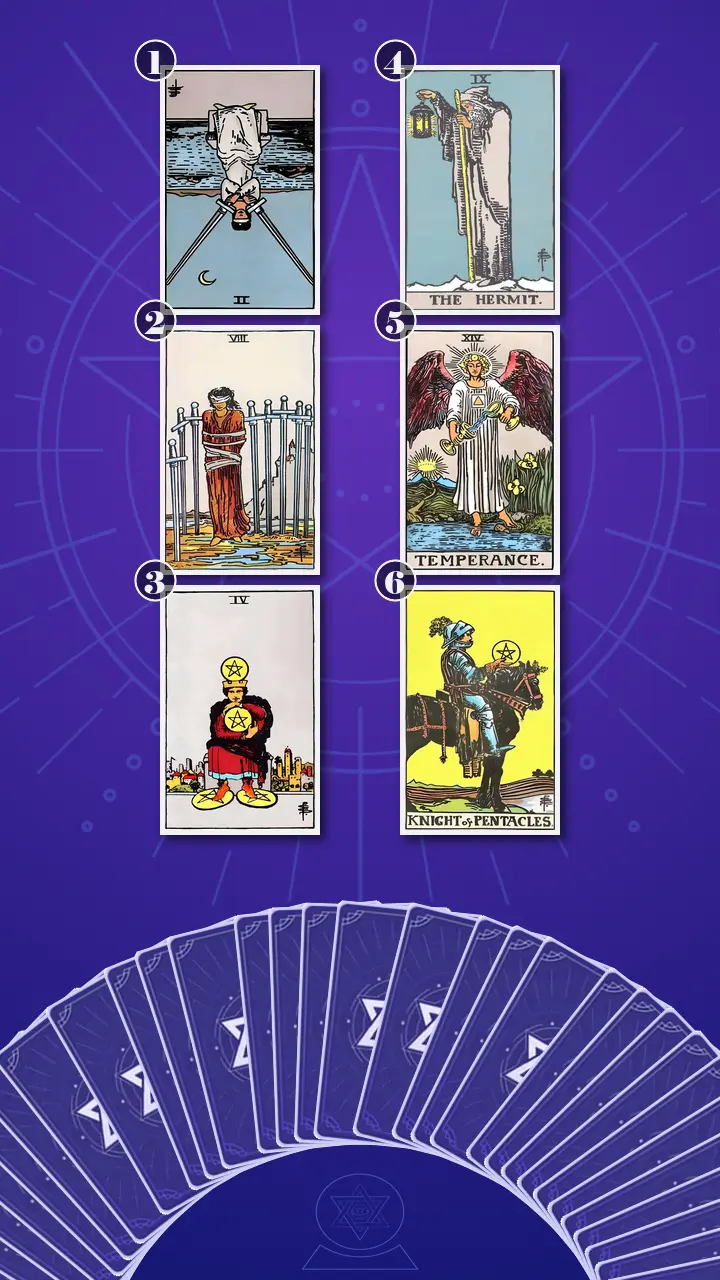
The Blindfold and the Invisible Rules
Position 1: The Freeze You Can See (and Feel)
“Now flipped over,” I said, “is the card representing the immediate, observable reaction to the shared calendar invite—the freeze, the stalling behavior, the felt sense.”
Two of Swords, reversed.
In the image, the blindfold and the crossed blades always make me think of self-protection through non-decision. And in Jordan’s life, it translated cleanly: You get the shared calendar invite, open week view, and start doing ‘calendar Tetris’ like you’re searching for a perfect, consequence-free slot. You move a focus block by 30 minutes, re-check Friday, then close the tab without responding—because clicking Accept/Decline feels like choosing a whole identity: reliable partner/teammate vs trapped person with no room to breathe.
Reversed, the energy isn’t “calm neutrality.” It’s blockage—a stalemate that leaks into stress. The mind tries to hold both swords forever, and the body pays the bill: clenched jaw, tight chest, restless hands. The short-term relief is real (“Nothing is locked in yet”), but it’s also a trap: the decision doesn’t disappear. It just turns into background static.
Jordan let out a small laugh that had a bitter edge to it. “That’s… honestly brutal,” they said. “Like, accurate. But brutal.”
I nodded. “I’m going to name something without shaming it.” I tapped the card lightly. “A pending invite is still a commitment—just to anxiety.”
Their eyes flicked down and to the side—classic impulse to check their calendar even while we were talking about not checking the calendar. Then they caught themselves and exhaled through their nose, like they’d been seen.
Position 2: The Story You Auto-Attach
“Now we’re looking at the card representing the meaning-story attached to the invite—what you assume it implies about expectations, identity, and freedom.”
Eight of Swords, upright.
This is the “mental cage” card, but it’s crucial that the bindings are loose. In modern life, it sounded exactly like this: The invite is for 60 minutes, but in your head it expands into: emotional availability, flexibility, follow-up, being ‘easy to work with,’ and proving you care. The cage is real in the body, but it’s not fully real in the agreement.
I guided Jordan through a quick “rules audit,” like we were debugging a product requirement that quietly scope-crept. “Let’s list the invisible add-ons your brain attaches,” I said. “Not what was asked—what you think it implies.”
I watched the screen glare reflect faintly in their glasses as they listened, shoulders starting to lower:
What was asked: “Thursday, 60 minutes.”
What your brain adds: “Be on emotionally.” “Be flexible.” “Be grateful.” “Follow up.” “Don’t be difficult.” “Don’t disappoint.” “Be available again next week.” “Prove you care.”
A Slack ping popped again in the background—perfect environmental sabotage—and Jordan’s face did something subtle: the jaw loosened a millimeter, like the realization created a tiny exit ramp. “I… yeah,” they said, voice quieter. “No one asked for half of that.”
“Exactly,” I told them. “Your calendar isn’t asking for your soul. It’s asking for terms.”
Position 3: What the Anxiety Is Protecting
“Now we turn to the card representing what the commitment anxiety is protecting—the resource or boundary being guarded.”
Four of Pentacles, upright.
This card always shows me a person clutching something like it’s the last stable thing in a shifting world. In Jordan’s real life: Your commitment anxiety is protecting your base layer: recovery time, creative energy, and the feeling that your week belongs to you. In a hybrid job where meetings can multiply fast, your calendar becomes the last place you can still ‘own’ something—so you hold it tightly.
The energy here is excess control—not because Jordan is selfish, but because their system remembers what happened when they didn’t guard it: overcommitting, resentment, burnout. Toronto realism matters here. Time feels as expensive as rent. It’s not greed. It’s survival math.
Jordan’s hand went to their collarbone without them noticing, fingers flattening there like they were checking the tightness in their chest. “I hate that it’s this intense,” they said. “But… yeah. If my week gets away from me, everything else falls apart.”
“That’s not a character flaw,” I replied. “That’s capacity-protection. We can work with that.”
Position 4: The Healthy Need Inside the Defense
“Now we’re stepping across the ladder,” I said, “to the card representing the hidden need or healthy intention inside the protection strategy—the part of you trying to help.”
The Hermit, upright.
In the Hermit, the lantern isn’t about withdrawing forever. It’s an internal pacing signal. The modern-life translation was almost tender: Instead of answering from panic or people-pleasing, you take five quiet minutes on purpose: phone face down, one breath, then a quick internal check—‘Do I have the energy for this this week?’ The goal isn’t to delay forever; it’s to decide from self-knowledge.
I painted a five-minute micro-scene, because your nervous system listens better to images than lectures: “Phone face down. One sip of water. You look out the window—condo glass, a hint of grey sky, the TTC rumble distant like a low bass note. And you say to yourself: I’m not deciding forever. I’m pausing on purpose.”
Jordan’s eyes softened. Not dramatic—just a visible permission. “That feels… different,” they said. “Like it’s allowed.”
“It is,” I answered. “Solitude is a charging dock, not a personality flaw.”
When Temperance Spoke: Freedom in a Clean Container
Position 5 (Key Integration): The Bridge Between Autonomy and Connection
I let my hands rest on the deck for a second. The room felt quieter—not because the city stopped, but because Jordan stopped bracing long enough to listen.
“We’re flipping the most central card now,” I said. “This one represents the key integration: the mindset and structure that can reconcile autonomy with connection.”
Temperance, upright.
Temperance is measured pouring—two cups, a calm transfer, one foot in water and one on land. In Jordan’s real life it’s this: You reply with a clear yes plus a clear container: ‘Yes—5:00–6:00, and I need to wrap at 6.’ Or ‘Yes, but I can’t do it back-to-back; I’ll need a buffer after.’ It’s not all-in or all-out. It’s a bounded agreement.
And this is where my Venetian brain always reaches for bridges. I call it my Bridge-Corridor Theory: a bridge connects two islands—two people—without demanding the islands become one. But a bridge needs edges. Without guardrails, it stops feeling like connection and starts feeling like a corridor with no exits.
Jordan’s shared calendar invite wasn’t a demand for surrender. It was a bridge request. Temperance says: build the bridge with parapets. Define the container so your autonomy stays intact inside the connection.
Setup: I could see Jordan in the familiar moment—finger hovering over “Accept,” jaw clenched, and suddenly a 60‑minute invite feeling like it’s taking their whole week hostage. Their mind was still trying to solve the impossible problem: “How do I say yes without risk? How do I say no without losing love?”
Stop treating the invite like a trap, and start treating it like measured pouring—define the container, then let connection fit inside it.
There was a pause after I said it, the kind of pause you can almost hear.
Reinforcement: Jordan’s reaction came in layers, like weather shifting. First: a tiny freeze—breath held for half a second, eyes widening just a touch. Then: cognitive seep-in—their gaze unfocused, as if replaying every time they’d written a four-sentence “soft no” in Notes and called it “being considerate.” Finally: release—their shoulders dropped, not dramatically, but like a backpack sliding off one strap at a time. Their mouth opened and closed once, searching for the old argument, and then they exhaled, shaky but relieved. “Oh,” they whispered. “So I’m not trying to avoid plans. I’m trying to avoid… being consumed.”
I kept my tone steady and warm. “Exactly. And the way out isn’t ‘endless maybes.’ It’s containers.” I leaned in slightly. “Now—use this new lens and think back: in the last week, was there a moment when this insight could’ve changed how you felt? A single invite, a single ‘quick sync,’ a single ‘can we plan Friday?’”
Jordan blinked, and I saw the memory land. “My partner sent one for Sunday brunch,” they said. “I left it pending for two days. I could’ve just said ‘Yes, but I need to be home by 2.’ That would’ve solved… so much.”
“That’s the shift,” I said. “Not from ‘commitment fear’ to ‘fearless.’ From calendar-triggered commitment anxiety and protective non-decision to calm self-trust through explicit, bounded agreements.”
Position 6: The Grounded Next Step You Can Repeat
“Last card,” I said. “This represents a grounded next step you can practice this week to respond to invites with clarity and self-trust.”
Knight of Pentacles, upright.
This knight doesn’t rush. One pentacle. One realistic commitment at a time. In Jordan’s life: You pick one plan you can truly keep, confirm it, and then honor it without constant renegotiation. You block a small recovery buffer around it like you would budget money around rent.
The energy here is balance through consistency. Not perfection. Not “be endlessly available.” Just: commit slowly, keep it clean, then keep it.
Jordan gave a small, practical nod—the kind product designers do when something becomes implementable. “I can do that,” they said. “Like… I can close one loop today.”
From Insight to Action: The One-Sentence Container Reply
I pulled the whole ladder into one story for them, so it wasn’t just six separate ideas. “Here’s the arc,” I said. “The Two of Swords shows the freeze—non-decision as protection. The Eight of Swords shows the mental add-ons—the invisible rules that make a 60-minute invite feel like lifelong access. The Four of Pentacles names what’s real: your capacity is finite, and you’re guarding it. The Hermit says the need underneath is quiet, self-led pacing—not more spiraling. Temperance gives the integration: measured pouring, a clear container. And the Knight of Pentacles makes it behavioral: fewer, clearer commitments and steady follow-through.”
Then I named the blind spot gently, because shame makes people defensive and clarity makes people brave. “Your cognitive blind spot is thinking your autonomy is protected by delay,” I said. “But delay just hands the steering wheel to anxiety. Autonomy is protected by explicit, bounded agreements.”
“And yes,” I added, “this may feel weirdly ‘too much’ for a simple invite. That thought is part of the loop. We’re not making your life more complicated—we’re making your commitments more sustainable.”
I offered Jordan a few low-friction next steps. I framed them using one of my favorite communication metaphors from home—Burano lace: tiny, precise stitches that hold a whole pattern. I call it the Lace Communication Method: fewer words, cleaner edges, stronger connection.
- The 5-Minute Hermit PauseBefore replying to any shared invite, set a 5-minute timer. Phone face down. One sip of water. One slow breath. Ask: “Do I have the energy for this this week—yes or no?” Then open the invite and answer.If you catch yourself spiraling, switch from thinking to sensing. The rule is: pause with a timer—this isn’t stalling with better branding.
- The Two-Step Reply (Yes/No + One Container)For one week, every invite gets one sentence: (1) a clear yes/no, and (2) one clean container (end time or buffer or scope). Example: “Yes—5:00–6:00, and I need to wrap at 6.”If you feel yourself writing a paragraph, stop. Choose one condition only. A container is not an excuse—it’s your terms.
- Close One Pending Invite in 10 MinutesPick one invite you’ve been “maybe-ing.” Set a 10-minute timer and accept/decline using the one-sentence container reply. If you accept, immediately add an end time and a 15-minute decompression block after it.Think of it like the Gondola Balance Technique: you redistribute the emotional load. The buffer is the weight on the other side of the boat so you don’t tip into resentment.
Jordan read the steps back to me in their own words, which is always my favorite sign. It means the insight has moved from “idea” to “ownership.”

A Week Later: Ownership, Not Certainty
Six days later, I got a message from Jordan. No long explanation. No apology paragraphs. Just a screenshot of a calendar block with a neat 15-minute buffer after it and a caption: “Closed the loop in 8 minutes. Said yes, ended at 6. Didn’t die.”
They added one more line: “I still felt the clench. But I didn’t let it drive.”
That’s the quiet proof most people miss: clarity isn’t the absence of tension. It’s the presence of a structure strong enough to hold it. In Jordan’s journey to clarity, the calendar stopped being a threat to their autonomy and started becoming a tool for self-trust—because their commitments finally had edges.
When a simple calendar invite makes your chest tighten, it’s usually not the event you’re afraid of—it’s the moment you imagine your freedom getting quietly negotiated away, and you panic because you don’t trust you’ll be able to show up without losing yourself.
If you let one commitment be a clearly bounded container this week—something you can keep with ease—what would you want that “yes” (or “no”) to sound like in your own words?