Stuck in Meme-Apology Banter Mode—How I Learned to Ask for Repair

The GIF That Lands Like a Sticker on a Crack
You’re a 20-something in Toronto tech who can write perfect Slack messages, but the second your partner sends a meme apology, you freeze and default to “lol it’s fine” even as your jaw clenches.
Jordan said that to me like she was reporting a bug she couldn’t reproduce on command—half a laugh, half a wince. She’d booked a late session after a long hybrid-work day, and when our video call connected, I could see the TTC glow still in her eyes: that slightly overlit, fluorescent residue you get from Line 1.
She described the moment with the kind of precision only a UX designer can manage when she’s trying not to cry about it. “Union Station. One hand on the pole. My phone’s warm from doomscrolling. And then the meme pops up—like, an apology, but… a joke.” She swallowed like her throat had to negotiate permission for the next sentence. “My jaw clamps. I type, ‘Can we actually talk about what happened?’ And then I delete it. I send ‘lol.’”
Frustration, in her, wasn’t an abstract feeling. It was a tight throat like her words were getting stuck on a narrow staircase. It was a clenched jaw that kept clicking shut, as if her body had already decided: we’re not doing earnest tonight.
“You’re not asking me how to win,” I said softly. “You’re asking how to ask for repair without performing chill. That’s a real skill. Let’s make a map for this—something you can use the next time a meme tries to replace accountability.”

Choosing the Compass: The Celtic Cross for a Repair Conversation
I asked Jordan to take one slow breath and hold the question in her mind—After they apologize with memes, how do I ask for repair? Not as a spell. As a focus tool, like closing a few browser tabs so the one you actually need can load.
On my side of the screen, I shuffled while the room settled. My studio always smells faintly of paper and citrus—blotters, bergamot, the clean bite of something honest. I’ve learned, in fifteen years of perfume training, that clarity is often a subtraction. You remove the noise until the true note is undeniable.
Today, I told her, we’d use the Celtic Cross. It’s ideal for moments like this because the goal isn’t prediction—it’s finding clarity: what’s happening in the present dynamic, what blocks real repair, what fear lives underneath, and—most important—what your next practical communication stance should be.
In this spread, the center shows the “right now.” The crossing card shows the obstacle that keeps you stuck in banter mode. And the near-future card—Position 6—often gives the cleanest “what do I do next?” guidance for actionable advice.
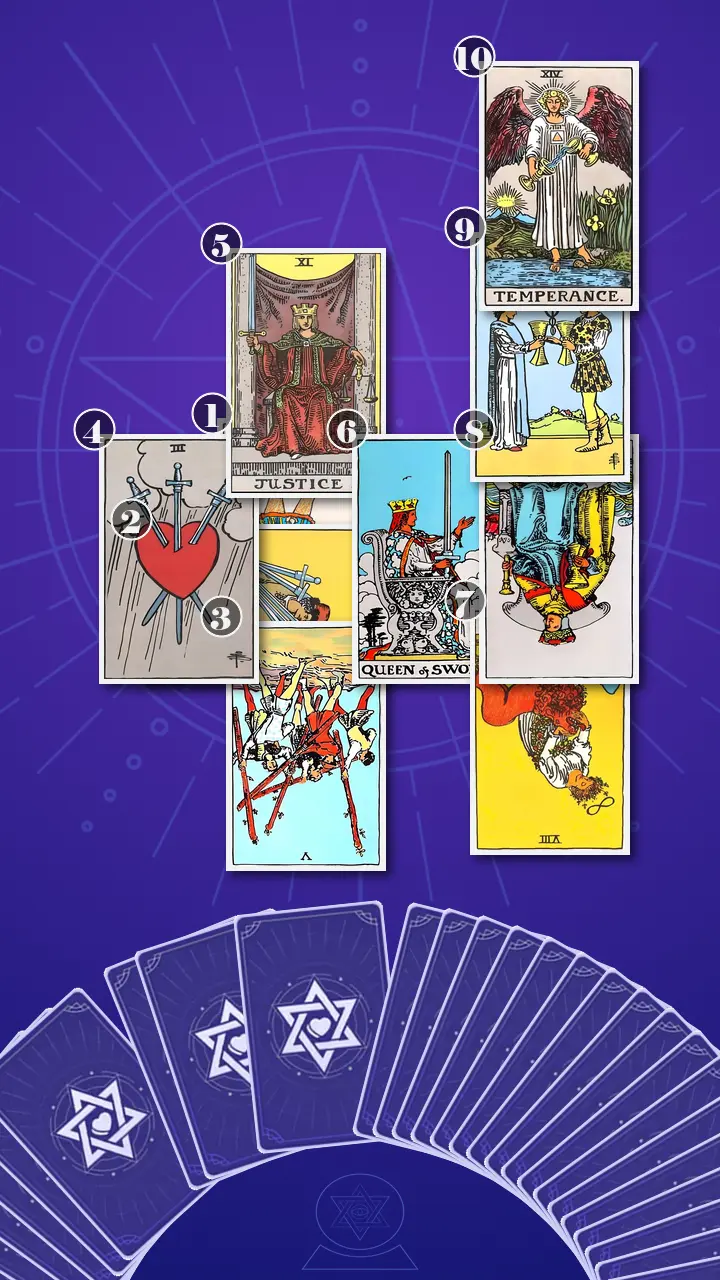
Reading the Map: How Tarot Works in Context (and Why You Keep Freezing)
Position 1 — Present dynamic: what happens right now
“Now turning over,” I said, “is the card that represents the present dynamic: what is happening right now when they ‘apologize’ with memes and you try to respond.”
Page of Cups, reversed.
“This,” I told her, “is the sweet, tentative messenger of feelings—except reversed, the message is playful and indirect when what you need is sincerity and follow-through.” I nodded toward her camera. “A meme apology can be a bid for reconnection. But in this position, it also shows how cute communication becomes a way to skip the hard part.”
In modern life terms, it’s exactly what you described: a funny GIF that gestures at feelings, while the real conversation floats offshore with no plan for what changes next.
Energetically, reversed Page of Cups is a blockage: emotional contact is offered, but it’s underdeveloped—more “vibe check” than “repair conversation.”
Jordan gave a small, uncomfortable laugh that sounded like a sip of air through clenched teeth. “That’s… brutal,” she said. Then she paused and added, almost accusing herself, “Because I take it. Every time.”
I kept my voice warm, not indulgent. “A meme can reconnect you. It can’t repair you.”
I watched her eyes flick down to her phone, like her body remembered the thread on its own.
Position 2 — Core challenge: what blocks repair
“Now turning over,” I said, “is the card that represents the core challenge: what blocks a real repair conversation from happening after the meme apology.”
Seven of Swords, upright.
I pointed to the figure sneaking away with the swords. “This is the easiest exit route. Not necessarily malicious—just strategic avoidance. The apology is delivered in a way that makes follow-up questions feel like you’re ‘ruining the vibe.’”
And here, I used her own world: “It’s like a coworker dodging a hard question by changing the meeting agenda mid-call. The conversation moves forward, but the actual issue stays untouched.”
Energetically, this is deflection. The loop becomes: they keep it light, you match the humor, and nobody has to risk a real yes-or-no about accountability.
To mirror what I was seeing, I narrated it like a phone-screen close-up—because that’s where this pattern lives. “The meme lands. Heat rises in your face. Your thumb auto-types ‘lol it’s fine.’ And meanwhile, the unsent draft—‘Can we talk for real?’—sits in the input box like a document you’re too scared to save.”
Then I gave her the inner monologue contrast, clean and non-shaming: “If I keep it playful, we stay connected… but if I keep it playful, nothing changes.”
Jordan nodded once, sharp and small. Like she was admitting the bug was real.
Position 3 — Root cause: the deeper driver underneath “keep it light”
“Now turning over,” I said, “is the card that represents the root cause: the deeper driver that keeps both of you in the pattern instead of direct repair.”
Five of Wands, reversed.
“Underneath the meme-apology dynamic,” I said, “is a deep discomfort with open conflict. Reversed Five of Wands doesn’t mean you can’t handle hard things. It means unstructured emotional conflict feels like chaos, so your nervous system reaches for smoothing and minimizing.”
Jordan’s mouth tightened in recognition. “At work, I can do critiques all day,” she said. “There’s an agenda. A Figma comment thread. In dating, it feels like one wrong sentence and suddenly I’m… the villain.”
Energetically, reversed Five of Wands is a deficiency of structure. And when structure is missing, humor becomes a substitute for containment. That’s why time-boxing matters so much for repair: a 10-minute check-in feels survivable where a vague “we need to talk” feels like falling down a staircase.
Position 4 — Recent past: the moment that still stings
“Now turning over,” I said, “is the card that represents the recent past: the rupture or moment of hurt that still needs to be acknowledged.”
Three of Swords, upright.
“This validates something important,” I told her. “The sting isn’t imaginary. This wasn’t ‘nothing.’ A joke landed like disrespect, and the apology didn’t touch the exact impact.”
Three of Swords is clean pain—direct impact. Like a cracked screen catching the light again days later, even after you put a cute sticker over it.
Jordan’s eyes went a little glassy, not dramatic—just honest. “I can quote the exact sentence,” she admitted. “And I hate that I can.”
“That’s your body keeping the receipt,” I said. “Not your weakness.”
Position 5 — Conscious aim: what you actually want
“Now turning over,” I said, “is the card that represents your conscious aim: what you actually want from an apology and repair.”
Justice, upright.
The room seemed to get quieter—not mystical, just focused. “Justice says you want accountability and clarity,” I said. “Not a reset button. Not a vibe reset.”
I translated the scales and sword into something modern and non-punitive: “This is a terms & conditions moment. Not cold—clear. Not ‘did you mean it?’ but ‘what will be different?’”
And I gave her a one-line definition, the kind you can actually use: “Fair repair is measurable: words, change, and follow-through.”
Jordan let out a visible exhale. Her shoulders dropped a fraction. “Permission to be specific,” she said, like she’d been waiting for someone to say it out loud.
Position 7 — Self position: why your confidence wobbles at send-time
“Now turning over,” I said, “is the card that represents you: your internal state and self-trust when you try to ask for repair.”
Strength, reversed.
“This isn’t a lack of strength,” I said. “It’s doubt about your right to use it calmly.” Strength reversed is that moment your chest tightens and you suddenly feel weirdly small for wanting something basic.
I offered the practical mirror-scene, because her body needed to rehearse the words as survivable. “It’s 11:03 p.m., bathroom light too bright, toothpaste-mint in the air,” I said. “You practice: ‘I’m not mad, I just want repair.’ And then you hear your own fear whisper, ‘Don’t be intense.’ So you add an escape hatch: ‘It’s not a big deal.’”
Jordan’s face softened—an “oh” that wasn’t self-pity, more like recognition without shame. “I do that,” she said quietly. “I literally do that.”
“You don’t need to sound fearless,” I told her. “You need to sound steady.”
Position 8 — Environment/other person: how they tend to handle discomfort
“Now turning over,” I said, “is the card that represents the environment: how the other person is likely to engage with accountability and emotion.”
King of Cups, reversed.
“I’m not going to diagnose them,” I said, because I never do. “But this card describes a pattern: charm without follow-through. They manage discomfort by staying emotionally slippery—pleasant, joking, smooth—without actually holding accountability.”
Energetically, this is avoidant containment: the outside looks calm, but the emotional work doesn’t get held.
“So your best move,” I added, “is structure. Not debating feelings in circles. Asking for one specific repair step.”
Position 9 — Hopes and fears: what you’re longing for underneath the frustration
“Now turning over,” I said, “is the card that represents your hopes and fears: what you want repair to be, and what you fear it might reveal.”
Two of Cups, upright.
Her eyes flicked up at that—like she wanted to believe it.
“You want mutuality,” I said. “Not a power struggle. You’re not asking for groveling. You’re asking for a shared agreement: ‘We handle conflict like adults.’”
And the fear part lived right beside it: “Two of Cups here also asks: if you make a clear request… do they meet you, or do they dodge? Your request becomes a test of reciprocity.”
Position 10 — Integration outcome: what becomes possible with clarity
“Now turning over,” I said, “is the card that represents the integration outcome: what becomes possible when you ask for repair clearly and observe their response over time.”
Temperance, upright.
As a perfumer, Temperance always feels personal. It’s the card of blending—alchemy, calibration, the exact opposite of all-or-nothing.
“This outcome isn’t a dramatic showdown,” I said. “It’s a repeatable repair protocol. You blend honesty with warmth. You keep humor in the relationship, but you stop letting it replace sincerity.”
Temperance is a thermostat, not a light switch. Not “never joke again.” Just “jokes don’t get to be the only tool in the room.”
When the Queen of Swords Cut Through the GIF
Position 6 — Near-future approach: the stance that works next
I let my hand hover for a beat before turning the next card. “This,” I said, “is the near-future approach—the most effective communication stance for asking for repair in the next conversation.”
Queen of Swords, upright.
There’s a particular quiet that happens when someone recognizes a tool they’ve been needing. Jordan’s face went still—like a browser finally stopped loading and showed the page.
“The Queen of Swords is clarity without cruelty,” I said. “A short message. A specific request. And the discipline to not fill the silence with extra justifications.”
Then I brought in my own framework—my Emotional Repair Pathway, the one I use with couples who want intimacy without guessing games. “In repair,” I said, “I look for three phases: Impact (name what happened), Accountability (what changes), and Reconnection (how we come back together). Meme-apologies are often an attempted reconnection without impact and accountability. The Queen says: put the missing phases back in, simply.”
Setup: I could almost see the exact moment in her body: thumb hovering over the chat, jaw tight, rewriting “can we talk for real?” into something cute enough that she wouldn’t get labeled “intense.” She wanted closeness, but she didn’t want to beg for basic accountability.
Stop decoding memes and start naming your needs with the Queen’s raised sword—clear, calm, and unmistakable.
Reinforcement: Jordan’s reaction didn’t arrive all at once. First, she went very still—breath caught, like her lungs were waiting to see if this would be safe. Then her eyes unfocused for a second, as if replaying a dozen threads: the typing bubble anxiety, the timestamps, the way she always backspaced the honest sentence into something softer. Finally, her shoulders lowered on a long, shaky exhale, and her mouth pulled into a tiny smile that was half relief and half grief for all the times she abandoned herself. “But if I do that,” she said, a little sharper than before, “doesn’t it mean I’ve been… letting this happen?”
“It means you’ve been trying to belong,” I said gently. “And now you’re upgrading the system. No shame. Just new information.”
I asked her the question that turns insight into something you can actually use: “Now, with this new lens—can you think of a moment last week when you felt the throat-tightening start, and this two-sentence clarity could have changed how you felt in your body?”
Jordan blinked quickly. “Tuesday,” she said. “Kitchen. Kettle. I did the ‘lmaoo ok’ thing. If I’d sent the clean version… I would’ve at least known.”
That was the shift, right there: from irritated shutdown to vulnerable honesty that feels risky—one step toward calm clarity. Not just about a decision, but about moving from self-doubt to steadier trust in her own needs.
From Insight to Action: The Two-Sentence Repair Ask (Plus a Scent Anchor)
When I looked at the spread as a whole, the story was almost painfully coherent: a tender but underdeveloped bid for connection (Page of Cups reversed) gets protected by an exit route (Seven of Swords), because underneath there’s a fear that serious talk equals chaos (Five of Wands reversed). A real sting still needs naming (Three of Swords). And Jordan’s conscious self is already holding the standard (Justice)—she just needs the near-future stance to carry it (Queen of Swords), even when her confidence wobbles (Strength reversed), especially with someone who prefers smooth vibes to accountability (King of Cups reversed). The hope is mutual repair (Two of Cups), and the likely path is a workable blend over time (Temperance).
The cognitive blind spot I named for her was simple: “You’ve been treating your need like it has to be approved by their tone. But your need doesn’t become valid only when they deliver it in the right packaging.”
The transformation direction was exactly what she came for: shift from decoding their tone and trying to keep it light to making one clear, specific repair request—and letting their response give you real information.
I offered her a set of next steps that were intentionally small—because steadiness beats intensity.
- The Two-Sentence Repair RequestOpen Notes and draft this now (so you’re not improvising in the chat): Sentence 1 = impact. Sentence 2 = one concrete next step + a time container. Example: “When you sent the meme after what happened, I felt brushed off. Can we do a 10-minute call tonight to talk about what repair looks like and what we’ll do differently next time?”If your throat tightens, set a 60-second timer, breathe, and come back. You’re allowed to choose timing; you’re not required to send it immediately.
- The Yes/No Accountability ForkIf they reply with another meme, respond once (only once): “I’m not looking for jokes right now—are you willing to talk and repair this, yes or no?” Then stop talking and let the answer be data.This isn’t you escalating. This is you preventing the Seven-of-Swords exit route from turning into a pattern.
- The 7-Minute Face-Down Rule + a Scent CueAfter you hit send, put your phone face-down for 7 minutes. No rereading, no editing, no “lol jk” follow-up. If you want a body anchor, dab one simple scent you associate with “clean air” (citrus, mint, even your hand soap) before sending—your Queen of Swords cue that this is clarity, not a performance.In perfumery, top notes are loud and fast; base notes are what lasts. Your boundary is a base note—quiet, steady, not begging to be liked.
And because Temperance was waiting at the end of the spread, I gave her an optional reconnection ritual—my “shared blending” strategy, simplified for real life: “After the repair talk, if it goes well, suggest something small and sensory you both enjoy—make tea together, pick a candle, cook one simple meal. It’s not a reward for them. It’s a way to mark: we did accountability, and we came back to warmth.”

A Week Later: Warm, Not Vague
Six days later, Jordan messaged me a screenshot—not of his reply, but of her own Notes app. Two sentences, exactly. Under it she’d typed: “I sent it. I didn’t add ‘lol.’ I put my phone face-down and walked to Tims like a normal person.”
Her follow-up text came a minute after: “He called. He actually apologized without a meme. We kept it to ten minutes. I’m… weirdly shaky, but I feel clearer.”
That’s how a Journey to Clarity usually looks in real life: not fireworks, not perfection—just one clean request, one honest response, and your nervous system slowly learning that you can be warm without being vague.
She didn’t suddenly become fearless. She just stopped negotiating with hints. And that was enough to change the whole shape of the conversation.
When you’re laughing along so they won’t leave, but your throat still tightens because the thing that hurt never got named, it’s not that you’re “too intense”—it’s that you’re trying to belong without asking to be handled with care.
If you let their next response be information—not a verdict on your worth—what’s one small, specific repair request you’d be willing to make this week?
Every reading at AceTarot is a Journey to connect with inner wisdom and empower next step.
Learn more about our Journey to Clarity.