From Doorway Chaos to Steadier Mornings: A 10-Second Reset

The 8:12 A.M. Doorway Spiral
If you're organized at work but weirdly chaotic at the exact moment you have to leave home, especially in a small apartment where every surface becomes a maybe-spot, I usually know within two sentences that I’m looking at a pattern, not a personality flaw.
That was how Taylor (name changed for privacy) opened our session. She sat down across from me, wrapped both hands around a paper cup of coffee, and said, almost before I had finished greeting her, “Why do I keep losing my keys every morning? And why can’t I find my charger before work every day?” Then she gave a quick, embarrassed laugh. “I lose ten minutes every morning to the same stupid scavenger hunt.”
As she spoke, I could see the scene with painful clarity: 8:12 a.m. in her compact Toronto apartment, tote open on the floor by the door, the Transit app refreshing while her phone battery hovered in the red, one shoe fully on and the other half-folded under her heel. The coffee on the counter had already gone lukewarm. Somewhere, a charger brick buzzed softly from the wrong outlet. Her hand kept patting the same jacket pocket twice, as if motion itself might make the missing objects appear.
What she wanted was simple: calm, ready mornings. What she kept getting was a mini scavenger hunt at the door. Her frustration wasn’t abstract. It had the feel of trying to unlock your phone while the screen keeps sliding away from your thumb—small, stupid, and somehow able to make you doubt your entire morning.
I told her, gently, “You’re not bad at adulting. You’re describing ordinary-life chaos that gets loud at transition points. Let’s not argue with the fog. Let’s map it.”

Choosing the Compass: How Tarot Works for a Repeating Morning Scramble
I asked her to take one slow breath and hold the question in plain language: not “What’s wrong with me?” but “What pattern am I in, and what would support look like?” Then I shuffled slowly, not as performance, but as a way to let the room settle. In my work, that moment matters because it turns self-blame into observation.
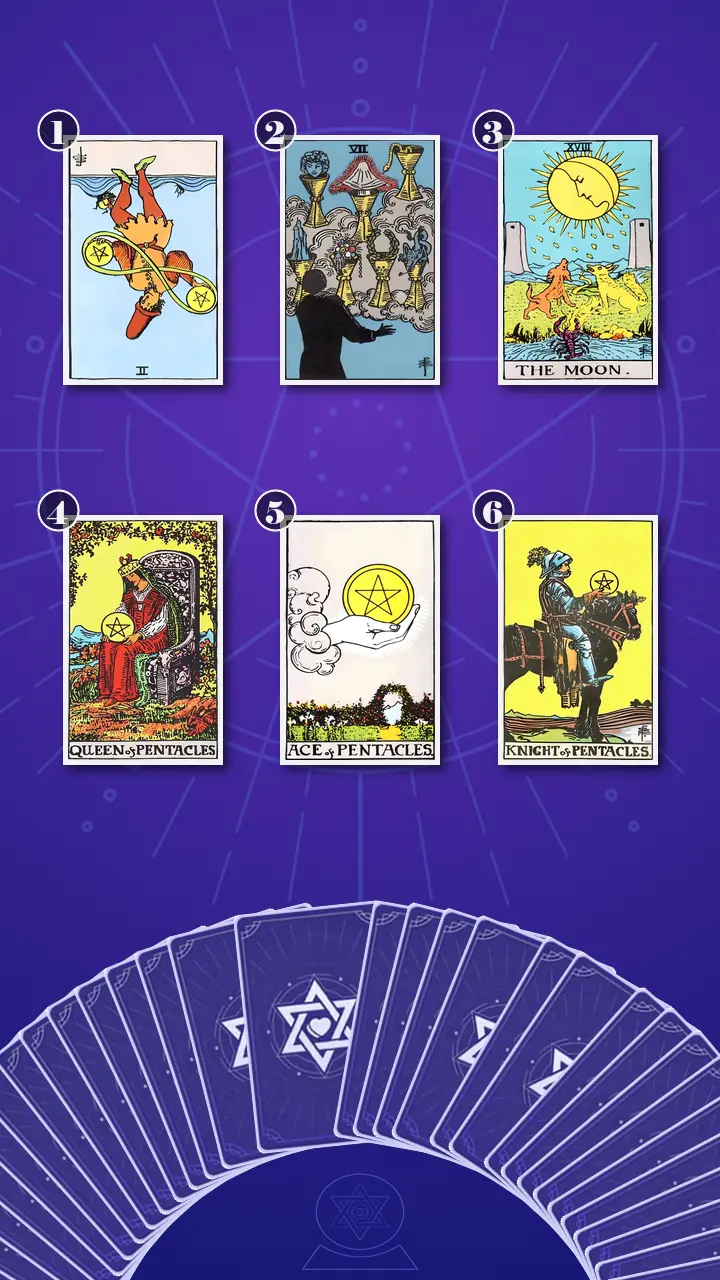
For this reading, I used the Transformation Path Grid (6) · Context Edition, a six-card routine-pattern spread I reach for when the issue isn’t a one-off bad morning but a loop that keeps rebuilding itself.
This is how tarot works best for something like morning chaos in a small apartment: it doesn’t mystify the problem. It gives the pattern shape. A simple past-present-future spread would flatten the cycle. A larger spread would add more symbolism than this question needs. This grid is just enough structure to track symptom to friction, friction to root, root to pivot, pivot to action, action to integration—like reading a tiny apartment floor plan and noticing where the flow keeps snagging.
I told her what I was watching for. The first card would show the visible scramble for keys and a charger before leaving. The next two would reveal the hidden friction and the deeper autopilot underneath it. The fourth card, sitting directly beneath the symptom, would tell us what inner shift could interrupt the loop. Then the last two would show the practical experiment and the kind of steadier morning that could grow from it.
Reading the Top Row: Where the Search Actually Begins
Position 1: Motion Without Closure
Now the card representing the concrete morning behavior in her question was Two of Pentacles, reversed.
Reversed, this card doesn’t tell me Taylor isn’t trying. It tells me the rhythm is dropping. I told her it looked exactly like leaving one room mid-task, phone in hand, tote still open, charger in an unknown outlet, and keys somewhere she was sure she “just had.” The energy here was excess motion without closure. Like switching between five apps mid-task and none of them actually saving your progress, her body was already moving into the next thing before the last action had fully landed.
“So the search isn’t random,” I said. “It’s the visible result of too many tiny loops left open.”
She let out a short laugh that carried more sting than amusement. “That is… accurate enough to be rude.” Her fingers tightened around the coffee cup and then loosened again.
I smiled. “Good. Because this is not a memory problem first. It is a transition problem first.”
Position 2: The Apartment as a Maybe-Zone
The next card revealed the hidden everyday friction keeping the scramble alive: Seven of Cups, upright.
This card is excess possibility. Not fantasy in some dramatic sense—just too many temporary homes pretending to be flexibility. I told her I could see the whole apartment as a maybe-zone: kitchen counter, couch-side outlet, yesterday’s tote, nightstand, coat pocket, bathroom shelf. Every flat surface becomes a temporary parking lot. In the moment, that feels efficient. Under pressure, it behaves like a phone home screen full of folders labeled misc—technically everything exists, but nothing is easy to find.
I let the inner monologue land out loud: “It could be here… or here… or maybe I moved it… wait, did I already check that?” That is Seven of Cups energy in real life. Too many options, too little grounding. The blockage wasn’t lack. It was diffuse attention.
She nodded before I finished. “The temporary spots are exactly the problem.” This time the laugh that escaped her was softer, more relieved. Naming it had already taken some of the shame out of it.
Position 3: The Night Before Is Still in the Room
Then I turned over the card exposing the deeper autopilot pattern beneath the habit loop: The Moon, upright.
I always slow down for The Moon. In Taylor’s case, it wasn’t about danger; it was about low visibility. I told her this was the tired evening threshold: coming home from a hybrid office day still mentally inside Slack threads, dropping keys without looking, plugging the phone into the nearest free outlet, leaving the tote half-unpacked by the door, and telling herself, “I’ll remember later.” The energy here was blockage through fog. She was trusting tomorrow-morning memory more than tonight’s tired reality.
The card reminded me of closing time in a café. After twenty years of listening to people over coffee, I’ve learned that the way a counter is left at night writes the first paragraph of the next morning. Not because anyone is failing, but because tired hands make instinctive decisions. Taylor’s apartment was doing the same thing. Work brain had technically clocked out, but, in a very small Severance kind of way, it was still shaping what happened at home.
When I asked, “On the nights you say you’ll remember later, what state are you actually in—hungry, overstimulated, already half on the couch, trying to do three things at once?” she went very still. Her gaze slipped past the cards for a second, as if replaying the exact walk from the front door to the sofa. Then she exhaled through her nose and said, “Usually all of the above.”
When the Queen of Pentacles Took the Doorway Back
The room changed a little when I reached for the fourth card. The rain against the window softened, the fridge hum seemed suddenly louder, and that ordinary quiet that sometimes arrives before a real insight settled between us. This was the card sitting directly beneath the symptom—the one identifying the internal shift that could interrupt the loop.
Position 4: The Kind Threshold
The card was Queen of Pentacles, upright.
I told Taylor this was the antidote. Not more pressure. Not a better memory. Not a prettier life. Grounded self-support. In modern terms, it looked like stopping the question, “Why can’t I just remember?” and replacing it with, “What setup would make this easier for the tired version of me?” The Queen of Pentacles designs for reality the way a good product designer reduces clicks. She makes the environment do some of the work.
This is where I used one of my favorite lenses, something I call Daily Clutter Deconstruction. When the same objects keep landing on random surfaces, I don’t read that as proof of carelessness. I read it as a map of psychological noise. Physical disorder tells me where attention is leaking, where transitions stay unclosed, and which tiny frictions are over-extracting energy from the baseline. In Taylor’s apartment, the keys and charger weren’t the whole problem. They were the brightest little markers showing me exactly where her day kept snagging.
I asked her to picture the familiar moment: one shoe on, bag half-zipped, phone battery dipping, hand hitting the same empty pocket twice. The object is small, I said, but the feeling is not. In that moment, the whole morning starts to seem less trustworthy.
Stop treating the scramble as proof that you are careless; build a Queen-of-Pentacles home for your essentials, and let steadiness replace the scavenger hunt.
She didn’t relax immediately. First came the freeze: her breath paused and her fingers stopped on the tote strap. Then came the recognition—her gaze went slightly unfocused, like she was replaying three mornings at once. When she finally spoke, there was a flare of resistance in it. “But if I need a whole system for keys and a charger,” she said, “what does that say about me?” I told her, “It says you’re a human being with a nervous system, not a filing cabinet. A drop zone is not overkill. It is what happens when you stop asking a stressed brain to be your filing system.” Her jaw unclenched first. Then her shoulders lowered. Then came a small, shaky exhale, the kind that carries both relief and the odd dizziness of realizing the answer might be simple enough to use. “Ordinary systems are allowed to be how you take care of yourself,” I said. “Now think back to last week—when would this have changed the feeling?”
“Wednesday,” she said. “If there had been one spot by the door, I wouldn’t have dumped my whole tote on the bed.” That was the crossing: from self-annoyed doorway chaos to grounded self-trust.
Position 5: One Visible Home
Now the card translating that shift into one concrete environmental change was Ace of Pentacles, upright.
This card loves a tangible beginning. I told her not to think in terms of a full apartment overhaul, a perfect checklist, or a Notion Sunday reset she’d resent by Wednesday. Think smaller. One bowl by the door. One command hook. One visible charger dock that never moves. One visible home beats five temporary spots every time. The Ace’s energy is balance through simplicity: one place, one routine, one repeated hand movement when she walks in.
She immediately raised the practical obstacle I had been expecting. “But I don’t really have an entryway.”
“Perfect,” I said. “Then we design for the home you actually have, not the Pinterest one. The back of a chair counts. A shelf corner counts. A hook beside the door counts.” I told her this was exactly the kind of moment where I use my 15-Minute Physical Anchor Experiment: over the next 48 hours, reorganize one tiny physical corner until it supports the next version of you without asking for motivation.
Position 6: Boring, Reliable Morning
The final card, showing what daily life feels like once the routine becomes steadier, was Knight of Pentacles, upright.
I love this card because it is so gloriously unglamorous. The Knight doesn’t promise a transformed personality. He promises repeatability. I described the future it pointed to in plain terms: Taylor reaches for the same hook, lifts the same keys, sees the charger already where it belongs, checks the drop zone once before shoes, and leaves without turning the apartment upside down. No dumping a tote onto the bed. No rechecking the same outlet twice. Just a boring, reliable shortcut that works often enough to become muscle memory.
“Boring works,” I told her. “That is the point.”
She smiled for real then. “I actually want boring for this,” she said, and the whole reading settled around that sentence.
From Guesswork to Steadiness: Finding Clarity by the Door
When I laid the whole spread out again, the story was clean. The top row showed the loop: motion without closure, too many temporary homes, and evening autopilot so foggy it kept asking morning-Taylor to solve what night-Taylor had scattered. The bottom row answered it with earth: grounded care, one tangible system, and repeatable routine. The reading did not ask her to become a different person. It asked her to stop solving a design problem with self-criticism and speed.
The blind spot was subtle but costly: she had been treating a tiny system failure like evidence against her character. She had also been trusting memory at the exact transitions when memory was least reliable. The direction of change was just as clear: shift from relying on recall during rushed transitions to a ten-second drop-zone reset every time she walks in. From guesswork to steadiness. From chaotic exits to ordinary mornings.
- 15-Minute Physical Anchor ExperimentTonight or tomorrow, spend fifteen minutes creating one landing zone within arm’s reach of the door you actually use most—a bowl, tray, hook, or cleared shelf corner for keys, badge, and tote.If you don’t have a real entryway, use the back of a chair, a command hook, or the edge of a bookshelf. Small and visible beats pretty.
- 10-Second Doorway ResetFor the next two nights, pause at the threshold before you fully come home and place the essentials on purpose: keys there, charger there, badge in bag, tote in its spot. If it helps, say the items out loud once.If four items feels annoying, start with keys only. No catch-up punishment if you miss a night—just restart the next time you walk in.
- Single-Home Charger RuleChoose one charger to live at home in one visible outlet only, and if you need a travel charger, make it visually distinct and keep it in your default office-day bag.Fewer possible homes beats a smarter memory. Keep the landing zone the same even if your office and work-from-home days change.
I reminded her that actionable advice only works if it survives a tired Tuesday. The goal wasn’t to become aesthetically organized or suddenly turn her apartment into The Bear-style mise en place for adulthood. The goal was simpler: make the threshold kinder, and let the system hold what stress has been overloading.

A Week Later, the Quiet Proof
Five days later, I got a message from Taylor. “I did the bowl by the door and gave the home charger one outlet. It is so basic I hate that it works,” she wrote, followed by a laughing emoji and then, more honestly, “But I found everything in like three seconds this morning.”
What I liked even more was the small, imperfect part she added after that: “I still woke up thinking, what if I forgot something? Then I saw the tray and kept moving.” That is how self-trust usually returns—not as fireworks, but as one ordinary moment that no longer steals seven minutes from you.
That was her journey to clarity. The cards didn’t magically organize her apartment. They helped her see the loop, stop turning it into a verdict on her character, and choose a calmer next step she could actually repeat.
If tonight your own hand hits the same empty pocket twice after your shoes are already on, remember this: a missing charger can feel like proof that the whole morning is slipping, but noticing the loop already means you are no longer standing at its starting point.
So if you gave tomorrow’s self one visible place to land tonight, what would you want waiting by the door?
Every reading at AceTarot is a Journey to connect with inner wisdom and empower next step.
Learn more about our Journey to Clarity.