After a LinkedIn Promotion Post, I Quit Spiraling and Sent One Thing

Finding Clarity in the “Congrats!!” Comment
If you’ve ever typed “I’m so happy for you!!” under a LinkedIn promotion post while your stomach drops and your chest tightens—this is for you.
Jordan (name changed for privacy) showed up on my screen from Toronto with the kind of posture I recognize immediately: shoulders slightly lifted like they were bracing for impact, one hand hovering near their phone as if it might buzz with a new verdict.
They described the moment that had brought them in—8:47 PM on the TTC Line 1 heading north, the carriage smelling like wet coats, their phone screen the only bright thing in their lap. LinkedIn loaded a friend’s “Excited to announce…” post, complete with the glossy promo graphic and the inevitable “Congrats!” dogpile comments.
“I’m happy for them,” Jordan said, and their voice did that split-second wobble people try to sand down with a laugh. “But it makes me feel like I’m failing. One post and suddenly my whole career feels fake.”
I watched their throat tighten on the word fake. The way their fingers kept flexing—reach, stop, reach—told me their body was already in the loop before their mind could catch up. Envy-tinged shame doesn’t arrive as a thought; it arrives like a trapdoor: a tight chest, a heavy drop in the stomach, restless hands that keep reaching for the phone as if scrolling could stitch dignity back together.
“That sting isn’t your personality—it’s your nervous system reading a post like a threat,” I said gently. “And we can work with that. Let’s draw a map that gets you from the trigger to one real, doable step—so you leave with clarity, not another plan you punish yourself with.”

Choosing the Compass: The Four-Layer Insight Ladder Tarot Spread
I invited Jordan to take one slow breath in and an even slower breath out—not as a mystical ritual, just a nervous-system handoff from doomscroll mode to present-moment mode. Then I shuffled, steady and unhurried, until the air in the room felt less like an emergency.
“Today I’m using a spread I call the Four-Layer Insight Ladder · Context Edition,” I told them. “It’s a four-card tarot spread designed for a specific trigger—like a friend’s promotion post—so we can trace what’s happening without predicting your future.”
For anyone reading this who’s ever Googled ‘tarot spread for LinkedIn comparison and career jealousy’ or wondered how tarot works in a practical way: this is why I like this layout. It keeps the reading behavioral. It moves from reaction → root → reframe → action so you don’t leave with “insights” that never touch real life.
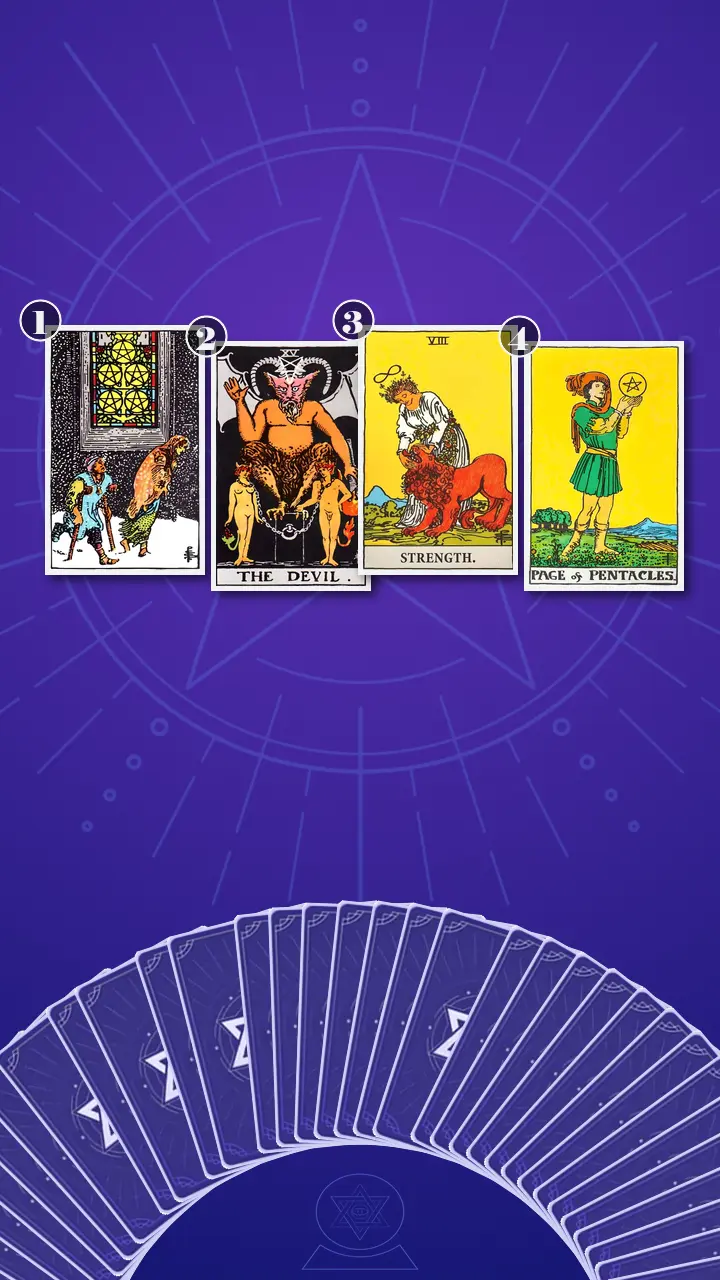
“Card 1 will show the immediate comparison trigger—what that post activates in your body and the story you start telling,” I explained. “Card 2 will point to the underlying comparison wound—the belief the trigger hooks into. Card 3 is the turning point: the inner capacity that breaks the spell. Card 4 is one concrete step you can complete this week.”
Reading the Map: From Trigger to One Step
Position 1 — The Immediate Comparison Trigger
“Now flipped over,” I said, “is the card that represents the immediate comparison trigger: what the promotion post is activating in you right now.”
Five of Pentacles, upright.
It’s the image of being out in the cold, looking at light through stained glass—warmth that feels like it belongs to someone else.
“This is so TTC-coded it hurts,” I told Jordan, keeping my tone light but precise. “You’re on the ride home, thumb hovering over LinkedIn, and a friend’s ‘Excited to announce…’ post lands like proof you’re locked out. You click into their role ladder and mutuals the way someone checks a restaurant’s reservation list from outside the window—like warmth belongs to ‘them’ and not you.”
In my own practice, I call this an Earth-collapse moment: the energy contracts, gets heavy, and the body starts moving like it’s trying to survive winter with no coat. You don’t just think “I’m behind.” Your ribs feel smaller. Your stomach drops. Your hands go hunting for proof.
Jordan let out a short, bitter laugh—one of those involuntary sounds that’s half recognition, half self-defense. “Okay, that’s… rude,” they said, wiping their palm on their jeans. “Like, yes. I’m literally outside the window.”
I nodded. “And the tricky part is: when you feel outside, you tend to keep walking. Scrolling, comparing, withdrawing. You don’t knock. You don’t ask for help. You don’t take one visible step—because the story says you don’t qualify.”
Their eyes flicked down to the card, then away, like it was too accurate to hold for long.
Position 2 — The Underlying Comparison Wound
“Now flipped over,” I said, “is the card that represents the underlying comparison wound: the core belief/fear that keeps the spiral repeating.”
The Devil, upright.
“This is the hook,” I said. “The real wound isn’t the promotion—it’s the belief that titles and visible wins equal safety. You refresh LinkedIn, check tenure, open salary threads, and tweak your résumé because it feels like control without vulnerability.”
I tapped the image lightly with one finger. “The chains are loose in this card. That matters. It’s powerful, but it’s not fate.”
Jordan swallowed. Their jaw tightened in the exact place they’d described clenching while walking through the PATH with coffee in one hand, phone in the other—like their body was trying to bite down on uncertainty.
“When status becomes safety, scrolling turns into compulsion,” I said. “You’re not stuck—you’re hooked.”
And here’s where my Body Signal Interpretation becomes more than a nice idea. I told Jordan, “Your chest tightens because your nervous system is reading ‘their success’ as ‘your danger.’ The phone-grab isn’t laziness. It’s a fast attempt to regulate—your body reaching for the illusion of certainty.”
They exhaled, long and relieved, like something shameful had just been reclassified as workable. “So I’m not broken,” they murmured. “I’m just… attached.”
“Exactly,” I said. “And attachment can be loosened.”
Position 3 — The Turning Point (The Antidote)
Before I turned the next card, the room got quieter in that specific way it does when someone has stopped performing competence and started actually listening to themselves.
“Now flipped over,” I said, “is the card that represents the turning point: the inner capacity or reframe that breaks the status-spell and restores self-trust.”
Strength, upright.
Jordan’s breath hitched—small, quick—then they tried to smooth it over with another inhale. Their body was bracing for the idea that the solution would be “try harder.”
“Here’s the thing,” I said, letting the words land steadily. “You don’t win against comparison by proving harder—you win by regulating first. It’s catching the moment your chest tightens, placing a hand there, and choosing a kinder inner voice: ‘I can want more without humiliating myself.’”
It was 9:58 PM on a Sunday in their mind: LinkedIn, job boards, and their résumé open—tight chest, fingers reaching for the phone—trying to solve their whole timeline in their head so they wouldn’t have to risk one visible step.
Not brute-forcing your way out of comparison, but gently loosening its grip—like Strength calming the lion instead of trying to defeat it.
Jordan froze for a beat—breath paused, fingers hovering as if they were still holding a phone. Then their gaze unfocused, like they were replaying every night they’d tried to bully themselves into motivation. Finally, their shoulders dropped a full inch, and their eyes went wet in that quick, startled way people get when they realize they’ve been at war with themselves for years.
“But if I’m gentle,” they said, and there was a flash of anger under it, “doesn’t that mean I’ve been doing it wrong? Like… all this time?”
I kept my voice calm. “It means you’ve been surviving with the tools you had. Strength isn’t ‘soft’ as in passive. It’s ‘soft’ as in steady. Like a hand on a skittish animal—firm enough to guide, kind enough not to injure.”
And then I gave them the clean lever that Strength always offers when someone is trapped in a status-scoreboard spiral:
Your next move doesn’t require worthiness. It requires self-respect—once.
Their lips parted. They nodded like the sentence had weight. I watched their hand—almost without thinking—press to their chest, exactly where they’d been describing the tightness. That’s my work, the way I learned it in my family: when the body signals shift, the story is ready to change.
“Now,” I asked, “use this new perspective and look back over the last week—was there a moment when the chest-tightening started, and this could have gone differently? When you could have done the breath first, then chosen one respectful action instead of another round of scrolling?”
Jordan blinked, once, twice. “Thursday,” they said quietly. “I was on Instagram career content, then LinkedIn, then my résumé doc. I could’ve stopped. I felt it. I just… didn’t trust that stopping would be enough.”
“That’s the step,” I said. “From contracted spiraling into grounded clarity—one interruption. One choice. That’s how self-trust is built.”
Position 4 — One Step You Can Complete This Week
“Now flipped over,” I said, “is the card that represents one step: a small, concrete action to take within a week that builds momentum without needing certainty first.”
Page of Pentacles, upright.
“This is beginner focus,” I told them. “Your one-step medicine is to pick one practical action and treat it as a practice rep. One message to one person. One application submitted with a ‘good enough’ résumé. One portfolio bullet updated and sent.”
I could almost see their browser tabs collapsing in real time. “The Page studies one coin,” I said. “Not the entire economy.”
Jordan’s shoulders stayed down this time. Their mouth twitched into something close to a smile—exposed, but real. “So… not a full career plan in Notion called ‘Career Pivot Plan’ that I reorganize at midnight?”
“Exactly,” I said. “Collapse the 17 tabs into one sent thing.”
The One-Tab Rule: Actionable Advice for the Next 7 Days
When I looked at the whole line of cards—Five of Pentacles to The Devil to Strength to the Page of Pentacles—it told a tight, honest story: the promotion post hits and your body reads it as exclusion. Then the deeper belief clamps down: status equals safety, so you chase relief through comparison and “research.” Strength arrives as nervous-system leadership—self-respect without self-attack—so you can finally do what the Page does best: one measurable, outward-facing step.
The cognitive blind spot here is subtle: you think you need more information to feel safe enough to act, but the “more tabs” behavior is actually a defense against being seen. The transformation direction is the opposite of what shame demands: from proving to practicing; from public timeline scoring to private follow-through.
Here are your next steps—small enough to do, real enough to count:
- The 60-Second Strength ResetFeet on the floor. Put one hand on your chest. Inhale for 4, exhale for 6, for three rounds—before you open another profile, tab, or draft.If you can, step onto your balcony for 5 minutes first (my “balcony energy awakening” practice): feel the air on your face like a system reboot. No balcony? Do it right after a quick shower and let the water remind your body it can move through intensity.
- Name the Hook (Out Loud)Say: “I’m treating status as safety right now.” Then ask: “What would self-respect look like in the next 10 minutes?”You’re not banning LinkedIn—you’re delaying it by 10 minutes. The delay is you proving you have agency.
- The Page of Pentacles Practice Rep (One Sent Thing)Pick ONE outward-facing step you can finish in 30 minutes: send one coffee chat request, submit one application, or make one internal ask at work. Draft it in 7 minutes, then send/submit the same day.If perfectionism spikes, remind yourself: “Make it a practice rep, not a life verdict.” Put the follow-up date on your calendar so your brain stops carrying it.

A Week Later: The Quiet Proof
Six days later, Jordan emailed me a screenshot—one sent message, nothing flashy. It was a simple coffee chat ask to a former coworker: 15 minutes, one topic, two time options. Under it they wrote, “My hands shook a little. Then I felt… proud. Not cured. Just proud.”
That’s the real Journey to Clarity in moments like this: not never feeling the sting again, but noticing the sting without letting it become a self-worth verdict—then choosing one grounded action that builds trust through follow-through.
When someone else’s win hits your chest like a verdict, it’s not because you’re petty—it’s because you’re trying to turn “being on schedule” into proof you’re safe and good enough.
If you didn’t have to earn worth before you moved, what’s the smallest one-step action you’d be willing to complete this week—just to practice trusting yourself again?