From LinkedIn Comparison Spirals to Grounded Momentum: A Pivot Case

Finding Clarity in the 8:47 p.m. LinkedIn Glow
If a LinkedIn “1st job” anniversary notification can send you straight into a Career Pivot Anxiety spiral—rewriting your headline, saving 10 tabs, and still not applying—you’re not alone.
Jordan (name changed for privacy) came onto my video call from her Toronto condo with her hair still damp from a quick post-work shower, hoodie on, shoulders hovering like they didn’t trust the air. In the background, I could hear the soft click of her kettle, then the low hum of a radiator that sounded like it was trying to keep up with the late-winter chill.
“It was 8:47,” she said, like she’d timestamped the moment the way you do with a minor disaster. “Tuesday. I kicked off my shoes, made tea, opened LinkedIn for five minutes… and then there it was. ‘Happy 1st job anniversary.’”
The blue screen-glow kept flashing in her glasses as she talked—notification, scroll, scroll, scroll—like her eyes were being tugged along by an algorithm’s little hook.
“And I just… fell in,” she said. “I started saving jobs with totally different titles. I edited my headline. I opened my resume doc—like, the one that’s literally called FINAL_final_v3. And I didn’t apply to a single thing. I don’t need a dream job, I just need a direction that actually makes sense.”
I watched her thumb rub at the side of her mug, restless, like it was trying to sand down a feeling. The contradiction was right there in her posture: she wanted her next role to feel aligned and forward-moving—yet she was terrified that choosing wrong would be visible proof that she was behind, or never competent enough in the first place.
The anxiety didn’t look like panic. It looked like a jaw held too tight for too long—like a door you keep pushing closed with your shoulder, hoping no one notices how hard you’re bracing.
“Okay,” I told her gently. “That loop makes sense. It’s protective. And it’s exhausting.” I leaned closer to my camera, lowering my voice the way I do under a planetarium dome when the lights go down. “Let’s make this practical. We’re not here to get a cosmic verdict. We’re here to find clarity—enough clarity to take one real step, and then the next.”

Choosing the Compass: The Four-Layer Insight Ladder Spread
I asked Jordan to plant both feet on the floor and put one hand on her sternum, right where she’d described that tightening. “Before we do anything,” I said, “let’s do a three-minute reset. I call it cosmic breathing—not because it’s mystical, but because it changes your timing.”
We inhaled slow, counted out like a steady orbit: in for four, hold for two, out for six. The point wasn’t to ‘calm down’ on command. The point was to shift from reactive scrolling speed into a pace where choice is possible.
“Today,” I said, “we’ll use a spread called the Four-Layer Insight Ladder · Context Edition.”
For anyone reading along: this is a six-card, linear tarot spread designed for moments exactly like this—when the question isn’t “What job will I get?” but “What pattern keeps steering me, and how do I choose my next role without getting trapped in analysis paralysis?” It moves from the surface symptom (the LinkedIn-triggered loop you can see) down into the recurring template and core fear that fuel it—then back up into a resource, a key shift, and one grounded next step. It’s a map for career indecision that doesn’t rely on prediction. It relies on pattern recognition and actionable advice.
I told Jordan what to expect: “The first card will show the observable loop—what you do right after the notification. A deeper card will show the old template the reminder hooks into. Another will name the hidden rule that makes applying feel unsafe. Then we’ll find your leverage point and your next step—something you can do in the real world, not just in your head.”
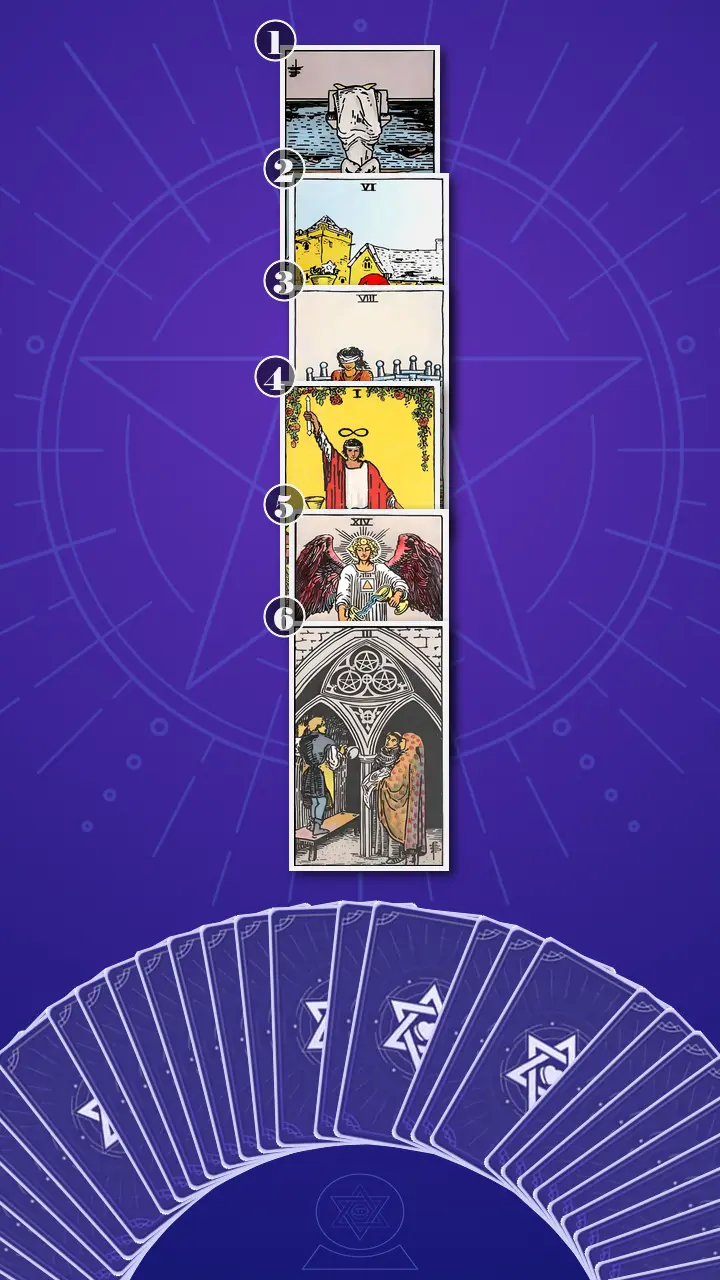
Reading the Map: From Air-Lock Thinking to Something You Can Touch
Position 1 — The Loop That Looks Like “Being Strategic”
“Now turning over is the card representing Surface symptom: the most observable way the LinkedIn reminder triggers career stuckness and postpones action.”
Two of Swords, reversed.
Even through the camera, the image landed with a kind of blunt familiarity: a blindfold. Crossed swords over the chest. Still water behind the figure—calm on the surface, frozen underneath.
“This is like when you’re on your couch after work, telling yourself you’re being ‘strategic,’” I said, keeping it plain. “In reality you’re blindfolding yourself with endless tabs: three different role titles saved, your LinkedIn headline open in edit mode, and a resume doc with tiny wording tweaks. It feels productive because nothing is at risk yet—no rejection, no visible choice—so the stalemate keeps winning.”
Reversed, the Two of Swords isn’t quiet. It’s a blockage that starts to throb. Air energy—thinking, comparing, optimizing—gets contracted and sharp. It becomes self-protection that turns into self-stalemate.
I mirrored her inner monologue out loud: “If I just research ten more minutes, I’ll feel safe enough to choose.” Then I let the contrast hang there: “Safe… versus visible.”
Jordan made an unexpected sound—one quick laugh that had a bitter edge, like she’d been called out by a friend, not judged by a teacher. “That’s… honestly kind of brutal,” she said. Then she exhaled, long. “Because it’s true. I’m acting like one more headline edit is going to reveal the right future.”
“Exactly,” I said. “And I want to name something with zero shame: that loop gives you short-term relief. You get to feel ‘busy’ without risking rejection. But the long-term cost is no momentum, no feedback, and more doubt.”
Position 2 — The Template Hiding in the Throwback
“Now turning over is the card representing Recurring pattern: the repeated career theme or early template that keeps being reactivated by milestones and comparisons.”
Six of Cups, upright.
“This card is memory with a soft filter,” I said. “And it’s not random that LinkedIn’s ‘1st job’ reminder hit you like that.”
I pointed to the modern-life translation in her language: “The notification doesn’t just make you sentimental—it activates a template. You start measuring every posting against a vibe from back then: clear expectations, a mentor who liked you, a team that felt like a place you belonged. You keep trying to find a role that recreates that courtyard-safety feeling, and anything that looks messier than your first chapter gets rejected before it’s even tested.”
Water energy enters here—nostalgia, belonging, the emotional shape of “I knew who I was.” And the tricky part is how quietly it becomes a job requirement. I told her one of my favorite truths for this card: “Nostalgia is a clue, not a job description.”
Jordan’s eyes softened for a moment, then flicked away from the screen as if she could see that first office badge photo in her mind. Her grip on the mug loosened just a little.
“I miss having… structure,” she admitted. “And someone senior who actually cared if I was learning.”
“Great,” I said. “That’s usable. That’s a quality you can look for—without trying to reinstall an old version of yourself like an app rollback.”
Position 3 — The Rule That Builds the Cage
“Now turning over is the card representing Core fear/belief: the hidden rule or assumption about worth and competence that maintains the loop.”
Eight of Swords, upright.
The visual echo mattered: another blindfold. Another ring of swords. Another kind of trapped.
“This is the moment you read a job description and your mind instantly builds a cage,” I said. “I can’t apply unless I match every bullet, unless my story is clean, unless I’m sure. Your body reacts first—tight chest, tense shoulders—then you retreat into safer tasks: more research, more edits.”
Here’s the energy dynamic: this isn’t a lack of options. It’s a blockage created by private standards that are so strict they function like walls. The Eight of Swords is the difference between ‘I can’t’ and ‘I won’t let myself.’
I used the name-the-rule technique, softly but directly: “If your job search had one governing law right now, would it be this? ‘I can’t make a visible move unless I’m 100% qualified and can explain my path perfectly.’”
Jordan went still. Not frozen in panic—more like her brain paused a video mid-frame. She swallowed once, small and tight, then nodded. “Yeah,” she said quietly. “That’s… exactly it.”
“And here’s the loophole,” I added, keeping my tone warm. “On the card, the ropes are loose. There’s open space beyond the swords. You’re not trapped by the market as much as by your private standards.”
Position 4 — The Tool You Can Actually Use
“Now turning over is the card representing Accessible resource: the skill, strength, or leverage point you can use immediately to shift from thinking to movement.”
The Magician, upright.
My shoulders relaxed the way they do when I’m guiding visitors through a planetarium show and the projector finally locks onto the right coordinates. “Okay,” I said. “Here’s your turning point.”
“This is the moment you stop treating LinkedIn as a mirror and start treating it as a tool,” I told her. “Instead of rewriting your headline again, you send one clear outreach message: who you are, what you’re exploring, and a simple ask for 15 minutes.”
Magician energy is Fire plus focus: not chaotic ‘do everything,’ but intentional agency. It’s potential turning into motion through tools already on the table—your writing, your stakeholder skills, your ability to make a narrative coherent.
I made it tactile, like holding a tool instead of imagining one: “Pick one thing. One message. One sample. One conversation. One outward move that creates feedback.”
Jordan’s posture shifted—barely, but it was there. She sat a little taller. Her eyes flicked down toward her phone, like Messages was suddenly a real option, not a last resort.
“You can’t optimize your way into clarity,” I said, giving her a line I’ve watched land on a lot of people at career crossroads. “Clarity shows up after contact.”
When Temperance Spoke: The Sentence That Changes the Search
Position 5 — The Key Shift (Temperance)
I let a small silence settle before the next card. Even through Wi‑Fi, the room felt quieter—as if the city outside her window had lowered its volume for a moment.
“Now turning over is the card representing Key shift: the integrating insight that reveals the career pattern and changes how you choose your next role.”
Temperance, upright.
Before I even spoke, I felt my own professional reflex kick in—the part of me that spends nights under a dome explaining orbital transfers. Temperance always makes me think of trajectories: not one dramatic rocket launch, but steady adjustments over time. A spacecraft doesn’t ‘pick the perfect path’ once. It updates, integrates, corrects.
And Jordan—right then—was stuck trying to choose a perfect career ladder in a world that doesn’t hand out clean ladders.
Setup (30–50 words): It’s 11:38 p.m., your tea’s gone cold, and LinkedIn is still open. You’ve saved three totally different job posts, tweaked your headline again, and your jaw is tight—like the “right” next step is one edit away from appearing.
Delivery:
Not a perfect career ladder, but a steady pour—blend what you’ve learned across chapters and let that mixture guide the next move.
I didn’t rush past it. I let it sit between us like a lantern.
Reinforcement (100–200 words): Jordan’s breath caught—one quick pause where her chest didn’t rise, like her body needed a second to decide if it was safe to believe that. Her gaze unfocused, not blank, but searching—like she was replaying old scenes: first job confidence, later pivots, the messy middle she’d been trying to hide. Then her shoulders dropped, slow, and her jaw unclenched in a way that made her look suddenly younger. “But… if I’m blending,” she said, voice quieter, “then I’m not behind. I’m just… integrating.” There was relief, and then a flicker of something sharper—almost grief, almost anger at how long she’d punished herself. “I’ve been acting like my career is a verdict,” she added, and the words came out with a tiny shake. I nodded. “Your career isn’t a verdict. It’s a craft.” I watched her swallow again, this time easier. “Now,” I asked her, “use this new lens—steady pour, not perfect ladder—and think back to last week. Was there a moment you felt the spiral start, where this would have changed how you treated yourself?”
She looked down and pressed her thumb against the base of her index finger, grounding. “Yeah,” she said. “On the TTC. I saw someone post ‘I’m thrilled to announce…’ and I started doing timeline math. If I’d remembered this… I could’ve asked, ‘What am I actually building?’ instead of ‘What am I failing to be?’”
This was the turning point from comparison-driven anxiety to the first edge of grounded momentum. Temperance isn’t flashy. It’s sustainable self-trust built through coherence.
And this is where my researcher brain joined my tarot brain. “I want to run something I call a Gravity Assist Simulation,” I told her. “In spaceflight, you don’t always power straight through. You use a planet’s gravity to change your trajectory efficiently.”
“In your career,” I continued, “a ‘perfect title’ is like trying to brute-force a straight line. Temperance is saying: use what’s already in your orbit—your repeatable strengths, your working style, the conditions you thrive in—to assist your next move. We can simulate the long-term impact of choices by looking at what repeats across chapters, not what looks impressive in a headline.”
Then I layered in my other diagnostic lens: “And we’ll do a little Dark Matter Detection—because what’s been driving you isn’t only skills. It’s invisible factors: belonging, mentorship, feedback cadence, team culture. Those don’t show up in job titles, but they shape your whole lived reality.”
A Shared Worktable: Three of Pentacles and Real Feedback
Position 6 — The Next Step That Creates Momentum
“Now turning over is the card representing Next step: one grounded, real-world action that creates feedback and momentum toward the next role.”
Three of Pentacles, upright.
“This card changes the setting,” I said. “We move from the bedroom-night-scroll to a shared table. From isolation to collaboration.”
And the modern-life translation was clean: “Instead of trying to fix your career story alone at night, you bring it into a room—virtual or real. You ask for feedback on a short case study, you join a small project, or you have an informational chat where someone can reflect your strengths back to you.”
Earth energy shows up here as measurable progress: proof you can touch. It’s the end of “saved tabs” and the start of “someone reacted.”
I gave her a line that works like a handrail: “Feedback is not a referendum; it’s a shortcut to clarity. And—listen—one message beats twenty saved tabs.”
Jordan opened her mouth like she wanted to agree… and then the real-life obstacle showed up, practical and human. “But I don’t even know when I’d do this,” she said. “I get home, I’m tired, I tell myself I’ll send a message after I fix my headline, and then it’s midnight.”
I nodded. “That’s exactly why we make it stupid-small,” I said, slipping briefly into coach mode. “We’re not scheduling a personality transplant. We’re adjusting your ‘spacecraft attitude’—your orientation—so the next move is possible.”
“Five minutes,” I added. “And a boundary: no headline edits until after the outward move. Otherwise the loop wins.”
From Insight to Action: Your Next 7 Days at a Career Crossroads
I pulled the whole ladder together for her, top to bottom, like tracing constellations into a picture you can finally name.
“Here’s the story these cards are telling,” I said. “The LinkedIn milestone notification triggers a surface Air-lock spiral—tabs open, drafts saved, headline edits—because visibility feels dangerous (Two of Swords reversed). Under that is a nostalgia template: you’re chasing the feeling your first job gave you—structure, mentorship, belonging—and mistaking that feeling for a title requirement (Six of Cups). The engine underneath is a hidden rule: ‘If I’m not perfectly qualified and perfectly explainable, I can’t move’ (Eight of Swords). But you already have the resource to shift: communication and connection used outwardly (Magician). The real transformation is integration—blending your repeatable themes into a coherent pattern (Temperance). And the next step is grounded collaboration: invite someone into the draft and get real feedback (Three of Pentacles).”
“Your cognitive blind spot,” I said carefully, “is believing you need a perfect narrative before you can take action. Temperance is flipping that. The transformation direction is: themes over titles, experiments over verdicts, contact over optimization.”
Then I gave her a small plan—because clarity that can’t move your calendar isn’t clarity yet.
- The 10-Minute “Temperance Theme Pour”Open Notes. Title it “My repeatable strengths.” Set a timer for 10 minutes. Write only 3 bullets: (1) what you reliably build, (2) how you work at your best, (3) the conditions you thrive in. No job titles allowed.Stop when the timer ends even if it’s messy. If your chest tightens, do 3 slow “cosmic breaths,” close the note, and walk to refill your water—data, not a verdict.
- A 7-Day Career Hypothesis (Not a Forever Answer)Pick one temporary direction for seven days and write it as a single sentence you can say out loud, e.g., “I’m exploring roles where I do X for Y teams.” Say it once to yourself before you open LinkedIn.Expect your brain to call it “not strategic enough.” That’s the spiral protecting you from visibility. Let it complain while you run the test anyway.
- One Magician Message (15-Minute Coffee Chat Ask)Send one 3-sentence message to a real person (ex-coworker, alumni, someone in Toronto doing a role you’re curious about): context, curiosity, ask for 15 minutes. No additional research required.Boundary: no LinkedIn headline edits until after you hit send. If it feels intense, choose a “safe” contact first, not a dream-company VP.
“This is interstellar navigation,” I told her, using my favorite metaphor when people are stuck at the ‘choose perfectly’ stage. “You don’t need a single, eternal route. You need a heading and two checkpoints. You run small course-corrections based on real data. And you let yourself be a person in motion.”

A Week Later: Ownership, Not Certainty
Six days later, Jordan messaged me. It wasn’t a dramatic life overhaul. It was a screenshot of a sent note and a line of text: “I did the one-message-before-optimization rule. I asked for 15 minutes. She said yes.”
She told me she’d slept a full night for the first time in weeks—then admitted that the next morning, her first thought was still, What if I’m wrong? She paused, then added, “But it didn’t spiral. I just… made tea and looked at my Themes note again.”
That’s what a real Journey to Clarity looks like most days: not certainty, but a quieter nervous system and one repeatable step that proves you can move.
When you want a next role that finally feels aligned, but your chest tightens at the thought of choosing wrong—like one visible move could “prove” you were never that competent—you end up editing your story instead of living the next chapter.
If you didn’t have to pick the perfect title this week—what’s one tiny experiment you’d be willing to run, just to get real feedback instead of more screenshots in your Saved jobs?