The 8:41 p.m. Rejection Tab—And the Moment It Turned Into Data

Finding Clarity in the 8:41 p.m. Rejection Tab
If you have ever opened a vague rejection after days of silence and immediately started doing the job-search version of doomscrolling, rereading, over-editing, and hunting for hidden meaning, you already know this feeling.
Jordan (name changed for privacy) sat cross-legged on her Toronto couch like she’d been pinned there by her own laptop heat. It was 8:41 p.m. on a Tuesday—the radiator clicked under the window in stubborn little pops, the fluorescent kitchen light hummed like it had an opinion, and her phone kept lighting up with a LinkedIn offer post she hadn’t meant to open. The rejection email stayed open in one tab, refreshed so many times the thread looked worn.
“I know it’s only one email,” she said, staring at the screen like it might confess, “but it still lands like a judgment.”
I heard the core contradiction immediately: the desire to be chosen and move forward, versus the fear that one rejection proves she doesn’t really belong in UX. In her body it showed up as a tight chest, a heavy stomach, and a jaw she was holding like a locked door.
Shame can feel like trying to breathe through a scarf you didn’t choose—everything technically still works, but the air comes in smaller than it should.
“Okay,” I told her, keeping my voice gentle and very normal on purpose. “Let’s not make you argue with that sting. Let’s just map it. Our whole goal tonight is finding clarity—so this email stops being a verdict and starts being data.”

Choosing the Compass: The Four-Layer Insight Ladder Spread
I’m Alison Melody—radio host by day, tarot reader by night, and the person in my friend group who notices when the room is loud but the real noise is inside your head. I don’t treat tarot like a magic eight ball. I use it the way I use sound in music therapy: as a structured mirror. Not “what will happen,” but “what’s happening in you, and what’s the next workable move.”
I asked Jordan to take one slow breath with me—not as a ritual for the universe, just a nervous-system handrail. While she exhaled, I shuffled until the cards felt settled, the way a playlist finally clicks into the right order.
“Today, we’re using a spread called the Four-Layer Insight Ladder · Context Edition,” I said.
For a question like After a job rejection email, what old story is shaping my career? a bigger spread can turn into more tabs in your brain. This ladder is clean on purpose: it moves from (1) your visible reaction, to (2) the hidden story underneath, to (3) the turning point that restores self-trust, and finally to (4) a grounded next step you can actually do tonight. It mirrors how a rejection spiral works in real life—and how to stop rereading rejection emails without pretending you don’t care.
“We’ll start with what your body did first,” I added. “Then we’ll name the script your mind wrote underneath the email. Then we’ll find the interrupt—what helps you keep your dignity intact. And we’ll end with one practical action to rebuild momentum.”
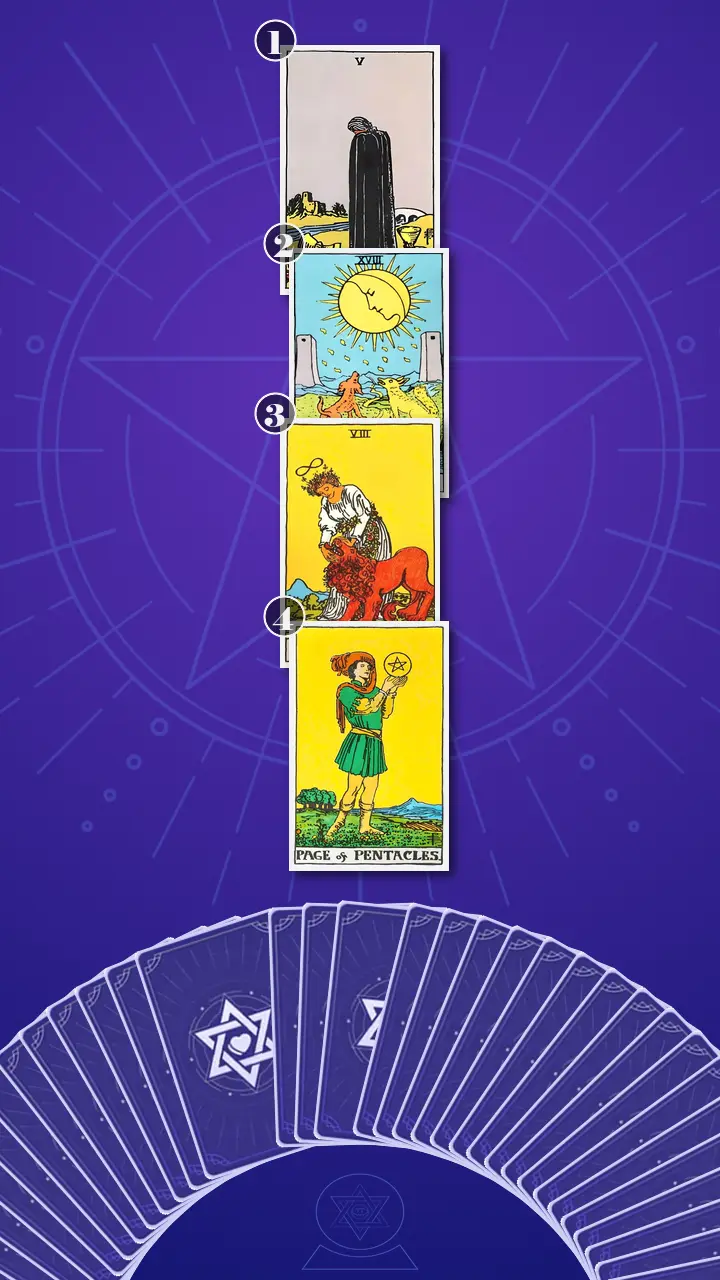
Reading the Map: Five of Cups and The Moon in a Job Search Spiral
Position 1 — Visible reaction and immediate emotional response: Five of Cups (upright)
“Now flipped over is the card representing your visible reaction and immediate emotional response.”
Five of Cups, upright.
This is classic disappointment—the part of you that can only see what spilled. And in modern life it looks like this: opening a rejection email at 8:15 a.m., then spending the next hour staring at the same inbox thread, convinced the whole search just collapsed even though your portfolio, references, and earlier wins are still sitting there untouched.
“This card isn’t saying you’re dramatic,” I told her. “It’s saying your attention got hijacked. It’s grief with selective vision.”
Energy-wise, Five of Cups is excess water: the emotional tide rises fast, and it narrows the frame until three spilled cups become the whole story. That’s why the email starts to feel personal—like it’s deciding your worth—because the card’s pull is to treat one loss as the headline.
Jordan let out a little laugh that wasn’t amused—more like a cough of recognition. “That’s… kind of cruelly accurate.”
I watched her micro-reaction unfold in three beats: her breath caught for half a second, her gaze went unfocused like she’d replayed the morning the email arrived, and then her shoulders dropped a millimeter—just enough to say, okay, you see me.
“Five of Cups always has two upright cups behind the figure,” I said. “In career terms, those are the skills and proof that didn’t disappear. You just can’t turn around yet when your chest is tight.”
Position 2 — Hidden story and unconscious meaning-making: The Moon (upright)
“Now flipped over is the card representing your hidden story and unconscious meaning-making.”
The Moon, upright.
Immediately, I could feel the temperature of the reading change—like the room got quieter, but the silence got louder. The Moon is uncertainty, projection, and that specific career anxiety where ambiguity becomes evidence.
In modern life it’s reading a vague rejection and instantly building a private theory out of the silence: maybe the bar was higher, maybe I missed something obvious, maybe this means the field has already decided I’m not one of the people who get in. It’s a foggy ATS screen in your head, where the blanks get filled with your worst guesses.
“This is the ‘Severance hallway’ card,” I said, and Jordan’s eyes flicked up at that. “Half-lit corridors. No signage. And your brain goes, ‘If I can’t see the answer, the answer must be bad.’”
I kept my words clipped, almost bullet-pointed, because The Moon feeds on long, persuasive narratives.
It’s just one email.
But what if it means I’m behind?
What if everyone else has some secret, cleaner version of competence?
What if I only get chosen when I’m flawless?
That’s The Moon’s energy as a blockage: not intuition, but projection dressed up as “realism.” And it keeps the loop running—reread the email, over-edit the portfolio, check LinkedIn, feel behind—because it offers a short-term hit of control while quietly stealing momentum.
Jordan pressed her tongue against the inside of her cheek, like she was trying not to admit something. “I keep reopening it,” she said. “Like I’m going to find the one sentence that explains me.”
“Yeah,” I said softly. “That’s the old story hunting for proof.”
Position 4 — Grounded next step and embodied action (preview): Page of Pentacles (upright)
I like to show the landing spot before we hit the turning point, so your nervous system knows this isn’t endless fog.
“And at the base of the ladder,” I said, “the card representing your grounded next step and embodied action.”
Page of Pentacles, upright.
This is the apprentice—the person who learns by doing one real thing, not by achieving emotional perfection first. In modern life it’s: stop trying to solve your whole career in one sitting and treat the next move like a prototype. One revised bullet. One cleaner case-study intro. One application sent before the night is over.
Page of Pentacles is balanced earth. It doesn’t argue with the Moon. It just plants something small and trackable. It’s the exact opposite of “polishing instead of sending.”
Jordan nodded, practical even through the sting. “That… feels possible,” she admitted, and then immediately added, “but only if I can stop spiraling first.”
“Perfect,” I said. “That’s what our next card is for.”
When Strength Spoke: Dignity Over Flawlessness
Position 3 — Turning point that restores self-trust: Strength (upright)
“Now we flip the card representing the turning point that restores self-trust.”
The room felt suddenly still—the kind of stillness you hear in a studio right before the red light turns on.
Strength, upright.
Strength isn’t hype. It’s regulated courage. It’s the difference between forcing yourself through pain and staying with the sting without turning it into shame.
Jordan’s first response wasn’t relief. It was resistance.
She inhaled and held it, her fingers freezing around her phone like she might throw it into the couch cushions. Then her brows pulled together, and the words came out sharper than she meant: “But if I’m supposed to be ‘gentle’ about it… doesn’t that mean I was just being ridiculous? Like I made it a bigger deal than it was?”
I didn’t correct her fast. I let the moment breathe.
“No,” I said, calm and direct. “Strength doesn’t call you ridiculous. Strength calls you human. It’s saying you can feel the hit without using it as a reason to punish yourself.”
Setup
Right then, I could see the exact bind she lived in: the anxiety that says, Pick the correct interpretation of this email or you’ll lose your future, and the shame that says, If you were better, you wouldn’t be affected. She was trying to earn belonging through perfection, because the alternative felt like free-falling.
Delivery
Not 'I must be flawless to belong,' but 'I can stay with the sting, keep my dignity, and keep moving' - like Strength's gentle hand on the lion.
I paused and let it hang in the air, the way a single sustained note changes a whole chord.
Reinforcement
Jordan’s face shifted in layers. First: a tiny widening of the eyes, like she’d just realized how mean her inner voice had been without noticing. Second: her jaw worked—clench, release, clench—until she finally let it drop open a fraction. Third: the exhale arrived, long and shaky, as if it had been trapped behind her ribs all week.
Her shoulders didn’t collapse; they softened. It wasn’t triumph. It was the first 10% of release. The kind that feels almost dizzy because you’ve been bracing for so long you forgot what “not bracing” is.
“I… don’t have to hit myself to keep going,” she said quietly, surprised by her own sentence.
“Exactly,” I said. “And I want to make it even more practical.”
This is where my work with sound always comes in. I call it Music Pulse Diagnosis: I look at what you’ve been listening to lately the way I’d look at your sleep data—not to judge your taste, but to spot the stress pattern.
“After that email,” I asked, “what did you put on? Like, what was on your Spotify On Repeat?”
Jordan blinked. “Honestly? Sad girl stuff. And then lo-fi, but like… the kind that makes time disappear. And I replayed the same track on the TTC because it felt safer than thinking.”
I nodded. “That’s Strength’s lion, right there. Your nervous system chose repetition because repetition feels controllable. The issue isn’t the music—it’s that your brain used it to stay in the loop, not to move through the feeling.”
I slid into my second tool, the one that turns insight into something you can do in your body: Breath Soundtrack.
“Let’s give your inner voice a different tempo,” I said. “Both feet on the floor. Unclench your jaw like you’re letting go of a word you don’t need to say. And breathe to this rhythm: inhale for four beats, hold for two, exhale for six. Three rounds.”
As she did it, the apartment noise—the radiator, the kitchen hum—stopped sounding like an accusation and started sounding like weather. Still there, but not personal.
“Now,” I said, “use this new lens and think back: in the last week, was there a moment—on the TTC, in the inbox refresh, mid-LinkedIn scroll—when this could’ve changed how you spoke to yourself?”
Jordan swallowed. “Friday. I saw my reflection in the dark window on Line 1 and I looked… so tense. I remember thinking, ‘You’re embarrassing. You’re behind.’ If I’d had this… I could’ve just said, ‘Ouch. Okay. Next.’”
“That’s the shift,” I told her. “From shame-driven overthinking to calm self-respect. Not because the job search is easy, but because you refuse to turn pain into proof.”
Build Evidence, Not a Trial
I looked back down at the ladder—water, fog, fire, earth. Five of Cups showed the immediate slump. The Moon showed the old career script: ambiguity means I don’t belong. Strength offered the antidote: self-command without self-punishment. And Page of Pentacles promised something simple and true: confidence comes back through repeatable action, not through a perfect mood.
“Your cognitive blind spot,” I said, “is that you’ve been treating a hiring decision like a courtroom. Every bullet point becomes cross-examination. Every silence becomes a verdict.”
Jordan gave me a look that was half offended, half relieved. “Yeah,” she said. “I’m building evidence, but it’s like… evidence against me.”
“Right. The transformation direction is small but powerful,” I said. “Stop asking the rejection to define you. Start asking what story you attached to it—and what one next action looks like if this email is only data.”
I tapped the table lightly. “The email is factual; the story is optional. One rejection is a data point, not a verdict.”
- The 3-Minute Story vs Data CheckWith the email closed, open Notes and write two lines: “What happened” and “What story I attached to it.” Then underline only the factual words you can prove.If your chest tightens, ask a friend to sit with you while you do it—or do it from memory for now. Stop at 3 minutes. Clarity, not force.
- Strength Before You Edit (Jaw-Unclench Cue)Before touching Figma or your resume, do three rounds of 4–2–6 breathing. Then say out loud: “One no is not my whole career.” Only after that, make one small edit—one bullet, one intro sentence, one portfolio caption.If LinkedIn is your reflex, set a 20-minute timer for a “mute window.” Don’t negotiate with it.
- The Gentle Next-Send (5-Minute Sprint)Choose one application you can submit tonight. Set a 5-minute timer. Make it “good enough,” hit send, and log it in your Notion tracker as a completed experiment—green card, done.If perfection shows up, downshift: title the file “v1,” save, and stop. The win is momentum, not suffering.
Before she left, I added my BGM Prescription—not as spirituality, but as an environment hack for a Toronto apartment where the city’s hum keeps your nervous system half-on.
“Pick one for the next week,” I said. “Use it only during the reset and the send—so your brain learns a new association.”
Track 1: low, steady brown noise for 15 minutes (good for “my brain won’t stop scanning”).
Track 2: slow instrumental around 60–70 BPM (good for “I’m about to open the email again”).
Track 3: a simple piano or ambient tone bed—no lyrics (good for “I’m editing like it’s life or death”).
“You’re basically giving Strength a soundtrack,” I said. “So your body can remember the turning point without having to re-earn it every time.”

A Week Later: The Quiet Proof
A week later, Jordan texted me a screenshot: her Notion board with one more green card than red. Under it, a message: “Did the two-line facts vs story thing. Didn’t open LinkedIn. Sent one application in five minutes. Still felt tender, but I didn’t spiral.”
Her update wasn’t fireworks. It was something better: proof that the career is wider than one inbox thread.
In my head, I heard it like a clean mix—less distortion, more signal. That’s the real Journey to Clarity: not certainty, but ownership. Not “I’m flawless,” but “I can keep my dignity and keep moving.”
When a rejection email hits, it can make your chest go tight, your jaw lock, and the whole job search feel like it is deciding whether you belong at all.
If you let this email stay data instead of a verdict, what small next step would feel the least heavy today?